
By Mike Sain't Louis ·
Bags down to the floor and a brand-new tattoo: the unequal grief of «¿Por qué él no llora?»
After a break-up there's a question almost everyone has asked at some point, usually in the small hours with a phone in hand: why am I in this state while he's so calm? You don't sleep, you don't eat, you go back over old conversations looking for the exact moment it all went wrong. And meanwhile the other person posts a smiling photo on a café terrace, as if nothing had happened.
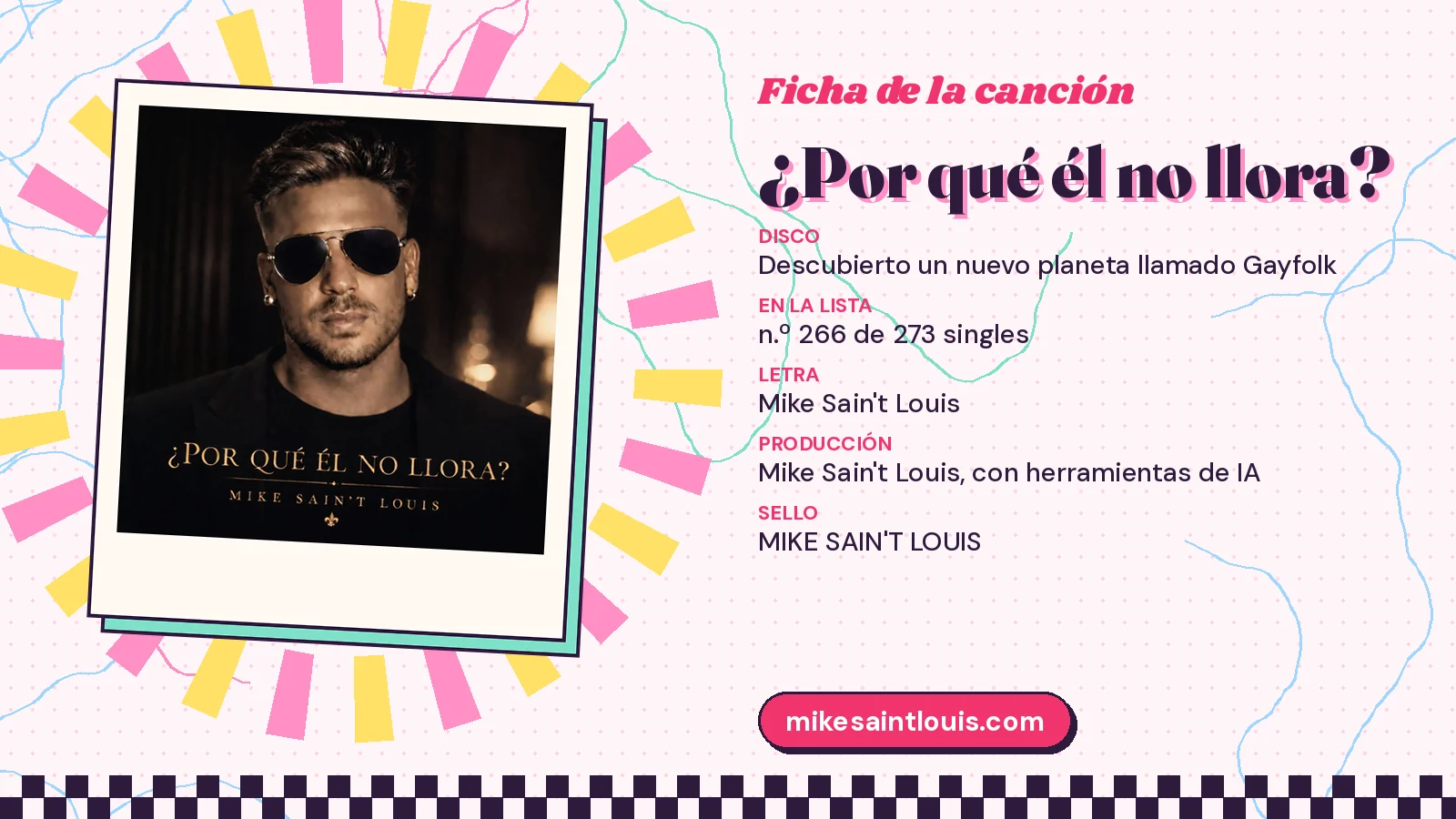
«¿Por qué él no llora?» (Why doesn't he cry?) is a whole song about that question. It's on «Descubierto un nuevo planeta llamado Gayfolk», the first album of the trilogy. The basics are on the song's own page and the full lyrics are published. Here I want to focus on three things: the image that sums up the whole song, the eye bags versus the tattoo; the widespread idea that men don't cry; and the lyric's most unexpected twist, which is ending up declaring that you, too, are Ylenia Padilla.
As always, a note first: the characters in my songs are characters. The «he» in the title has no name and there's no need to go looking for one. What is real, and very common, is the feeling it describes.
The image that sums it all up
Some songs need a lot of verses to get an idea across. This one sums it up in two lines: why do my eye bags reach the floor? And you, meanwhile, showing off a brand-new tattoo.
It's one of the clearest comparisons I've written. On one side, the body of the one who's suffering: bags under the eyes so exaggerated they reach the floor, like in a cartoon. On the other, the body of the one who doesn't seem to be suffering at all: a freshly done tattoo, displayed with pride. Both leave a mark on the skin, but they mean opposite things. The eye bags are the trace of sleepless nights. The tattoo is a decision, a whim, a way of saying «I'm starting a new chapter».
That difference is what hurts. It's not just that he's fine. It's that he seems better than ever. That the break-up, which for you was an earthquake, was for him an excuse for a makeover.
The exaggerated eye bags are very typical of my lyrics. I've written more than once about how I like blowing images up so they're easier to grasp, as in «La ley de la exageración». Nobody has eye bags that reach the floor. But we've all had eye bags that felt as if they did, and the song is about how it feels, not how it measures up.
The tattoo as a message
The new tattoo deserves a section of its own, because it's a very modern detail. After a break-up, some people cut their hair, some join a gym and some get a tattoo. They're gestures of renewal, of taking back control of your own body. And there's nothing wrong with them.
What the song points at is something else: the showing off. The verb matters. It doesn't say «you've got a tattoo». It says «presumiendo de tatuaje nuevo», showing off a new tattoo. In other words, the tattoo isn't just for him, it's for being seen. And one of the people who sees it, whether they want to or not, is the one left with the eye bags.
In the age of social media this is almost unavoidable. Break-ups don't happen in private any more. Each person keeps seeing, even out of the corner of their eye, what the other is up to. And what the other shows is always their best version: the tattoo, the terrace, the smile. Nobody posts a photo of their eye bags. So the comparison is rigged from the start. You're comparing your insides with his shop window.
That's why the question in the title is so human and so unfair at the same time. Why doesn't he cry? Maybe he does. Maybe he doesn't. What's clear is that he doesn't show it, and you only have access to what he shows.
I have another song in the catalogue built around a tattoo, «Tattoo de fénix», and I find it funny that tattoos turn up in my lyrics as a symbol of rebirth. That's exactly what the phoenix is: the bird that rises from its own ashes. In «¿Por qué él no llora?» the tattoo has a less friendly meaning. It's the other person's rebirth, the one that isn't yours.
Men don't cry
The title has another layer that can't be ignored. «Why doesn't he cry?» asks about one specific person, but it also touches on a very old idea: that men don't cry.

Many boys have grown up hearing that phrase. At home, at school, on the football pitch. Crying was for girls, for the weak, for sissies. And the result of that upbringing is that many adult men find it enormously hard to express sadness. It's not that they don't feel it. It's that they learned to hide it, or to turn it into something else: anger, silence, frantic activity, tattoos.
For queer people that phrase carries a special weight. Many of us were singled out precisely for crying, for being sensitive, for not fitting the idea of a man held by the people around us. Crying was proof that we were different. And over time many of us have learned to reclaim exactly that: crying isn't weakness, it's a way of being alive.
In my catalogue there's a single called simply «Llorar», To cry, and in Planeta Gayfolk tears are not hidden. They're displayed, exaggerated, turned into copla-style drama. That's why the question in the title carries both reproach and compassion. Reproach, because it seems he isn't suffering. Compassion, because maybe he doesn't know how to.
The song doesn't settle that doubt, and I think that's right. We don't know whether he cries in secret or genuinely doesn't care. What we know is that the narrator can't stop wondering. And that question, asked over and over, is already a form of grieving.
The forgotten wedding
There's a line in the final part that strikes me as one of the strangest and loveliest in the song: yesterday morning I was celebrating my wedding with Algora, and by night I'd already forgotten my wedding with Algora and could only think about why he doesn't cry.
Algora is a name the lyric doesn't explain, and I'm not going to invent a story for it. What interests me is the mechanism. In the morning, a wedding: the happiest event imaginable, the one that's supposed to wipe out everything that came before. And by night the wedding is already forgotten, because the mind has gone back, like a dog to its bone, to the same old question.
That's exactly what an obsession does. It doesn't matter what happens during the day, however good. At night it comes back. The wedding, the party, the new love, everything slips into the background next to that question with no answer. It's a very vivid way of saying that a badly closed break-up can poison even the best moments.
And there's some black humour in it too. Picturing someone who gets married in the morning and by night has forgotten all about it because they're thinking about their ex is absurd. But it's an absurdity we recognise. We've all had days when something wonderful happened and our mind still drifted back to the same place.
«And here we are once again»
Just before that line comes a very short one: «y así estamos una vez más», and here we are once again.
It's a line of weariness. From someone who knows they're back at the same point, that this isn't the first time they've asked themselves that question and probably won't be the last. There's resignation in it and some humour, like when you tell a friend you've texted your ex again and she just looks at you without a word.
I like that the song admits that repetition. You don't get over a break-up in a straight line. You move forward, slip back, fall again. One day you think it's done and the next you see the tattoo in a photo and you're back at square one. «And here we are once again» is the line for all those relapses.
I'm Padilla too
And now the lyric's most surprising twist. The song opens and closes with lines that seem to have nothing to do with the break-up: I do understand Ylenia Padilla, I'm Padilla too. And a good part of the song is taken up by a chorus of total support: I'm like Ylenia Padilla, I defend her, I'm on her side, I publicly support her.
For anyone who doesn't know her, Ylenia Padilla is a very well-known figure on Spanish television. She's from Benidorm, became famous in 2012 on the MTV reality show «Gandía Shore», and later appeared on contests such as «Gran Hermano VIP» in 2015 and «Gran Hermano Dúo» in 2019, as well as being a regular on many programmes and releasing the single «Pégate». She's one of those faces that have become part of Spanish pop culture over the last decade.
What is she doing in a song about an ex who won't cry? The answer is in the line that goes with the chorus: I too have felt at some point that everyone had let me down, and that they turned their backs on me at the worst possible moment.
That's the key. The song doesn't talk about Ylenia Padilla's life or offer opinions about her. What it does is identify with the public image of someone exposed, judged and discussed by an entire country. Anyone who has been on a reality show knows what it's like to have thousands of people passing judgement on you. And the narrator, in the middle of a break-up, feels something similar: that everyone has failed them, that everyone has turned their back.
Why identify with a TV star
It may seem odd, but it makes a lot of sense. When we're in a bad way, we look for mirrors. Someone who has been through something similar and come out the other side. And often those mirrors aren't philosophers or poets, but TV personalities we've watched cry, lose their temper and pick themselves up in front of the cameras.
Queer culture has a very special relationship with these figures. Reality-TV divas now occupy a place similar to the one once held by the «folclóricas», the great copla stars, or the vedettes: exposed women, often criticised, who become icons precisely because of the way they weather the storm. We adore them because we recognise ourselves in the way they survive other people's judgement.
Saying «I'm Padilla too» is, in that sense, a declaration of belonging. It's like saying: I've also been the one everyone pointed at. I've also had to get back up with everyone watching. And that's why I'm on her side.
That gesture of support matters so much to the song that it has its own single in the catalogue, «Yo apoyo públicamente a Ylenia Padilla», with which «¿Por qué él no llora?» shares a good part of its chorus. They're sister songs: one focuses on the support and the other places it inside a break-up.
Publicly supporting her
I love the word «públicamente», publicly, in the chorus. Understanding her in private isn't enough. The lyric wants it on record, known, written down. I publicly support her.

There's a certain courage in that. On social media it's very easy to join the collective pile-on against someone famous. The hard part is taking their side when everyone else is pointing the finger. The song chooses the hard part, and does it with the enthusiasm of a front-row fan.
And here the circle closes with the break-up. The narrator feels abandoned, feels that people turned their backs at the worst moment. And the response isn't to turn their back on someone else, but the very opposite: to publicly support someone who has also been judged. It's a way of doing for another person what they would have liked others to do for them. I find that a lovely gesture, even wrapped in glitter and humour.
The humming
The published lyric has a lot of humming lines, strings of m's repeated between verses. I'm not going to explain why they ended up like that or give them a meaning they don't have in the lyric. I'll just say that, reading it, those hums create a curious effect: they sound like someone who can't find the words. Like when you're so sad that all that comes out is a murmur.
In a song about not knowing how to express pain, that murmur has a certain charm. He doesn't cry. And the narrator, between one line and the next, can only manage a sound without words. Neither of them quite manages to say everything they feel.
A song between reproach and fandom
If I had to describe the song's tone, I'd say it sits halfway between reproaching an ex and a love letter to a star. The two seem incompatible, but in Planeta Gayfolk they live side by side all the time. Romantic drama and TV fandom mix because in real life they mix too. There are nights when you cry over your ex while watching a reality show, and you're not quite sure which of the two is moving you more.
That mix is very queer, and very Spanish. Celebrity gossip culture, TV studios, panel shows and contests are as much part of our sentimental education as love songs. We learn to suffer by watching others suffer on television, and we learn to get back up by watching them get back up.
There are other titles in the catalogue where TV and heartbreak cross paths, and on my blog I've written about how I laugh at my exes because it's the most honest way I have of telling the story. «¿Por qué él no llora?» follows the same line: it doesn't exactly laugh at the ex, but it doesn't go under completely either. It clings to something bright, even if it's a TV star, so as not to drown.
Eye bags as a medal
There's one reading of the song that I find great fun, and that's the eye bags as a medal. In the tradition of melodrama, suffering a lot has a certain merit. The heroines of copla didn't cry a little: they tore themselves apart. The leading ladies of soap operas weren't sad: they were devastated. And in that world, eye bags that reach the floor are almost proof of true love.
Seen that way, the question in the title has a touch of wounded pride. I've suffered properly, with Greek-tragedy eye bags. And you? You went off to get a tattoo. It's as if the narrator were reproaching the other for not living up to the drama. As if the break-up deserved more tears than he's willing to shed.
It makes me laugh because it's a very human and very unreasonable feeling. Nobody wins anything by suffering more. Eye bags won't bring anyone back or prove you right. But at the moment of a break-up, feeling that you loved more, and so you suffer more, is a kind of comfort. A way of telling yourself that what you had was real.
The song doesn't judge that feeling. It shows it with affection and a little irony, which is how I tend to look at almost everything. And it lets the listener decide whether the eye bags are a medal or just eye bags.
The order of the song
It's also worth looking at how the published lyric is put together. It starts with the identification, I'm Padilla too. It continues with the chorus of support, repeated many times. And only at the end does the break-up appear: the forgotten wedding, the eye bags and the tattoo. It's as if the song first needed to find a refuge before daring to look at the wound.
And it ends the way it began: I do understand Ylenia Padilla, I'm Padilla too. The circle closes in the same place. After peering into the pain, it goes back to the mirror.
What the song doesn't say
I think it's important to point out what the song doesn't do. It doesn't say he's a bad person. It doesn't say he doesn't care. It doesn't accuse him of anything specific. It simply notes a difference: you with eye bags, him with a tattoo. The question in the title stays open.
That openness is honest. In a break-up we never fully know what the other person feels. We can imagine it, deduce it, suspect it. But someone else's sadness is invisible if they don't want to show it. The song respects that uncertainty and sticks to the only thing it can truly know: how the narrator feels.
Nor does it say anything about Ylenia Padilla's private life. It offers no opinion on her relationships or her controversies. It only says that it understands her and supports her. It's a tribute, not gossip.
If you're asking yourself the same question
If right now you're wondering why he doesn't cry, a few simple ideas might help. The first: what you see on his social media isn't what he feels. It's what he wants you to see. The second: comparing yourself with his shop window will only hurt you more. The third: eye bags fade. It takes time, but they fade.
And one last idea, the one the song itself suggests: find someone to identify with. It could be a friend, a character, a TV star who has been through something similar. Someone who reminds you that you're not the first person to have people turn their backs on you, and that you can come out of it with your head held high. If the sadness drags on or gets very heavy, talking to a professional helps too.
How to listen
The song is on the singles page and on every platform, and you can download it from the downloads section. Listen to it alongside its sister song, the one about publicly supporting Ylenia, and you'll see how the same chorus changes meaning depending on what surrounds it.
As a lyricist, composer and music producer, what interests me most about this song is that mix of pain and fandom. The music and the performances are generated with artificial intelligence, but the question, the one we've all asked ourselves at some point in the small hours, is as human as eye bags down to the floor.
Frequently asked questions
What is «¿Por qué él no llora?» about? It's about the difference in how the two people in a break-up live through it: one has eye bags down to the floor and the other shows off a brand-new tattoo. The song blends that question with a chorus of support for Ylenia Padilla, whom the narrator identifies with because they too feel that everyone has turned their back on them.
Why does Ylenia Padilla appear in the song? As a figure to identify with. The lyric doesn't talk about her private life: it says it understands her and publicly supports her, because the narrator has also felt let down at the worst moment. It shares its chorus with the single «Yo apoyo públicamente a Ylenia Padilla».
Which album is it on? It's part of «Descubierto un nuevo planeta llamado Gayfolk», the first album in Mike Sain't Louis's Gayfolk trilogy, available on Spotify and all other platforms.
Who makes this song? Mike Sain't Louis, a lyricist, composer and music producer who calls himself the first AI songwriter: he writes the lyrics and directs the production, and the music and vocal performances are generated with artificial intelligence.