
By Mike Sain't Louis ·
Ninety-three songs instead of thirteen: the never-ending exam and the own-brand option
I. Have. To. Prove. Constantly.
That's how the lyric starts, and it isn't a typesetting error. I wrote it one word per line, one after another, like someone climbing five floors with no lift and the supermarket bags cutting into their fingers. If you read it on the lyrics page it looks like a vertical shopping list. I, have, to, prove, constantly, to, everyone, that, I've, got, talent. Twenty steps to reach an idea that fits in a tweet.
Well, that's the joke. And it's also the complaint.
This piece is about that staircase. About why a song that seems to laugh at Madonna, a deodorant and a Valencian supermarket chain is actually the song where I make clearest how exhausting it is to sit an exam every time I release something. And about how, in the end, I surrendered to the own brand and found it works too. Well, not found: confirmed. I've banned the word "discover" from my own writing, and I'm already misbehaving in the first paragraph.
One word per line, like an interrogation
When someone asks whether your stuff is real, they don't ask all at once. They prise it out of you bit by bit. "But do you write the lyrics?" "And the music?" "Doesn't the machine just do that on its own?" "So what exactly do you do?" It's a police-station interrogation where you're the suspect and the crime is having finished a song.
I wanted the shape of the lyric to have that rhythm. Each word dropping on its own, with its pause, like when someone makes you explain yourself very slowly because they've assumed you're lying. I. Have. To. Prove. There's something humiliating about having to spell out the obvious. And something very comic too, because by the fourth line you're already laughing at yourself for the solemnity of your defence.
The first verse, in full: «Tengo / Que / Demostrar / Constantemente / A / Toda / La / Gente / Que / Tengo / Talento / Y / Que / Lo / Mío / No / Es / Un / Cuento» ("I / Have / To / Prove / Constantly / To / All / The / People / That / I've / Got / Talent / And / That / My / Thing / Isn't / A / Fairy tale"). Nineteen lines for one sentence. In prose it would take a line and a half. Stacked vertically it fills half a phone screen.
And then comes the top of that staircase, which is where the trick is: despite using. Using what? It cuts off there. And what comes next isn't a word, it's a stammer.
I A, I A, IA IA IA IA
The two letters, IA, Spanish for AI. Apart at first, as if pronounced in fear, then stuck together and repeated four times, like an ambulance siren or a donkey's bray (ee-aw in Spanish is near enough i-a); pick whichever image amuses you more. I like to think of both at once.
I wrote the initials that way because that's exactly what happens when you say them out loud in front of certain people. You pronounce them and watch the other person's face change. It's the word that explains everything and explains nothing. You say it and the rest of the conversation no longer matters. Never mind that you've spent years writing lyrics, never mind that every line has a story behind it, never mind that the album has an idea and an invented planet with its own laws. You've said the two letters. You've been sentenced.
I've told this elsewhere with more fury. In «El segundo exacto» I answer the person who says all this is done by pressing a button. In «Discutiendo con la IA» I squabble with the tool itself while Locomía plays in the background. Here the tone is different. Here I don't argue: I shrug and shout.
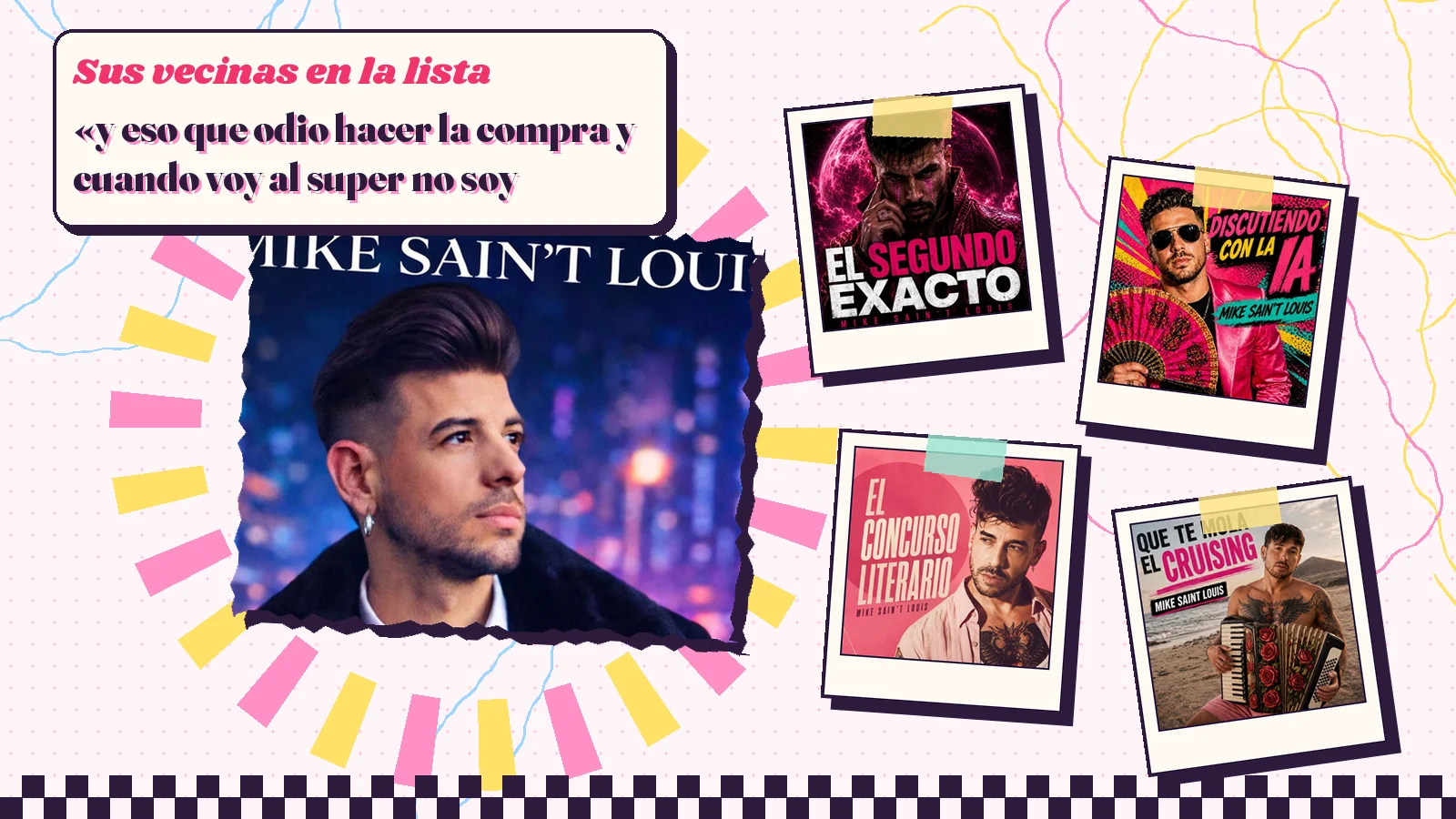
«¡Sí, que pasa! ¡Eso no significa nada!» "Yes, so what! That doesn't mean a thing!"
That's the song's second quote, and I wrote it with the exclamation marks fore and aft, Spanish-style, because it's the only line in the whole song that admits no nuance. Yes. I use it. So what. It means nothing. My thing is the lyrics. I make the music and vocals with artificial intelligence tools such as Suno, and I say so on my about page without hiding it, just as I say it here. What I won't do is apologise every time.
Mirwais and the crown
To defend me, the lyric doesn't produce a study or a statistic. It produces a queen.
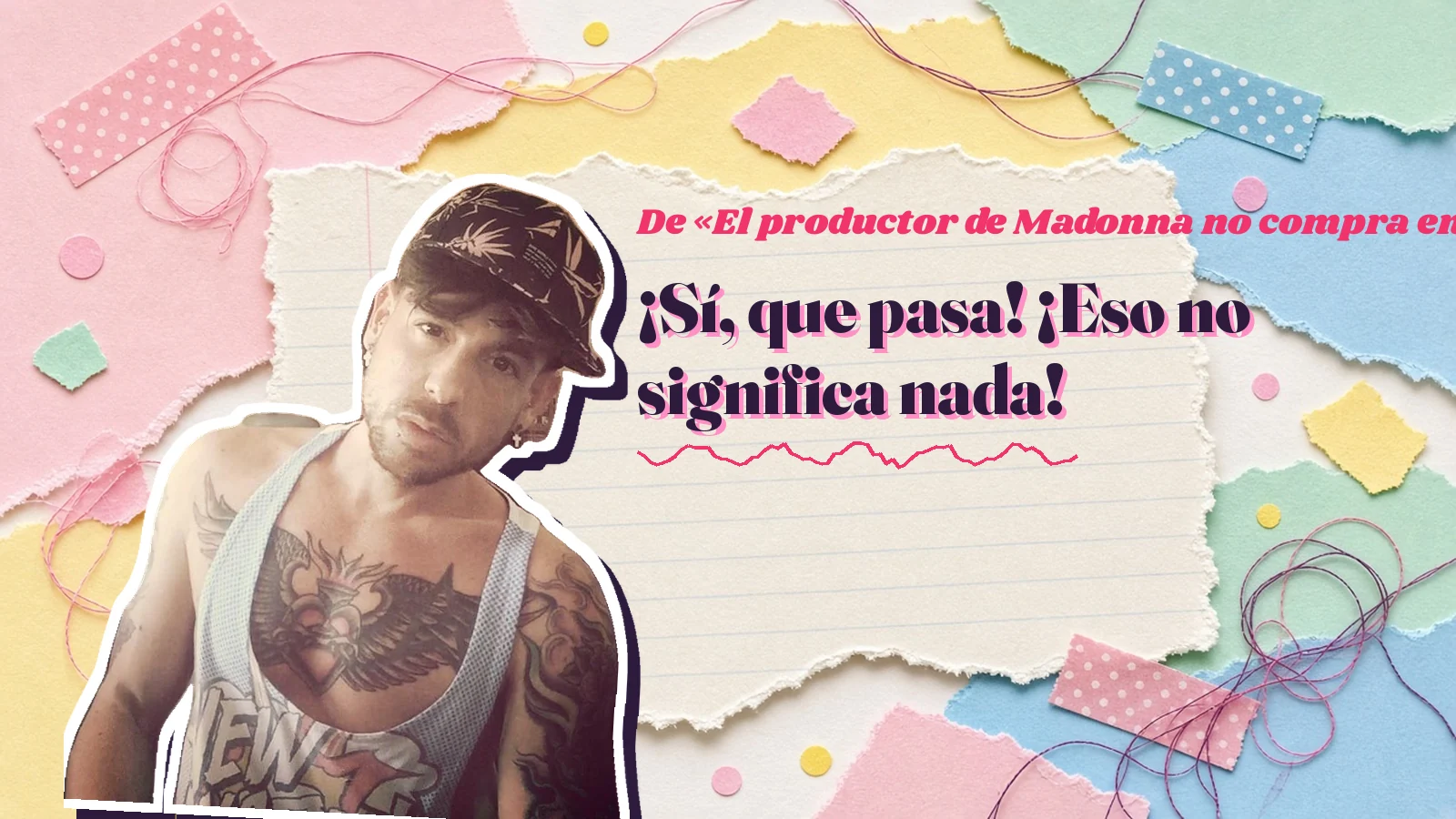
«Ya lo lleva usando Mirwais el Productor de / ¡Madonna! / Desde hace veinte años y mira donde sigue la reina / ¡con su corona!» "Mirwais, the Producer of / Madonna! / has been using it for twenty years, and look where the queen still is / with her crown!"
Mirwais is the French producer who worked with Madonna on albums such as «Music», the one from the turn of the century when the queen came out chopped up, robotic, run through filters, in jeans and a cowboy hat. I use him in the song the way you'd use, in a pub argument, a cousin who has a mate who works in telly: as a wildly disproportionate appeal to authority. You tell me my work doesn't count because I use machines, and I bring out Madonna. Done. Argument over. Let's see who's brave enough to take Madonna's crown.
Now, I know perfectly well it isn't the same. Mirwais had filters, drum machines and computers, and I have tools that generate music and vocals from what I ask of them. I'm not saying it's identical. I'm saying something else: every generation has had its suspect machine, and every suspect machine has ended up on the radio. The synthesiser was cheating. The drum machine was cheating. Autotune was cheating. The sampler was theft. And here we still are, with the queen on her throne and the rest of us mortals saying the old stuff was real music.
I like the word crown in the lyric. Because nobody gave Madonna her crown for behaving nicely. She won it through scandal, contrariness and doing exactly what she was told not to do. If there's one figure in pop who understands being doubted every couple of years, it's her.
So I bring her into the song as counsel for the defence. Though later, you'll see, I fire her.
The literary prize and false modesty
There's a part of the song that makes me a little embarrassed to reread, and that's precisely why I left it as it is.
The song asks, scandalised, whether anyone really thinks I have no talent, and answers itself: I'm a revolutionary, I once won a literary prize.
It's the most ridiculous answer you could give someone who says you've no talent. Waving a literary prize about as if it were the Nobel. And calling yourself a revolutionary, in the same line, without blinking. It's that family-dinner moment when someone needles you and you leap up with the first thing in your pocket: the school certificate, the honourable mention, the essay prize from when you were eleven.
I wrote it that way on purpose because it feels very honest. When you've been doubted for long enough, you end up boasting about absurd things. You defend yourself with what you've got. And what you've got is sometimes rather little. The prize, by the way, has its own song, «El concurso literario», which sits very close to this one in the singles list and is funnier still if you play it straight after.
I love the word aquél, "that", on the second pass, when the prize becomes that famous prize. Accent and all, as if it were a historic event everyone ought to remember. Famous. That one. Like the 2010 World Cup or Isabel Pantoja's wedding (the Spanish copla star's nuptials were a national event). It's the grandiloquence of someone with nothing grander to hand.
And that's self-parody, but it's also self-defence.
Ninety-three instead of thirteen
Then the lyric turns defiant, and this is where the song becomes more mine than ever.
The verse promises to try harder, to far outdo any traditional album: ninety-three songs instead of thirteen, with ninety-three music videos thrown in if need be, anything so long as they stop nagging.
There's exaggeration here, yes, but less than you'd think. Take a stroll through the singles list and you'll see I'm not exactly stuck at number thirteen. The Planeta Gayfolk trilogy is enormous, there are videos for loads of songs, there are shorts, there are lyrics published one by one. And part of that sheer quantity, I confess, comes from exactly what the verse says: the feeling that, because I use these tools, I have to do triple the work to be taken half seriously.
It's a trap, of course. Because it's never enough. Make thirteen songs and they say anyone could do that with a machine. Make ninety-three and they say that could only be done with a machine. You always lose. It's like those diets where if you eat too little you put on weight because your body panics, and if you eat a lot you put on weight because you eat a lot.
What I still love about that line is the ending, the nagging. All the ambition of outdoing any traditional album, all the epic of ninety-three videos, resolves into a tired mum's phrase. Leave me in peace. That's the real goal. Not glory, not the crown: just stop going on at me.
When I write these things I think of how people talked in my neighbourhood. Nobody said "I want recognition". They said "let's see if they'll leave me alone for once". Well, there you go.
Madonna gets on my nerves (thanks to someone else)
And here the song swerves. After using Madonna as defence counsel for two choruses, I suddenly sack her.
Madonna, all of a sudden, starts to get on my nerves. The blame lies with an ex and what the lyric calls his lethal blow.
This happens to me a lot when I write. I start with a serious idea, defending myself from the never-ending exam, and halfway through an ex climbs in through the window. I can't help it. It's like going to a funeral and running into someone you slept with in 2014: you're no longer at the funeral, you're in another film.
The ex in the song adored Madonna, and the only thing he loved as much as her was cruising. Madonna and cruising, the gentleman's two passions. I love putting them in the same sentence, as if they were equivalent hobbies, like saying you're into padel and Thai cooking. If that second subject interests you, by the way, it has its own song: «Que te mola el cruising».
The thing about exes and music is that they contaminate your records. There are songs you can't listen to any more because you listened to them together, or worse, because he played them on a loop while you gazed at him all moony-eyed. And suddenly a diva you adored becomes the soundtrack of someone who hurt you. It isn't her fault. Poor Madonna knows nothing about it. But it's not the same any more.
That's the lethal blow: the ex steals even your divas.
Rexona, the one that never lets you down
And then comes what is, for me, the best line I wrote in this song. The one that makes sense of everything:
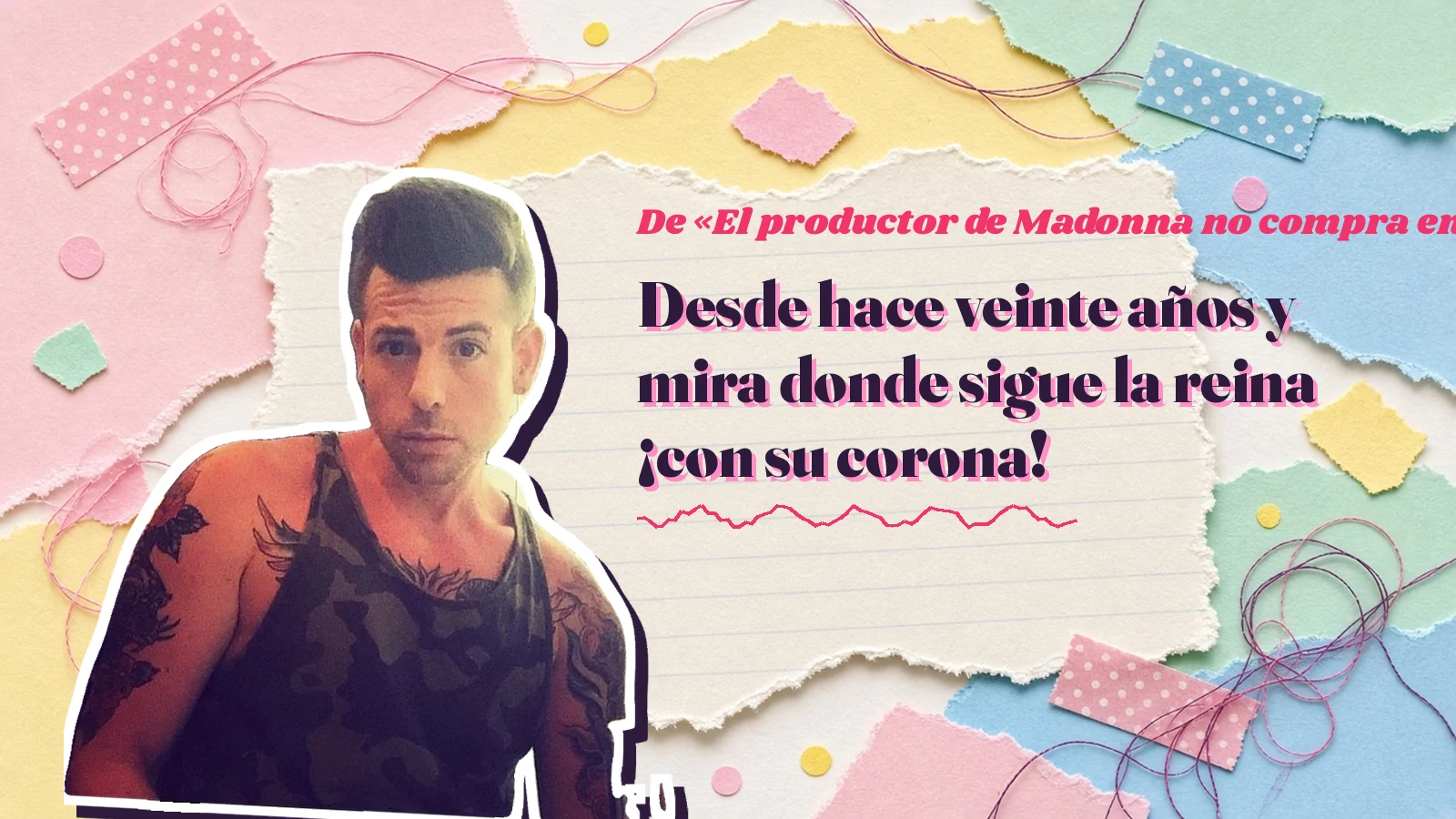
«Madonna era como / Rexona / que nunca te abandona / pues mira bonito / me he cambiado / a la marca blanca de / Mercadona y / también funciona» "Madonna was like / Rexona / that never lets you down / well, look, sweetheart / I've switched / to the own brand from / Mercadona and / it works too"
Rexona, que nunca te abandona, "it won't let you down". Anyone who watched Spanish television in the nineties has that deodorant slogan tattooed somewhere in the brain, between the Lunnis theme tune and the "hola, soy Edu, feliz Navidad" Christmas ad. It's an advertising line we can all finish. And I use it to say something rather cruel: that the diva, like the deodorant, was a promise of loyalty. Something you thought would always be there. Something branded.
And the twist couldn't be more domestic. I've switched to the own brand. Mercadona's, Spain's ubiquitous supermarket. And it works too.
That line makes me laugh a lot, because it's such a homely way to talk about a break-up. I don't say "I've overcome my emotional dependency". I say I've changed deodorant. That what you thought was essential was an expensive logo, and what's underneath, the bit that actually does the job, you can get at the corner shop for less than half.
Then there's pues mira bonito, "well, look, sweetheart". That's pure Madrid market talk, the lady who snaps back at you in the fishmonger's queue. Mira bonito. With an edge. Head tilted. It's the most castizo, the most old-Madrid, way of telling someone you couldn't give a fig what they think.
What the own brand really is
Let me be serious for a moment; it's about time.
When I wrote the own-brand line, I wasn't only talking about the ex. I was talking about myself too. About what I do. Because, deep down, the one who's spent the whole song defending himself against the exam is a man who makes music with tools that, for many people, are exactly that: the own brand of music. The cheap version. The Hacendado knock-off (Mercadona's house label) of the real record.
And the song, without saying so, replies: fine, and so what? It works too.
If a song of mine is any use to someone on a Tuesday night, if it makes them laugh or puts a name to something that happened to them, it doesn't matter what label is on the bottle. What's inside does the job. I don't need the crown. I'm happy for the song to do what it has to do. I wrote it down on my site, in the house rules: "A song kept in a drawer is of use to no one."
It isn't a line for winning arguments. It's just why I keep going.
Mercadonaaaaa
And then comes the final chorus, the vowel stretched to infinity: Mercadonaaaaa. Written like that, with five a's, because the word demands it. It's a stadium roar dedicated to a supermarket. I thought of it like those football chants repeated so often they stop meaning anything and become pure sound.
El productor de Madonna no compra en Mercadona. Madonna's producer doesn't shop at Mercadona.
Which is a sentence that, if you think about it, says absolutely nothing. Of course Madonna's producer doesn't shop at Mercadona. He lives in Paris or Los Angeles or wherever people like that live. But I like it for exactly that reason: it's a statement of the obvious delivered with tremendous solemnity, like graffiti in the school toilets that makes you laugh without your being able to explain why.
And also because it puts everyone in their place. The queen's producer, in his branded world. Me, in the dairy aisle. And that's fine. It's my place and I know exactly where to find it.
Seven to eight, and the pineapple
The last part of the song goes down to the real supermarket, opening hours included.
I'll end up like everyone else, it says, from seven to eight at Mercadona, though I hate doing the shopping and in the supermarket I'm not fit to be around.
Seven to eight in the evening. Mercadona's rush hour, when everyone's out of work and there's a queue even in frozen foods. I love the resignation in that line, ending up like everyone else. After a whole song boasting of being a revolutionary and of ninety-three music videos, the final destination is the same as any neighbour's: the trolley, the queue and the woman who pushes in with a single baguette.
The bit about not being fit to be around in the supermarket is true. I'm not. I turn into a bear with a sore head. And that's no invented anecdote; it's what the lyric says, and I'll leave it there.
Then the finishing touch, which is pure code for those in the know: since on top of everything I don't like pineapple, I'll have to keep an eye out in case someone winks at me. Those who know, know. There's an urban legend in Spain about an upside-down pineapple in your Mercadona trolley at certain hours meaning you're looking for a partner, and the song uses it to close with a literal wink. The own-brand man hasn't lost his appetite for flirting. He's just changed aisles.
What this song shares with its neighbours
If you open the song's page on the blog, you'll find the full lyric and the link to listen. What you won't find there, because it's another way of telling it, is how it fits with the other songs where I talk about artificial intelligence.
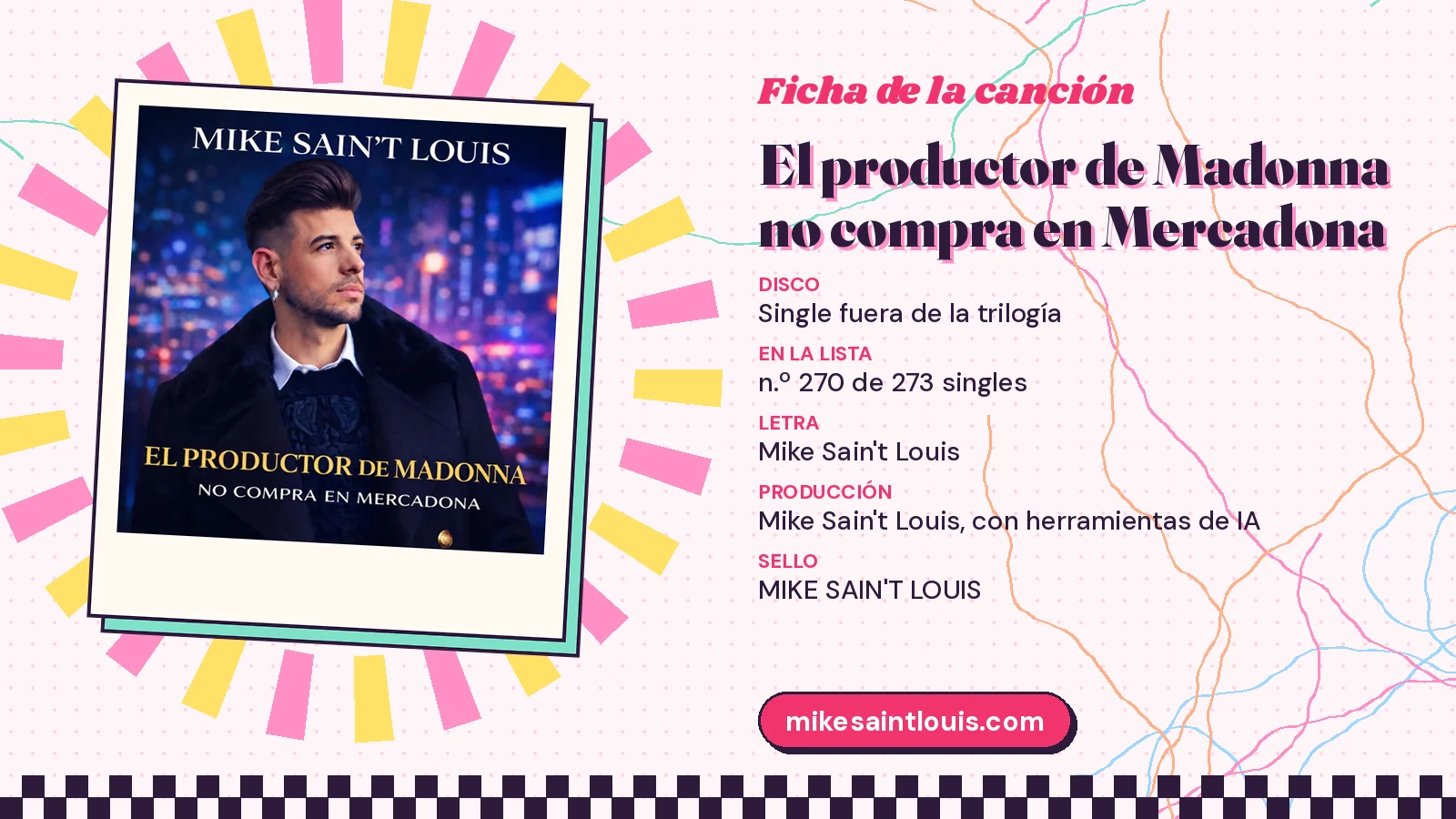
They are, let's say, three different stances on the same question. In «El segundo exacto» I turn melancholy and wonder whether the machine could ever choose the exact moment someone bursts into tears. In «Discutiendo con la IA» I lose my temper with it, like arguing with a flatmate who never does the washing-up. And in this one, the Madonna one, I laugh at the exam and head to the supermarket.
None is truer than the others. It depends on the day. Some days the question of whether my work is real makes me cry, some days it makes me shout and some days it makes me shrug and think about the pineapple. And since I write according to the day, I've got songs for all three moods.
There's a fourth, if you push me: «Tus letras son basura», the direct reply to the haters who don't even bother with AI and go straight for the lyrics. That's another war, but the same army.
Why I don't weep in this one
People sometimes ask why some of my songs about things that hurt are so cheeky. And the answer is in this song better than in any other.
Because if I get serious about the never-ending exam, I sink. If I write a sad ballad about how unfair it is not to be taken seriously, I stay in bed for three days. But if I turn it into a staircase of loose words, into an IA IA IA siren, into Madonna as a barrister and Rexona as an ex, then I can look it in the eye. I can laugh at the examiners and, while I'm at it, at myself for taking the exam so seriously.
You can tell the truth with humour too. That's written in my house rules, and this song is proof that I believe it.
But mind you, laughing isn't the same as not caring. I care. I care enormously that people know the lyrics are mine, that no machine wrote them, that every line of this song, the pineapple included, came out of my head on an ordinary day. The music and vocals I make with AI. The words, no. And that's why, when someone says my work is a fairy tale, a twenty-step staircase comes out of me in reply.
How I'd listen to it
If you ask me how to listen, I'd say with a trolley. Seriously. Put your headphones on, walk into your local Mercadona between seven and eight, when it's busiest, and press play. When the own-brand bit arrives, pick up a Deliplus deodorant and look at it fondly. When the pineapple bit arrives, glance around.
And if someone asks why you're laughing to yourself in the fruit aisle, tell them you're listening to a revolutionary who once won a literary prize.
That one. The famous one.
If you'd like more context on how I work, there are the frequently asked questions, where I explain it with fewer jokes, and the lyrics page, where all the published ones live. And if you're one of those who still think this is nonsense made with a button, don't worry: I've got ninety-two more songs for you to keep examining me on.
Frequently asked questions
Who is the Madonna producer mentioned in the song? The lyric names Mirwais, the French producer who worked with Madonna on albums such as «Music». The song uses him as an example of how technological tools in music haven't taken the queen's crown away.
Is the song made with artificial intelligence? The lyric is mine, written without AI. The music and vocals are made with artificial intelligence tools such as Suno. The song is precisely about how tiring it is to have to justify that again and again.
What does the Mercadona own-brand line mean? It's a domestic comparison: Madonna was like Rexona, «que nunca te abandona» ("it never lets you down"), and the narrator has switched to the own brand and «también funciona» ("it works too"). It's about getting over something you thought was essential, in this case a diva tied to an ex.
Where can I read the full lyric? On the lyrics page at gayfolkplanet.com and on the song's page on the mikesaintlouis.com blog, which also has the link to listen on Spotify.