
By Mike Sain't Louis ·
Not looking is an answer too: your gaze as the last power you have
There's a title that's a promise and a threat at once: «No te vuelvo a mirar más», I'm never looking at you again. It doesn't say «I'm never speaking to you again», which would be the usual thing. Nor «I'm never seeing you again», which is impossible if you share a building, a family or a corridor. It says looking. What the narrator promises himself isn't to vanish from the other person's life, but to take away something very specific: his eyes.
The song's page talks about the door that closes slowly and the mud that won't come off with a cloth. I won't repeat that reading. Here I want to stay with the title, with that tiny, enormous decision never to look at someone again, and with the setting the song puts it in, which isn't a house or a bed but an office.
An office with a big top
The line in the lyric that matters most to me is this one:
«Tu oficina es un circo, tu dignidad un cubo,» («Your office is a circus, your dignity a bucket,»)
There's the setting. The lyric isn't talking about an ex, or not only. It's talking about someone who has an office, who's in charge somewhere, who turns that place into a show where everyone else plays the clowns or the wild animals. The speaker in the song has been inside that circus. He's trodden on the rubbish where the other one keeps his pride.
Heartbreak songs have a very limited repertoire of settings: the bedroom, the bar, the station, the beach in summer. The office almost never turns up. And yet, for a lot of people, the place where they've been most humiliated isn't a relationship. It's a job. A boss who shouts, a colleague who takes credit for your work, a manager who belittles you in front of everyone. Power relationships you can't walk out of with a slammed door, because walking out means losing your wages.
I wanted to write a break-up song for those relationships. Because they break too, they hurt too and they need their chorus too. If there are a thousand songs for the boyfriend who left, there can be a few for the boss you can't leave.
What you can't do
Think about what someone in that situation doesn't have.
They can't leave, or not yet. They need the job, or the contract, or the reference. They can't answer back the way they'd like, because answering back to whoever's in charge has consequences. They can't always report it, because sometimes there's no proof, or the people who saw it won't testify, or the bureaucracy is slow and daily life is fast. And they can't stop seeing that person, because he's there every morning, at the coffee machine, in Monday's meeting, across the corridor.
What's left? One thing nobody can take away: where they look.
They can decide that person no longer deserves their eyes. That they'll speak to him if it's essential, take his orders, be in the same room. But they won't give him their gaze. Not the frightened look, not the furious one, not the pleading one. Nothing.
That's what the title promises. It isn't running away. It's withdrawing something the other one needed.
Why your gaze matters so much
Anyone who abuses their power needs an audience. Being in charge isn't enough: they need to see the effect. They need the lowered eyes of the one obeying, the scared eyes of the one waiting to be shouted at, the wet eyes of the one about to cry. The circus, to work, needs spectators who react.

That's why withdrawing your gaze is so powerful. It denies the other person confirmation of their power. You speak to him, but you don't look at him. You do what's asked, but you don't react. For someone who feeds on other people's reactions, that's the worst thing that can happen: realising you're not giving them anything any more.
The lyric says it with another image I really like. At first, the other one apologises with his back turned, not facing him. And when the narrator turns round, his eyes stick the knife in. The gaze as a weapon. The other one used it to wound. Now the narrator takes it away from him.
Choreography of the corridor
Not looking at someone you share a space with is harder than it sounds. It takes a kind of choreography.
There's the lift, where two people not looking at each other become experts in floor numbers. There's the meeting, where you can look at the screen, at your notebook, at the person talking right next to him. There's the coffee machine, where all it takes is waiting two minutes for him to go. There's the narrow corridor, where your eyes drop to the floor or to your phone. And there's the compulsory greeting, the «morning» you can say while looking at some vague point above his shoulder.
All of that is tiring. Not looking at someone is extra work, on top of work. That's why the title is a vow rather than a description: you have to renew it every morning. «I'm never looking at you again» is something you tell yourself on Monday, and Tuesday, and Wednesday, until one day you don't need to say it because your eyes have learnt on their own.
Some people will think this is childish, like kids in the playground not speaking to each other. I don't think so. Kids who stop speaking to each other do it so the other one notices. Here it's the reverse: the point isn't for him to notice, though he will. The point is to stop depending on what happens on his face.
A chorus for the bus
The song's chorus is shaped like a vow:
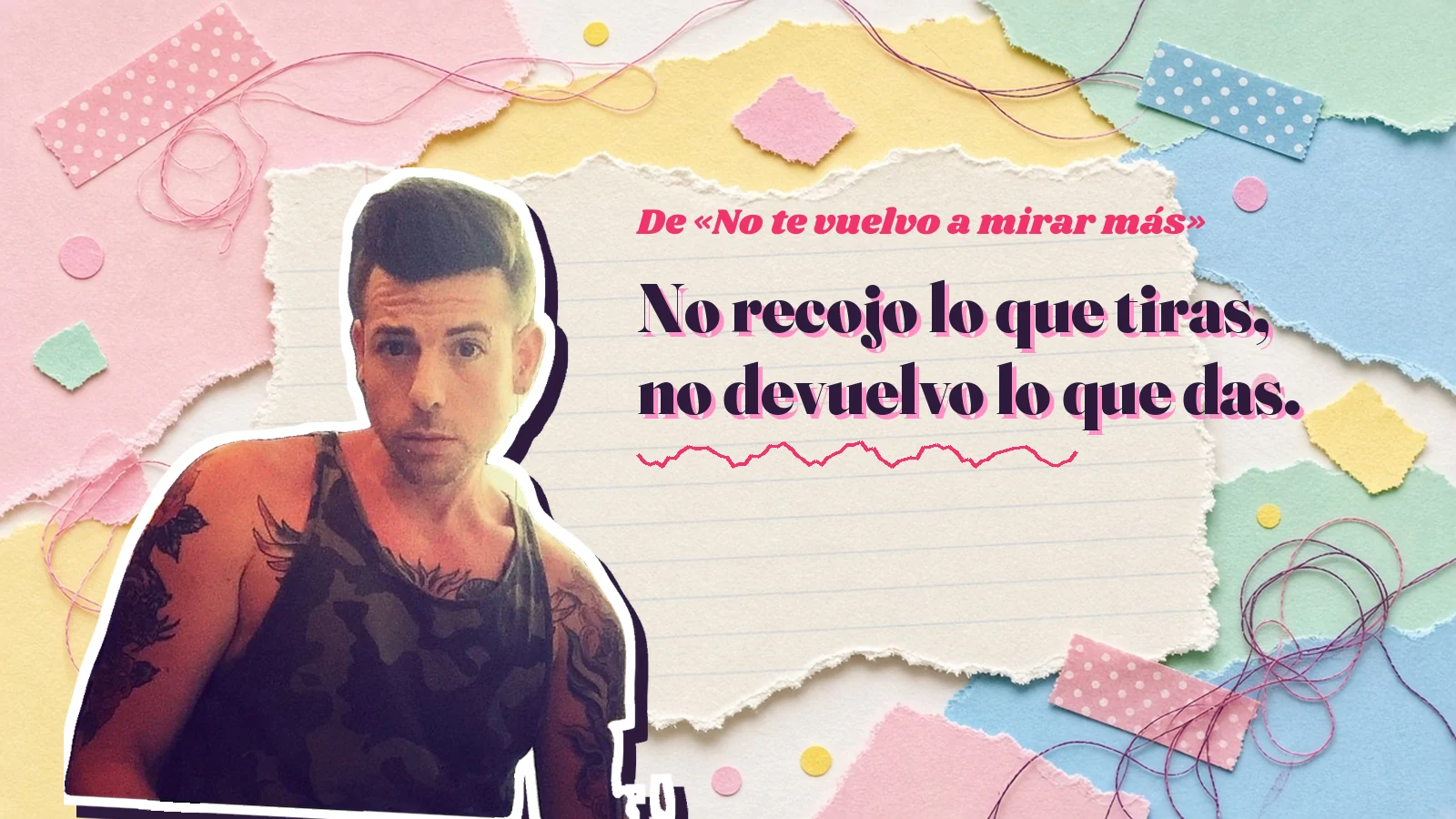
«No recojo lo que tiras, / no devuelvo lo que das.» («I don't pick up what you throw down, / I don't return what you hand out.»)
I like to think of this chorus as something you repeat inside your head. Not to say to his face, which probably isn't possible. To repeat on the bus to work, in the lift before you walk in, in the loo when you need five minutes. It's a secular prayer for holding on.
«I don't pick up what you throw down» is a very office-y line, when you think about it. In toxic workplaces there's always someone who leaves their stuff lying around for others to pick up. The unfinished report, the angry client, the blame for the mistake. «I don't return what you hand out» is the opposite of an eye for an eye: I'm not going to pay you back in the same coin. If you shout, I don't shout. If you sneer, I don't sneer. Not because I'm a saint, but because I won't give you the satisfaction of seeing me sink to your level.
The bargain-bin victim
There's a line in the first part that captures a figure anyone who's worked somewhere toxic will know. The other one has cast himself as a bargain-bin victim.
It's a classic strategy. When the abuser finds himself called out, he starts to cry. He tells everyone else how badly the other one treats him, how hard he is to work with, how unfair it all is. And since the others haven't seen what goes on behind closed doors, they believe him. The lyric says it further on: he cries in front of the people who know nothing, dresses up as the good guy and paints the other as the villain.
I've looked at this from another angle in «Perverso narcisista», where I talk about the risks and the usefulness of putting psychological labels on people who hurt us. In «No te vuelvo a mirar más» there's no label. No diagnosis. Just the description of a behaviour, and that seems more honest to me. I don't know what that person has inside. I know what he does.
«Víctima de saldo», bargain-bin victim, is my phrase and I'm fond of it. Saldo as in the sales, clearance-rack victim, second-hand. A role that isn't his and that he's picked up cheap for the occasion.
Pride and dignity
There are two words in the first verse worth separating, because the lyric separates them very carefully: dignity and pride.
The other one's dignity, says the circus line, is a bucket. An empty container, or full of any old thing. And he keeps his pride in the rubbish, where the narrator has trodden on it. In other words: the other one has plenty of pride and little dignity. Pride is what takes offence when you answer back. Dignity is what stops you shouting at a junior in front of everyone.
That's usually how it is with people who abuse their power. They have enormous, touchy pride that flares up at the slightest thing, and tiny dignity. They feel attacked by anything and feel no shame about attacking.
The narrator goes the opposite way. He swallows his pride, because he can't answer the way he'd like, and holds on to his dignity. Not looking is an act of dignity, not of pride. Pride would want to answer back, come out on top, win the argument. Dignity is content not to take part in it.
That distinction, which sounds like something from a dictionary, is for me the moral centre of the song.
No slammed door
Almost every break-up song I know runs hot. There's shouting, tears, smashed plates, doors that shake the walls. The emotion rises and explodes. And that's fine, sometimes you need a song like that. I've got some too.
This one is cold. Not in the music, which can be as intense as it likes, but in the speaker's attitude. He doesn't explode. He lists. You swore me this and did that to me, you asked me for this and you did the other. Like someone reading out the minutes. And at the end, instead of a scream, a decision.
I think coldness, in some contexts, is more devastating than rage. Rage is still a form of relationship: you get angry with someone because they matter to you. Coldness is total withdrawal. When someone shouts at you, you still matter to them. When they stop looking at you, you don't.
The rules
The end of the song is a declaration of sovereignty:
«Las reglas las pongo yo…» («I'm the one who makes the rules…»)
The interesting thing is that this comes from someone who, at the start, made no rules at all. The other one was in charge. The office was his, the circus was his. And now, without anything necessarily changing on the org chart, the narrator says the rules are his.
How can that be? Because there are rules nobody can make for you. Where you look, who you answer, what you take personally and what you don't. The other one can still be the boss. He can still sign your payslips. But the rules of your dignity are yours to set, and the first one is this: I'm never looking at you again.
It's a small, inner sovereignty that can't be seen from outside. But it's what lets you hold on as long as you need to, until you can really leave, or until things change.
Copla in office language
The song's page says it's copla in today's language, and that's right. But I want to add something.

Classic copla was full of women humiliated by men with power. The landowner's son who took advantage of the maid, the husband who left her for another woman, the man who disgraced her and walked away. And those women's responses in coplas were often like this: dignity, pride, one devastating line before turning their back. Copla was, deep down, the genre of women who could do nothing except have the last word with style.
«No te vuelvo a mirar más» moves that pattern into the twenty-first century. The landowner's son is now a boss with an office. The humiliation isn't disgrace any more, it's the shouting in the meeting and the contempt in front of colleagues. But the response is the same: dignity, one devastating line and your back. I talk about why copla is so useful to me for writing pop in copla inside queer pop.
For an ex too, for a friendship too
Although I read the song as an office song, the lyric leaves the door open. The song's page says so: it works just as well for an ex, a boss or that friendship that cost more than it gave.
I like that. Power dynamics don't care about categories. Some couples work like toxic offices, with a boss and a subordinate. Some friendships are a circus where one person always plays the clown. And there are families, of course, which you can't leave because they're your family.
In all those cases the tool is the same. When you can't cut things off completely, you cut off your gaze. You still go to Christmas dinner, but you don't seek that person's approval. You stay in the group of friends, but you stop laughing at his jokes. You keep sharing the flat until the lease runs out, but you stop explaining yourself.
What it isn't
I want to be clear about what this song isn't, because it could be misread.
It isn't advice to put up with things in silence. There are situations where what you need to do is leave, report it, get help, talk to a union or a lawyer. In Spain workplace harassment is covered by the Criminal Code, and there are ways to defend yourself. The song doesn't replace any of that.
What the song does is keep you company in the in-between time. That stretch when you're still inside, while you prepare your exit or gather the strength to take the step. In that in-between time you need something to hold you up every morning, and sometimes what holds you up is a sentence. I'm never looking at you again. And then another: I'm the one who makes the rules.
It isn't a revenge song either. There's no line where the narrator wishes the other one harm or plans to bring him down. The harshest thing he says is that his hands smell of what he hasn't washed off. It's an observation, not a threat. Everyone carries their own load.
Looking somewhere else
There's one thing I really love about the idea of not looking: it forces you to look somewhere else.

If you don't look at the one who hurt you, where do you look? At the colleagues who do treat you well. Out of the window. At your own hands doing their job well. At the door you'll walk out of one day. At what's outside the office: your people, your home, your music.
Your gaze is limited. What you give one person you don't give another. Someone who lives hanging on a toxic boss, or on an ex who wrecked them, is handing their eyes to the person who deserves them least. Taking them away from there is also a way of giving them back to where they belong.
I think that's what I'd most like listeners to take from the song. Not just the gesture of turning your back, but the question that comes after: and now, what do I want to look at?
The ones who should look
There's a third group in the song who are neither the speaker nor the humiliator: everyone else. The people who know nothing, says the lyric, in front of whom the other one cries his victim act.
In any office turned circus there's an audience. Colleagues who hear the shouting through the door, who see faces coming out of meetings, who notice someone has stopped having lunch with the group. And very often that audience looks the other way. Not out of malice, almost never, but out of fear, convenience or not knowing what to do.
It seems important to say this, because the song is about not looking and it might seem that not looking is always the answer. It isn't. Don't give your eyes to the one humiliating you. But the one being humiliated, the colleague who's having a hard time, that person you must look at. Ask how they are. Tell them you've seen what's going on. Offer to speak up if needed.
The abuser counts on two things: his victim's frightened gaze and the witnesses' averted gaze. Take away the first and take away the second, and his circus is over.
Other songs in the same family
There are quite a few songs in my catalogue that could be cousins of this one. «Quien miente y jura» is the proverb version of the same anger: the mistrust earned by someone who swears falsely. «Vampiro emocional» is about people who drain your energy, also with the idea of shutting the door.
And in a completely different tone, with a lot more humour and a lot less solemnity, there's a song with a female boss in the middle of it too: «Que me coma el chumino la jefa de servicio». The title alone tells you the response there is very different (it's unprintable, roughly «the head of department can eat my fanny»). I like that they live side by side. There are days for serious dignity and days for belly laughs, and both help you survive a job.
If you listen to several in a row you'll see an idea that keeps coming back in my lyrics: the last word isn't always the loudest. Sometimes the last word is saying nothing and looking the other way.
A song without names
One last note. The lyric has no names. It doesn't say who the boss is, or where the office is, or exactly what happened. And I'm not going to say it here either.
I do it that way on purpose. A song with names is a settling of scores. A song without names is a mirror. Whoever listens puts in their own boss, their own ex, their own office. Everyone fills it with their own stuff. And that's what I want: for it not to be my story, but a story with room for lots of them.
Frequently asked questions
What is «No te vuelvo a mirar más» about? About someone who, faced with a person who has looked down on and humiliated him, decides to withdraw his gaze and set his own rules. The full lyrics are at gayfolkplanet.com/letras.
Is it a song about work? The lyric mentions an office turned into a circus, so it can be read that way, but it also works for an ex or a friendship that did harm.
Is it a revenge song? No. The narrator doesn't wish the other person harm. He simply doesn't pick up what he throws down, doesn't return what he hands out and never looks at him again.
Who makes the song? Mike Sain't Louis writes the lyrics, composes and produces. The music and vocals are made with artificial intelligence.