
By Mike Sain't Louis ·
«It's not you, it's me»: the excuses of someone who isn't ready, in Scott Bonehill
Some phrases stop meaning anything from sheer overuse. «It's not you, it's me» is probably the queen of them all. We've heard it in films, in series, in bar conversations and in messages sent at three in the morning. It almost always means the opposite of what it says: it's you, but I don't feel like arguing about it.
That's why the way Scott Bonehill opens interests me so much. The song starts with that phrase, but uses it the other way round. Nobody here says it in order to leave. It's said by someone who is staying, who is asking for patience and who, instead of putting the blame outside, carries all of it on their own back. It isn't a polite goodbye: it's a confession.
On the song's own page I've already told what the story is about, and the full lyrics are published. I don't want to retrace that route here. I want to stop on something else: the language of excuses, what happens when a couple suggests opening up the way you'd suggest moving the furniture around, and the right, so rarely defended, to say you aren't ready for something everyone else finds perfectly normal.
The line we've all heard
Break-up clichés work like a form. You fill in the blanks, sign and leave. Their advantage is that nobody has to invent anything at a moment when inventing hurts, and their drawback is that they sound like a lie precisely because they belong to everyone.
The funny thing is that the phrase, read literally, is fairly honest. It says the problem lies with the person speaking. That the other person has done nothing wrong. That the fault is one's own. What has ruined it is the usage, not the meaning.
The lyrics of Scott Bonehill rescue that literal meaning. Whoever says «it's me» means it. They aren't looking for an elegant way out. They're trying to explain something happening inside them that they don't know how to put any other way. And to put it, they grab the first thing to hand, which is the usual phrase.
It strikes me as a very human gesture. When you can't find words of your own, you fall back on inherited ones. And sometimes inherited words, placed in exactly the right spot, go back to saying what they said in the first place.
An apology that leaves nobody
What sets these lyrics apart from an ordinary break-up song is the direction. In break-up songs someone leaves, and the phrase softens the exit. Here the phrase is used to put the brakes on. The narrator doesn't want to go; they want not to be pushed.
That difference changes everything. An apology that comes with a goodbye is a formality. An apology that comes with a request for time is a risk. Because whoever says it exposes themselves: they admit they aren't well, that they have problems of their own and that they need the other person to be patient with them.
And they do it without melodrama. There's no pleading, no tears. There's a kind of weariness, of not wanting to be a bother, that shows from the very first line. The narrator apologises almost for existing, for taking up space, for being a problem. It's a way of talking that many people will recognise, because it's how someone talks who has felt like a burden for a long time.
Self-esteem as an argument
In the second line the reason for everything appears, stated bluntly: self-esteem is at rock bottom. It isn't dressed up or justified. It's put on the table like someone showing a medical report.

There's something very valuable in naming that inside a relationship. Many relationships break up over things nobody ever gets round to saying. One person shuts down, the other drifts away, and by the time anyone talks there's nothing left to save. Here, at least, someone says it in time. It may not help, but they say it.
There's also something sad about using self-esteem as an argument. It's like saying: don't ask me for anything more, because I have nothing more to give. And in a couple, that can sound like sincerity or like emotional blackmail, depending on the day and on who's listening. The lyrics don't decide for us. They leave the phrase there, bare, for each of us to read as best we can.
I like that the song doesn't turn low self-esteem into a virtue or a flaw. There's no breakfast-mug moral. It's one more fact of the situation, like the weather or the time of day. And with that fact, decisions have to be made.
Don't push me when you no longer hold me
The third line has one of those pairs of ideas that land like a soft slap. On one side, the request: don't push me to the limit. On the other, the complaint: when you don't even hold me any more. Together they say something very specific about how relationships go out.
First, touch disappears. Then pressure arrives. And the order matters. When someone no longer holds you but does ask things of you, the feeling is that you only exist as a problem to be solved. You're no longer the person they sleep beside; you're the obstacle to something they want.
This part seems to me one of the best in the lyrics because it doesn't accuse directly. It doesn't say «you're cold» or «you don't love me any more». It describes a missing gesture and lets the gesture speak. It's a way of writing a complaint that trusts the listener, and that's always welcome.
The funeral with all the props
Then comes the black humour. The relationship is so dead that all it lacks is the funeral kit: stone, tool and professional. The image is exaggerated on purpose, and the joke lives in that exaggeration.
Death appears a lot in the Planeta Gayfolk catalogue, almost always as a metaphor for something ending. But here it has a comic tone that makes it bearable. It isn't an elegy; it's almost a sketch. You picture the gravedigger turning up at night with the shovel over his shoulder, asking where he's supposed to dig.
That kind of humour is very much ours, very Spanish. Laughing at the disaster while the disaster is happening. Not because it doesn't hurt, but because laughing is the only way to keep talking about it without collapsing. The lyrics use it just before the most serious moment of the song, and that sets up the blow.
Opening up as a last repair job
And the blow is this: «ya solo nos falta abrir la relación», all that's left is to open the relationship. The line arrives as the next item on the funeral list, as if opening up the couple were one more step towards the grave and not a rescue.
That's the tension of the whole song. For one of the two, opening the relationship is a solution. For the other, it's the final nail. And both may be partly right.
Open relationships aren't good or bad in themselves. Some couples work that way for years, with clear agreements and a lot of communication, and some couples open up when they're already broken, like someone painting a house that's falling down. The lyrics don't judge the model. They judge the timing. Suggesting you open up when there are no more hugs isn't the same as suggesting it from a place of closeness.
What I find interesting is that the song doesn't present the proposal as a betrayal. Nobody cheats on anybody. People talk, suggest, try. It's all very grown-up and very reasonable, and that's exactly why it hurts more. You can get angry at a betrayal. Faced with a reasonable proposal, all you can do is feel old-fashioned.
«Y lo peor de todo»
Then comes the line that shifts the tone: «y lo peor de todo es que tienes razón», and the worst of it is that you're right. It's the hardest sentence to say in an argument, and here it comes out quietly, almost like a sigh.
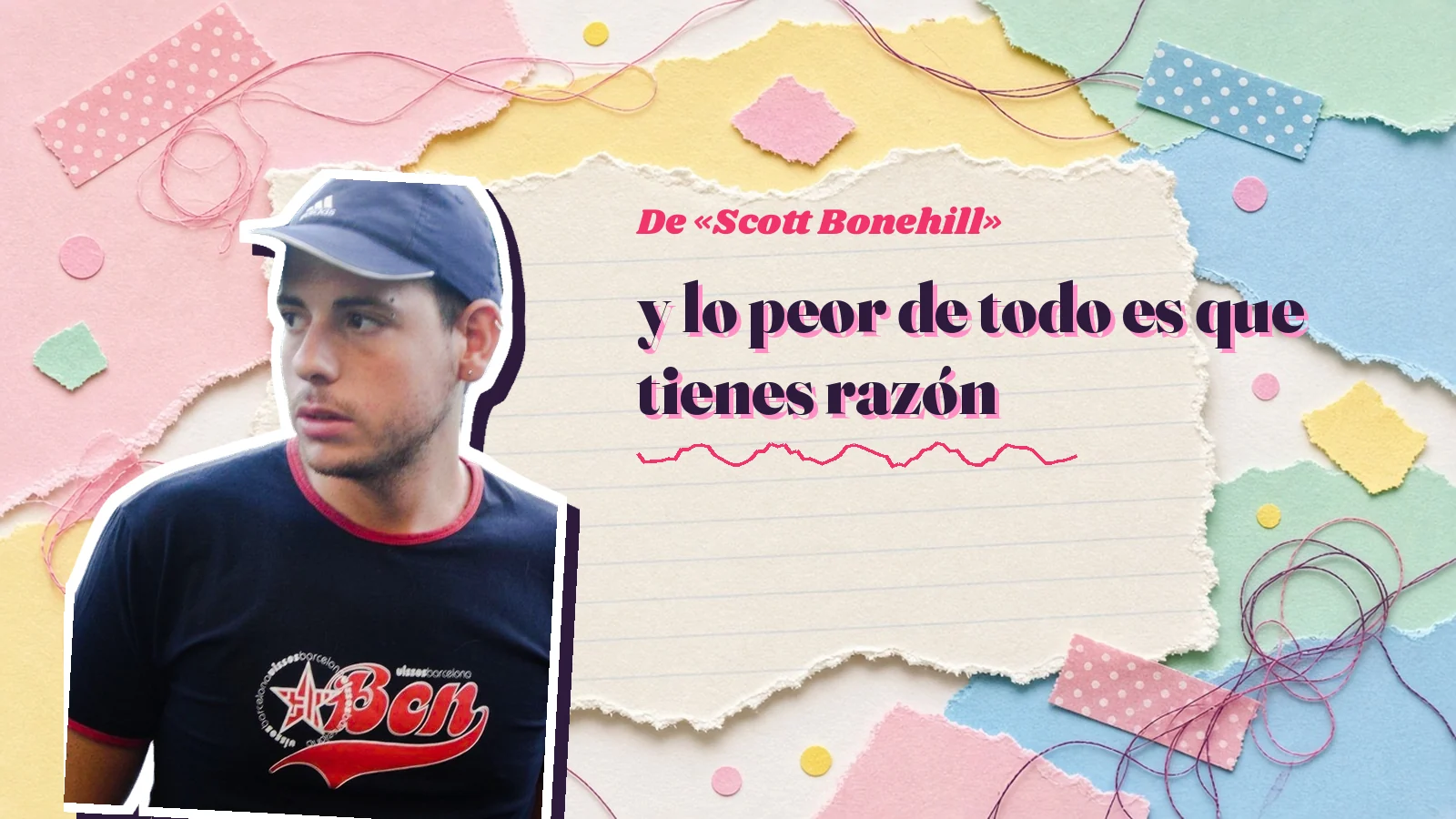
Admitting the other person is right when what they're proposing hurts you is a huge exercise in honesty. It would be much easier to paint them as selfish or shallow. The lyrics refuse to. They admit the proposal makes sense, that the relationship is where it is, that something has to be done.
And at the same time that admission solves nothing. Being right doesn't mean the solution will work. You can agree with a diagnosis and be unable to stand the treatment. That's exactly what happens to the narrator: they understand the reasoning, but they can't cope with it.
The questions you ask yourself
The bridge of the song is a string of guesses: maybe I'm not modern, maybe I'm heading straight to hell, maybe I'm always bitter. They're written with exclamation marks on the key words, as if the narrator were shouting them at themselves or mocking them.
They're the questions of someone who is starting to doubt their own way of loving. Am I the odd one? Am I a fossil? Have I been left behind? And the interesting thing is that each one is an accusation the narrator levels at themselves before anyone else does. They stick the label on first so it hurts less when it comes from outside.
The mention of hell is a nice touch, because it mixes two worlds. On one side, the age-old religious guilt, the idea that certain desires damn you. On the other, the opposite and very contemporary fear: being damned for not desiring enough, for not being free enough. The narrator is caught between two moralities and doesn't quite fit in either.
Old-fashioned in an age of agreements
The word «modern» is the key to that bridge. Today there's a certain pressure to be flexible about everything, love included. The apps, the agreements, the new labels for kinds of relationship that used to have no name. All of that has opened doors that were shut, and that's great. But it has also created a new way of feeling out of place.
Someone who wants a closed relationship can end up feeling like the square at the party. As if wanting exclusivity were a sign of insecurity or possessiveness. And sometimes it is, of course. But sometimes it's simply what someone wants, no further explanation needed.
I like that the lyrics leave room for that person. They neither ridicule them nor hold them up as a model. They let them say what they feel, with all their contradictions, and that's already quite a lot.
Monogamy, non-monogamy and queer culture
In LGBTQ+ culture the debate about monogamy has a long history. For decades, many queer people built their lives outside heterosexual couple models, and for some that included more open kinds of relationship. With marriage equality, which arrived in Spain in 2005, part of the community also embraced the classic couple model.
Today every option coexists, and that's a richness. But coexisting doesn't mean there are no tensions. Within one couple there can be one person who wants to open up and another who doesn't. And there no law or manual applies. There are only two people trying to understand each other.
Scott Bonehill sits right at that point. It isn't a pamphlet in favour of monogamy or a defence of open relationships. It's the portrait of a couple in which those two desires collide, told from the side of the one who feels less modern.
Being ready isn't compulsory
The line that closes the bridge sums it all up: the narrator repeats that they aren't ready. They repeat it, mind you, like someone who has said it before and wasn't listened to.

That sentence deserves more respect than it usually gets. We're surrounded by messages urging us to leave our comfort zone, to try things, not to be afraid. And that's fine. But there's also the right not to be ready. To say something isn't for you, now or ever. Without having to justify it with a diagnosis or a theory.
In a relationship, that right should count as much as the other person's wish to try something new. When it doesn't, the couple stops being an agreement between two people and becomes a negotiation in which one always gives in.
A summer and a proper name
And then the story makes its leap. The first time they tried, that summer, it ended the way many experiments like this end when the relationship is already shaky: someone falls in love with someone else.
The chorus says it with the full name, Scott Bonehill, repeated three times. Like every name in my lyrics, he's an invented character. You don't need to know who he is, because he isn't anyone in particular. He's the third person who shows up when you open a door without really knowing where it leads.
What amuses me about that ending is that it turns the drama into something almost comic. After so much reflection on modernity and hell, the outcome is as simple as it gets: a summer, a guy, a name that sounds like a cologne advert. The narrator's fear was well founded. And the repetition in the chorus sounds like someone who can't quite believe it.
Why a name in the chorus
Putting a proper name in the chorus is a choice that changes how a song is remembered. An abstract chorus gets forgotten. A name sticks. And it also gives the story a concreteness that makes it more believable: it isn't «someone else», it's somebody with a first name and a surname.
The name also works as a joke. It has the ring of a summer heart-throb, of someone who appears by a swimming pool in sunglasses. And the fact that it's an English name inside lyrics in Spanish reinforces that sense of something exotic bursting into a worn-out routine.
That mix of languages is very Planeta Gayfolk. The lyrics jump from Spanish to English naturally, the way many conversations go today. And here that jump marks the difference between the same old thing and what arrives from outside.
Humour as anaesthetic
The whole song is shot through with a dry humour that stops it from turning into a lament. The shovel and the gravedigger, the exclamations in the bridge, the repeated name. Each of those elements takes a little weight off a story that, told another way, would be very bitter.
That humour isn't a way of downplaying the pain. It's a way of being able to tell it. Some things can only be said if you laugh a little while you say them. Otherwise they stay inside.
That's why I think it's a song you can play at a party without anyone noticing what it's about, and also alone, in the small hours, when the lyrics are understood differently.
What the lyrics leave out
As interesting as what Scott Bonehill tells is what it keeps quiet. We don't know how long the couple had been together. We don't know exactly who suggested opening up, though we can guess. We don't know what happened after that summer, whether there was a break-up, a reconciliation or a long season of shared silence.

That lack of detail is deliberate in the sense that the song doesn't need it. What matters is the mood, not the chronology. And by not filling in the gaps, the lyrics let everyone who listens fill them with their own story. Whoever has lived something similar will add their own dates and names. Whoever hasn't will imagine theirs.
Nor do we know what the other person feels. The song is told from one side only, and that makes it partial, as every break-up story is partial. But the partiality here is honest: the narrator doesn't claim to be objective. They speak from their fear, from their weariness and from the feeling of having lost a game they didn't even want to play.
I like to think that, if there were a song told from the other side, it would be just as reasonable. Someone who wanted to save a relationship that had gone out, who suggested something with good intentions and who found, without looking for it, a summer that changed everything. Neither of them would be the bad guy. Both of them would be sad.
Neighbours in the catalogue
Scott Bonehill is part of Descubierto un nuevo planeta llamado Gayfolk (A new planet called Gayfolk discovered), and in the catalogue it has neighbours it talks to very well. El anillo de casado (The wedding ring), from the same album, speaks from its very title about commitment and what gets promised. Buscando el polvo perfecto (Looking for the perfect shag) looks at desire from another, more festive angle. And No quiero otro novio cojín (I don't want another cushion boyfriend) is almost the answer of someone who has already learned what kind of partner they don't want.
In the list of singles it sits right next to Dark Corners, which comes just before. And if the break-up side interests you, La despedida (The farewell) and Me rindo (I give up) fill in the map of how things end in my lyrics pretty well: sometimes with a list, sometimes with numbers, sometimes with a proper name.
Who this song is for
For anyone who has ever said yes to something out of fear of losing someone. For anyone who has felt old-fashioned for wanting what they wanted. For anyone who has admitted the other person was right and still couldn't follow them.
Also for whoever is on the other side: for the one who suggested opening the relationship and ended up falling for someone else without planning to. The song doesn't give them a villain's face. It gives them a summer.
And for anyone who hasn't been through any of this yet, but senses it. Because couples change, desires change, and they don't always change at the same pace.
How to listen
The song is on the singles page and on every platform, and you can download it from the downloads section. I'd put it on at the end of summer, when you already know how the stories that started in June turned out.
As a lyricist, composer and music producer, I'm very interested in writing about those moments when nobody is entirely to blame. The music and the vocal performances are generated with artificial intelligence, but the narrator's doubts, the wish not to be a bother and the fear of being left behind are about as human as it gets.
Frequently asked questions
What is Scott Bonehill about? About a couple in crisis in which one of the two suggests opening the relationship. The narrator, whose self-esteem is low, admits the other person is right but confesses they aren't ready. The first time they try, one summer, the partner ends up in love with a third person called Scott Bonehill.
Who is Scott Bonehill? He's an invented character. Like every name that appears in Mike Sain't Louis's lyrics, he doesn't refer to any real person: he's the third party who appears in the story.
Which album is it on? It's part of «Descubierto un nuevo planeta llamado Gayfolk», one of the albums in Mike Sain't Louis's Gayfolk trilogy, available on Spotify and every other platform.
Who makes this song? Mike Sain't Louis, a lyricist, composer and music producer who presents himself as "the first AI songwriter": he writes the lyrics and directs the production, and the music and vocal performances are generated with artificial intelligence.