
By Mike Sain't Louis ·
What others throw away: «En el basurero», the torn pink jacket and the art of scrap
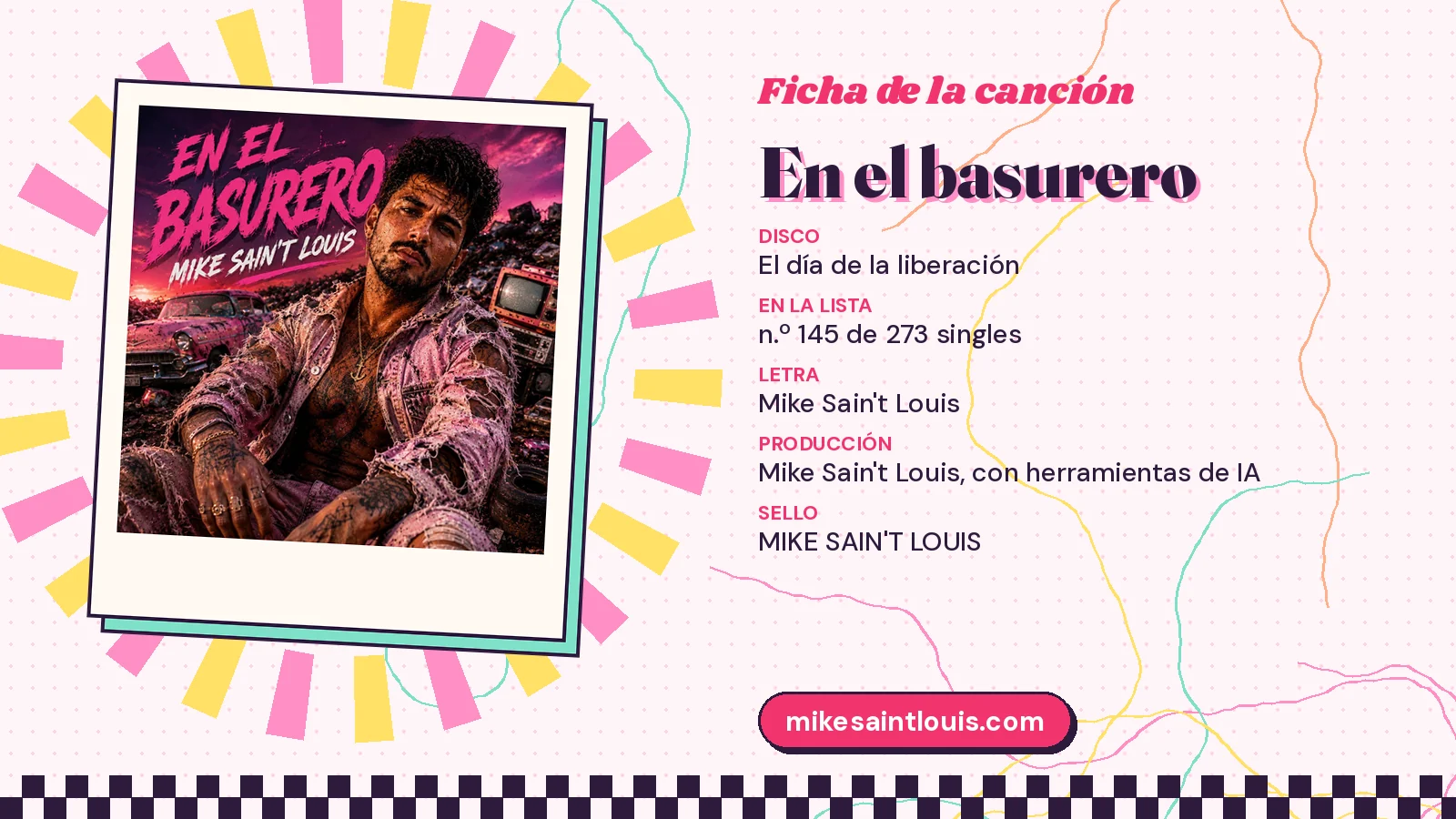
There are places nobody goes for fun. A rubbish dump is one of them. You arrive by lorry, at dawn, with the load already decided: what doesn't work, what broke, what went out of fashion, what someone loved one day and stopped loving the next. That's why the cover of «En el basurero» (At the rubbish dump) makes me smile so much. Because the man in it doesn't look as if he arrived on the lorry. He looks as if he chose the place. He's sitting among mountains of junk the way you'd sit on your own sofa, legs apart, arms loose, eyes fixed on whoever is looking at him.
A warning before we go on: the words of this track haven't been made public yet, and its page on gayfolkplanet.com's lyrics section promises they'll arrive soon. Meanwhile I won't copy or make up a single line of it. I'll stick to what anyone can check: the image, the title, its number in the catalogue and the album it belongs to. That's enough for a long walk among the waste. And I'll tell you now: it isn't a sad walk.
A fuchsia sky over the scrap
The first thing that hits you is the colour. The sky isn't blue or grey, as you'd expect over a wasteland full of rubbish, but a fuchsia that darkens towards purple, with torn clouds and a low, almost spent sun in the left-hand corner. It's the hour when everything looks prettier than it is. The hour of beach wedding photos and film endings. And here it's handed to a dump.
That contrast is the cover's first gesture. Take the ugliest spot in any city, the one hidden behind the motorways that never appears on a postcard, and bathe it in the most flattering light possible. Not to disguise it: the scrap is still there, rusty, piled up, with its cables and casings. But to look at it with different eyes. The light doesn't change what's there. It changes how we see it.
The title, written in big pink letters that look painted with a broad brush, takes up half the image. «En el basurero». It doesn't say "getting out of the dump" or "thrown in the dump". It says "at". A preposition of place, calm, without drama. Like saying "at home", "at the beach", "in bed". Being at the dump, on this cover, is a state. And it's not clear it's a bad one.
A pink jacket in shreds
The protagonist wears a pink jacket that has lived too much. It's frayed everywhere: at the shoulders, the cuffs, the lapels. Threads hang like fringes, there are holes, stains, patches where the fabric barely exists any more. Underneath, a bare tattooed chest, a chain with an anchor, rings on almost every finger and bracelets on his wrists. His face smeared with dust or grease. His hair curly and tousled.
It could look like the portrait of someone something bad has happened to. And maybe it is. But the posture says something else. There's no shame in that body. There's tiredness, perhaps, and a seriousness that commands respect. But also a kind of dirty pride, that of someone who knows he got here with only what he was wearing and that what he's wearing, even torn, is still his.
I'm fascinated that the jacket is pink. Pink was given, generation after generation, the job of marking the soft, the twee, the effeminate. A colour that's supposed to be clean, ironed, new, fresh from the shop window. Here pink appears wrecked and yet loses nothing. On the contrary: it gains. A torn pink has more history than a newly bought one. You can tell it has danced, fallen, been dragged across floors that weren't its own, and that, even so, it's still on someone's shoulders.
Nor does the anchor on the pendant seem accidental to me. An anchor is what stops a boat drifting away. It's an old sailors' symbol, of hope, of staying still when everything pushes you to move. In the middle of a landscape of abandoned things, someone wears around his neck the very object meant to keep you from getting lost.
The pink car nobody came to collect
On the left, behind the protagonist, an old car peeks out with a fifties look, also pink, with a chrome nose, round headlights and bodywork eaten by rust. It's half sunk among the junk, as if the dump were slowly swallowing it.
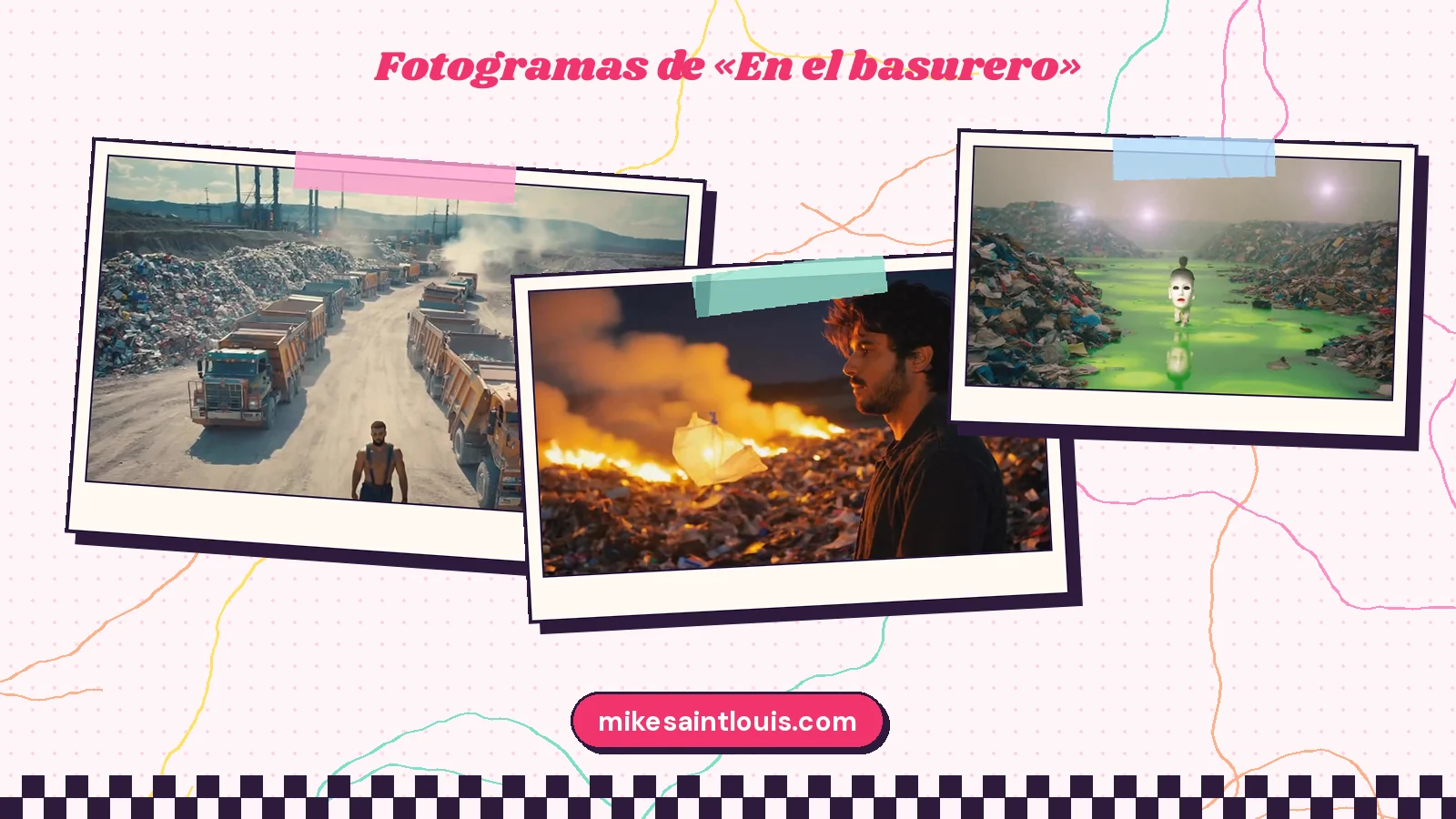
That car carries a weight anyone recognises. The big pink American car of those years is almost an emblem of the dream of prosperity: success you can park at your front door. Elvis Presley gave his mother, Gladys, a pink Cadillac in 1955, and that car ended up as a museum piece at Graceland. An object that went from indulgence to relic.
On the cover, though, the pink car hasn't made it to the museum. It's made it to the dump. It's the same dream, seen a few decades later, when nobody wants it any more, when the paint has peeled and the engine won't start. And I find it a beautiful image of what happens to many promises: what once shone at the front door ends up, sooner or later, on a patch of wasteland. Not because it was false, but because everything ages.
What's interesting is that the protagonist and the car wear the same colour. There's a complicity between them. Both are pink, both are worn, both are there. As if the cover were saying: they threw us both away, and here we still are, colour-coordinated.
The TV that's still on
On the right there's another piece I'm in love with. An old television, the kind with an orange casing and a bulging screen, sitting on a pile of old appliances. And the screen is on. It glows with a white-blue light, as if it were broadcasting something, though you can't see what.
A TV switched on at a dump is an impossible image, because nobody plugged it in, and at the same time a very powerful one. It recalls «WALL·E», the 2008 Pixar film, in which a little robot spends his days compacting rubbish on an abandoned Earth and, at night, watches an old tape of «Hello, Dolly!» over and over. In the middle of the desolation, what keeps him alive is a musical, a song, a dance. Rubbish all around and the sparkle of a show on the screen.
That, for me, is the loveliest idea on the cover. What's been discarded still wants to broadcast. The TV won't give up. It keeps trying to tell something even though nobody is sitting on the sofa in front of it any more. And maybe that's also the condition of many artists: to keep sending a signal from places where nobody expects there to be one.
What gets thrown out and what stays
We all have an intimate relationship with rubbish, even if we don't think about it. Every day we decide what stays and what goes. The empty packaging, the crumpled paper, the T-shirt with the stain that won't come out. Small, almost automatic decisions. But others weigh more. The letters of someone who left. The jumper an ex gave you. The photos you don't want to see and don't dare tear up either.
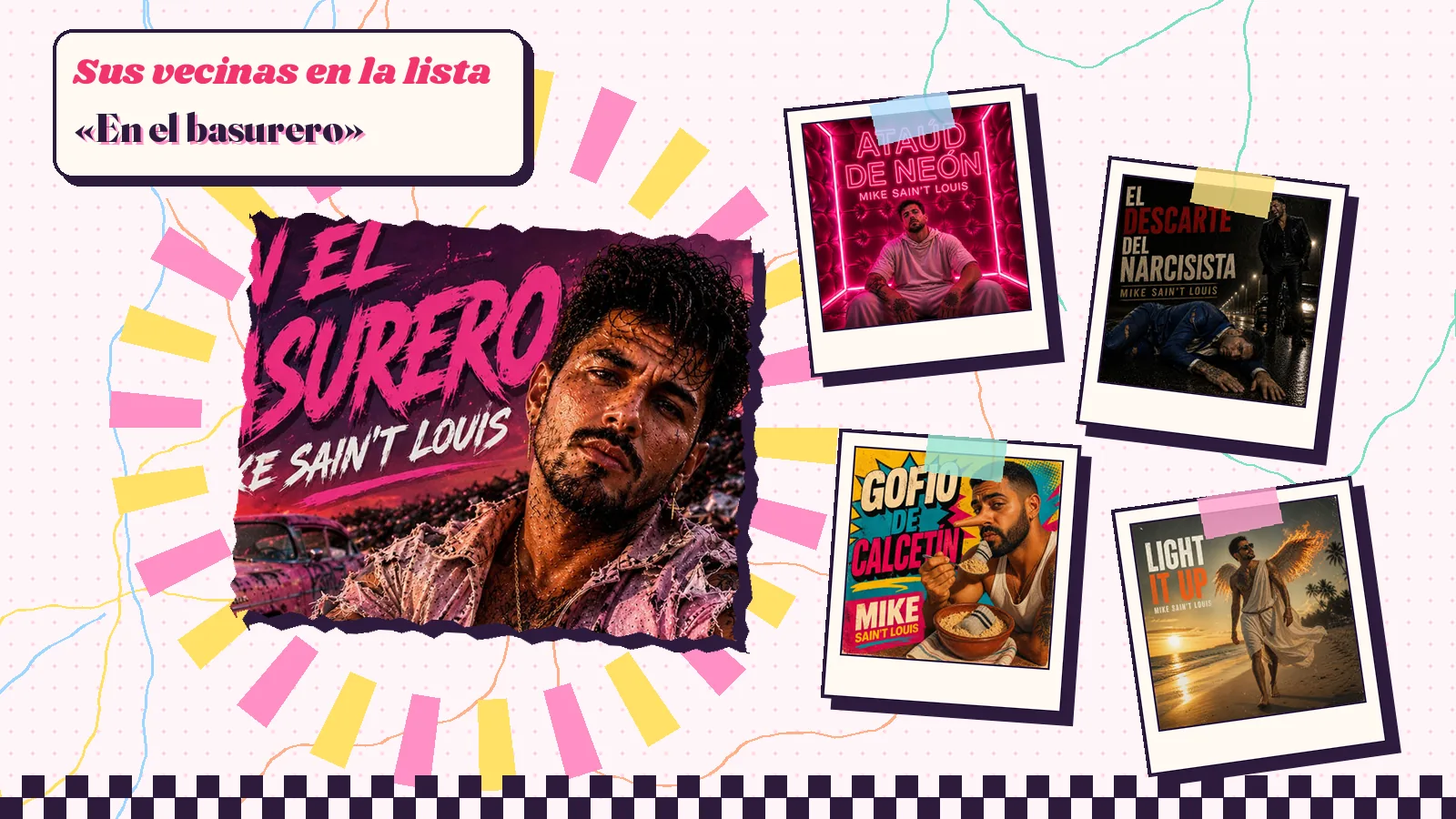
Throwing something away is deciding it's no longer part of your story. That's why some objects are never thrown away, even if they're useless. And that's why others are thrown away in anger, like slamming a door. The dump is where all those decisions go. A mountain of endings.
Seen like that, a landfill is almost an archive. An involuntary archive of what a society has stopped wanting. If someone dug one up a thousand years from now, they'd learn more about us from what we threw away than from what we keep in display cases. Archaeologists know this well: many of the most valuable pieces we have from ancient civilisations came out of their rubbish heaps, their waste pits, the remains nobody thought mattered.
The dump as a place of beauty
I'm not the first to look at rubbish with affection, far from it. There's a whole tradition of artists who have found their raw material in what's discarded. Ramón Gómez de la Serna devoted an entire book in 1914 to El Rastro, Madrid's Sunday flea market where old objects find second lives. He wrote it like someone strolling through a museum without display cases, stopping at each knick-knack as if it held a secret.
Agnès Varda filmed «The Gleaners and I» in 2000, a documentary about people who collect what others leave behind: potatoes rejected for their shape, fruit that never reached the market, furniture abandoned in the street. Varda included herself in the film, filming her own ageing hands, as if saying she too was something time was setting aside. And in 2010 the documentary «Waste Land» followed the Brazilian artist Vik Muniz at Jardim Gramacho, one of the largest landfills in the world, on the outskirts of Rio de Janeiro, where he worked with the waste pickers to turn rubbish into huge portraits. The film was nominated for the Oscar for best documentary.
In all those works there's a shared idea: rubbish isn't the opposite of beauty. It's beauty that has lost its context. A chair at a dump is still a chair. It just needs someone to look at it again.
Trash, camp and the pride of the tacky
Within queer culture, that way of looking has its own name. In 1972 the director John Waters released «Pink Flamingos», a deliberately outrageous film in which Divine competed for the title of "the filthiest person alive". The writer William S. Burroughs went as far as calling Waters "the Pope of Trash", and he adopted the nickname proudly. The tacky, the exaggerated, the tasteless, turned into a flag.
A few years earlier, in 1964, Susan Sontag had published her «Notes on "Camp"», describing a sensibility that delights in the artificial, the excessive, what takes itself so seriously it ends up being fun. On my planet, that exaggeration doesn't decorate: it protects. That's why I also wrote it among funeral neon lights in «Ataúd de neón» (Neon coffin).
The cover of «En el basurero» drinks from both sources. It has camp's excess, with its fuchsia sky and pink everywhere, and it has trash's pride, with its accepted dirt and scrap on full display. But there's no mockery in it. The protagonist isn't posing to laugh at himself. He's posing to say that what others consider rubbish can also be a throne.
When they treat you like rubbish
There's another reading, a harder one, that I don't want to dodge. Many LGTBI people have been made to feel like rubbish at some point. At school, in the family, at work, in a relationship. There are words that stick to your skin like the grease on this cover: dirty, strange, deviant, sick. For a long time, society treated difference as something to be set aside, hidden, removed from view. The way rubbish is set aside.
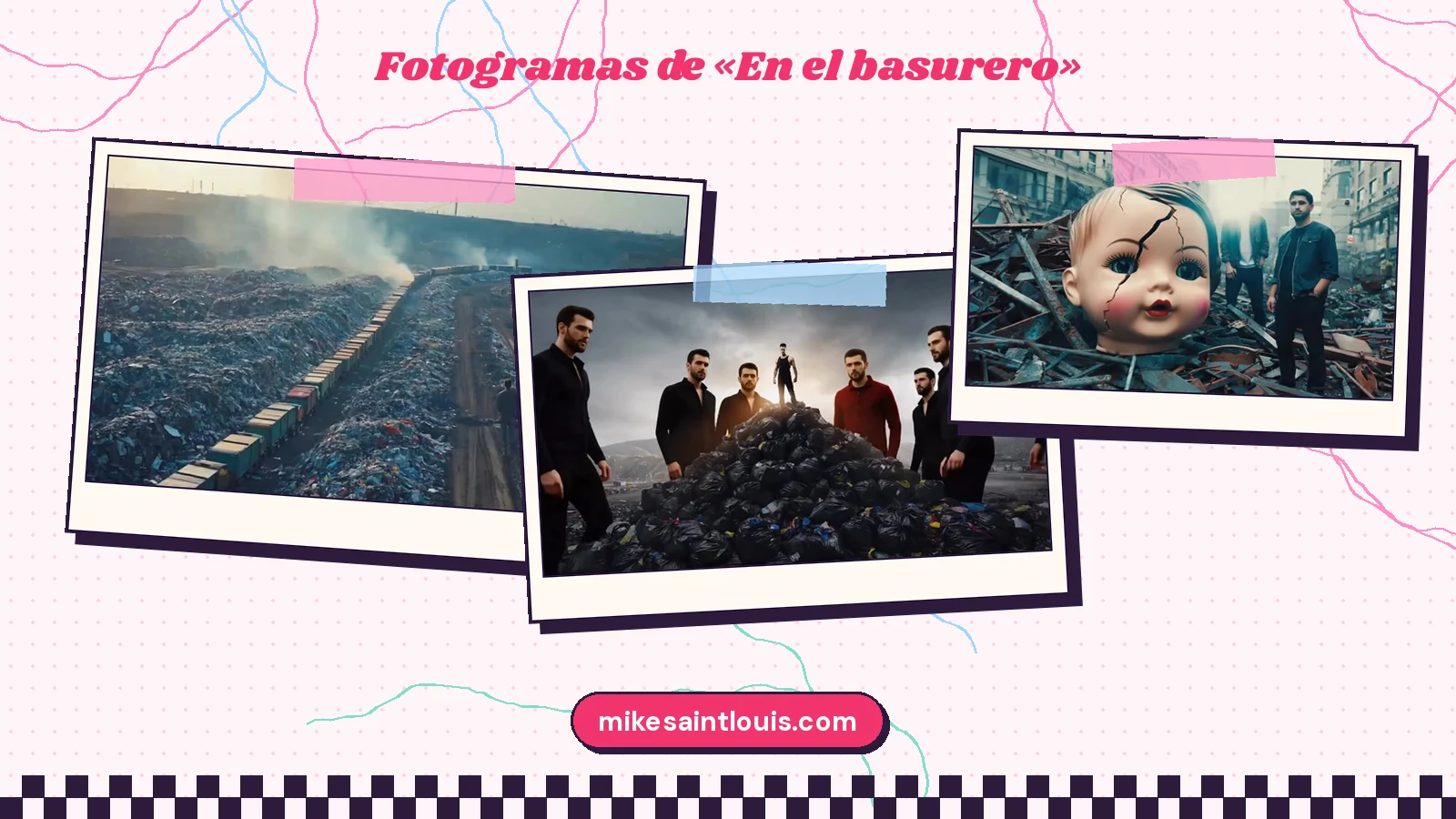
And there are relationships that leave you with that feeling too. I said it bluntly in «El descarte del narcisista» (The narcissist's discard), which has two lines that fit this cover like a jigsaw piece:
Como si hubiera sido el rollo de una noche Que usas o tiras a la basura
(As if it had been a one-night fling / that you use or throw in the bin.) Being discarded like that, with indifference, like a disposable object, leaves a mark. It makes you doubt your worth. It makes you wonder whether you really are what the other person decided you were. And the answer, even if it's hard to reach, is no. The person who threw you away doesn't get the last word on what you're worth.
I love that the man on the cover is sitting and not lying down. That he looks straight ahead. That he wears the torn jacket with the same dignity someone else would wear a tuxedo. If they threw you on the dump, at least let them find you well dressed.
Kintsugi for a pink jacket
In Japan there's a technique called kintsugi that repairs broken ceramics with lacquer mixed with gold powder. Instead of hiding the cracks, it highlights them. The repaired piece doesn't go back to being what it was: it's something else, with its golden scars on show, and it's often considered more valuable than the original.
The jacket on the cover hasn't been repaired. But I think it asks for something similar. It doesn't ask to be thrown away or swapped for a new one. It asks to be looked at whole, rips included. Each loose thread is a memory. Each hole, a night. What would be a flaw in a shop is a CV here.
I like to think we all wear a jacket like that. An invisible garment that has been through too much and that, even so, we keep putting on every morning. It doesn't need to be perfect. It's enough that it's ours.
Between a sock and a light bulb
In the full catalogue, this track sits at number 145 of 273. It's preceded by «Gofio de calcetín» (Sock gofio) and followed by «Light It Up». The sequence has its charm. «Gofio de calcetín» is about an ex who ended up, literally, at sock level, with a chorus that leaves no doubt:
No quiero otro novio cojín, El que tuve quedó a la altura de un calcetín.
(I don't want another cushion boyfriend, / the one I had ended up at the level of a sock.) A sock is exactly what ends up in the old-clothes bin. And after that discarded partner comes the dump, and after the dump, a song whose title asks you to switch the light on. From the sock to the scrap, and from the scrap to the light. If someone asked me to sum up rebuilding yourself after a break-up in three titles, I couldn't do much better.
It belongs to «El día de la liberación» (Liberation Day), the third instalment of my trilogy, and it feels at home there. Freeing yourself is also no longer being afraid of the places they told you that you belonged. If you send me to the dump, I'll sit down, get comfortable and turn the landfill into a film set.
A stage made of waste
There's something very theatrical about this cover. The composition is that of a film poster: the title at the top, the artist's name below, the protagonist in the foreground and the scenery around him, each piece with its role. The car on one side, the TV on the other, the sky as a backdrop. Nothing seems placed at random.
And that makes me think of how many stages have been built with whatever was to hand. The first queer clubs in many cities were basements, warehouses, abandoned premises that someone decorated with a few lights and plenty of will. Many drag acts were born from market-stall dresses, reused wigs and sequins sewn on by hand. The creativity of those without a budget has always been a form of resistance.
In that sense, the dump on the cover is also a tribute. To everything built from leftovers. To every improvised stage. To all the nights when the clothes weren't new but the attitude was. What others throw away becomes scenery here.
My own relationship with the discarded
I write songs from the margins, and I say it without complaint. For a long time, making music with artificial intelligence has been seen by many people as second-rate, not worth listening to. Some dismiss that work with a single word before listening for a minute. I turned it around with humour in a title that needs no explanation, «Tus letras son basura» (Your lyrics are rubbish), and in «Outsider radical», where I claim the place of whoever stands outside.
It doesn't entirely bother me. Many things admired today started out despised. And if my place is the dump, I'll make it the most beautiful dump in the world, with the pinkest sky and the TV always on. What I do is write the lyrics, compose and direct the production; the performances and the music are generated with artificial intelligence. That combination is what lets me tell everything I carry inside. And I won't apologise for the tools.
Music is also, for me, a way of looking after myself, and I talk about it in «La música me está salvando» (Music is saving me). But I also know a song doesn't replace real help, and that sometimes you need more than a pair of headphones.
If you feel like rubbish
If you've ever felt thrown away, discarded or worthless, I want you to know that feeling doesn't tell the truth about you. It says something about what happened to you, about how you were treated, maybe about how tired you are. But it isn't a definition. Nobody is rubbish.
Putting it into words helps: to a friend, to a professional, to someone on the other end of the phone. Anyone in Spain can call 024 at any hour, free and without giving their name; that number exists for crises and also for the nights when everything weighs too much. If there's immediate danger, 112. From another country, the local crisis line or its emergency number. Asking for help isn't giving up. It's the first step out of the dump.
And if what made you feel this way is a relationship, remember you have the right to leave, to talk about it and to rebuild yourself calmly. You don't need a new jacket to start. You can start with the torn one.
A dedication among the junk
For anyone who has felt discarded and decided to stay sitting with their head held high. For anyone who collects objects nobody wants and sees a beauty in them others don't. For anyone who has built a stage with what was at hand. For anyone wearing a torn garment they wouldn't swap for anything in the world.
And for anyone who loves sunsets in ugly places, old cars, tube TVs and colours that match nothing. For those who go to El Rastro on a Sunday with no intention of buying and come back with an impossible knick-knack under their arm.
Until its lines appear, the track plays on Spotify and the rest, and you can download it without paying or signing up from my downloads. The day I publish the lyrics, they'll go up complete and untouched, with all their loose threads.
Frequently asked questions
What is «En el basurero» about? The lyrics aren't published yet, so this post doesn't quote them. What can be read is the cover: a man sitting among scrap in a shredded pink jacket, an old pink car half buried and an old TV switched on under a fuchsia sky. The post reads it as a tribute to what others throw away.
Which album is it on? On «El día de la liberación» (Liberation Day), the third album of the Gayfolk trilogy. It's track 145 of 273 on the singles list, between «Gofio de calcetín» and «Light It Up».
How is it related to «El descarte del narcisista»? Both touch on the feeling of being treated as something disposable. «El descarte del narcisista» says it with explicit lines about the bin; the cover of «En el basurero» answers with an image of dignity among the waste.
What can I do if I feel like this? Talk to someone. In Spain, 024 answers free and confidentially 24 hours a day, and 112 is there in an emergency. Outside Spain, look for your country's crisis line or call the local emergency number.
Where can I listen to it? On Spotify and the other platforms, and it can be downloaded free from mikesaintlouis.com, without signing up or paying.
Who makes this song? Mike Sain't Louis, a lyricist, composer and music producer from Madrid, the first AI songwriter. He writes the lyrics and directs the production; the music and performances are generated with artificial intelligence.