
By Mike Sain't Louis ·
The song where I didn't allow myself a single joke: «Forocoches» and the phone in my hand
Look through my lyrics for a Mercadona, a SHEIN, a Carmina Barrios, a Veneno. You won't find them in this one.
I've written about croquetas on a cruise that looked like a funeral parlour on the high seas. I've written about the queer Shakira of the pound shop. I've called a fair few exes every name under the sun, complete with postcode. I have a well-earned reputation for never managing to keep a joke in my mouth. And even so, in the middle of the third album of the trilogy, «El día de la liberación», there's a song named after an internet forum in which I didn't allow myself a single laugh.
It's called «Forocoches» and it has no jokes. Well, one. A tiny one. We'll get there.
This piece is about that decision. About why sometimes humour, which nearly always saves me, is surplus to requirements. And about what I did with the darkest lines I've ever put in a lyric.
The title lies, and I know it
I can picture the face of someone seeing the title on the singles list for the first time. Forocoches. You think of a thread of blokes arguing about diesel engines, of the put-downs, of the crude humour of Spain's most notorious forum, its memes and its spite. You expect a piss-take. You expect me to be laughing at someone.
And what you find is a person at two in the morning crying with a phone in their hand.
I left it that way because that trap was exactly what interested me. The forum appears only once in the entire lyric, in the line that gives it its title, and it appears as a comparison, not a subject. What the song tells has nothing to do with cars. It has to do with what happens when your own head turns into a comment thread where everyone is insulting you and the loudest one shouting is you.
That's the first quote I want to leave here, because it's the key to everything:
«Me he despertado entre treinta insultos y reproches / Ya no distingo si es mi vida o forocoches» («I woke up among thirty insults and reproaches / I can't tell any more if it's my life or Forocoches»)
Thirty. Not many, not loads. Thirty. It's the number of notifications you see when you switch on the screen in the morning, or the number of things you tell yourself before your feet touch the floor. I don't know which reading is the right one and I like not knowing. Maybe they're messages from him. Maybe they're your own thoughts. Maybe, at that hour, there's no difference.
Why there was no room for outrage here
When I write about something that hurts, my instinct is to find the absurd angle straight away. It's a survival tactic: if I turn the ex into a deodorant or the narcissist into a B-movie vampire, I can look at it without getting burned. That mechanism runs through nearly my whole catalogue, and I stand by it, because you can tell the truth with humour too. It's written on my about page, among the house rules.
But there's a kind of night when the joke doesn't come. Not because you don't want it, but because there's no energy even for that. It's the night when humour would be a lie. And if I'd slipped in a reference to Locomía or a dig with someone's name on it, I'd have been writing to look good, so people would laugh and not notice how bad a way the person in the song was in.
So I banned the funny. It was a conscious decision, one of the few times I've written with a rule set in advance. No brands, no celebrities, no creative insults. Only what's in the room.
And there's very little in the room: an empty bottle, a phone, some photos.
That had to be enough.
Inventory of a dark room
I love a list. In other songs the lists are long and absurd, five specific things that don't belong together. Here the list is short and there's nothing absurd about it. The lyrics lay objects on the table one by one, like someone emptying their pockets when they get home.

An empty bottle of yaguer in the bin. I spelt it like that, the way it's pronounced in a Madrid bar, not the way it's printed on the Jägermeister label. Because nobody says the proper German name at four in the morning. It's yaguer and that's that.
His Instagram, open. Not his face, not his home, not his smell. His profile. Which is all that's left of a person once you can't call them any more: a grid of photos someone else keeps updating.
The messages, which get sent. And the war the next day.
The photos, again. The ones looked at on a loop in the chorus.
And the psychologist. She isn't in the room, but her sentence is.
There's nothing else. No friends ringing, no mum asking, no dog jumping on the bed. It's an empty room with five things in it, and that emptiness is what I wanted you to feel.
The phone is the other lead
If you asked me who the main character of «Forocoches» is, I'd say the phone. More than the person crying, more than the ex, who barely appears. The phone is in charge.
I wrote it in a line that still strikes me as one of the most honest I have:
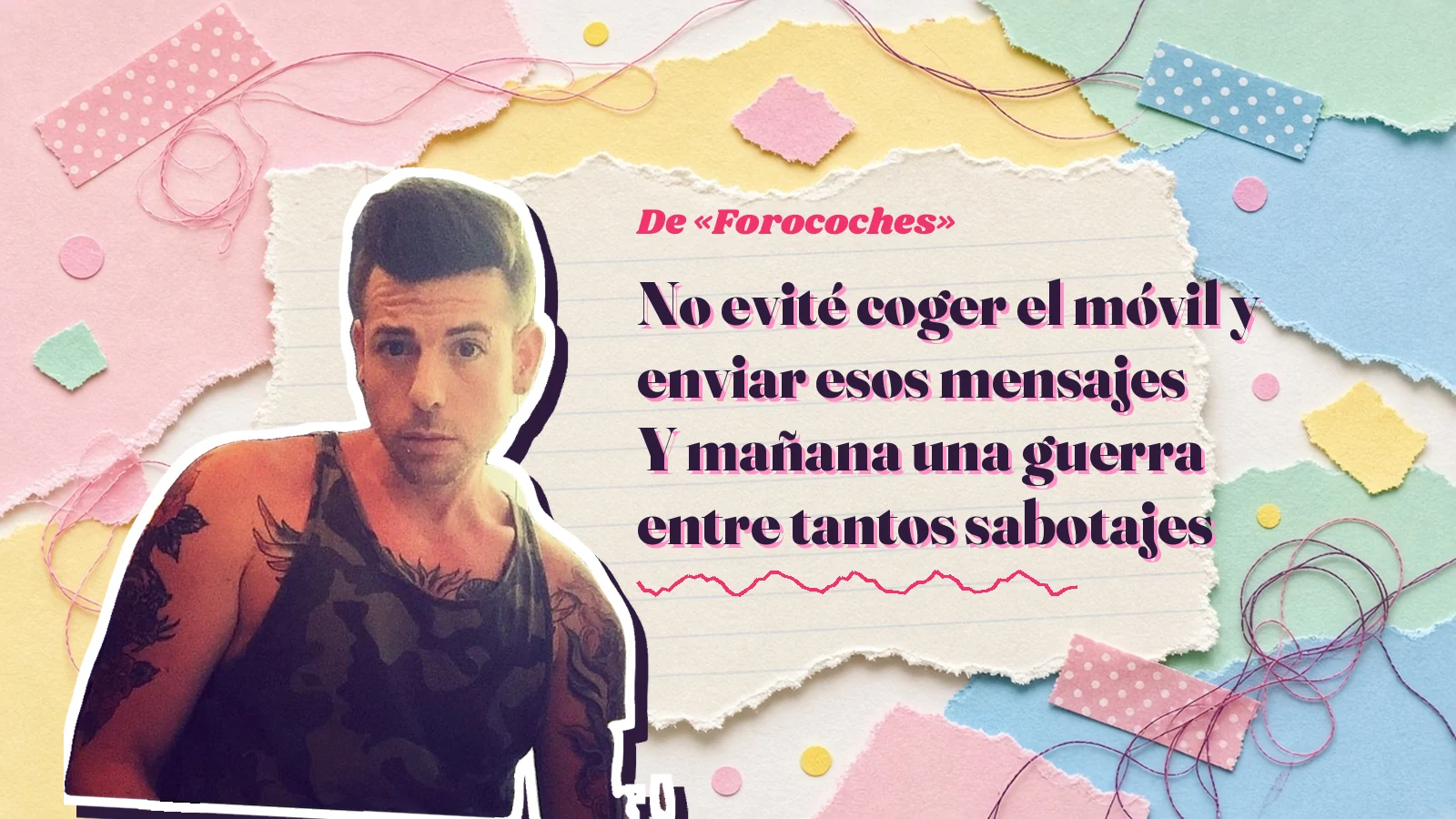
«No evité coger el móvil y enviar esos mensajes / Y mañana una guerra entre tantos sabotajes» («I didn't stop myself picking up the phone and sending those messages / And tomorrow a war among so many sabotages»)
Look at the verb. It doesn't say «I picked up the phone». It says «I didn't stop myself». As if picking up the phone were the natural thing, gravity, what happens unless you make an enormous effort to prevent it. And that effort, that night, never came. There was no strength left to stop it.
Anyone who's been through a break-up knows what I mean. Three a.m. messages don't get written: they escape. And the next day you wake up in a mix of shame and terror, open the app with one eye shut and see what you sent. And the reply. Or worse, the two blue ticks and no reply.
The war of sabotages is exactly that. You sabotage your own calm by sending what you shouldn't, he sabotages whatever's left by replying with venom or with silence, and in the end you don't know who started it. It's a spiral. And I, who have written so much about narcissists who punish with silence, put myself on the other side of the mirror here: the person who can't stop typing.
That, by the way, is the opposite of what I tell in songs like «No contact», which spells out the rule in its very title. The beauty of having so many songs is that I can show both the rule and the night you break it.
The psychologist and the gym
I told you there was a tiny joke. Here it is.
«La psicóloga me dijo que empezara a hacer deporte / Pero estoy sin fuerzas, he perdido el norte» («My psychologist told me to start doing some exercise / But I've got no strength left, I've lost my bearings»)
I didn't write it as a joke. But every time I hear it I smile a little, and I think plenty of people do the same. Because it's the most sensible advice in the world and, at the same time, the most impossible to follow in certain weeks. Go for a run. Join a gym. Do yoga. Oh, of course. And then I'll do my tax return and change the curtains.
I'm not mocking the psychologist, mind. Quite the opposite. I put her in the song because in that empty room she's the only figure trying to help. The only sensible one. The problem isn't her advice; it's that it reaches someone who can't even get out of bed to go to the loo.
That gap between what you know you ought to do and what you're able to do is, for me, the heart of break-up depression. You're not short of information. You know perfectly well that exercise helps, that the phone should live in another room, that you mustn't look at the photos. You know it all. And you can't manage any of it.
If that isn't black humour, it's a close relative.
What we might have been
The chorus keeps going back to the same image: looking at the photos, getting lost in them, imagining what might have happened. And it closes with a question that has no answer:
«Ya no soy nada para ti, ¿qué hubieramos sido?» («I'm nothing to you any more, what might we have been?»)
I left it with its missing accent, just as it appears on the lyrics page, because that's how I wrote it and that's how it stayed. My lyrics have typos and I don't correct them to look posher.
That question is the heaviest thing in the whole song. What we might have been. The conditional perfect, the tense of lives that never happened. A tense that doesn't exist and yet takes up more room in your head than the present. You picture the home you won't have, the holidays you won't take, the Christmases with his family that aren't yours any more. You build an entire flat in mid-air and then it hurts that it isn't real.
And the first half, being nothing to him, is drier still. It doesn't say «you don't love me any more». It says I'm nothing now. Zero. Not a fond memory, not a grudge. Nothing. It's the feeling of having been erased.
There's no funny rhyme that fixes that.
The darkest lines
Here I have to stop and talk seriously, properly seriously, because the lyrics have a moment that frightens.
In the second verse, after the strength runs out, the lyrics name a thought a lot of people have on those nights and almost nobody says out loud: the thought of not being here. Of thinking about your family if you died. I wrote it plainly, no metaphor, no vampires or neon coffins, which is how I usually dress up death in other songs.
I won't quote it in full here, because it's in the lyrics for anyone who wants to read it, and because in this piece I'd rather be the one explaining it than leave the line on its own, without context.
I put it in because that thought really does exist in bad break-ups. Because keeping quiet about it doesn't make it go away. And because there are countless heartbreak songs about crying and missing someone, but very few about that, and anyone living through it can feel even stranger listening to them. As if what they feel were an exaggeration. As if they were the only one.
You're not the only one. If you're there, on that night, please talk to someone. In Spain you can call 024, the suicide prevention line, which is free and open around the clock. If you're outside Spain, call your local emergency number. You can also talk to your doctor, to someone you trust or to a professional. A song keeps you company, but it doesn't replace anyone. I'm saying it here in so many words because that's the only moral I want to leave in this post.
That line in the song also ends with two letters stuck together, an I and an A, which are in the lyrics exactly like that. I won't explain more than the lyrics explain. I'll leave them there.
The song's clock
The song opens with one hour and moves on to another. Seven in the evening, when the day is finally over. Two in the morning, still awake.

That «finally» fascinates me. Seven in the evening arrives like relief: the working day is done, you don't have to pretend in front of anyone. But the relief doesn't last, because with the night come the cold sweats and the melancholy. The day was awful, but at least it had obligations to distract you. The night has nothing. The night is you alone with your phone.
It's a clock anyone with anxiety knows. In the morning you struggle to get going, by mid-afternoon you're nearly fine, and when the sun goes down the slide begins. In «Ruido en mi mente» I write about the noise that won't switch off; here the noise keeps office hours.
What the song doesn't have is a dawn. There's no next-morning verse where the sun comes out and everything's better. Well, there's waking up among thirty insults, but that's anything but a pretty sunrise. I left it like that on purpose. I didn't want to lie with a happy ending the song hadn't earned.
Repeat it till it wears thin
The chorus repeats many times. If you read the full lyrics you'll see the photos, the loss and the question keep coming back, sometimes twice in a row. Some people think that's padding.
It isn't. It's the loop.
When you're like that, your head doesn't move forward. It goes round in circles. You think the same thing twenty times over, look at the same photos twenty times over, ask yourself the same question twenty times over. And if the song moved forward, if each chorus brought something new, it would be lying about how that night works. The repetition is the portrait.
I do something similar in other lyrics, but with a different aim. In party songs I repeat so the chorus sticks and you dance to it. Here I repeat so you wear out a little, the way the person crying wears out. Same tool, two opposite jobs.
An almost invisible ex
There's another odd thing about this song compared with the rest of what I write: the ex has no face.

In my lyrics, exes usually come with a full file. They have a home village and a declared age that never matches the real one. They have quirks, a job with a middle-management title, even the brand of swimming trunks they took with them when they left. I describe them in such detail it sometimes looks like I'm filling in a police form. And here, nothing. There's a «you» who has Instagram, who gets messages and who no longer thinks you're anything. Full stop. We don't know his name, what he does, or what he did wrong.
That was deliberate too. When you're at the bottom of the well, the other person stops being someone with specific flaws and becomes an absence. You don't think any more about how tedious he was about football or how he left wet towels on the floor. You think about the hole. And a hole has no features.
In my angry songs I need the ex sharply defined, because anger needs a target. This one has no anger. It has grief. And grief doesn't aim at anyone; it stays inside.
I didn't want to hand out blame either. The lyrics admit there have been screw-ups, that the sorrows have been too many and there's no going back. They don't say whose screw-ups they were. I like leaving that hanging, because in real break-ups it's almost never as clear as in songs. There are textbook narcissists, and I have a whole repertoire about them, but there are also stories that simply break and break you along with them, with no villain to point at.
This is one of the second kind. Or that's how it looks from inside that room, at two in the morning, which is the worst possible place to judge anything.
So when someone asks me who «Forocoches» is aimed at, I say nobody. It's aimed with somebody. With whoever is listening to it in the dark.
Where I put it, and in what company
«Forocoches» is on the third album of the trilogy, called «El día de la liberación», «Liberation Day». The album title says plenty: it's the part of the story where you get out of something. And it felt important that an album about breaking free should also have a song reminding you what it costs. Liberation isn't a party with confetti. It has nights like this one.
So if you listen to it, I'd suggest doing it alongside a couple of songs that keep it company. «La música me está salvando», «Music is saving me», is almost the reply to this one: the same wreckage, but with something to hold on to. And «Sing me a sad song» is about the very thing I do here: writing a sad song to hold yourself up when you fall apart.
You'll find the full lyrics on the song's page, with the link to listen. And the lyrics page has all the others, in case after this one you need a laugh, because I've got plenty of those too. Loads.
What writing it without jokes taught me
Writing without jokes scared me. I thought the song would fall flat, that without my usual tricks it wouldn't have any personality. That people would miss the croquetas Mike.
And then I realised personality isn't in the joke. It's in the details. In spelling yaguer with a y. In «I didn't stop myself» instead of «I picked up». In the psychologist and the exercise. In leaving the missing accent. In the forum appearing only once. In not giving it a dawn.
They're small decisions, but they're mine. The same ones I make when I write something cheeky, except here there's no laughter to hide them.
The lyrics are mine, written without AI. I made the music and the vocals with artificial intelligence tools such as Suno, like the rest of the catalogue, and I explain that in the FAQ. But every word in this empty room I put there myself, one night, with the phone face down.
Or not. Maybe face up. I don't remember any more.
What I do know is that if you listen to it on one of those nights, don't put it on repeat. Play it once, let it do its job, then change the record. Your head already does the looping, and it doesn't need help from anyone, least of all me.
Frequently asked questions
Is the song «Forocoches» about the forum? Only in passing. The forum appears in the line that gives the song its title, as a comparison: waking up among thirty insults and reproaches and not being able to tell if it's your life or a forum thread. The song is about a break-up and a very bad night.
Which album is «Forocoches» on? «El día de la liberación», the third album of Mike Sain't Louis's Planeta Gayfolk trilogy.
Who makes the music and the vocals? The lyrics are by Mike Sain't Louis, a lyricist, composer and music producer from Madrid, written without AI. The music and the vocals are made with artificial intelligence tools such as Suno.
What should I do if I recognise myself in the darkest thoughts in the lyrics? Talk to someone. In Spain, 024 is the free suicide prevention line and it's open around the clock; if you're outside Spain, call your local emergency number. You can also go to your doctor, a mental health professional or someone you trust.