By Mike Sain't Louis ·
Upholstered cages: the neon coffin and the luxury that locks you in
Pink buttoned leather.
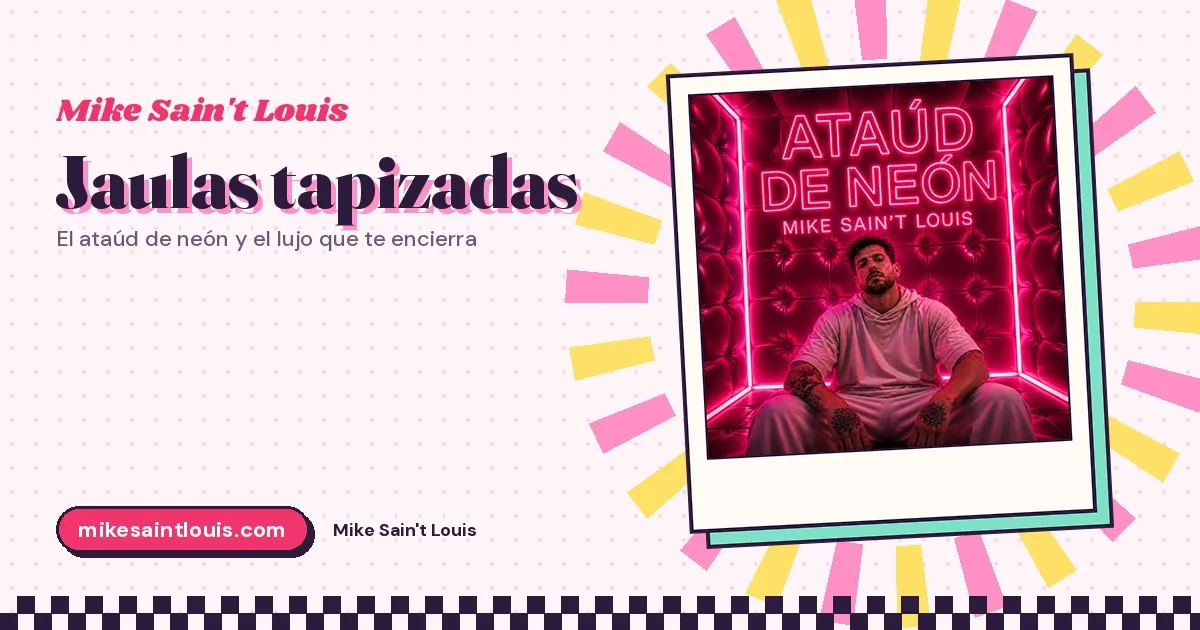
That quilted, buttoned padding you find on the Chesterfield sofas in lawyers' offices, on five-star hotel headboards and on the luxury coffins in the funeral parlours of American TV series. That soft hide, sunk into diamonds, inviting you to lean back. Now picture an entire box upholstered like that, in pink, with fuchsia neon tubes along the edges. And inside, sitting, a boy in a pale hoodie, legs apart, tattooed hands on his knees.
That's the cover of «Ataúd de neón», «Neon coffin». And that, to me, is what some of the most dangerous relationships I know look like: pretty on the inside, lit up like a shop window, and no handle to get out.
What I won't spoil
Before I go on, an honest disclaimer. The lyrics of this song aren't published yet in the Lyrics section, so I won't quote them or tell you what happens in them. That would be cheating. On the song's page I left everyone free to read it their own way, and I'm sticking to that.
What I will talk about is the image. The title. What two words that shouldn't go together suggest to me. And how that image links up with things I have written and published, because in my head everything is connected, like a detective's pinboard with drawing pins and red wool.
Two words that fight
Coffin. Neon.
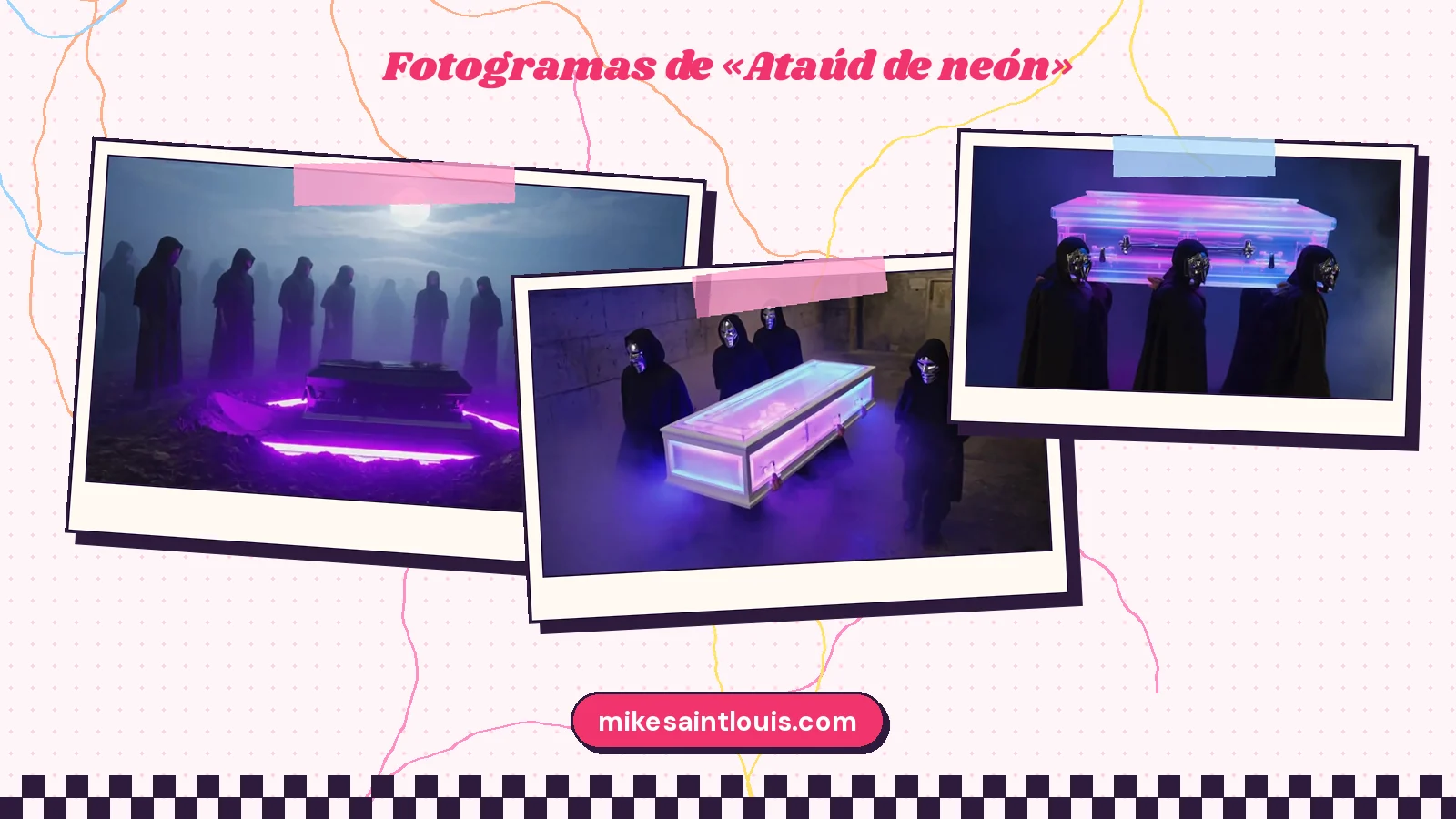
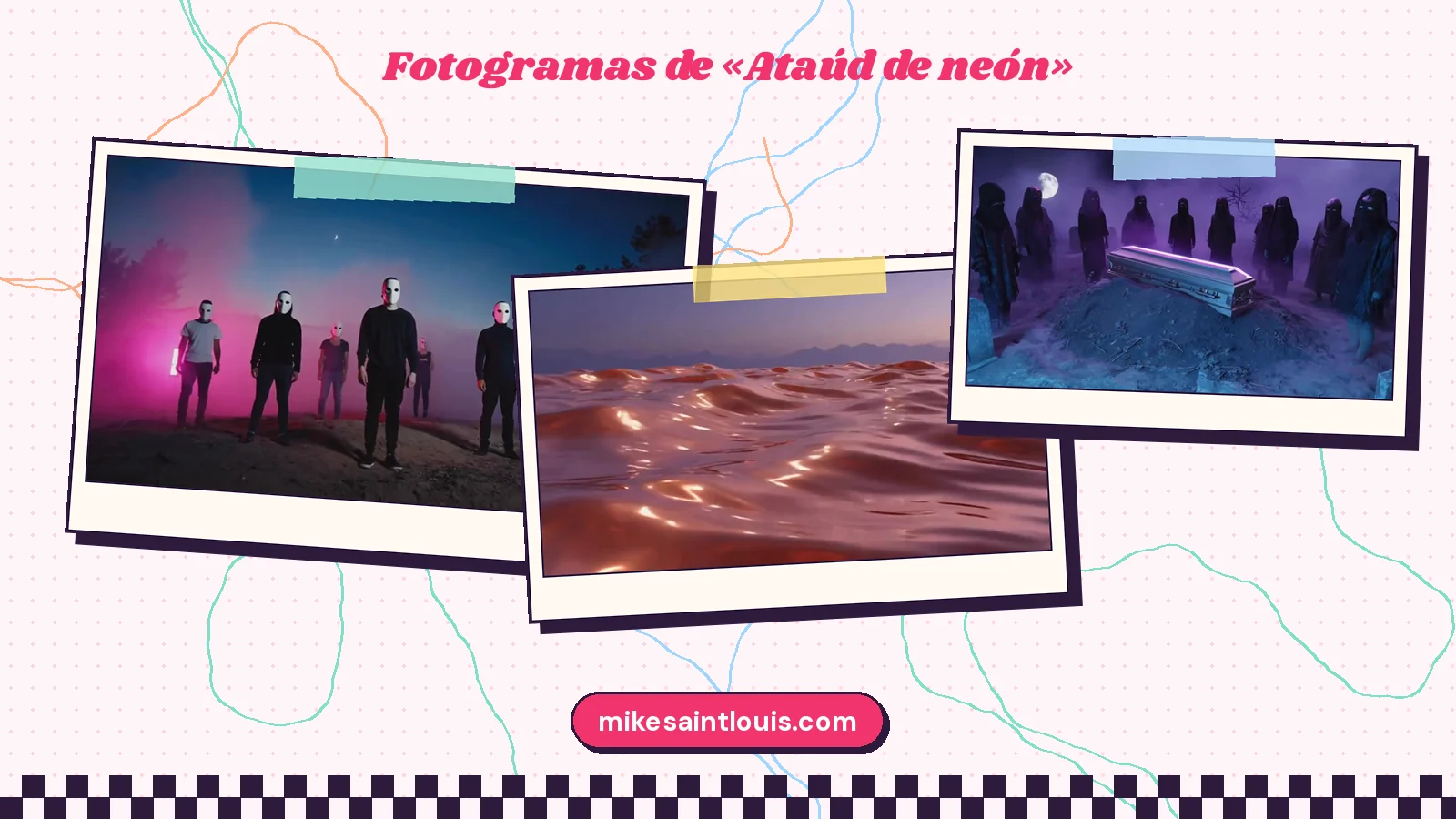
The first is the end of everything. Silence, wood, earth, a queue of people in black at a funeral home off the M-40 ring road with a coffee machine that doesn't work. The second is the night. A nightclub sign, the all-night chemist, the bar of a Chueca pub at three in the morning, the signs in Benidorm that light up when the sun goes down.
Putting them together is outrageous. Which is exactly why I love them. It's what I always do: take something solemn and hang fairground lights on it. A requiem that ends with a neighbour screaming, a cruise that looks like a funeral parlour, a funeral in sunglasses. The macabre and the tacky are two cousins who get on famously, even if the family won't seat them together at the wedding.
In Camp isn't a joke, even if you laugh I explained why I take excess seriously. This title is pure excess. If the day comes to say goodbye, let it at least be well upholstered.
But there's something more under the joke.
A gorgeous place you don't leave
Look at how the boy on the cover is sitting. He isn't lying down, like a corpse. He's sitting. Eyes half closed, calm, almost comfortable. Like someone in a club's VIP booth waiting for the bottle to arrive.
That's what unsettles me. He doesn't look like he wants to get out.
There are places like that. Pretty, warm, well lit. Places where they treat you well at first, where everything is designed to make you feel special. And one day you realise there's no door. That the padded walls aren't there for your comfort: they're there so you don't hurt yourself when you start hitting them.
An asylum cell is padded too. Just in white.
Luxury as a lock
Let me bring this down to earth, or I'll go all poetic and lose myself.
Some relationships lock you in with money. With presents, weekends in Ibiza, dinners in places where the waiter lays the napkin on your lap. With a lovely flat in a neighbourhood you could never afford on your own. With the clothes he buys you, the perfumes, the watch. All of that is buttoned leather. Soft, expensive, nice to the touch. And every button in the padding is a thread tying you a little tighter.
I'm not saying people with money are bad. I'm saying luxury can be a lock. That when someone gives you everything, they can also take everything away. And that sometimes that's exactly what they want: for you to know they can take it away.
In one of my most savage lyrics I said it with a line that still makes me laugh and shiver at the same time:
«Ahora es un bloque de cemento. Si tienes pasta podrás mantenerlo.» («Now he's a block of cement. If you've got the cash you'll keep him running.»)
That's from «El castigo más duro». In that one, the hot dark-haired boy turns out to be a hologram, and when you stop paying for him he turns into cement. It's a joke out of cheap sci-fi. But what it says is serious: some loves only exist for as long as you pay. In money, in patience, in silence, in self-esteem.
The neon coffin is that hologram seen from the inside. Gorgeous while it's switched on.
Shop-window lights
The neon interests me for another reason too: neon belongs to shop windows. It's the light of things on display.
Shops use it so you look. Bars, so you come in. Clubs, so you stay. It's a light that sells. And some relationships are shop windows too. They work for the outside. For the Instagram photos, for dinner with friends, for your cousin's wedding. Everyone sees how good you are together, how gorgeous you look, how much you love each other. And inside the box, sitting with his eyes half closed, one of the two is going out like a light.
I've seen it a lot on the scene, and not only on the scene. The perfect couple online who don't speak at home. The boyfriend who shows you off to everyone like a trophy and then treats you like furniture. The shop window full of light and the back room in darkness.
Neon doesn't shine inwards. It shines outwards. That's why the boy on the cover has his eyes half closed: the light isn't for him.
Hope turned into salt
There's a line of mine that always comes back to me when I think about these gorgeous boxes.
«Te alimentas de esperanza y la conviertes en sal» («You feed on hope and turn it into salt»)
It's from «Como en la matanza de Texas», the emotional-vampire one. There I was writing about someone who eats your will to live and hands you back tears. Salt is what's left when the water evaporates. What's left when you've cried a lot.
The neon coffin, to me, is the place where that happens. You go in full of hope, because everything's pretty, because the light is pink, because the leather is soft. And little by little, without noticing, the hope dries up. You stay sitting, calm, eyes half closed. Salted on the inside.
And the most twisted part is that from the outside you look fine. Comfortable, even. Lucky, even. Look what a lovely coffin he's got.
Sitting, not lying
Back to the posture, because it's the key.
If the boy were lying down, he'd be dead. End of story. A macabre image and that's that. But he's sitting, and that means he's alive. That he got in himself. Or that he was put in, but is still conscious.
People who live inside a neon coffin aren't dead. They're on pause. They still go to work, still see their friends, still smile in photos. But part of them has sat down in that box and isn't getting up.
I've written it a thousand ways, to be honest. Half my catalogue is about narcissists, punishments, silences that last for weeks. But this image sums it up better than plenty of my lyrics: the problem isn't that they kill you. It's that they make you comfortable.
They give you a cushion. They dim the lights. They tell you you're fine in there.
Legs apart
There's another detail on the cover that amuses me and that I don't want to skip. The legs apart. Hands on the knees. The pose of a lad from the estate on a park bench, on the metro, outside the school gates.
That pose is very macho. Taking up space. And it's inside a padded pink coffin with fuchsia neon. It's like putting a bouncer from Tetuán in Rocío Jurado's dressing room.
I love that collision. Because it says the coffin doesn't distinguish between weak and strong. Anyone can end up sitting in there. The cockiest, the most tattooed, the one who acts like nobody can touch him. The pink box doesn't discriminate.
And it also says something about how we lock ourselves in. With our pose. With our nothing-to-see-here. With our legs spread so nobody notices we're trapped.
Burying the other one, not yourself
Now let me flip it, because not everything in my work is about being shut in. There are plenty of burials too where the one left in the box is the other guy.
«Hoy te he olvidado y te he enterrado» («Today I've forgotten you and I've buried you»)
I wrote that in «La casa de los mil cadáveres», right before comparing myself to Pepi Valladares. There, the coffin is revenge. A way of saying: it's over, into the ground with you, let the worms have you and let them carve on your headstone what you deserve.
I like to think there are two coffins in my universe. The neon one, the pretty one, where you get locked in. And the pine one, the real one, where you finally put whoever was locking you in. And that getting from one to the other is what I tell in lots of my songs. Climbing out of the pink box to put the one who put you there into the wooden one.
I don't know whether this song is about that. I've told you I won't spoil it. But if you ask me which coffin I prefer, the neon one is prettier and the pine one is fairer.
The night as a funeral parlour
There's one more reading of the title that keeps nagging at me, and it's about the night.
Neon is the night. And for a lot of people of my generation, the night has been both party and funeral. The bars where we were free for the first time and the bars where some of us stayed for good. Dawns spent dancing and dawns spent not knowing how to get home. The club as refuge and as trap.
I won't name names or tell stories that aren't mine. But anyone who's gone out a lot in Madrid knows what I mean. Some people walked into the night as if into a box of pink light and never came out. They stayed sitting, eyes half closed, while the neon kept flickering. Because of drugs, loneliness, a boyfriend, all of it at once.
The neon coffin can be that too. A dance floor that never ends. A party that turns into a cell.
And that's where the joke ends.
Five pretty boxes I know
So this doesn't stay a metaphor, here's a list. Five neon coffins anyone who's been around the scene a bit will recognise, no names, no surnames. If you see yourself in one, don't worry: it's not an accusation, it's an inventory. I recognised myself reading it back, and I wrote it, which is a crime in itself.
The Malasaña flat with exposed wooden beams and a terrace, paid for by him, where you can't invite your friends because he doesn't like them. Gorgeous. Afternoon light pouring in through the balcony. And you lonelier inside it by the day.
The WhatsApp group of the perfect couple, with three hundred brunch photos, where nobody knows you've been sleeping in separate rooms for a fortnight. Pure shop-window light.
The club's VIP booth, with a pricey bottle of gin and diamond-shaped ice cubes, where you can't move because he wants everyone to see you're with him. Buttoned sofa and red rope at the entrance.
The built-in wardrobe in a village house, smelling of mothballs and Granny's mink coats, where so many of us spent years hidden without it feeling ugly. It was warm. It was ours. And it was a box.
And the cruise. You know I have a song about croquetas on the cruise where I wonder whether that was a ship or a funeral parlour on the high seas. A place full of lights, all-you-can-eat buffets and shows, surrounded by water on every side. There's no bigger coffin, and none with more neon.
Five boxes. All pretty. None with a handle on the inside.
Funerals in sunglasses
If you like your burials with style, there's another in my discography. On the cover of «Franco ha muerto» I appear in black from head to toe, sunglasses on and a black rose in hand, in front of a casket covered in white flowers. There the coffin belongs to someone else, and the mourning is more pose than grief.
I like putting the two covers side by side. In one, the boy is inside the box, sitting, still. In the other, someone else is in the box and I'm outside, posing. It's almost a sequence: first they lock you in, then you do the burying.
And between the two, life. Which is what I tell in almost everything I write. If you want to know what kind of creature puts you in the pink box, I have a whole page devoted to the emotional vampire. Spoiler: he doesn't have plastic fangs. He has excellent taste in upholstery.
An album called liberation
The song is on «El día de la liberación», the third album of the trilogy. And that feels very meaningful to me, because it's an album about getting out. Of closets, of relationships, of fears.
To get out of somewhere, first you have to know you're inside. And that's the hardest part when the place is beautiful. When it has pink buttoned leather and nightclub lighting. Nobody wants to escape from a gorgeous place. Until you realise it's a box.
That's why I like it being on that album. It's the before picture. The photo of the upholstered cage before the liberation. Like those before-and-after shots on home makeover shows, except here the before is luxurious and the after is the street, open sky, no cushions.
Between Barcelona and another pandemic
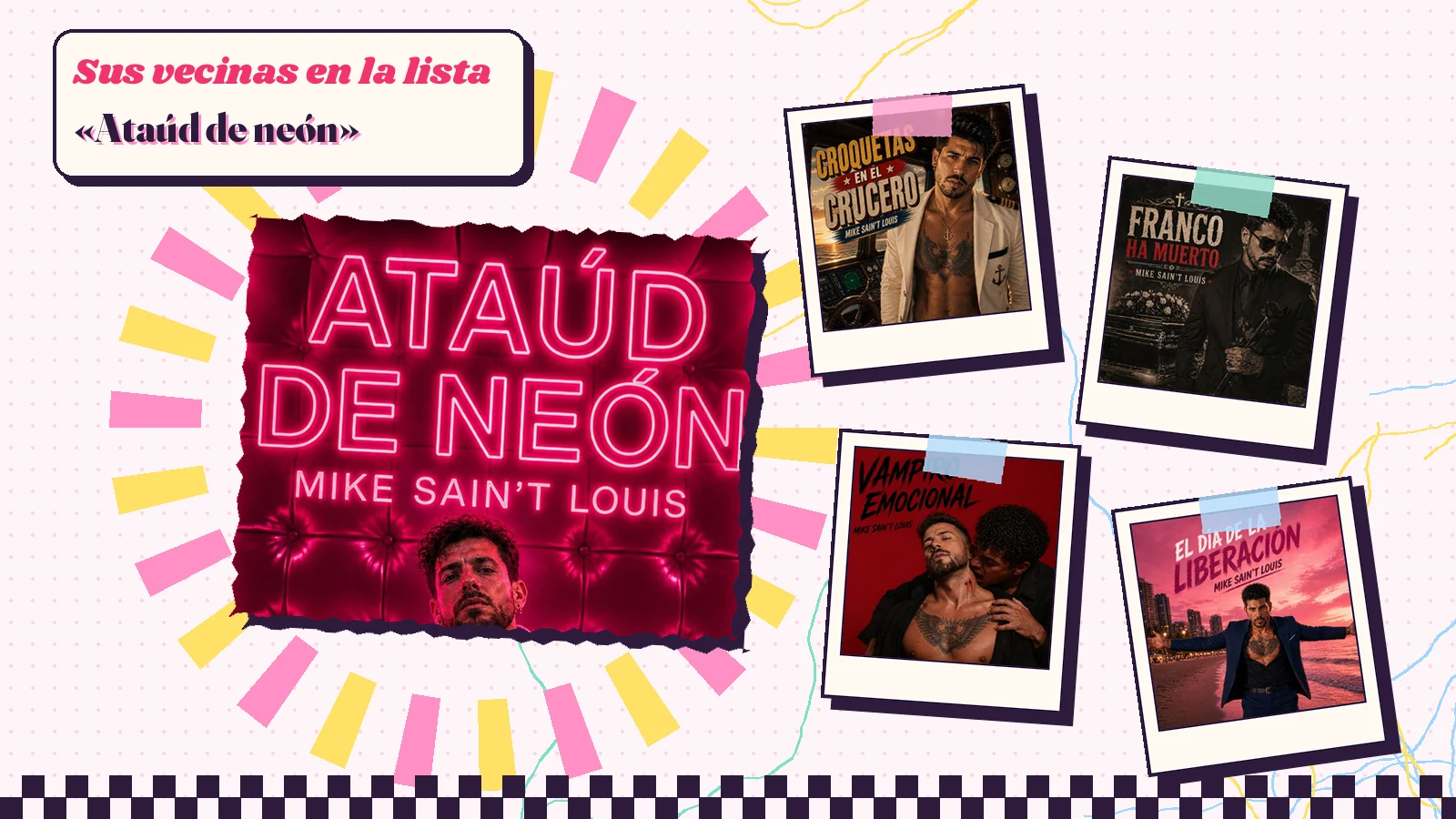
In the site's discography, the song has landed between «Barcelona» and «Otra pandemia», «Another pandemic». That neighbourhood cracks me up. First a city, then a coffin, then a plague. It reads like the line-up of the Sitges horror film festival.
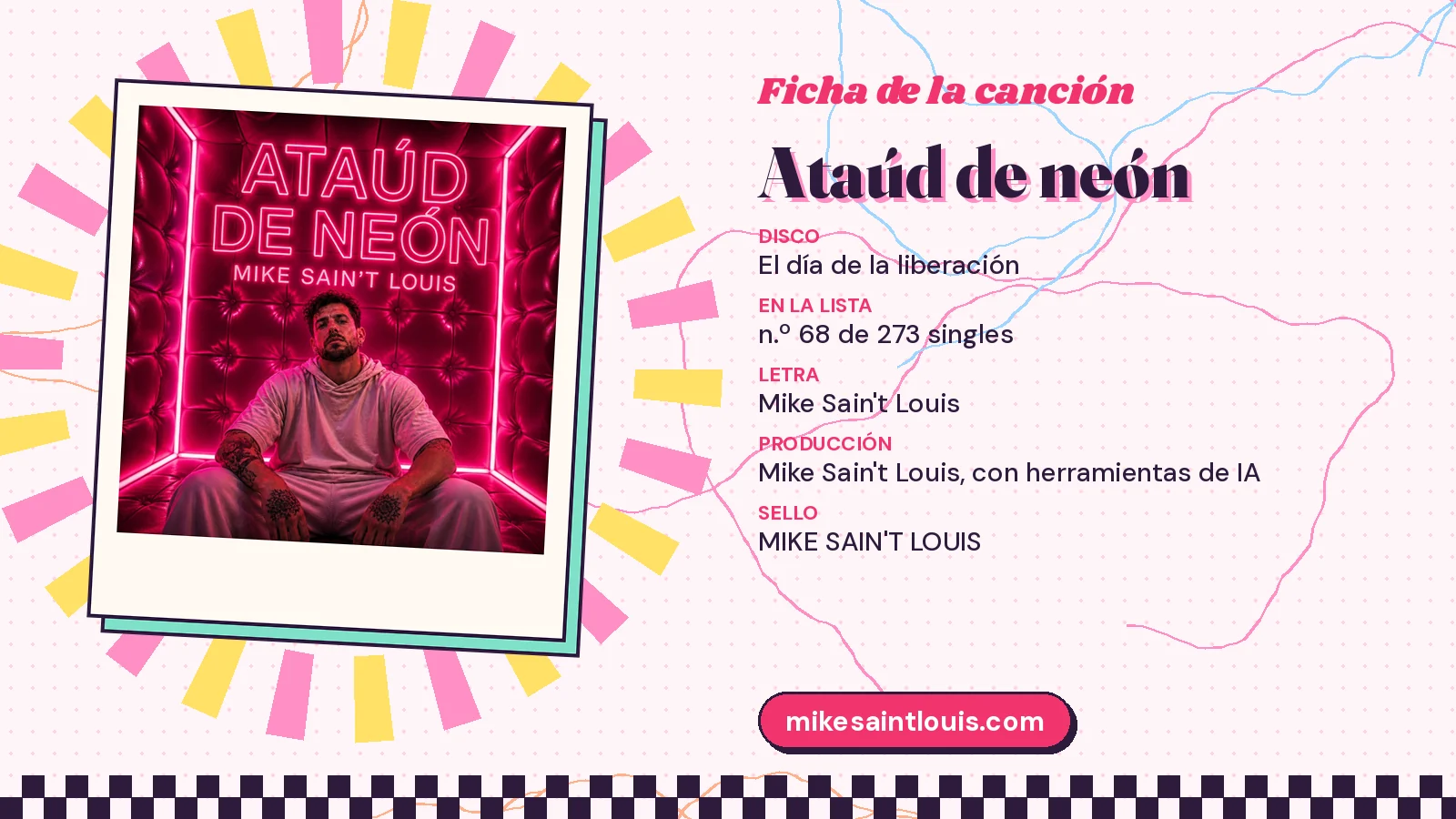
And another pandemic, right after the coffin, has a macabre logic I didn't plan but am grateful for. First the box. Then, once again, everyone shut in. Anyone who spent those months of 2020 stuck at home knows what it's like to be somewhere comfortable you can't leave. Plenty of Madrid flats were neon coffins for weeks, the telly on and the phone's glow on your face.
What the cover tells me
Let me tell you what I feel when I look at the artwork, which is another way of reading it.
I feel the boy knows where he is. That he isn't naive. That he sat down in there knowing it's a coffin, and chose it because, for now, it's colder outside. That's the most human and the saddest part. Sometimes we stay in the box not because we can't see the exit, but because the exit is scarier.
I understand it. I don't judge it. I've seen it in a lot of people I love.
And I also feel he could get up at any moment. That the legs-apart pose isn't surrender. It's waiting. Like someone on the bench before running onto the pitch.
I hope he gets up. I hope he kicks the pink leather and climbs out in a glitter-smeared hoodie. Now that would be a cover.
Pink isn't innocent
One last thing about the colour, because pink in my work is never an accident.
Pink is the colour of the ship in «La despedida», of the rocket leaving Earth, of planet GAYFOLK. It's the colour of utopia. And here it's the colour of the coffin. Of confinement. Of the trap.
I love that double edge. Because it says pretty isn't always good. That the same pink that carries you to a free planet can upholster a box. That you should look carefully before climbing into anything pink.
Even mine.
Made with AI, thought up by me
As always: the lyrics of «Ataúd de neón» are mine, written without artificial intelligence, although I haven't put them on the site yet. The music and the vocals are made with AI tools such as Suno. I'm a lyricist, composer and producer, and I'm not on vocals in any of my songs.
I'll tell you something that amuses me. AI doesn't know what a neon coffin is either. It's never been inside a pink-leather relationship. It doesn't know what it's like to stay sitting in a pretty box because it's cold outside. What I give it is the words, and it gives them sound. The box is mine.
How to listen
At night, as I said on the song's page. Lights low, some coloured lamp switched on. And now I'll add something: listen to it thinking about the pretty boxes you know. Your own and other people's.
If you're in one, I won't tell you to get out tomorrow. I'll tell you to look closely at the upholstery. Count the buttons. And ask yourself whether the light is for you or for the shop window.
The song tells the rest.
Frequently asked questions
What is «Ataúd de neón» about? The lyrics aren't published on the site yet, so Mike Sain't Louis doesn't give them away. The cover shows a boy sitting inside a coffin lined in pink buttoned leather with fuchsia neon lights, and he reads it as an image of beautiful places you never leave.
What does the neon coffin image mean? It brings together the end, the coffin, with the night and the shop window, the neon. Mike uses it to talk about relationships that lock you in with luxury and appearances, and about the night as both party and trap.
Which album is it on? «El día de la liberación», the third album of the Planeta Gayfolk trilogy.
Who does the vocals on his songs? The vocals and the music are made with artificial intelligence tools such as Suno. Mike writes the lyrics without AI and is the composer and producer.