By Mike Sain't Louis ·
Blood family: dream mothers-in-law, other people's mothers and brothers in my lyrics
«De mi última suegra mejor ni hablo.» ("Best not even mention my last mother-in-law.")
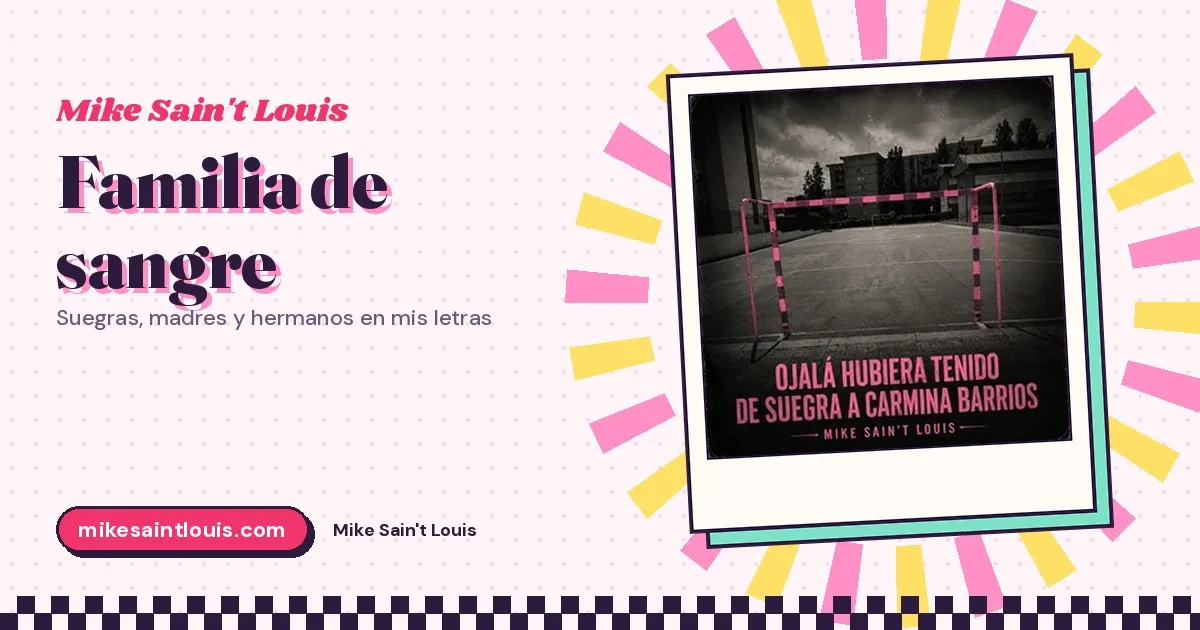
And then I mention her. Of course I do. A whole song, complete with a garden, a lunch outdoors and a mother-in-law hand-picked from every possible mother-in-law in Spain. That's how almost everything to do with family starts in my lyrics: by saying I won't go there and then walking straight into the kitchen.
Before going on, one thing should be clear. I'm not going to talk about my own family here. That's mine and it stays at home, door shut, doormat straight. What I will do is open up the other one, the paper one: the family that lives inside the songs of Planeta Gayfolk. That one has a family tree of its own. It has mothers-in-law, exes' mothers, brothers who fix nothing, parents who turn up as witnesses to a false oath and an aunt with a name I wouldn't repeat in front of a notary. It's an invented family, with invented characters, and that's why I can talk about it without asking anyone's permission.
I went through the catalogue looking for mothers. I expected to find three or four. They turned up everywhere. In a catalogue of 273 singles, family appears where you least expect it: in the middle of a funeral, in a WhatsApp status, at the end of a break-up, outside a concert. And it almost never shows up to offer affection. It shows up to take sides.
Obviously, he's her son
The mother-in-law is the family character who recurs most in my lyrics. Not the mother, not the father: the mother-in-law. And it makes sense. The mother-in-law is the family that comes to you on the rebound, bundled with the boyfriend, no instruction manual, and with an opinion of you already formed before you reach the main course.
In «Ojalá hubiera tenido de suegra a Carmina Barrios» ("If only Carmina Barrios had been my mother-in-law") I settled it in two lines that still make me laugh: «obviamente es su hijo, / tiene que estar del otro bando», "obviously he's her son, / she has to be on the other side". That's the whole drama of the real mother-in-law, the one you end up with. She isn't necessarily a bad person. It's just that he's her son. In a break-up, the mother-in-law isn't the judge: she's defence counsel for the other party, and she bills in croquetas.
What interested me about that line wasn't complaining about the mother-in-law. It was the «obviamente». That word does the dirty work. It admits that I understand, that it's logical, that I'd do the same in her shoes. And right after, without changing tone, the lyric admits it gets that, and that what it can't stand are her arguments. In other words, I understand everything except what she says. Which is like saying I understand nothing.
And then the TV studio arrives. «Señoras, señores, stop, stop, un momento.» ("Ladies and gentlemen, stop, stop, one moment.") The mother-in-law isn't alone any more: suddenly there's an audience, a jury, a whole room listening to me defend myself. That's how family works in a break-up. What starts as a conversation between two ends up as an afternoon talk show with guests, a floor manager and canned applause.
Hence the dream mother-in-law. If the one I got was on the other side, I went looking for one on mine. And I didn't pick just anyone. I picked a woman who, for many people in this country, is the mother we'd all love to have at a wedding: spontaneous, Sevillian to the bone, laughter first. The lyric sits me down to lunch with her in the garden. That's all. I don't ask her to defend me, or agree with me, or make me a stew. I ask for a lunch in the sun.
That's the trick. A song that looks like celebrity mockery is, deep down, a very small request: in-laws who don't judge you while you pass the bread.
The ex's mother
If the mother-in-law is the character who appears most, the ex's mother is the weapon I use most. And there's no subtlety here at all.
In «De mito a vómito» ("From myth to vomit") the farewell comes wrapped in a bar-counter saying: «Con Dios / ¡y que te aguante tu madre!», "Go with God / and let your mother put up with you!". It's the oldest line in the world. I've heard it in markets, in doorways, in the queue at the health centre. And it works in a song because everyone understands it without translation. Sending the ex back to his mother is returning a faulty product to the shop it came from. With receipt, no box.
In «No quiero otro novio cojín» ("I don't want another cushion boyfriend") it goes a step further: «Vete con tu madre / A criticar por detrás», "Go off with your mother / and bad-mouth me behind my back". There the mother isn't just where the ex goes back to. She's his accomplice. She's the round table with the heater underneath where the two of them sit and tear me to shreds. I picture the scene and laugh, because it's so specific it almost smells of oilcloth tablecloth.
And in «El día de la liberación» ("Liberation day") there's the domestic version, my favourite of them all: «Que te cocine ahora tu madre / o nútrete con un bote de pringles», "Let your mother cook for you now / or live off a tube of Pringles". No insult. Just logistics. The one who made your dinner is gone, sort yourself out. Mum or crisps in a tube. Your choice.
What these three mothers have in common is that none of them speaks. None has a line of her own in the lyric. They're a place, not a person: a destination you send someone to. And that has its logic, because deep down they aren't real mothers. They're the age-old "go home", wearing an apron.
There's one exception, and it's the one least suited to caricature. In «Quien miente y jura» ("Whoever lies and swears") the parents appear neither as refuge nor as punishment. They appear as a false guarantee. The last line says it all: «Nunca se volverá a confiar / En quién miente y jura por sus padres», "You'll never again trust / someone who lies and swears on their parents". Swearing on your parents is the most sacred thing many people have. It's the oath that doesn't break. And that's why whoever breaks it is beyond repair.
That song, by the way, doesn't have a single joke. I did that on purpose. There are things I laugh about and things I don't. Using your family as collateral for a lie is on the second list.
No psychologists, no friends, no siblings
In my lyrics, brothers and sisters have a curious role: they appear in lists of things that don't work.
«La música me está salvando» ("Music is saving me") is a roll call of failed rescues. «Ni psicólogos, ni amigos, ni hermanos, / Ni psiquiatras, ni médicos, ni novios.» ("Not psychologists, not friends, not siblings, / not psychiatrists, not doctors, not boyfriends.") And the list keeps going, gets absurd, throws in paediatricians and vets, a TV astrologer and even a rosary said on your knees in Madrid. The siblings are there in third place, between friends and psychiatrists, as one more resource that was tried and didn't work.
I didn't write it against anyone. I wrote it because it's true that there are moments when nothing that's supposed to hold you up holds you up. Not even family. And saying that out loud is frightening, because it sounds like an accusation. It isn't. It's an observation. Sometimes what pulls you out of the well is something with no surname that owes you nothing: a half-finished song, a chorus that gets into your head at three in the morning.
I like that, in a lyric about family as something that doesn't save you, the title uses the continuous tense. Not "it saved me". It's saving me. Still. Under construction. Like the house of any real family.
In «El segundo exacto» ("The exact second") family comes back, once again as a list: «Nadie me apoya, ni amigos ni familiares, / ni pareja, ni polvos, ni similares», "Nobody supports me, not friends or relatives, / not partner, not hook-ups, nothing of the sort". And then the saddest and funniest inventory I've ever written: «20 estados vistos en Whatsapp, mi novio, su madre, mi hermana, mi suegro, mi ex», "20 WhatsApp status views: my boyfriend, his mother, my sister, my father-in-law, my ex". There's the whole family, my paper one and the in-laws, sitting in a row in a WhatsApp status. They've all seen it. Nobody has reacted.
That's the modern family, the one you don't need to gather on Christmas Eve: it fits in the list of views. They see you. They know you're there. And they get on with their day.
I write it and laugh. And then I remember the line says «Ni un solo 'me gusta'», "Not a single like", and the laughter fades a little.
Blood family: my mother, my father
There are two songs where family appears under the most serious word there is for it. Blood family.

«Nadie hablará de mí cuando haya muerto» ("Nobody will talk about me when I'm dead") takes a head count at my own funeral. Who'll come. Who'll cry. «Dos amigos, como mucho, / tal vez uno. / Familia de sangre: / mi madre, mi padre, / mi última pareja...» ("Two friends, at most, / maybe one. / Blood family: / my mother, my father, / my last partner...") And there, on the guest list, the lyric puts the partner on the same level as the parents. Blood family and chosen family on the same line, no hierarchy. Until the next line takes one away: «Hasta que, al final, y con razón, él también se aleja», "Until, in the end, and rightly so, he drifts away too".
That «y con razón», "and rightly so", is what weighs most. It would have been easier to make him the villain. But no. In that song the one who leaves has good reason to leave, and that hurts more than any betrayal.
In «¡Eso es lefa!» the same wake turns into vaudeville. The list is almost identical: «Dos amigos contados, familia de sangre, mi madre, mi padre, / el buenazo de mi última pareja, algún vecino cotilla», "Two friends, tops, blood family, my mother, my father, / my last partner, bless him, and some nosy neighbour". Look at what happens. The family is there, front row, hankies at the ready. And right behind them, the nosy neighbour. Blood family and landing family sharing a church pew. What comes next I won't spoil here; those who know it, know it, and those who don't can read it with a coffee in hand and no children nearby.
I like that the two songs share almost the same list. It's like writing the same obituary twice, once in earnest and once with the neighbour shrieking. The family is the same. What changes is whether they let you grieve in peace or someone wrecks the funeral.
And there's something about those two lists that I think matters: the mother and the father are the only things not up for debate. The friends can be two or one. The partner can leave. But the mother and the father are always there, on the blood-family line. I don't give them a line, I don't give them a personality, I don't turn them into characters. They're there. And to me that's the closest thing to a tribute you can pay without getting soppy.
With new in-laws and the damned
Back to the mothers-in-law, because I'm not done with them.
In «El concierto de Ismael Serrano» there's a line that, for me, is the best definition of in-laws I've ever managed to write: «Con nuevos suegros y condenados», "With new in-laws, and doomed". I think about it and it still seems perfect. The ex has fallen for someone else at lightning speed, «dentro de un mes ya estáis casados», "within a month you'll be married", and with the new boyfriend comes the full package: new in-laws. And doomed ones.
Doomed to what? To the same as me. To sitting at a table with someone who won't be there in a year. The lyric says it bluntly: «Pero el año que viene ya estaréis separados», "But by next year you'll have split". So the new in-laws are, deep down, my classmates. People who don't yet know they're going to lose someone they've just laid a place for at Christmas.
There the mother-in-law stops being the enemy and becomes another victim. That happens to me a lot when I write: I start with a character to laugh at and halfway through the song I feel sorry for them. In that same lyric the feeling ends up switching sides: «Y en el fondo siento pena por él», "And deep down I feel sorry for him". For the new one. And, by extension, for his family. For those brand-new in-laws who are going to learn someone's name for nothing.
Writing about in-laws is like that. It's territory where nobody quite chooses. You don't choose your in-laws. They don't choose their son's boyfriend. And yet for a few years you share long lunches, birthdays, the family WhatsApp group with its 7 a.m. greetings. And one day, with no funeral and no goodbye, you stop existing for them.
That's a loss too, even if it never makes the obituaries.
Tía Chumino and the relative I don't quote
Not all the families in my lyrics are tragic. Some are pure farce.
In «Vas a escuchar un disco muy raro» ("You're about to hear a very strange album") the most absurd relative in the whole catalogue appears, an aunt with a name that sounds like a fairground joke. She gets the role of the snitch: whoever arrives full of prejudice has to run off and tell her. And then, of course, there's «¡Ay, mi madre!», which isn't anyone's mother: it's the exclamation. Mother as interjection. The one that comes out when something's too much for you, when you see the rent or when someone rolls a joint in your living room.
I love that Spanish has mothers tucked into its exclamations. «Madre mía», «ay, mi madre», «la madre que te parió». Family is in the language before it's in the lyric. I just take it out for a walk.
There is one kind of relative, mind you, who never appears by name in my lyrics. The father. Outside the blood-family lists and the false oaths, the father barely gets a line. It isn't a political decision or a hidden message. It's just that songs with him in don't come to me. Maybe one day. Maybe never. That's fine. Some drawers in the wardrobe open when their time comes.
A family tree with plenty of swish
When I put all these songs together I get a very strange family tree. Right at the top, a dream mother-in-law in a garden. On the neighbouring branches, the ex's mother with her oilcloth and her heater. Further down, siblings on a list of failed rescues. Parents sworn on falsely. Brand-new in-laws with no idea what's coming. A snitching aunt. And at the root, still, without a line, the blood family that's always in the front row at the funeral.
That tree isn't mine. It belongs to anyone who's been gay in a Spanish family and then had a boyfriend with a family of his own. Who learned to read faces at Sunday lunches. Who was "the friend" in some photos and "the boyfriend" in others. Who met mothers-in-law who loved him and mothers-in-law who seated him far away, next to the little cousin.
"Pluma", camp flair, is measured to the millimetre at those gatherings. There are long lunches where you calibrate your gestures the way you turn the telly down when someone walks in. None of that goes into the lyrics directly. But it lies beneath all of them. That's why the dream mother-in-law matters so much: because she's the fantasy of arriving at a family table and not having to calibrate anything. Sitting down. Eating. Laughing loudly. And nobody looking at your wrist.
And that's also why I so enjoy sending exes back to their mothers. It's handing the family back the problem the family raised. I say it with affection. Well, not with affection. I say it with a bit of spite and a lot of relief.
Why I keep my family out of my songs
It's a fair question. If I write so much about mothers-in-law, other people's mothers and funerals, why don't I write about my own?
The short answer is that I do, but sideways. The long answer is this.
When I write about an ex, the ex is a character. I give him an invented name, flaws under a magnifying glass, an origin, an age that lies. I can exaggerate everything because the character can take it. If I go too far, people laugh and that's that. With blood family it's different. I don't know how to exaggerate them. The joke won't come. And a song of mine without exaggeration limps: it's neither one thing nor the other.
So my real family appears the way families appear in obituaries: in a list, by their kinship names, no adjectives. My mother, my father. Full stop. To me that isn't coldness. It's respect. Some people deserve a whole song of mockery and some people deserve to sit in the front row without anyone turning them into a character.
And then there's the other family, the one you build away from home. The one that comes with you to a concert, or leaves you standing in the queue. The one that shares a jug with you in a bar where time stands still. The friends you can count on one hand with fingers to spare. I write about that one more, because I did choose it, and what you choose you can also criticise.
What family does to a song
If I had to sum up what family brings to my lyrics, I'd say it brings an audience. An awkward one.
When a mother, a mother-in-law or a sibling appears in a song, the story stops being between two people. It's no longer him against me. It's him, his mother, my sister, the new father-in-law, the snitching aunt, the twenty WhatsApp status views. It's a packed living room. And in a packed living room everything is said louder, exaggerated more, noticed more. That's why so many of my family lyrics end up in a TV studio: «Señoras, señores, stop». Because once you bring the family in, you're no longer talking to one person. You're talking to a people's court.
And humour, in that court, is how I defend myself without a lawyer. If I laugh first, they can't laugh at me. That's one of the house rules I've pinned up on my page: humour tells the truth too. In families above all. Because the truth told seriously at a family lunch ends in a slammed door, and told with wit it sometimes ends in a belly laugh and someone passing you the wine.
The family in my lyrics isn't a happy family. Nor is it a daytime TV-movie family, with secrets and inheritances. It's a landing family, a WhatsApp-group family, a family of long lunches that drag on and funerals where nobody's quite sure who'll turn up. A family that takes sides, that stands and stares, that swears falsely and that sometimes, very rarely, invites you to lunch in the sun.
I'll keep that last one. The mother-in-law in the garden, the dream one.
And the blood one, who needs no song.
If you'd like to read all these lyrics in full, with their mothers-in-law, mothers and aunts, they're in the lyrics archive, from A to Z. And the one that started it all, the dream mother-in-law, is there complete on gayfolkplanet.com.
Frequently asked questions
Does Mike Sain't Louis talk about his real family in his songs? Not directly. His mother and father appear in the lyrics as part of the "blood family", in lists, without anecdotes or traits. The mothers-in-law, exes' mothers, aunts and siblings who appear in the songs are characters.
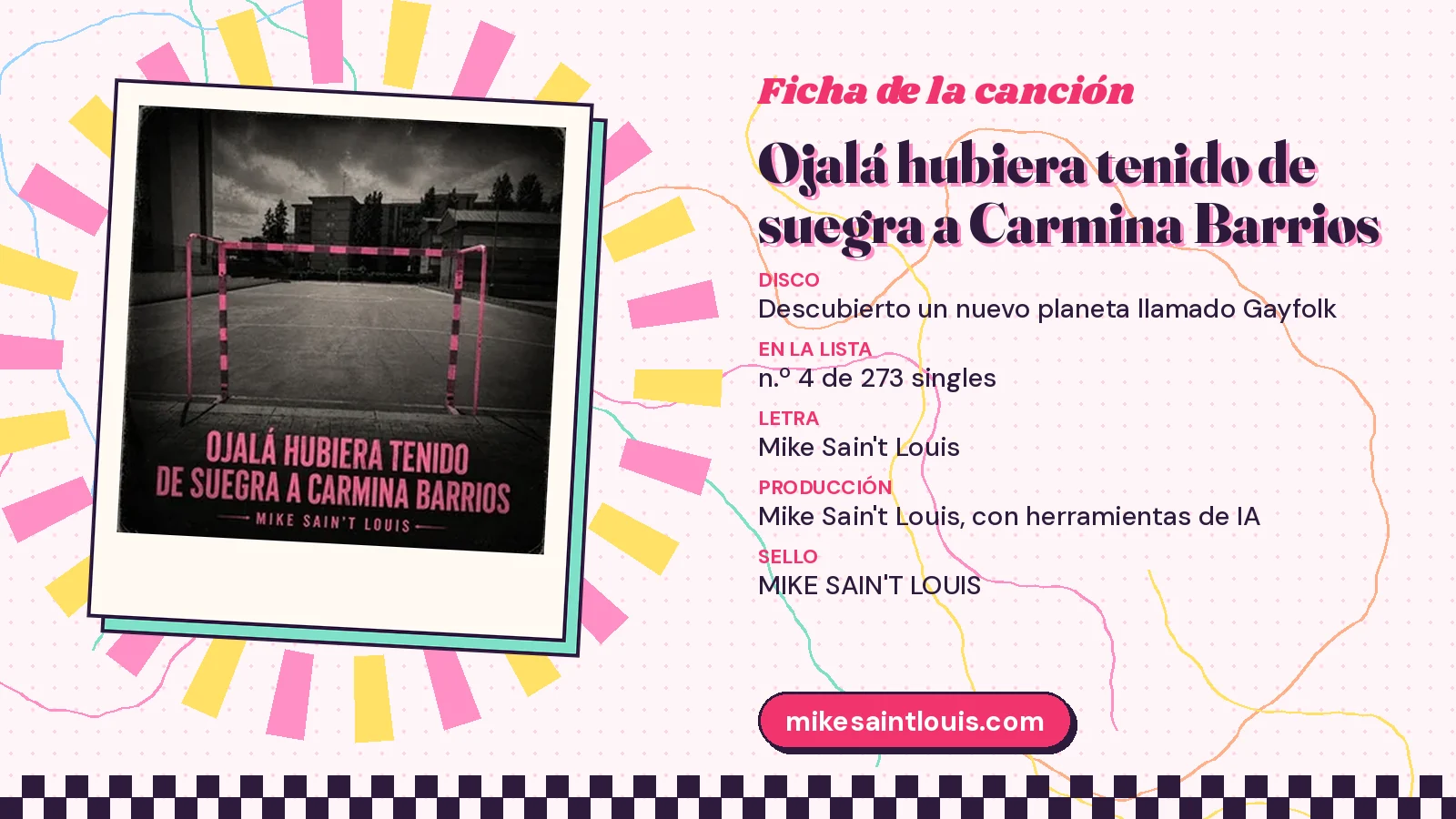
Which song features the dream mother-in-law? «Ojalá hubiera tenido de suegra a Carmina Barrios», from the first album of the trilogy, «Descubierto un nuevo planeta llamado GAYFOLK». The lyrics are by Mike; the music and vocals are made with artificial intelligence tools.
Which other songs are about family? «De mito a vómito», «No quiero otro novio cojín», «El día de la liberación», «Quien miente y jura», «La música me está salvando», «El segundo exacto», «Nadie hablará de mí cuando haya muerto», «¡Eso es lefa!», «El concierto de Ismael Serrano» and «Vas a escuchar un disco muy raro».