
By Mike Sain't Louis ·
The smell of the pillow: Voy a olvidarme de ti and why you can't forget by decree
Some sentences are said in order to make them true. I'm going to quit smoking. I'm starting at the gym on Monday. I'm going to forget you. They're spoken firmly, sometimes in a whisper and sometimes shouted, and what they have in common is that nobody who says them is sure they can keep them.
Voy a olvidarme de ti (I'm going to forget you) is built entirely on one of those sentences. On the song page I talked about its copla form, how the repetitions weigh more and more, and how honest I find it that it doesn't promise victory. Here I want to ask another, more down-to-earth question: can you forget someone because you decide to? And along the way I want to stop at the detail that, for me, is the heart of the lyrics: the smell of a pillow. The full lyrics are published and worth reading slowly.
A list of resolutions
The lyrics work like a list of New Year's resolutions, but for heartbreak. Each verse opens with a verb in the future: I'm going to forget, I'm going to put out, I'm going to cut. They're concrete tasks. Forget an "I love you". Put out a fire. Forget a desire and a smell. Cut a rose.
What all those resolutions have in common is that they don't depend only on the person making them. Nobody puts out an inner fire with a switch. Nobody forgets a smell because they've set their mind to it. The list is firm in form and fragile underneath, and that contradiction is what makes the song hurt.
I really like writing like this, with concrete gestures instead of grand abstractions. Saying "I'm going to get over it" moves nobody. Saying you're going to forget the smell of a pillow does. Because we've all had that pillow.
Overnight
The first verse sets the deadline, and the deadline is impossible:
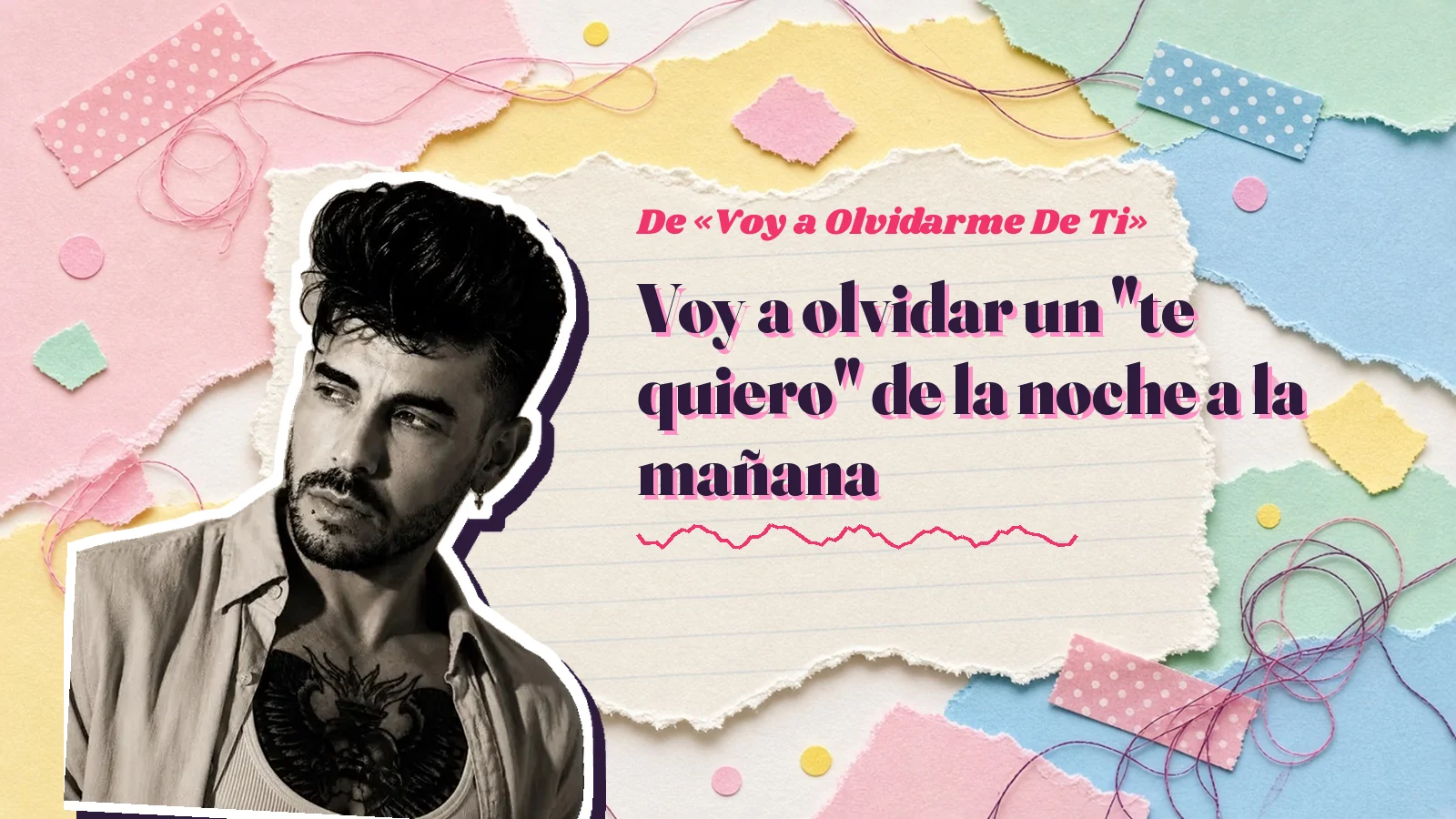
«Voy a olvidar un "te quiero" de la noche a la mañana»
"I'm going to forget an 'I love you' overnight." Overnight means suddenly, with no transition. And that's exactly what doesn't happen with heartbreak. Nobody goes to bed in love and wakes up indifferent. Forgetting, if it comes at all, comes in pieces, with relapses, with good days and days when everything comes flooding back.
But the Spanish phrase, literally "from night to morning", has a lovely literal reading too. From night to morning is the time you spend in bed. In other words, next to the pillow. Without knowing it, the first verse already announces the object that will appear later. Nights are when forgetting is hardest, and morning is when you promise yourself, once again, that today's the day.
The white bear
In the eighties, the American psychologist Daniel Wegner carried out an experiment that has been cited countless times. He asked a group of people not to think about a white bear for a few minutes. The result was that they thought about the white bear more than people who hadn't been given that instruction. Trying to suppress a thought made it come back stronger.
That experiment explains better than any poem why Voy a olvidarme de ti is such a sad song. Every time the narrator repeats that he's going to forget, he's thinking about the person he wants to forget. The promise itself keeps the memory alive. It's a circle you can't get out of by repeating the promise.
The structure of the song imitates that circle. The lines come back again and again, twice, three times, like the white bear returning to your head just when you've resolved not to think about it.
Forgetting isn't a switch
Memory doesn't work like a file you can delete at will. Memories, especially emotionally charged ones, stay. What does change over time is the effect they have on us. The same memory that tears you in two today might, a year from now, give you barely a twinge, or even a smile.

That's why I think the song, although it says forget, is really talking about something else. It's about no longer obeying the memory. About not playing along, as one of its verses says. The memory can stay, but it's no longer in charge. It no longer decides whether you reply to the message, walk down their street or look at their photos at three in the morning.
That difference seems crucial to me. Forgetting by decree is impossible. Stopping yourself from acting on someone's account, on the other hand, is hard but possible. And deep down, that's what the song is about.
The pillow
And so we come to the detail that, for me, is the heart of the lyrics:
«Y el olor de tu almohada»
"And the smell of your pillow." Of all the resolutions in the song, this is the most physical and the hardest. It's not about forgetting a sentence or a look. It's about forgetting a smell. And smells are probably the most stubborn memories we have.
Anyone who has been through a break-up knows it. You can put the photos away, delete the messages and change bars. But one day, on the metro, someone walks past wearing the same perfume or using the same fabric softener, and suddenly you're back in that bed. No warning, no defence.
The pillow is also an intimate object. It's where you rest your head, where you whisper, where you cry. The fact that the song chooses that object and not another says a lot about the kind of relationship someone is trying to forget.
Proust's madeleine
Literature has a very famous example of the power of the senses over memory. In Marcel Proust's novel In Search of Lost Time, the narrator dips a madeleine in a cup of tea and, as he tastes it, his whole childhood comes rushing back. Ever since, people have talked about Proust's madeleine to describe memories triggered by a taste or a smell.
It's often explained that the sense of smell is closely linked to the parts of the brain that handle emotion and memory. I'm not a scientist and won't go any further than that, but anyone can check it in their own life. There are smells we don't remember smelling for years that, the moment they appear, bring back a whole moment intact.
The pillow in the song is Proust's madeleine in reverse. It doesn't awaken a sweet memory you want to recover. It awakens a painful one you want to erase. And that's exactly why it's so hard to get rid of.
Washing the pillowcase
There's a practical solution to the smell of the pillow that we all know: wash the pillowcase. Or change the pillow. Or sleep on the other side of the bed. They're small, domestic gestures that lots of people make after a break-up without thinking too much about it.
I like thinking about those gestures because they're the real-life version of the song's resolutions. You can't forget a smell by decree, but you can put the pillowcase in the washing machine. You can't put out an inner fire, but you can stop feeding it. The song speaks in grand terms, the way copla does. Life gets sorted out in small ones.
That mix of the grandiose and the domestic is very much my way of seeing things. A copla-sized heartbreak is also lived among washing machines, supermarket receipts and pillowcases.
The fire that burns inside
The second verse talks about putting out a fire that burns inside. It's one of the oldest images in love poetry. Love as a flame, as a blaze, as something that consumes. It's in the poems of Spain's Golden Age, in boleros, in coplas, in ballads.
What's interesting is that in this song the fire isn't celebrated. It's something to be put out. It's not the passionate flame of the beginning, but the one that already hurts, the one that won't let you sleep. And according to the lyrics, jealousy is to blame.
That image of love turned into a sentence is very much part of the Spanish tradition. Love that hurts, punishes, chains you. But here the song doesn't wallow in the suffering. It names it in order to leave it behind.
Jealousy
The lyrics name jealousy as the cause of the sentence, along with treacherous eyes that stab like daggers. They're classic images, but what they describe is very recognisable: a relationship in which distrust has poisoned everything.
Jealousy is one of the hardest emotions to manage in a couple. It can come from a real betrayal or from your own insecurity, and from the inside it's often impossible to tell the two apart. What we do know is that a relationship ruled by jealousy becomes a place where nobody is well.
The song doesn't say who was jealous of whom, or whether there was reason to be. It just says that because of it, love has become a sentence. And that the only way out is to forget, or at least to try.
Not playing along
There's one verse I find the most clear-sighted in the whole song. The narrator says he's not going to play the other person's game, even though he's dying to. That line sums it all up: the desire is still there, intact, but the decision is not to act on it.
Many harmful relationships have that game. The midnight message, the call when everything seemed over, the "how are you?" that reopens the wound. And the person trying to get out knows that every time they reply, it all starts again.
Deciding not to play along even though you're dying to is, for me, the real courage of this song. It's not forgetting. It's choosing, every day, not to go back. And that's very close to what No contact tells elsewhere in the catalogue, in another tone and another language.
The rose and the thorn
The last verse turns to an image that has always existed: the rose that wounds with its thorn. Beauty that hurts, love that wounds. It's a metaphor so old it might seem worn out, but in this song it has an interesting twist.
The narrator doesn't just complain about the thorn. He decides to cut the rose. And he announces that the love will lose its petals. It's an image of an ending, of a flower shedding its petals one by one until nothing's left. And in that slowness lies the truth about forgetting: it isn't a clean cut, it's a shedding.
I like the song ending there. Not with forgetting achieved, but with a process under way. The rose has been cut. The petals will fall. There's no rush, but there is a direction. And sometimes, in the middle of heartbreak, knowing where you're heading is all you need to get up in the morning and promise yourself once again that today's the day.
Even if it costs me my life
The chorus repeats that he'll forget even if it costs him his life. It's hyperbole very typical of copla, where everything is life or death. Nobody takes it literally, just as nobody thinks someone who says they're starving to death is in danger.

Even so, I want to make one thing clear, because heartbreak can be very hard. If a break-up ever makes you think about hurting yourself, don't go through it alone. In Spain you can call 024, the suicide prevention line, or 112 in an emergency. If you're outside Spain, call your local emergency number.
The song talks about suffering and losing the game, but also about carrying on. That's what I want to stay with you: you can lose a game and keep playing at life.
Losing the game
There's a line in the chorus I find very wise: even if I lose this game. The narrator accepts in advance that he might lose. That forgetting isn't guaranteed. That maybe the other person wins this time.
That acceptance is freeing. Most heartbreak songs promise a victory or sink into defeat. This one stays in the middle. I'm going to try, even if I lose. I'm going to forget, even if it costs me. It's the attitude of someone who no longer needs to win in order to leave.
In a culture that pushes us to always win, to get over break-ups in record time and to show on social media how well we're doing, accepting that you might lose is almost an act of rebellion. The song allows itself to feel bad, allows itself not to know whether it will succeed. And there's more strength in that honesty than in any of the motivational quotes doing the rounds online.
Treacherous eyes
The first verse ends with treacherous eyes that stab like daggers. It's an image that seems to come straight out of an old copla, and it does, in the best sense. But look closely and there's something very current about it. Eyes are the first thing you remember about someone, and also the first thing that gives away a lie.
Talking about treacherous eyes means talking about a gaze you can no longer trust. The person who used to look at you fondly now looks at you and you don't know what's behind it. And that doubt stabs, as the lyrics say, again and again. The repeated "me clavan, me clavan" ("they stab me, they stab me") at the end of the verse sounds almost like a wounded heartbeat.
I like the song starting there, with the gaze, and ending with the smell and the thorn. It goes through the senses one by one: sight, the touch of fire, the smell of the pillow, the prick of the rose. It's a way of saying that heartbreak isn't only lived in your head. It's lived in your whole body.
Words that bounce back
One of the loveliest things about the lyrics is how the verses end. The last word repeats and keeps bouncing: condena, condena; lastima, lastima; de gana', de gana'. It's as if the sentence couldn't quite finish, as if it got stuck in the same place.
That device works very well for talking about a memory that won't leave. That's exactly what a memory is: something that keeps coming back, bouncing around your head just when you thought you'd turned the page. The song's form reproduces the experience of someone trying to forget and failing.
On the song page I mentioned the dropped Andalusian s in "gana'". Here I'll just add that this detail of pronunciation makes the line sound more intimate, more internal. It's not a public declaration. It's what you tell yourself in the kitchen in the small hours.
How long forgetting takes
If forgetting by decree is impossible, how long does it take to really forget? There's no answer, and I'm wary of anyone who claims to have one. Some say it takes half as long as the relationship lasted, some talk about months, some about years. Every story has its own rhythm.
What does seem universal is that forgetting doesn't move in a straight line. There are weeks when you think it's over, and suddenly a song, a street or a smell sends you back to the start. That doesn't mean you're not making progress. It means the road has bends.
The song, with its chorus that keeps coming back, captures that feeling very well. Every time the chorus arrives it's like a relapse. And every time the promise is repeated it's like getting back up. By the end of the song, the narrator hasn't forgotten. But he's still saying he will. And that's already a lot.
The shared pillow
There's something especially tender about the pillow image when you think about it from a queer perspective. For a long time, many couples of two men or two women couldn't share a pillow in front of anyone. The bedroom was the only place where you could be a couple without fear.
I'm not saying the song is about that, because the lyrics don't say so. But I find it beautiful that the central object of a heartbreak is precisely that: the pillow, the place of the most protected intimacy. Losing someone also means losing that small territory where you could be entirely yourself.
An album with many ways of saying goodbye
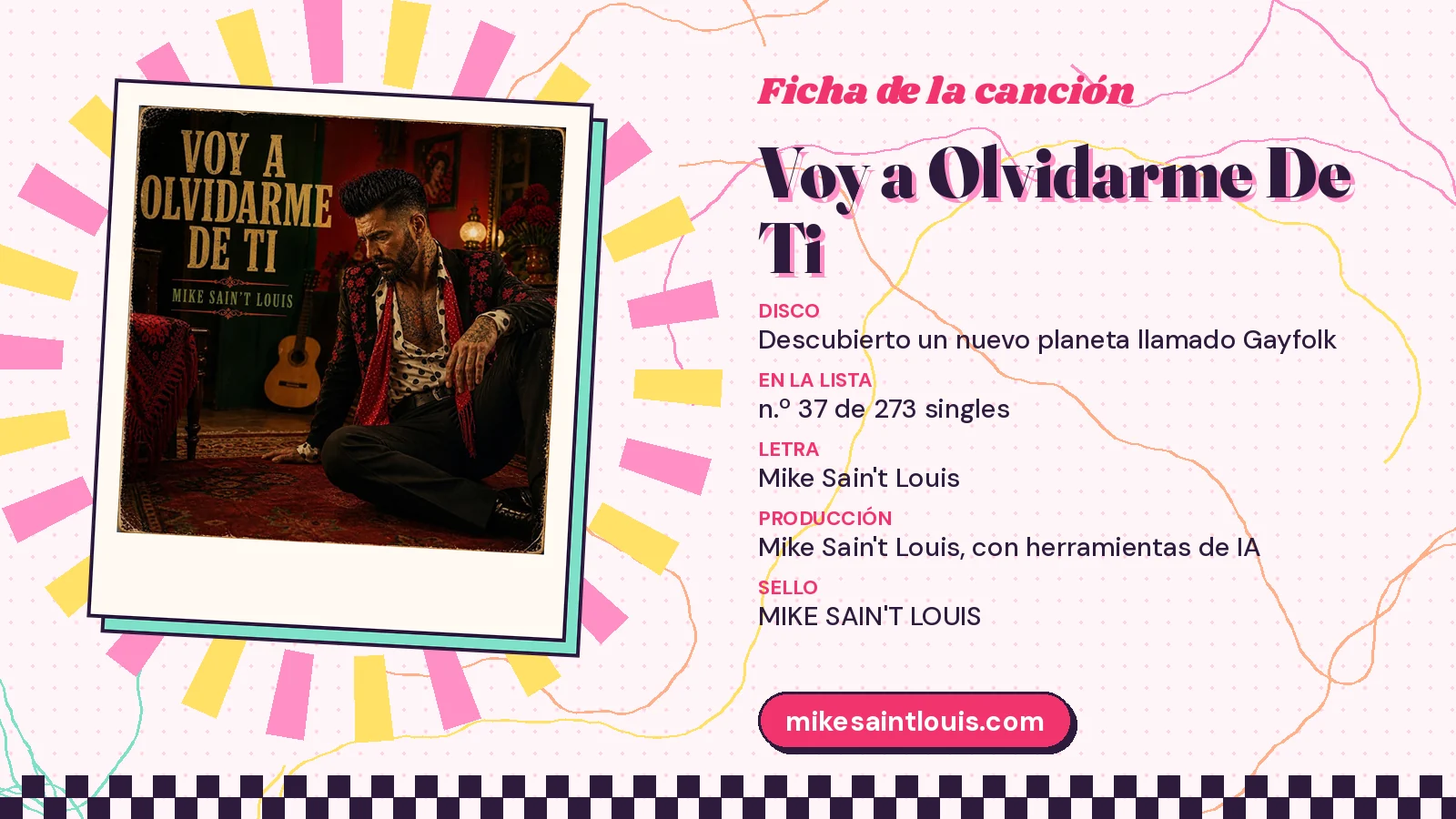
The song is part of Descubierto un nuevo planeta llamado Gayfolk (A new planet called Gayfolk discovered), an album in which heartbreak takes many forms. Alongside songs as light as Toxina coreana (Korean toxin), Voy a olvidarme de ti brings the copla touch, the wound taken seriously.
The catalogue is full of goodbyes. In Hoy es el último adiós (Today is the last goodbye) someone comes only to say it's over. In La última carta (The last letter) someone writes to close a chapter, not to get a reply. And in Ya no te quiero (I don't love you any more) the title announces the end. Voy a olvidarme de ti is the step before all of them: he hasn't forgotten yet, he still loves, but he has already decided.
Who this song is for
For anyone deleting a number they know by heart. For anyone who has switched sides of the bed. For anyone who has caught a perfume on the metro and had to get off at the next stop. For anyone who won't play along, even though they're dying to.
And for anyone who has already managed it and wants to remember how much it cost.
How to listen
The song is on the singles page and on every platform, and you can download it from the downloads section. Listen to it with a freshly washed pillowcase.
As a lyricist, composer and music producer, I like the catalogue to have real copla songs, the kind that take pain seriously. The music and the vocals are generated with artificial intelligence, but the smell of a pillow that no longer belongs to anyone is as human as anything I know.
If this subject hits close to home: in the series «Mental health without taboo» I talk openly about my mental health (narcissistic abuse, the bullying and abuse I suffered as a child, my diagnosis at 41, and therapy) and gather where to find help. If you're thinking about suicide, call 024 in Spain, or your local emergency number elsewhere.
Frequently asked questions
What is Voy a olvidarme de ti about? About someone who resolves to forget a person after a relationship marked by jealousy. Each verse is a resolution: forget an "I love you", put out a fire, forget the smell of a pillow, cut a rose with a thorn. The chorus repeats that he'll do it even if it costs him.
Can you forget someone through willpower? According to Daniel Wegner's well-known white bear experiment, trying to suppress a thought usually makes it come back stronger. What is within our control is no longer acting on the memory, which is what the song calls not playing along.
Which album is it on? Descubierto un nuevo planeta llamado Gayfolk (A new planet called Gayfolk discovered), the album that also includes Toxina coreana and Yo apoyo públicamente a Ylenia Padilla.
Who makes this song? Mike Sain't Louis, a lyricist, composer and music producer who calls himself "the first AI songwriter": he writes the lyrics and directs the production, and the music and vocals are generated with artificial intelligence.