By Mike Sain't Louis ·
The Monday exam: pretending you know who won the league, and other tests of manhood
«Did you see the match?»
Monday, quarter past nine in the morning, the office coffee machine. A brown plastic cup that burns your fingers at the sides. And the question, which isn't a question: it's passport control. Answer right and you're through. Answer wrong and they look at you funny all week.
A lot of us have learnt to answer right without having seen a thing. «Ugh, the agony at the end.» «The ref, again.» «What I don't get is why he didn't bring the kid on sooner.» Three wildcard lines that work for any match, any team, any season.
That exam is what «No me gusta el fútbol» («I don't like football») is about. Or at least, that exam is what I want to talk about today.
A five-word confession
The title is a confession. Five words in Spanish, four in English, no frills, like finally saying it out loud at Sunday lunch, with the news on in the background and the brother-in-law commenting on the score. I don't like football. There. I've said it.
In Spain, saying that as a man is a tiny coming-out of its own. I know because you can see it on people's faces. Some laugh, some don't believe you, some look at you as if you'd just confessed you don't like Spanish omelette. «What do you mean you don't like football? None of it? Not even the World Cup?»
Not even the World Cup.
The song's lyrics aren't published on Lyrics yet, so I'm not going to quote them or tell you what they say. That would be cheating, and I don't cheat with lyrics. Today I'm talking about the title, the cover and everything they suggest to me. Which is plenty.
The cover, point by point
I'll start with the image, which says nearly everything already.
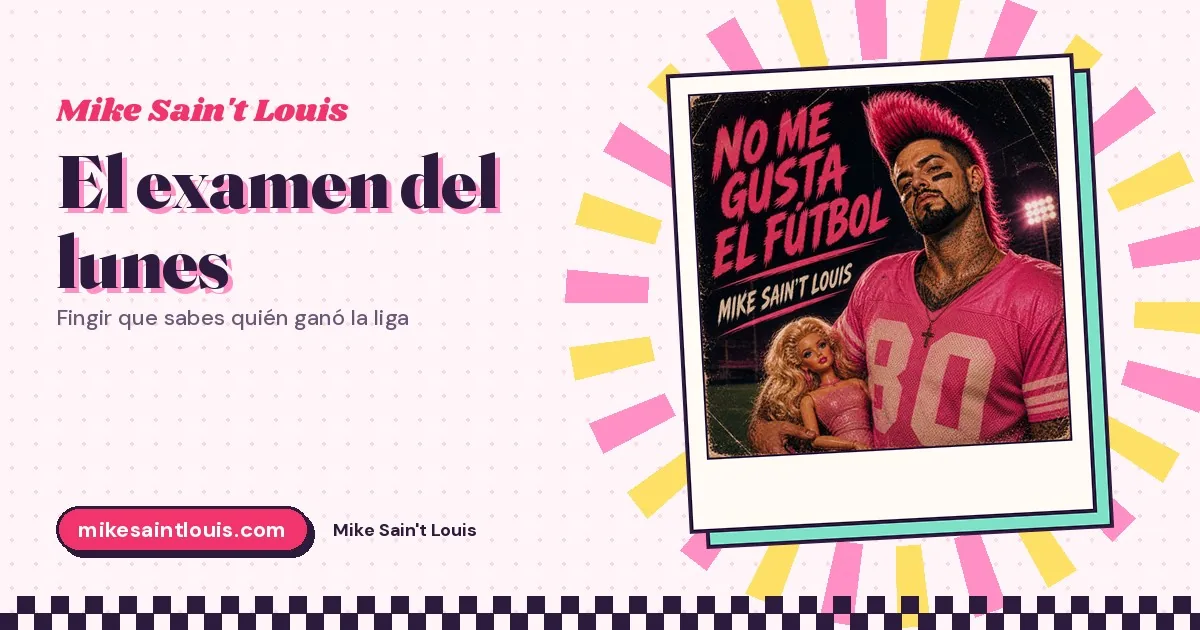
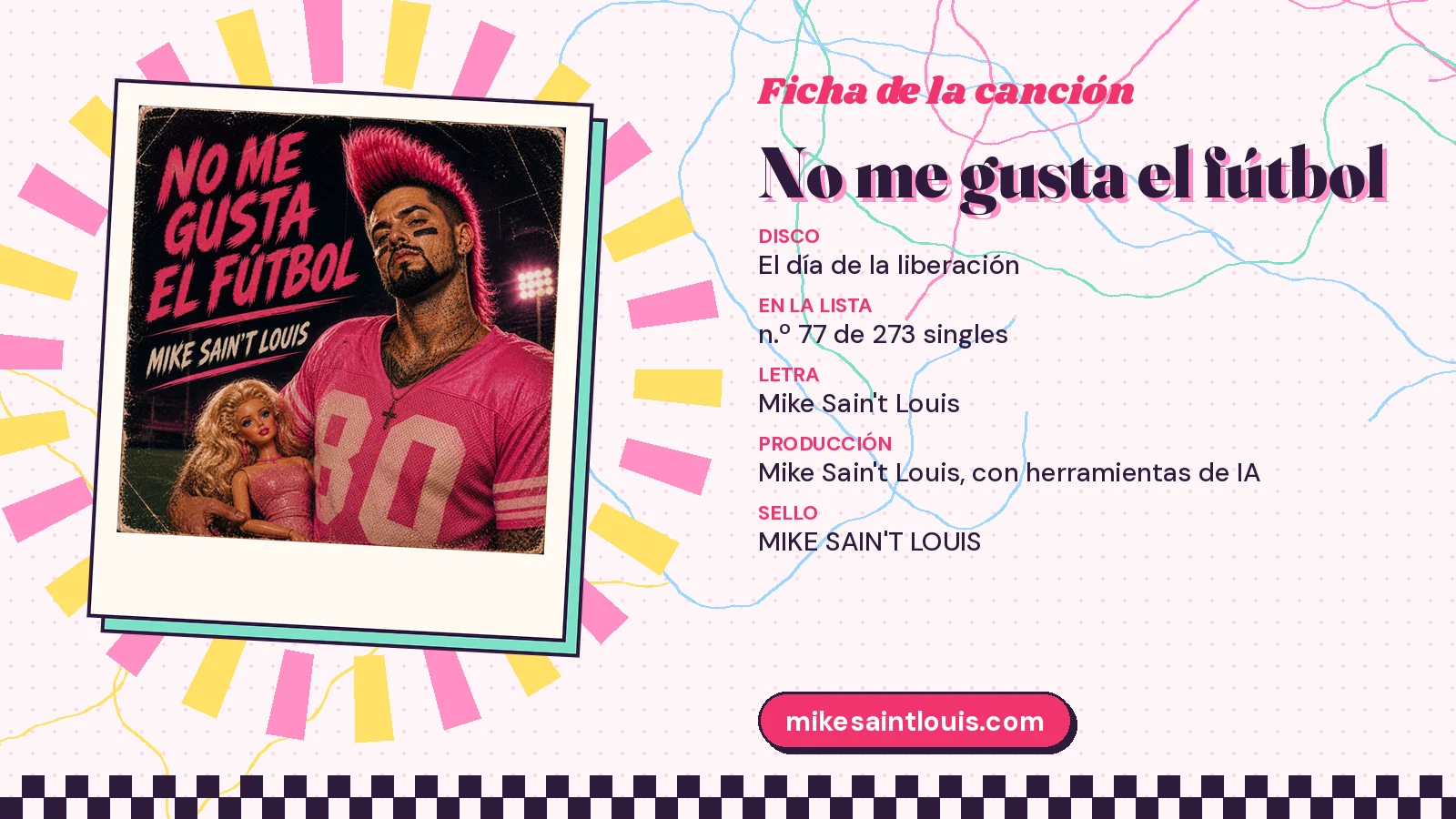
A lad who looks like a hard-man player. Beard, tattoos, those black stripes under the eyes that American football players wear so the floodlights don't dazzle them. Stadium lights behind him, the kind that turn night into midday. So far, a photo from a sports-drink advert.
And then you look closer. The mohawk is bubblegum pink. The shirt, number 80, is pink too. And what he's holding in his arms isn't a ball. It's a blonde Barbie in a glittery dress, held with the same care a striker holds the trophy after a final.
That swap of object makes me laugh so much. Because the ball is the toy they hand you at five if you're a boy, like it or not. And the doll is the toy they snatch out of your hands if they catch you with it. «That's for girls.» The cover takes the temple of masculinity, the stadium, and puts the forbidden toy right in the middle.
Without apologising and with the doll held tight, as I wrote on the song's page.
The ball you were handed
Lots of boys have lived this, and I'll tell it without bursting into tears, because today's not the day.
They give you a ball. They sign you up for the school team. They buy you the kit of your dad's club. They sit you in front of the telly on Sundays. And you, meanwhile, are looking at something else. The presenters' outfits. The Eurovision backing dancers. The Spice Girls' routines. Your cousin's doll.
And you learn, very early, that all that has to be hidden. That the ball is normal and the rest is weird. That if they catch you, they laugh. That there's a way of being a boy, you didn't come with it as standard, so you have to fake it.
Football isn't to blame, mind. Football's a sport. What's to blame is everything that's been built up around it: the idea that being a real man means knowing who scored on Sunday.
Sporty and a proper man
I've written that idea more than once, putting it in other people's mouths so I could laugh at it. The clearest case is in «Buscando el polvo perfecto», in a bit that mimics hook-up app profiles:

«Tienes pluma y eres afeminado, / Yo soy deportista y un buen macho,» («You're camp and you're effeminate, / I'm sporty and a proper macho man,»)
Anyone who's opened Grindr knows that tone. «Masc only.» «No fems.» «Discreet and sporty.» Sport as a certificate of manhood, even among maricas. Especially among maricas, sometimes. Because nobody polices camp more closely than someone who's had to hide his own.
And then comes the punchline, which still makes me laugh:
«Si no contesto y te bloqueo, / Ponte a hacer deporte, ¡Romeo!» («If I don't answer and I block you, / Go and do some sport, Romeo!»)
Go and do some sport. As if that fixed anything. As if the problem with someone not loving you were that you don't go to the gym. It's the same logic as the coffee machine, taken to bed: if you're not macho enough, train.
«No me gusta el fútbol» answers all of that from the title. I don't like it. And I'm not going to train until I do.
The three wildcard lines
Back to the office, because that's where this match is mostly played.
I said at the start that there are three wildcard lines for surviving Monday without having seen the match. Let me expand on them, in case anyone needs them. It's a public service.
The first, the agony. «Ugh, the agony.» Works for any match, because every fan always suffers, win or lose. If they won, they suffered to the end. If they lost, they suffered throughout.
The second, the ref. «The ref, again.» Foolproof. There isn't a fan in Spain without a grudge against the referee. Say it with a resigned face and you'll get a pat on the back.
The third, the manager. «What I don't get is why he didn't make the substitution sooner.» This one's advanced level, because it makes you sound like you know tactics. Nobody's going to ask which substitution. Everybody has a theory about some substitution.
With those three you'll survive any Monday. They're so universal nobody suspects whoever uses them.
The sad thing, and here I'll be serious for a second, is that you have to learn them at all. That you have to study to fit in.
Own goal
Let me tell you what pretending costs, because from outside it looks free.
Pretending to like football goes way beyond learning three lines. It's paying attention. It's checking the score on your phone on Sunday night, on the sly, so you don't look bad on Monday. It's knowing the manager's name even if you couldn't pick his face out. It's laughing at a joke about a player you've never heard of. It's going to the bar to watch the final with your colleagues and spending ninety minutes staring at the screen seeing nothing, waiting to know when you're supposed to throw your arms up.
It's a job. A small job nobody pays you for, added to all the other small jobs of fitting in. How you sit. How you laugh. How you talk about girls. What music you say you like.
And in the end, when you add up all those small jobs, you realise you've spent years scoring into your own net. That every time you pretend, you lose a bit more of the match. That the score's five-nil and the other team is you.
That's why a confession as silly as «I don't like football» is so freeing. Because it's one job fewer.
The Barbie isn't a joke
I want to stop on the doll, because I didn't pick it for a laugh.

For a boy, Barbie is the most closely guarded toy in history. No other object provokes so many «put that down!» per square metre of living room. You can play with Plasticine, with cars, with dinosaurs, with a stick. With your cousin's Barbie, no. If they catch you, the afternoon's over and the family worrying begins.
And then, as adults, a lot of those watched little boys end up collecting them, styling their hair, doing drag in their aesthetic, going to see Greta Gerwig's film at the cinema in a pink T-shirt and crying at the final scene. What they took out of your hands, you win back as a grown-up, with interest.
That's why the Barbie on the cover isn't a joke. Well, it is, because everything in my work is a bit of one. But it's a joke with a memory. It's the boy who can finally pick up the doll in front of the whole stadium with nobody telling him to drop it.
And look at how he holds her. Not on the sly, tucked under his arm, like someone carrying contraband. He holds her like a trophy. Like the Copa del Rey.
There's something of Ken in the lad on the cover too. Ken, the eternal supporting act, the decorative boyfriend, the one who exists so Barbie has someone to go to the beach with. Here the muscly lad isn't anyone's set dressing. He's the lead, and she's the one being carried. A little score-settling with the entire toy shop.
The brother-in-law and the match
The song's page ends with a recommendation: put it on for your brother-in-law during the next match.
I wrote that with a bit of malice, I admit. But affectionate malice. The cuñado, the brother-in-law, is a national institution in Spain, like the clay water jug or the siesta. The one who knows everything, who has an opinion on everything, who at Christmas lunch explains the offside rule to you with glasses and napkins while you try to eat your prawns in peace.
Putting on a song called «No me gusta el fútbol» in the middle of the match is a small domestic rebellion. No need to argue. No need for a speech. You press play, turn the volume up a notch and eat your prawn.
It's my favourite way to protest. With humour, and without getting up from my chair.
And if the brother-in-law asks what that is, tell him the truth: a song by a Madrid lyricist who doesn't know who won the league and has no intention of finding out. If he laughs, good. If he gets cross, even better. If by the end of the match the chorus is stuck in his head and he's humming it while he clears the plates, you've won, even if his team lost three-nil in stoppage time.
That's the lovely thing about songs. They sneak in. They don't need the referee's permission. They come in through the living-room door, sit on the sofa between the brother-in-law and the father-in-law, and before anyone notices they're part of the family. Like me, really, at so many Sunday lunches.
The most macho man on the cruise
There's another scene in my lyrics that comes to mind when I think about all this. It's in «Croquetas en el crucero», and it's one that makes me laugh the most:
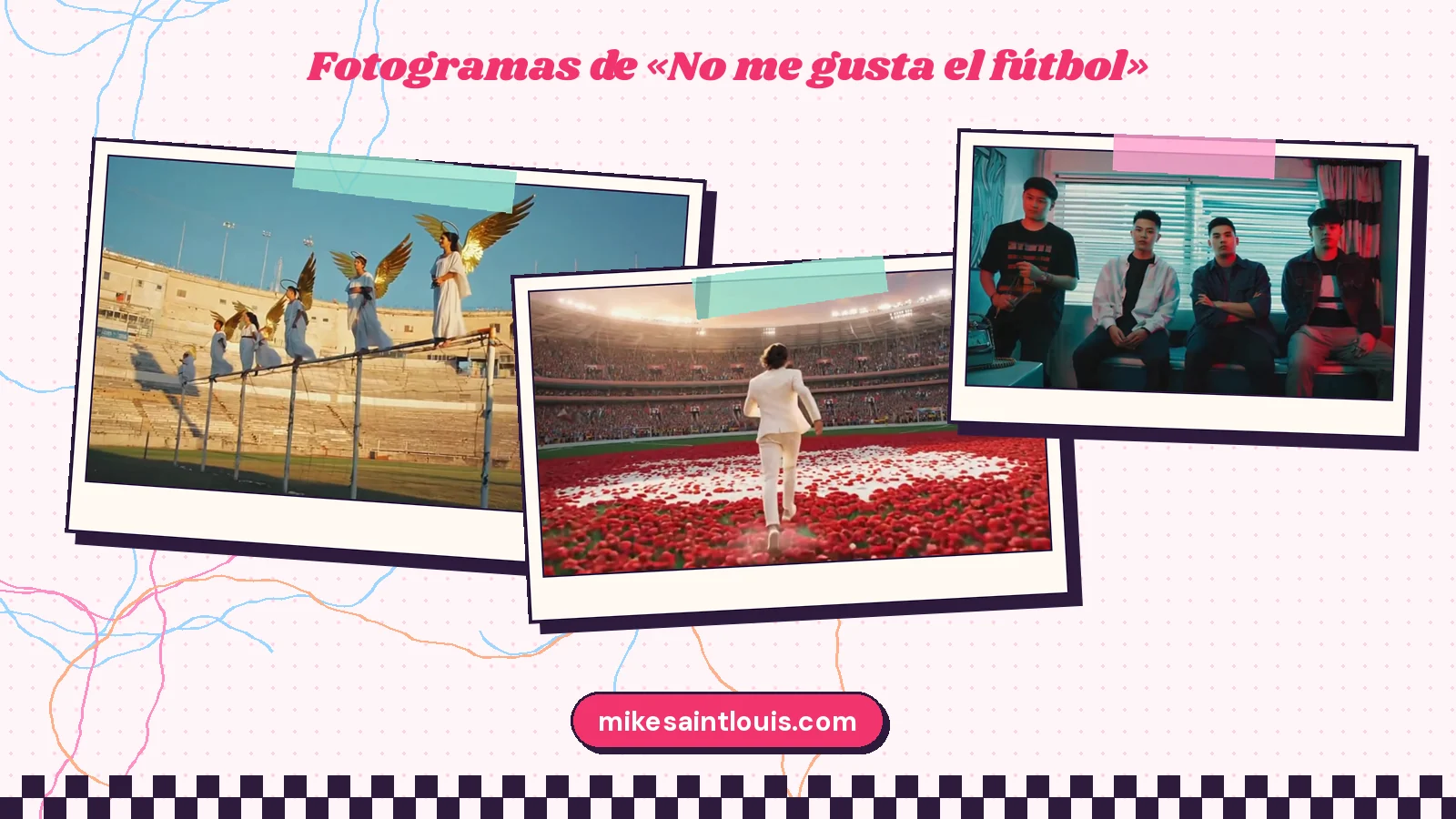
«Discutiendo sobre quién de su novio es el más macho» («Arguing over whose boyfriend is the most macho»)
Two chonis, Spain's answer to the brassy Essex girl, on a ship, competing over who's got the more macho boyfriend. It's the same contest as at the coffee machine, only on the deck of a cruise ship with a piña colada in hand. Who's got the biggest, the strongest, the most into football, the most man.
I love it because it shows that measuring manhood isn't only a men's thing either. We all do it. Girlfriends, mothers, grandmothers, friends. «My son's a proper little man, eh?» «My boyfriend isn't one of those.» Everyone carries a masculinity meter in their pocket and whips it out at the slightest excuse.
The cover of «No me gusta el fútbol» smashes it in their faces. The most macho man in the stadium has a Barbie.
Camp in the stadium
There's something I really like about the image: it doesn't run away from the stadium. It doesn't go somewhere else. It doesn't take refuge in a nightclub or a living room full of cushions. It stays on the pitch, with the floodlights, with the number on the shirt. But it does it its own way.
That matters a lot to me. For a long time, camp boys were offered two options: either fit into the stadium or leave. Either pretend you like football or stay outside the group. The cover proposes a third: I'm staying, but with my pink mohawk and my doll.
It's what I stood up for in «Soy marica sideral», in other words. There, the lyric said that if your macho man gets confused, he should look at my elegance. Here the macho man gets confused on his own pitch, in front of his own fans.
And there's nowhere left to hide.
Number 80
I don't know if anyone's noticed, but the number on the shirt is 80. That's not a normal player's number; in football the classic shirt numbers run from 1 to 11, and a few beyond. 80 is an odd number. A whim.
I'm not going to tell you any secret theory about the 80, because there isn't one I can tell. But I like that it isn't the 9 or the 10, the stars' numbers. I like that it's the number of someone who isn't in the starting line-up. Someone playing a different game on the same pitch.
And it makes me think of the eighties, of course. The decade of mohawks and Alaska on the telly, of the first ones brave enough to walk around Madrid camp enough to be spotted from the other side of Gran Vía. If it's a coincidence, it's a very well-placed one.
What the song isn't
So nobody takes offence, because in this country you have to tread carefully with football.
The song isn't against football. It isn't against fans. It isn't against the maricas who love football, of whom there are loads and I think they're great. There are LGBT football teams in Madrid, there are women players who've come out, there are whole supporters' clubs of maricas who know the line-ups by heart.
It's against the obligation. Against the idea that you have to like it. Against the Monday exam.
If you like football, enjoy it. Shout the goals, insult the ref, cry at finals. I only ask one thing: on Monday, at the coffee machine, when someone says they didn't watch the match, don't look at them funny.
The planet that comes next
In the site's discography, the song sits right before «Descubierto un nuevo planeta llamado GAYFOLK», the one that names the first album. And right after «Flow / We Glow».
I think it's a beautiful order, though I didn't plan it. First you confess you don't like football. And then, straight away, a new planet appears. As if the confession opened the door. As if saying out loud «I don't like it» were the first step towards finding a place where you don't have to.
GAYFOLK, in my universe, is exactly that. A planet where nobody asks you about the match.
An album of liberation
The song is on the third album of the trilogy, «El día de la liberación» («Liberation Day»). And that amuses me, because the liberation it offers is tiny. It isn't a revolution. It isn't a march with banners. It's saying out loud, at a family lunch, that you don't like something you're supposed to like.
But small liberations are the hardest. It's easier to go on a march with a hundred thousand people than to tell your father, on the sofa, that you don't want to watch the match. The first gets you applause. The second gets you looks.
If you've ever had to do the second, this song is for you. And if you haven't dared yet, in A letter to someone who still hasn't told anyone I wrote something that might help. It isn't about football. It's about the other thing.
Shake your feathers on the pitch
There's another song of mine that could play at half-time in this imaginary match, and it's «Mueve las plumas» («Shake your feathers»). I picture the lad from the cover running out onto the pitch with the Barbie in his arms while it blasts from the stadium speakers. The ultras not knowing what to do. The referee checking the rulebook in case anything forbids it.
Nothing does. I've checked.
Well, I haven't checked. But that's how I picture it, and that's what songs are for: imagining things that haven't happened yet and one day will. A whole stadium shaking its feathers. A pink Mexican wave in the stands. A brother-in-law humming along without realising.
Written by me, sounded by machines
As in all my pieces, let me be clear: I wrote the lyrics of «No me gusta el fútbol» myself, without artificial intelligence, even though they aren't up on the site yet. The music and vocals are made with AI tools, Suno among them. I'm a lyricist, composer and producer. I'm not the one on vocals.
And here's something that amuses me: AI doesn't like football either. It doesn't like anything, really, because it has no tastes. It's never had to pretend at a coffee machine. It's never had to hide a doll under the bed. I'm the one who puts in the words, because I know what it's like to be looked at funny on a Monday.
For the next match
My recommendation is the one on the song's page, extended.
Next Sunday there's a big match, the kind that brings the country to a standstill, put it on. In the living room, in the bar, in the car on the way to your in-laws'. If you're on your own, put it on anyway and enjoy not having to watch the match.
And on Monday, at the coffee machine, when they ask whether you saw it, try answering with the truth.
No. I don't like football.
Let's see what happens.
Frequently asked questions
What is «No me gusta el fútbol» about? The lyrics aren't published on the site yet, so Mike Sain't Louis doesn't give them away. The title is a confession, and the cover shows a lad who looks like a player, with a pink mohawk and a pink number 80 shirt, holding a Barbie in his arms instead of a ball.
Is it a song against football? No. According to Mike, it's against the obligation for men to like football in order to fit in, not against the sport or its fans.
Which album is it on? «El día de la liberación», the third album of the Planeta Gayfolk trilogy.
Who does the vocals on his songs? The vocals and music are made with artificial intelligence tools such as Suno. Mike writes the lyrics without AI and is the composer and producer.