
By Mike Sain't Louis ·
The right to a night without drama: «Pura magia», Portuguese and the dance floor as a refuge
Anyone who knows Planeta Gayfolk even a little knows that drama is never in short supply here. Narcissistic exes, nosy neighbours, broken hearts, revenge served with gofio and copla-sized tears. Almost every song has someone who has hurt someone, and almost every lyric settles a score with the past.
And suddenly, in the middle of all that, along comes «Pura magia» (Pure magic). A song with no ex, no reproach and no wound. Just a night, some lights, a beat and an invitation: «vem cá dançar comigo», come here and dance with me. And in Portuguese, what's more.
On the song's own page I've already said that the story is minimal, and the full lyrics are published. Here I want to defend something that sometimes looks minor and isn't: the right to a night without drama. And along the way, talk about what changes when a lyric is written in another language, and why the dance floor has been, and still is, one of the great refuges for queer people.
A lyric without conflict
The first thing you notice about «Pura magia» is what it lacks. Most songs tell you something that happens: someone leaves, someone comes back, someone lies, someone realises. There's a before and an after, a problem and a reaction. Not this one.
The published lyric is almost a list of sensations. The lights shine in the city. The night is all about fun. Let the beat carry you. Feel the emotion. Loud sound vibrates in the air. Hearts beat in rhythm. Dancing non-stop. Endless night.
There are no named characters, no past, no tomorrow. Everything happens in a continuous present, the present of the dance floor, where time works differently. It's a lyric that doesn't move forward, that keeps circling the same moment, the way you do when the music is very loud and you don't want it to end.
It may not look like much, but writing like this is harder than it seems. Without conflict, a song depends entirely on its images and its rhythm. There's no story to lean on. You have to make a line like «noite de pura magia», a night of pure magic, sound like exactly that, like magic, and not like a cliché.
Why a song like this is needed
In a catalogue full of drama, a song without drama is almost an act of rebellion. And I think it matters that it exists, for several reasons.
The first is that life isn't only pain. If a catalogue only talked about break-ups, lies and betrayals, it would be telling an incomplete version of things. There are good nights too. There are moments when nothing bad is happening and you're simply fine, surrounded by people, with the music turned up. Those moments deserve their song as much as the others.
The second is that joy is also a form of resistance. For many queer people, for a long time, life was made of fear, of hiding, of putting up with things. Being able to go out one night, dance without looking back and feel free isn't frivolous. It's something many people fought for. Celebrating it is a way of honouring that fight.
And the third is simpler: the body needs it. After so much crying, so much anger and so much score-settling, you need a breather. A song for not thinking. For letting the beat carry you, as the lyric says.
Changing language
«Pura magia» is written in Portuguese, and that changes a lot.
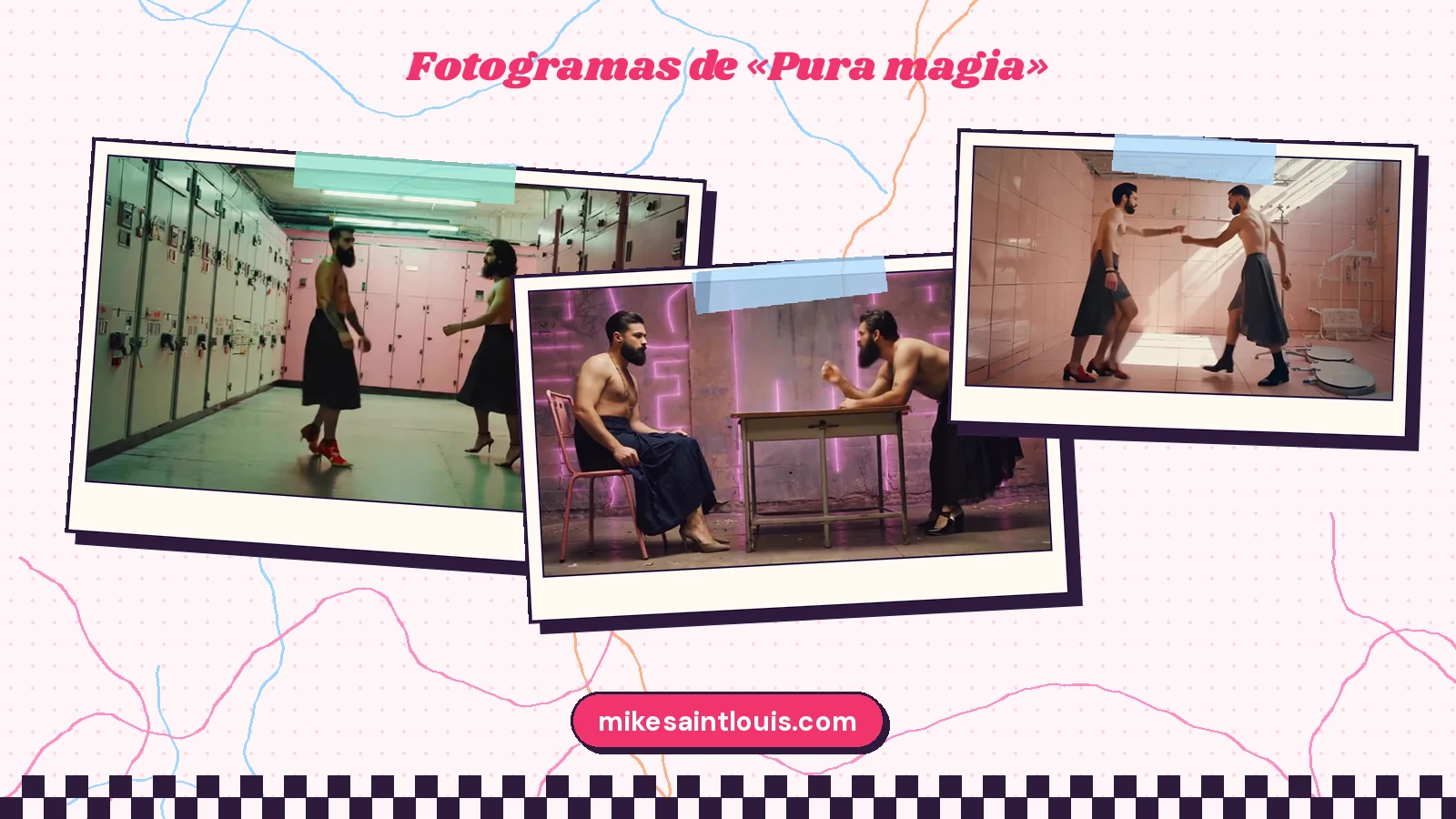
Portuguese is a sister language of Spanish. A Spanish speaker understands a good part of the lyric effortlessly: «luzes», «cidade», «noite», «diversão», «emoção», «corações», «ritmo». But not all of it, and that small distance has a curious effect. The words sound familiar and foreign at the same time. Like being on holiday somewhere that looks like home but isn't.
That feeling suits a party song very well. A night out has something of a journey about it too. You get ready, change your clothes, change your attitude, and for a few hours you're a slightly different version of yourself. Changing language in the lyric is like changing outfits: the same body, a different skin.
What's more, Portuguese is a huge language. It's spoken by more than two hundred million people across several continents, from Portugal and Brazil to Angola and Mozambique. Writing in Portuguese opens the door to another audience, to other dance floors, to other nights.
What's lost and what's gained
When you change language, something gets lost. In Spanish, my lyrics play a lot with street expressions, double meanings, creative insults, references to TV or the local supermarket. All of that is very hard to carry across. In Portuguese, «Pura magia» has no jokes of that kind. It has no irony. It's direct.
But something is gained too. Precisely because there's no joke, the song can be sincere in a way I find harder in Spanish. Lines like «seu sorriso ilumina como um verão», your smile lights up like a summer, or «somente a lua nos guia», only the moon guides us, might sound corny to me in Spanish. In Portuguese they sound beautiful. The borrowed language gives permission for tenderness without embarrassment.
I think that's an interesting lesson for anyone who writes. Sometimes, to say something simple without it sounding ridiculous, you need to change tools. Just as there are things you only dare say in an audio message at three in the morning, or in a letter you never send, there are things that only come out right in another language.
The images of the night
Short as the lyric is, it's full of very concrete images. They're worth looking at one by one.
The city lights, shining. It's the first image and it sets everything in motion. The city at night is another city. Streets that are grey by day fill up with neon, street lamps and lit shop windows.
The sea of neon. «Neste mar de neon», in this sea of neon. I love that image because it turns the dance floor into an ocean of light, something you can dive into. Neon turns up a lot in the catalogue, for example in «Ataúd de neón», Neon coffin, but here there's nothing dark about it. It's just light and colour.
The moon as a guide. «Somente a lua nos guia». Amid so much artificial light, the lyric remembers the moon, the night's only natural light. As if to say that, among all that neon, there's still something ancient showing us the way.
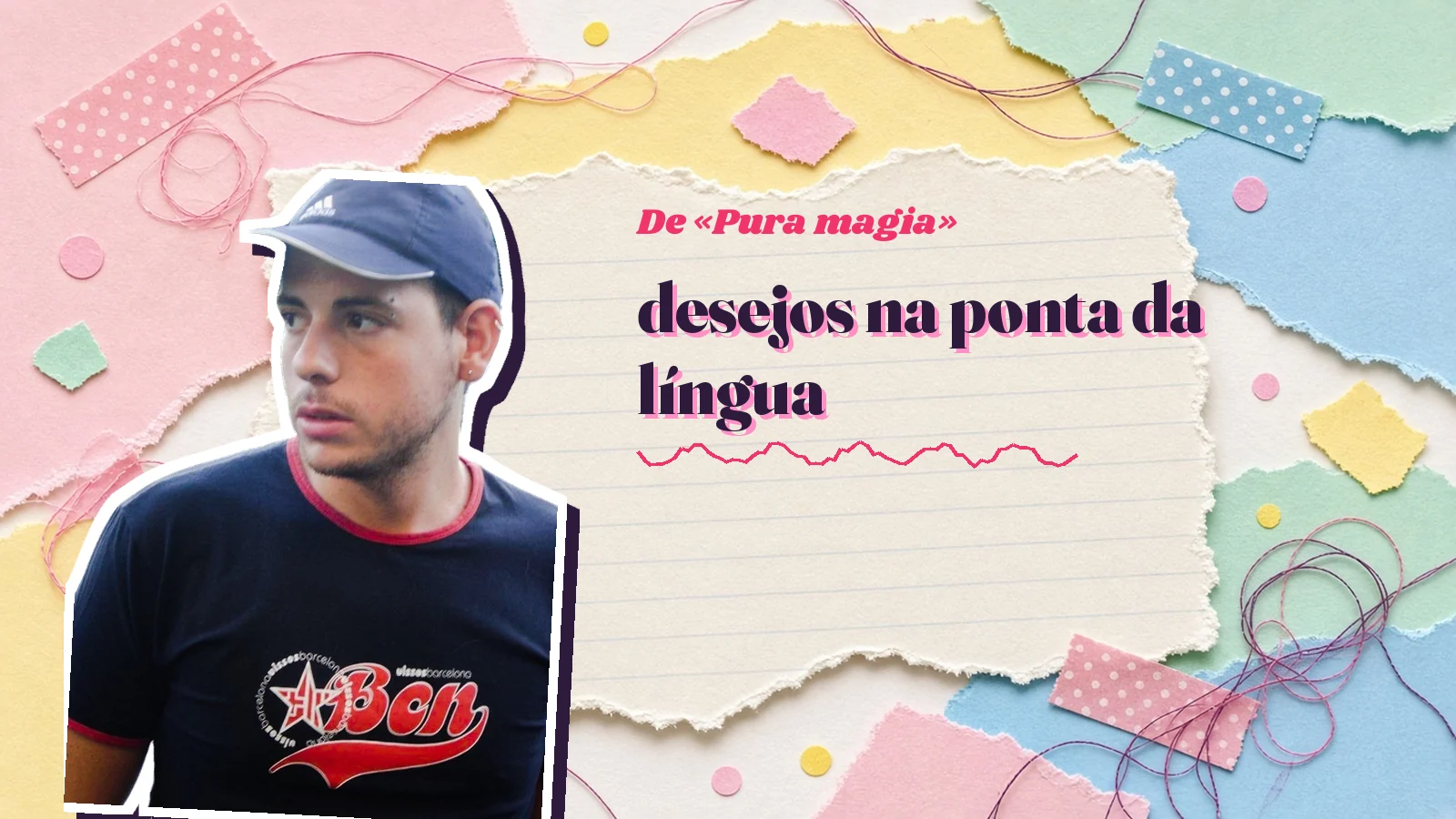
The shooting star. «Brilha estrela cadente», shine, shooting star. It's the image of wishing par excellence: when you see one, you make a wish. And right after, the lyric says «desejos na ponta da língua», wishes on the tip of the tongue. Wishes are no longer made in silence, looking at the sky: they're right there, about to be spoken.
And summer. «Seu sorriso ilumina como um verão». Someone's smile compared to an entire season. It's a very luminous way of saying you like someone.
«Vamos ser um só»
There's a line in the chorus that I think is the heart of the song: «vamos ser um só», let's be one.
On a packed dance floor, that's literally what happens. Bodies move to the same beat, people mingle, the boundaries between one person and the next blur. For a while, the crowd becomes a single organism pulsing with the music. Anyone who has danced at a big party knows that experience.
That «being one» has a romantic reading too: two people who meet on the dance floor and become one. But I prefer the collective reading. The idea that on the dance floor there are no isolated individuals, but a community. That a party is something we make together.
And that brings me to the idea of the dance floor as a refuge.
The dance floor as a refuge
The history of queer culture is closely tied to the history of the night. For decades, in many places, bars and clubs were almost the only spaces where LGBTQ+ people could meet, get to know each other and be themselves without hiding. Outside, the street was dangerous. Inside, there was music, lights and people like you.
That's why, for us, the dance floor has a value that goes far beyond fun. It's a space of freedom. A place where the body can move however it wants, where nobody looks at you funny for how you dance or who you dance with. A place where, for a few hours, the outside world stops existing.
Many of the great moments of queer culture have passed through there: disco music, the clubs of the big cities, Pride parties, drag nights. The dance floor has been refuge, school and family. And even though today, in many places, life outside the club is much freer than it used to be, that memory is still there.
«Pura magia» doesn't talk about any of this explicitly. The lyric mentions neither Pride, nor the struggle, nor history. But when it says «nossa festa não termina», our party doesn't end, I can't help reading it from there too. Our party. The party of everyone who danced before us, when dancing was a risk.
Dancing as a way of being well
There's a line in the lyric that looks very simple and runs deep: «cada passo é vida», every step is life.
Dancing is one of the oldest ways of feeling alive. Before almost anything else existed, people were already dancing: to celebrate, to say goodbye, to call on something, to fall in love. The body moving to the rhythm of something is one of the most universal human experiences.
And it's also a way of looking after yourself. Lots of people know from experience that dancing lifts your mood, releases tension and helps you switch off from your worries. When you're on the dance floor you can't think too much. The beat carries you, as the song says. And in that not-thinking there's something very close to rest.
That's why I like that, in a catalogue with so many sad songs, there's one that simply invites you to move. Not to forget your problems, because the problems are still there the next day, but to have a while when they don't weigh on you.
A sister of other nights
«Pura magia» isn't alone in the catalogue. Other songs share that summery, party light, like «Sunshine», «Summer vibes», «Me gusta el verano», I like summer, or «Ride the wave», whose title already invites you to let go. And there are others that look at the night from the opposite side, like «La noche no es para mí», The night isn't for me.
I like that they coexist. The night isn't the same for everyone, or for the same person at every moment. There are nights of pure magic and nights when you'd rather stay home. Both are legitimate, and both have their song.
I also like thinking of «Pura magia» alongside the posts I've written about partying and drag, like the one about the first drag and drag as a party. The same idea runs through all of them: celebrating isn't a way of running away from who you are, but of showing it.
«Vem cá dançar comigo»
The chorus of «Pura magia» is a direct invitation: «vem cá dançar comigo, sentir essa energia, vamos ser um só, noite de pura magia». Come here and dance with me, feel this energy, let's be one, a night of pure magic.

What I love most about that invitation is that it asks for nothing in return. No conditions, no calculated seduction, no power games. It's what you say to someone on the dance floor when a song you adore comes on and you want to share it. Come, dance, feel this with me. That's all.
Compared with other songs in the catalogue, where approaches usually hide traps, lies or ulterior motives, this invitation is almost disconcertingly clean. Nobody is going to manipulate anybody. Nobody is going to vanish the next day. Or if they do, it doesn't matter, because what mattered was the dance.
The chorus repeats several times in the published lyric, as it does in almost every dance song. And that repetition has its logic. On the dance floor, lines aren't heard once and analysed. They're repeated until they become part of your body. There comes a point when you're no longer listening to the lyric: you're dancing it.
Writing joy without clichés
I said earlier that writing a happy night is harder than it looks, and I want to dwell on that, because I think it's one of the great challenges of the craft.
Pain has details. When someone hurts you, you remember exactly what they said, where you were, what they were wearing. That's why sad songs and break-up songs are full of concrete objects, verbatim lines and recognisable settings. Pain sticks to things.
Joy, on the other hand, tends to dissolve. When you're happy, you don't pay as much attention to the details. You remember the feeling, not the scenery. And that's why, when you try to write about joy, it's very easy to fall back on the usual words: night, lights, dancing, heart, magic. They all appear in «Pura magia», of course. The question is what you do with them.
I think the song solves it in two ways. The first is the language, which I've already talked about: in Portuguese, those familiar words sound a little new. The second is a handful of images that break the mould, like that sea of neon or those wishes on the tip of the tongue. They're not grand metaphors, but they're enough to give the night some texture.
I'm not claiming «Pura magia» is a masterpiece of poetry. It's a dance song, and a dance song has to be light. But I care that the lightness is well made. That joy sounds like joy and not like a soft-drink advert.
The night that doesn't end
Two lines in the lyric repeat the same idea in different words: «noite sem fim», endless night, and «nossa festa não termina», our party doesn't end.
We all know nights end. The lights come on, the music stops, someone shouts that this is the last one. And we spill out into the street with aching feet and the sun coming up. But there's a moment in the night, right in the middle, when it feels as if it will never end. That moment is what the song captures.
I like that the lyric stays there, in the illusion of the infinite, and doesn't tell you how it ends. No lights coming on, no hangover, no journey home. The song freezes the night at its best moment, like a photograph. And whoever listens can go back to that moment every time they press play.
There's something very queer about that resistance to the end of the party. In nightlife culture, the after-party, the party that carries on when everywhere else has closed, has an almost symbolic value. It's refusing to be sent home early. Our party doesn't end, says the song. Not because it won't ever finish, but because we don't want others deciding when it does.
Dancing alone counts too
I talk a lot about the dance floor and the crowd, but I want to say something about dancing alone. Because «Pura magia» works in an empty room too.
Plenty of people don't go out at night, whether by choice, tiredness, work, shyness or because party venues don't feel safe or accessible to them. For them, the idea of the dance floor as a refuge may sound distant. And yet dancing doesn't need a club. A song and a little space are enough.
Dancing alone at home, with the music loud and nobody watching, is one of the freest ways to dance there is. You don't have to do it well, you don't have to impress anyone, you don't have to follow any steps. Just move. And when the lyric says «deixe a batida te levar», let the beat carry you, that holds just as true in the living room as in the best club in town.
The day of liberation
The song is part of «El día de la liberación», The day of liberation, and the album's title gives «Pura magia» one more layer. A party night without drama, after so much drama, has something liberating about it. It's the day, or the night, when you finally let go.
I won't say more about the album than its title does, but I like that such a luminous song lives under that word. Liberation. As if, after so many score-settling songs, the moment had finally come to stop looking back and start dancing.
What doesn't need explaining
Some songs need a post like this to be better understood. «Pura magia» doesn't. You get it the first time, even without knowing Portuguese. You just have to play it loud.
If I've written so much about it, it's because I think simple songs tend to get less attention than they deserve. People assume joy is easy and that only pain has depth. I disagree. Writing a happy night without falling into cliché is a challenge. And so is defending the right to that night, in a world that sometimes seems determined to take it from us.
How to listen
The song is on the singles page and on every platform, and you can download it from the downloads section. My recommendation: put it on before you go out, while you're getting ready. Or put it on at home, in the kitchen, and dance even if nobody's watching. A night of pure magic can start in the living room too.
As a lyricist, composer and music producer, I really enjoy going from a spite song to one like this. The music and the performances are generated with artificial intelligence, but the urge to dance is one of the most human things I know.
Frequently asked questions
What is «Pura magia» about? It's about a night out in the city: lights, rhythm, people dancing and an invitation to let yourself go. It's a song without conflict or drama, focused on the joy of the moment and on the dance floor as a meeting place.
Why is it in Portuguese? The lyric is written in Portuguese, a sister language of Spanish that is largely understandable without effort and that gives the song a different tone, more direct and tender than the Spanish-language lyrics in the catalogue.
Which album is it on? It's part of «El día de la liberación», one of the albums in Mike Sain't Louis's Gayfolk trilogy, available on Spotify and all other platforms.
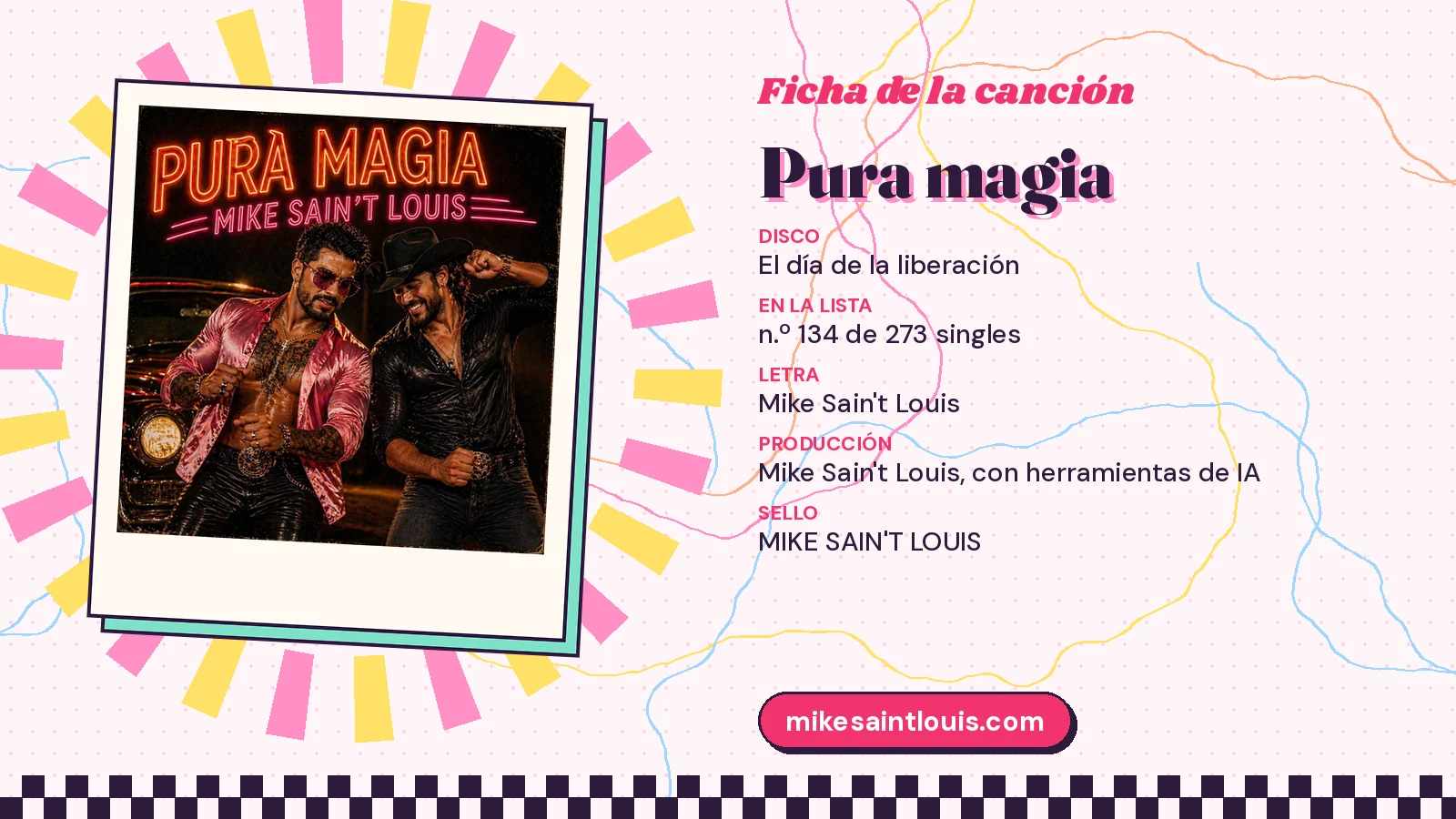
Who makes this song? Mike Sain't Louis, a lyricist, composer and music producer who calls himself the first AI songwriter: he writes the lyrics and directs the production, and the music and vocal performances are generated with artificial intelligence.