By Mike Sain't Louis ·
Use and throw away: Trasto viejo, the recycling point and people treated like furniture
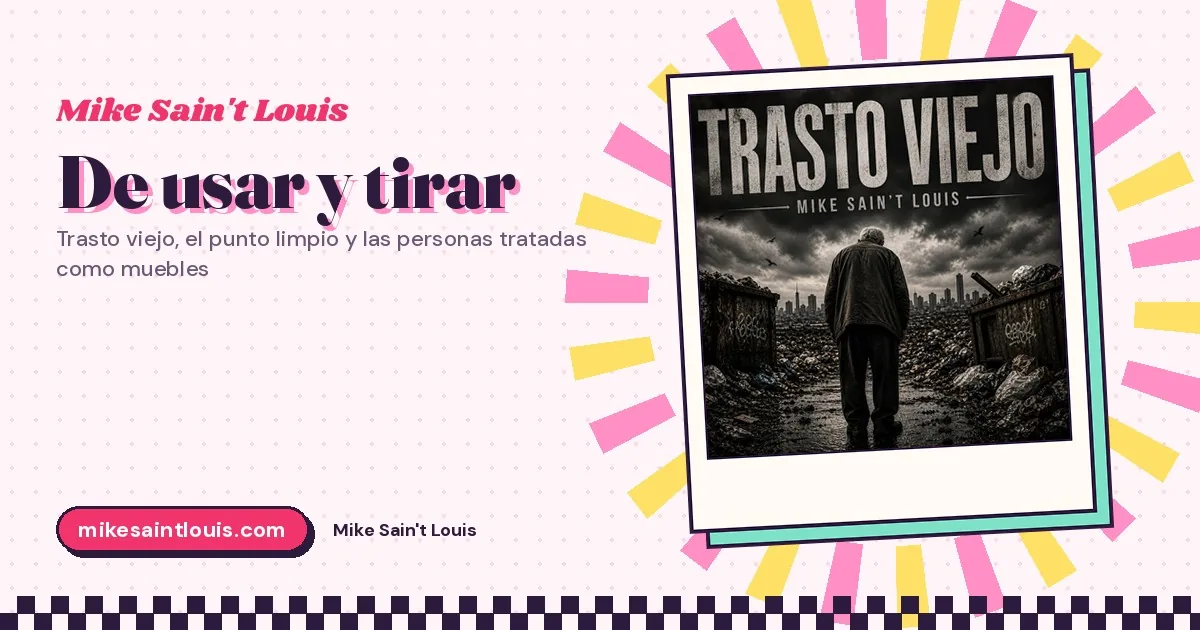
Some lyrics need paragraphs to explain themselves, and some explain themselves with a single word repeated to exhaustion. Trasto viejo (Old junk) is the second kind. It barely has a complete sentence. It has one word, a handful of adjectives and a route that runs from use to the rubbish tip. And that's enough to tell a story anyone who has come out of a difficult relationship will recognise instantly.
On the song page I talked about the double reading, about whether the junk is the one suffering or the one finally exposed, and about its playground-chant shape. Here I want to do something else. I want to look at the song from the objects' side: what we do with what we no longer want, how we throw it out, where we leave it, and what happens when we apply that same logic to a person. The full lyrics are published and very short, so it's worth reading them before going on.
An inventory in one word
The first thing that stands out is the economy. The lyrics don't describe the junk in detail. They don't say what colour it is, what shape, or where it came from. They just keep hanging labels on it. The chorus sums it up in one go:
«Trasto viejo, tirado, olvidado»
("Old junk, thrown out, forgotten.") Add to that filthy, useless, used, finished. Each label is one more step towards the bin.
It's like the inventory someone makes when clearing out a flat. There's no time for nostalgia. You look at the object, give it a word and decide its fate. This is useful, this isn't. This stays, this goes down to the street.
That coldness is exactly what's frightening. Because the adjectives hung on the junk are the same ones someone can end up feeling about themselves after a relationship in which they were treated like an object. Used. Useless. Forgotten. They're furniture words, but they hurt like people words.
From the living room to the pavement
We all know the route an old piece of furniture takes. First it's in the living room, in its place, doing its job. Then it starts getting in the way. It gets pushed into a corner, a spare room, a storage unit, the back of a wardrobe. And one day someone decides that's it, there's no room for it, and carries it down to the street.
In Madrid that moment has an unmistakable image: the sofa, the mattress or the bedside table waiting next to the bin. Sometimes for days. The city council has a service for collecting furniture and household items, and there are recycling points for whatever doesn't fit in the ordinary rubbish. But the sight of junk abandoned on the pavement is as much part of the city as its café terraces.
The song follows exactly that path, just compressed into a few lines. From use to abandonment, from abandonment to the tip. There's no stop along the way. No attempt to fix it or give it to someone who could use it. Straight into the bin.
The furthest bin
There's a detail in the lyrics that strikes me as a small masterpiece of everyday cruelty. The junk isn't left just anywhere. It's left in the furthest bin.
«Contenedor más apartado»
That choice ("the most out-of-the-way bin") says a great deal about the person throwing it away. Getting rid of the object isn't enough. It has to be moved away, put where it can't be seen, where you won't bump into it on your way to buy bread. It's the difference between throwing something away and wanting to forget it.
In a relationship, that out-of-the-way bin takes many forms. Blocking someone on every social network. Changing your usual bar. The version of the story told to mutual friends so nobody asks. Removing someone from your own landscape so you don't have to look at what you did to them.
What gets in the way and what stinks
The lyrics give two reasons for throwing the junk out: it's in the way and it stinks. Those are two very different verbs. Being in the way means taking up space someone else wants. Stinking means polluting the air.
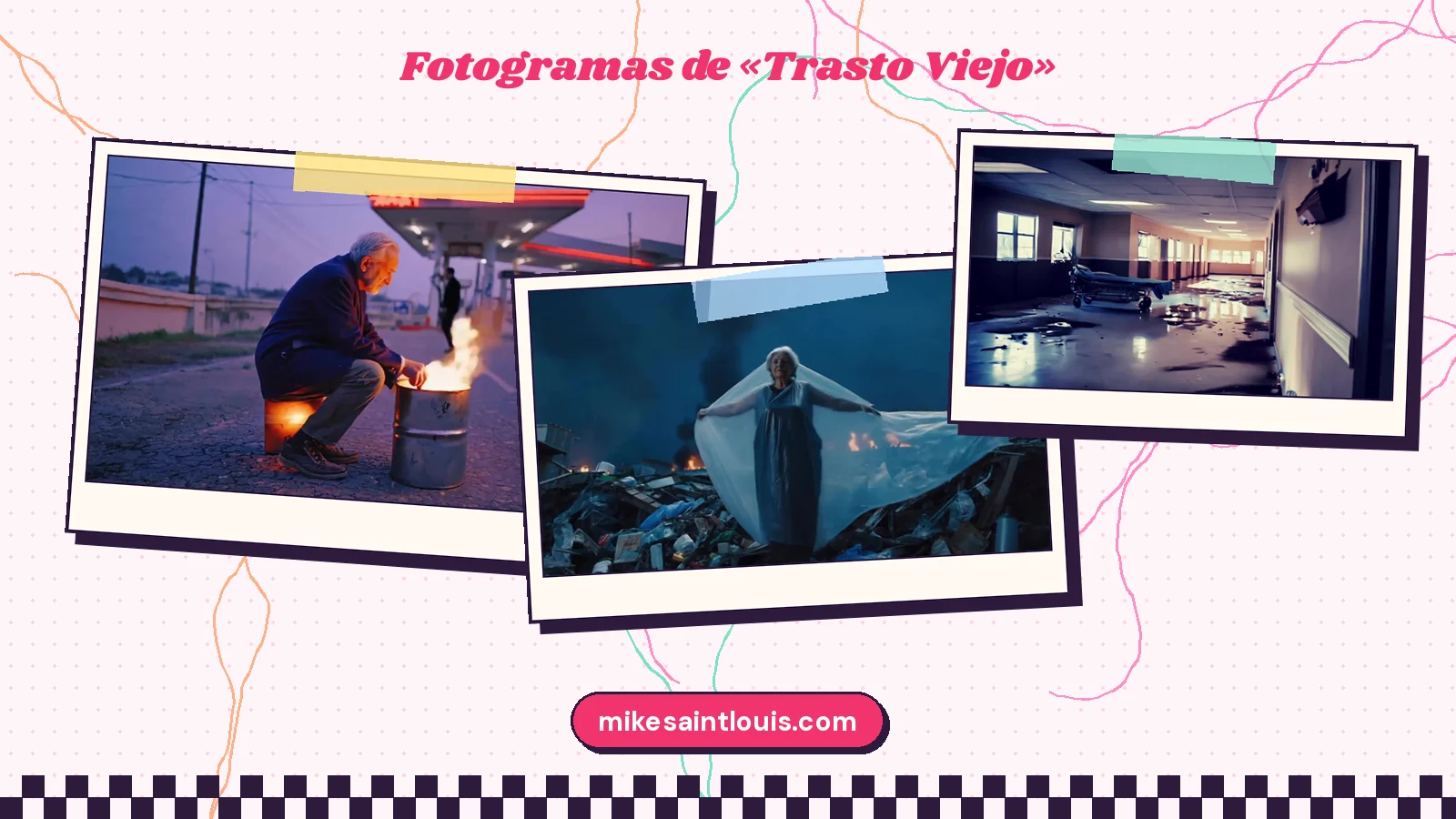
When an object is in the way, the problem is space. When it stinks, the problem is living together. And in relationships both happen. Some people get pushed aside because they're in the way of someone else's plans, and some get pushed aside after being accused of poisoning the atmosphere, even when the smell is coming from somewhere else.
That second possibility interests me. Whoever throws something out because it stinks rarely asks why it stinks. Maybe it was badly stored. Maybe nobody looked after it. Maybe it went bad precisely because of how it was treated. The song doesn't say, but it leaves the suspicion hanging in the air.
Use and throw away
We live in a throwaway culture. Razors, plastic cups, clothes that fall apart after three washes, phones that stop getting updates after a few years. We've got used to things having a use-by date and to replacing them instead of repairing them.
Some people argue that this logic has also crept into our love lives. Dating apps, with their endless catalogue of profiles, make it easy to feel that there's always someone else available, newer, shinier. If something goes wrong, you swipe and move on to the next one.
Trasto viejo doesn't make a speech about this, but it embodies it. It's the song of someone who has been treated like a product with an expiry date. Used while it was useful, thrown away when it stopped being useful. And it tells the story with the same dry vocabulary you'd use for a household appliance.
The planned obsolescence of love
There's a concept everyone knows even if they can't quite explain it: planned obsolescence. The idea that some products are designed not to last, so you'll have to buy another one. The classic example is the light bulb, whose manufacturers agreed a century ago to limit how long bulbs would last.
Applied to relationships, the concept is chilling. Some bonds seem designed to expire. From the start, one side knows it has an end date, that they're only interested as long as they're getting something out of it. The other side doesn't know. They put in hope, time and energy. And one day they find out they were never on the list of things to keep.
To me, that's the most painful reading of Trasto viejo. Not an object that wears out through use, but one that was always destined for the tip, even if for a while it seemed to occupy the best spot in the living room.
The discard phase
Anyone who has read a little about relationships with narcissistic people knows the pattern usually described in three phases: idealisation, devaluation and discard. First they put you on a pedestal. Then they chip away at your worth bit by bit. And finally they throw you out, often suddenly and without explanation.
Trasto viejo sounds like the soundtrack to that last phase. The discard isn't experienced as a break-up between equals, but as something that happens to an object. There's no conversation, no goodbye. There's a trip to the furthest bin. And the person discarded is left feeling that they really were worthless.
The catalogue has a song with that phase in its title, El descarte del narcisista (The narcissist's discard), and another that draws the whole character, El narcisista (The narcissist). Trasto viejo is the version without explanations, the one that only leaves the list of labels the discarded person ends up wearing.
Labels that stick
The most dangerous thing about the words the lyrics repeat is that they stick. If someone keeps telling you you're junk, you end up looking at yourself as junk. It's a well-known mechanism in psychologically abusive relationships: the person on the receiving end internalises the gaze of the one who despises them.
That's why the song's structure, hammering the same words again and again, works so well. It imitates the pounding. When you listen, you feel the weight of each adjective landing on top of the last. It's not a description. It's a pile-up.
And yet there's something liberating about putting it all into a song. Naming the labels is the first step to peeling them off. While they're inside your head, they seem like truths. When they're said in a lyric, you see them for what they are: words someone stuck on you.
The other reading: the ex as furniture
As I said on the song page, the song can be read the other way round. The junk might be the ex. The person who finally sees clearly who hurt them and puts him where he belongs: on the pavement, next to the bin, with his smell and his uselessness.
In that reading, the song is a deep clean. One of those afternoons when you decide you've had enough of keeping things that are no use. The photos, the presents, the hoodie he left behind. Everything into a bag, the bag into the street and the street as far away as possible.
I like the two readings living side by side. Because in real life both happen, often in the same process. First you feel like the junk. And one day, without quite knowing how, you realise the junk was the other one.
Tidying the house, tidying your head
In recent years a way of tidying the house has become fashionable that involves picking up each object and asking whether it makes you happy. If the answer is no, you thank it for its service and let it go. The idea became famous thanks to the Japanese organiser Marie Kondo, who turned home tidying into a worldwide phenomenon.
There's a bit of that in the second reading of Trasto viejo, though with far less delicacy. There are no thank-yous here. There's a filthy, useless piece of junk going to the tip. But the underlying gesture is the same: letting go of what weighs you down so the house can breathe.
Tidying the house and tidying your head are very alike. Both mean deciding what stays and what goes. And in both, the hardest moment isn't throwing things out, but admitting that something that once sat in the middle of the living room no longer has a place.
An album for letting go
The song belongs to El día de la liberación (Liberation day), an album whose title says it all. The title track celebrates the day the wounds finally stop bleeding and it's clear who has won. Trasto viejo is one step along that road, the moment you take the rubbish out.
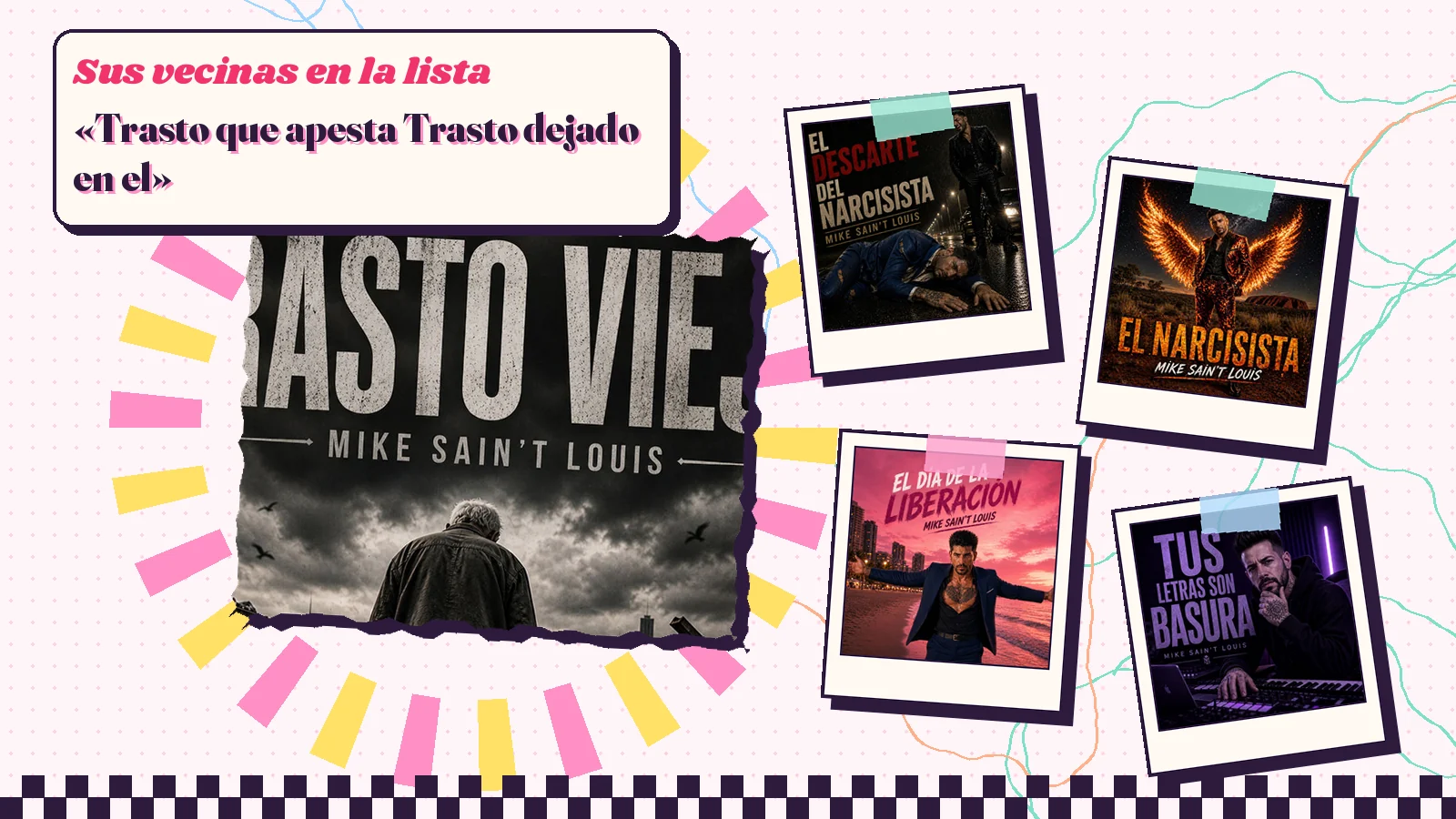
The same album includes Tus letras son basura (Your lyrics are rubbish), which plays with the word rubbish from another angle: that of someone answering the people who looked down on what he wrote. Rubbish, junk, tip. The album has a vocabulary of waste that's no accident. Talking about liberation means talking about everything you leave behind.
I like to think of the album as a house move. Some songs pack, some throw away and some move into the new place. Trasto viejo is clearly one of the ones that throw away. And as with any move, throwing things away is what costs the most and brings the most relief. When you take the last bag down and come back up, the flat looks bigger. Not because anything has changed, but because at last there's air where before there were things that no longer belonged to you. That sense of reclaimed space is what I'd like the song to leave behind.
The chant as a weapon
Repetition has a long tradition in popular music. Nursery rhymes, football chants, playground counting games. Repeating a word empties it of meaning and, at the same time, charges it with energy.
In Trasto viejo, repetition works like a spell. The word junk appears so many times it stops being a word and turns into a rhythm. And that rhythm is easy to remember, easy to chant along to, easy to use. It's a song that sticks, and that makes it a tool. You can put it on whenever you need to remind yourself that something, or someone, no longer has a place in your life.
Not everything needs poetry. Sometimes one ugly word said many times works better than a hundred metaphors. It's a lesson I've learned writing lyrics: directness, when it hits the mark, gets there faster than anything elaborate.
The last adjective
The chorus always ends in the same place, and that's no accident. After the whole list of furniture insults, the last words change register:
«Abandonado, utilizado»
("Abandoned, used.") Filthy, useless or old describe the state of the object. Abandoned and used describe what someone did to it. There's a hidden subject there. Nobody abandons themselves and nobody uses themselves. With those two words, the song stops talking about the junk and starts talking about whoever threw it away.
That tiny grammatical shift is, for me, the key to the lyrics. For most of the chorus it seems the object is to blame, for being dirty, for being useless, for getting old. And in the last line the truth slips in: someone used it and someone dumped it. The junk didn't become junk on its own.
Tip, bin, storage room
The lyrics use a very specific vocabulary of places for things nobody wants. The tip, the bin, and one that never appears but hovers around them: the storage room. Each is a different stage of abandonment.
The storage room is the waiting room. That's where things go that we no longer use but don't yet dare throw out. Exercise bikes, ugly presents, moving boxes that were never opened. Plenty of people keep relationships in storage mode: they don't live them, but they don't let go of them either, just in case.
The bin is the decision. Taking something down to the street means there's no going back, or almost none. And the tip is the end of the line, the place where nobody is going to rescue anything. The song skips the storage room and goes straight to the last two stages. There's no waiting room for this junk. And depending on how you read it, that's either cruel or a relief.
What a street word says
Trasto is a word with a lot of life in everyday Spanish. It isn't only used for objects. You say it fondly to a child who can't sit still: "you little rascal". You say it about a car that causes more problems than it solves. And you say it, with contempt, about a person who's no longer good for anything.
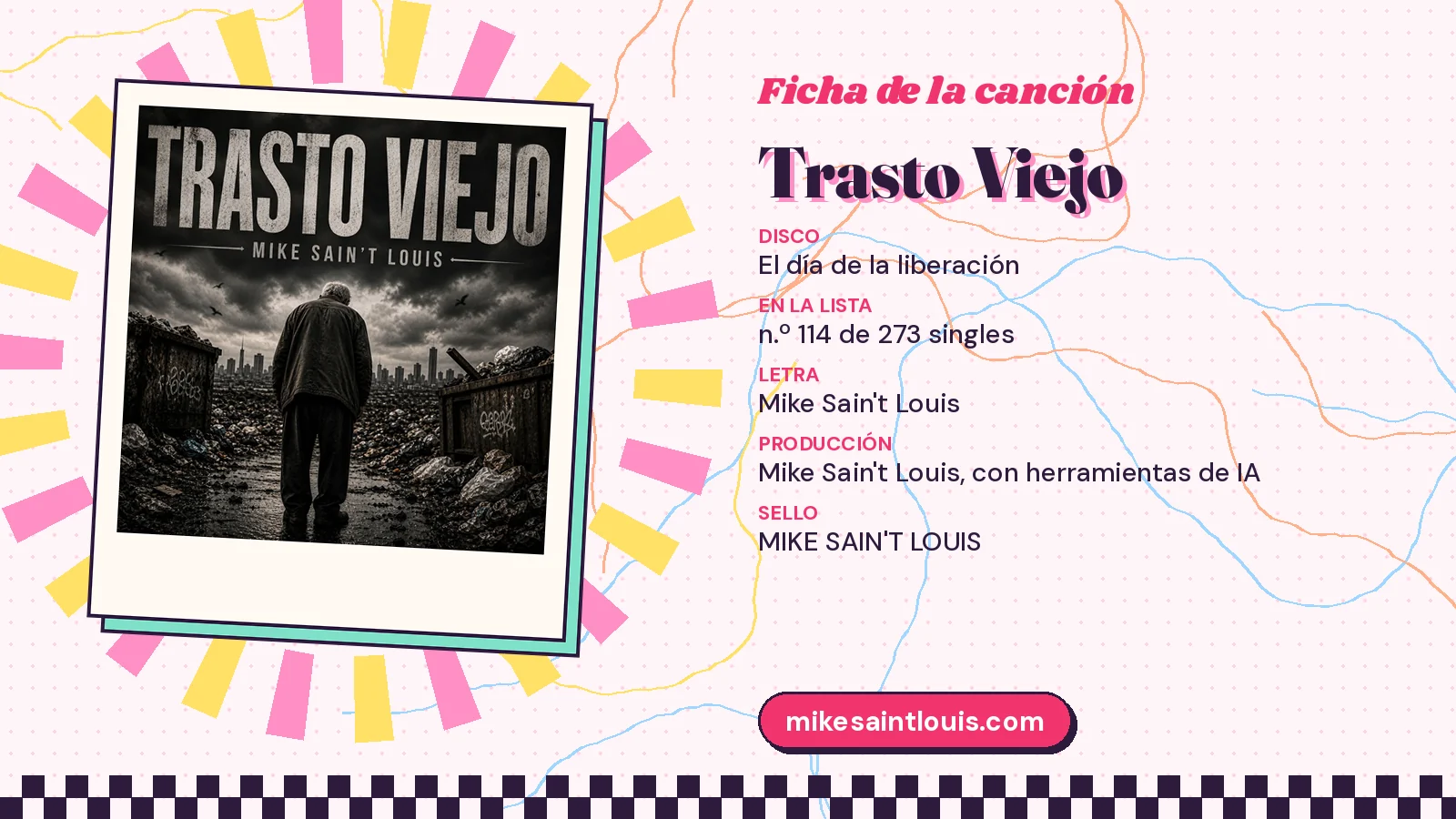
That range of uses makes the word work very well in a song. It has an endearing side that makes it less brutal than other insults, and at the same time an undertone of contempt you can't ignore. When the lyrics repeat it with all those adjectives behind it, the affection vanishes and only the contempt is left.
I like writing with words like that, words everyone uses without thinking and that, put in exactly the right place, reveal everything they carry inside. It's one of the things I enjoy most about writing in street Spanish: the words already come loaded with history.
What the junk knows
There's one last thought I like to leave here. Old objects hold memories. The sofa remembers the film afternoons, the table remembers the dinners, the mattress remembers the good nights and the bad ones. That's why they're sometimes so hard to throw away. We're not throwing out a piece of furniture, we're throwing out what we lived with it.
Whoever treats a person like junk is also trying to throw out that memory. They want to get rid of what happened so they don't have to answer for it. If the junk disappears into the furthest bin, nobody will ask what went on in that living room.
But the memory doesn't leave with the furniture. It stays with whoever lived it. And that memory, told in a lyric, is what ends up turning the question back on whoever threw the junk away. In the end, the song is the junk speaking. And junk that speaks is no longer junk.
Restoring
There's an ending the song doesn't tell but that I like to imagine. Not all junk stays at the tip. Some people walk the pavements looking for abandoned furniture, take it home, sand it, paint it and give it a second life. A chair someone threw away ends up being somebody else's favourite.
That's my most hopeful reading. If you've ever felt like the junk in the song, remember that old furniture can be restored too. That the person who threw you out wasn't the only one who could see you. That there are eyes capable of looking at a scratched piece and seeing everything it can still become.
I don't say this to sweeten the song, which is harsh and should be. I say it because life goes on after the tip. And very often the best thing that ever happened to you starts exactly when someone decided you were no longer any use.
Who this song is for
For anyone who has ever felt used and then left on the pavement. For anyone in the middle of clearing out their life who needs a soundtrack for taking the bags down. For anyone who has found out the junk was the other one.
And for anyone who enjoys minimal lyrics, the ones that say more with four repeated words than a three-page letter.
How to listen
The song is on the singles page and on every platform, and you can download it from the downloads section. Listen to it on a clear-out day, with the windows open and the bags ready.
As a lyricist, composer and music producer, I'm very interested in finding out how much can be told with very little. The music and the vocals are generated with artificial intelligence, but the feeling of being treated like furniture, and of shaking it off, is as human as anything I know.
Frequently asked questions
What is Trasto viejo about? About an object that is used, abandoned and ends up in the most out-of-the-way bin. The lyrics describe it only with adjectives (used, useless, old, abandoned) and leave open whether the junk is someone who was mistreated and discarded or an ex who is finally exposed.
Which album is it on? El día de la liberación (Liberation day), an album about leaving harmful relationships behind, which also includes El día de la liberación and Tus letras son basura.
Is it about narcissism? The song doesn't name it, but it fits what is usually called the discard phase in relationships with narcissistic people, a subject that appears in other songs in the catalogue such as El descarte del narcisista.
Who makes this song? Mike Sain't Louis, a lyricist, composer and music producer who calls himself "the first AI songwriter": he writes the lyrics and directs the production, and the music and vocals are generated with artificial intelligence.