
By Mike Sain't Louis ·
You disgust me, I disgust myself: the word «asco» there and back in my lyrics
A forgotten Tupperware at the back of the fridge. You open it. You don't even need to look: your nose has already decided. You snap the lid shut, bin it, box and all, and wash your hands twice even though you haven't touched a thing.
That's disgust. Asco, in Spanish. And it is, oddly enough, one of the words that turns up most in my break-up songs.
«Amore, Sinceramente das asco / Das asco, ¡y estoy harto!» "Amore, honestly, you're disgusting / You're disgusting, and I'm sick of it!"
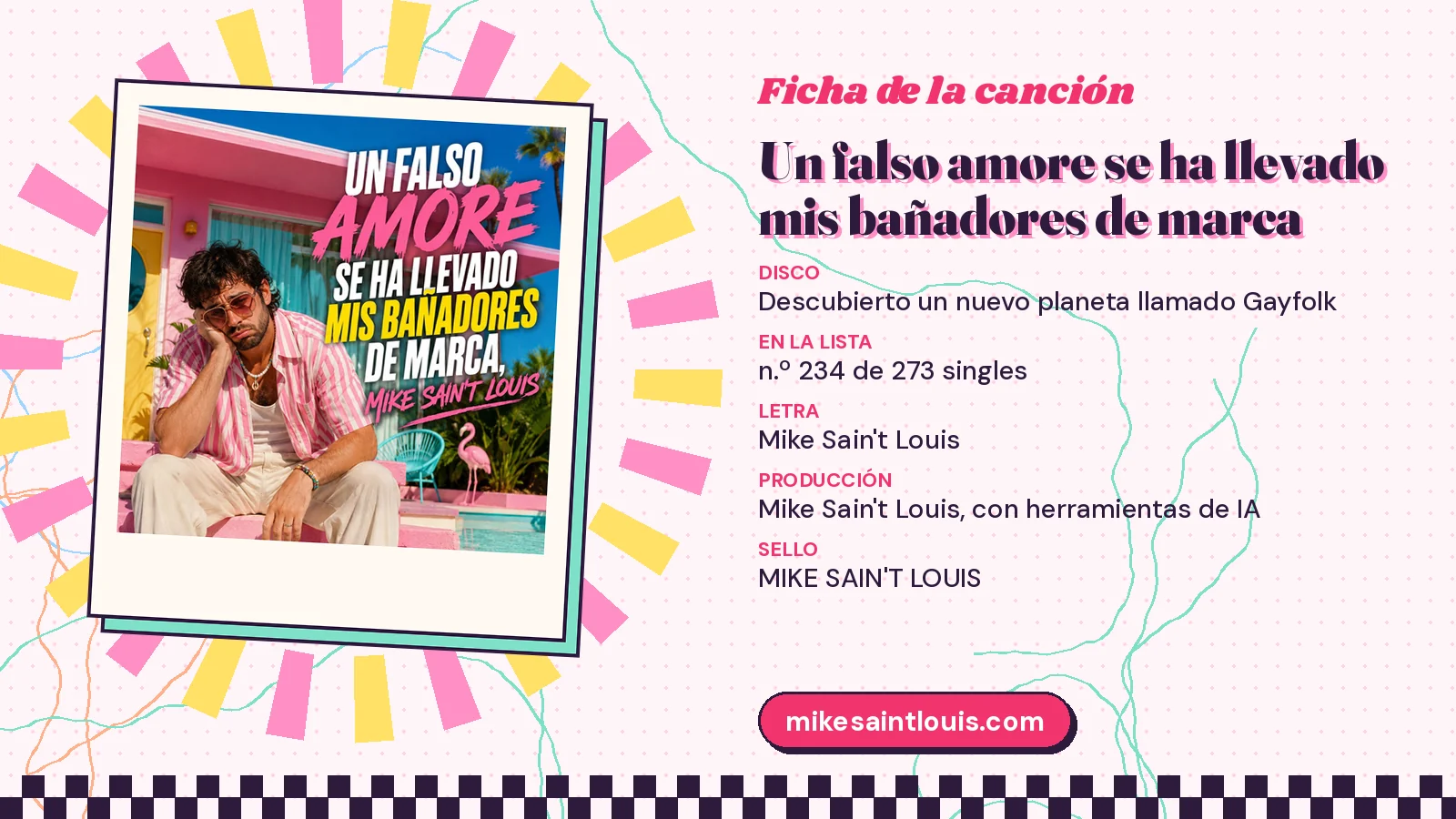
That's the chorus of «Un falso amore se ha llevado mis bañadores de marca» ("A fake lover has run off with my designer trunks"), and the song bellows it without a shred of shame. But it isn't the only one. Disgust comes back in «Esperma», peeps out in a song about politicians, and turns round in «El espejo de enfrente», where it no longer points at the other person but at oneself. The same word, there and back.
This piece isn't about one particular song. It's about a word. And about why, to tell the end of something, disgust serves me far better than hatred.
Hatred belongs to tragedy
Hatred has prestige. It's in Greek tragedies, in Verdi's operas, in the Venezuelan soaps that used to fill Spanish afternoon telly. Hating someone means taking them seriously. It grants them the importance of an enemy. Medea hates. Othello hates. The villainess of the soap hates the heroine for two hundred episodes and the veins stand out on her neck.
And that's why it's no use to me. If I write "I hate you" in a song about an ex who's run off with my designer trunks, I'm giving him a part he doesn't deserve. I'm putting him on a stage with spotlights and an orchestra. Hatred is a pedestal.
Disgust, on the other hand, belongs in the kitchen. It doesn't take the other person seriously: it moves them aside with two fingers, the way you flick a dead fly off the windowsill. There's no grandeur in disgust. There's a wrinkled nose and a bin bag.
If I hate you, you're my enemy. If you disgust me, you're an out-of-date yoghurt.
And I don't say that just for the joke. There's a difference of scale that matters a great deal when you write. Hatred needs an antagonist your own size, someone to fight as equals, like a Western duel at dawn. Disgust needs none of that. It's enough for the other person to be beneath you, down at bin level. And putting the ex at that level, after having him on a pedestal for years, is a little revenge that costs nothing. You don't even have to shout. Just wrinkle your nose and close the bin lid with your foot, the way the women in Carabanchel kitchens do when their hands are covered in flour.
Honestly
In the chorus of «Un falso amore» there's a word in front of the disgust that I think is crucial: honestly. «Amore, sinceramente das asco.»
That adverb changes the whole tone. Without it, "you're disgusting" would be an outburst, a playground insult. With it, it becomes a diagnosis. It's what a doctor would say with the X-ray in hand: "honestly, this doesn't look good". There's a calm in that "honestly" that makes the disgust more final. I'm not angry. I'm saying it with a cool head.
And the lovely thing is that disgust, unlike hatred, can be said calmly. Nobody hates calmly: hatred demands shouting and slammed doors. Disgust can be said over coffee, glancing at your phone, legs crossed. It's an observation. Like saying it's raining today.
That's the tone I'm after in many of my break-up lyrics. Not the tone of someone shattered, but of someone who has already sniffed the Tupperware and shut the lid.
The grammar of disgust
There's something about Spanish that I adore and that really shows in these songs: disgust has two very different constructions. «Das asco» and «me das asco».
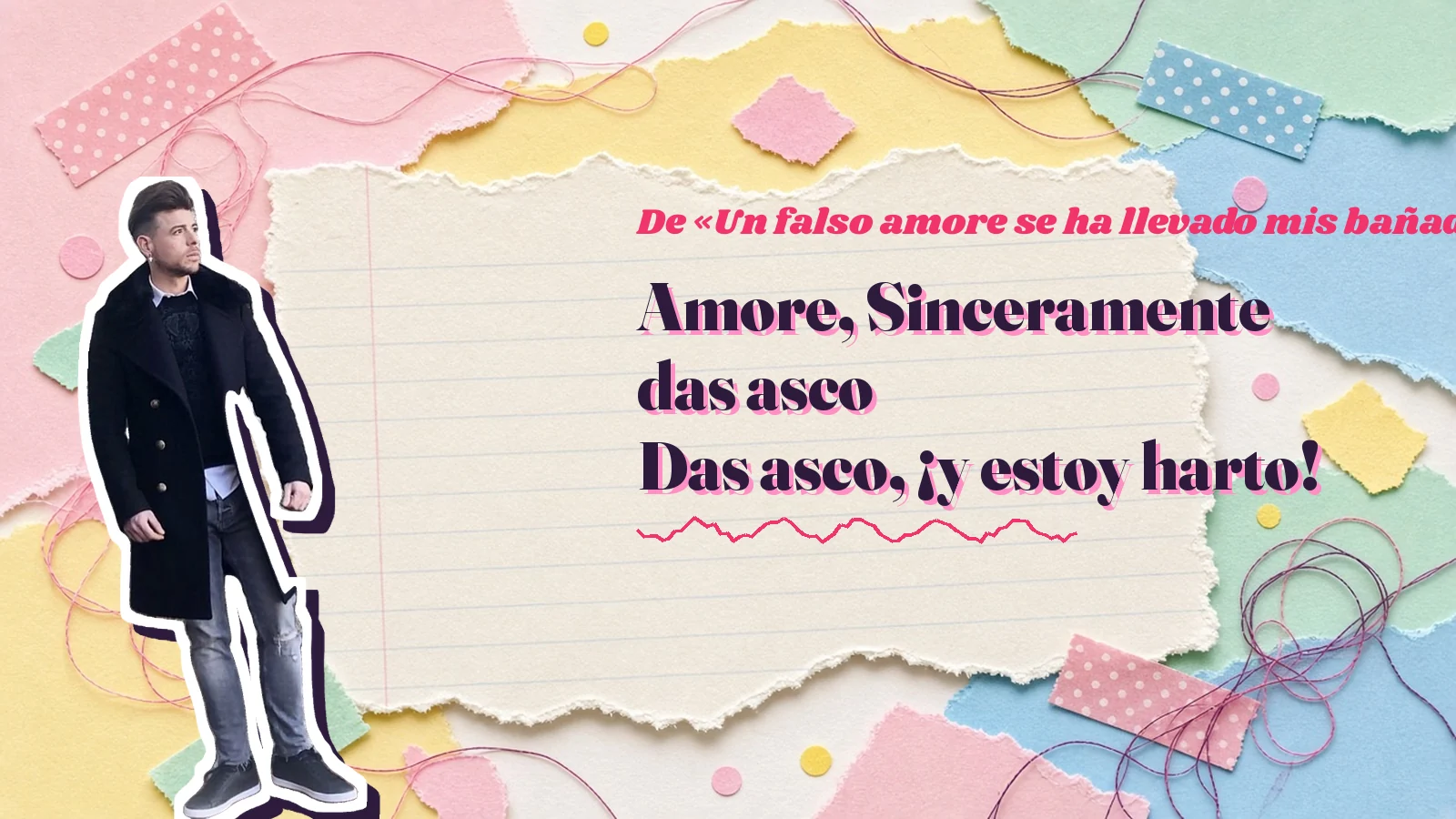
«Das asco», you're disgusting, is universal. It's a judgement on you, valid for everyone. As if disgustingness were one of your properties, like height or eye colour. You're disgusting, and anyone who gets a whiff of you will notice.
«Me das asco», you disgust me, is personal. It talks about what happens to me when I see you. It's more intimate and, deep down, humbler: it doesn't say you're repulsive to everyone, it says you seem so to me.
In «Un falso amore», the song uses both. It starts with the universal, «sinceramente das asco», and then moves to the personal, «me das mucho asco, amore», you really disgust me, amore. From diagnosis to confession. First I state it as a fact, then I admit it's me who feels it. I love that move because it makes the disgust more honest. I don't hide behind objectivity. I get my hands dirty.
«Esperma» and the lucky face
In «Esperma» disgust appears in a more twisted, almost philosophical form:
«La verdad es que te digan que das asco / No es para sentirse afortunado» "The truth is, being told you're disgusting / Isn't something to feel lucky about"
Here nobody is telling the other person they're disgusting. The song reflects on what it means to be told so. And the conclusion has a crushing logic, the kind that makes me laugh because it's obvious and nobody says it: being told you're disgusting isn't something to feel lucky about.
It's almost a Gila sketch, after the deadpan Spanish comedian who rang up the enemy in wartime. The tone is that of someone explaining something self-evident with great patience, like explaining to a child that fire burns. And under the joke lies the serious idea: that the other person, after hearing "you're disgusting", prefers to keep quiet because he knows he's been caught out. Disgust as a mirror that leaves the other speechless.
Those two songs, by the way, share lines. Part of what's said in «Esperma» also appears in «Un falso amore». That's no oversight. Some phrases come back because the wound comes back, and the page for «Esperma» and the one for «Un falso amore» each tell their own story. What interests me here is that, in both, disgust is the word that shuts the door.
Thieves, how disgusting
Nor does disgust stop at exes. In a song bluntly titled «Un político español» ("A Spanish politician"), the word heads somewhere else:
«Que asco de ladrones» "What disgusting thieves"
And here it works exactly as it does with the ex. No hatred, no speech, no manifesto. Just disgust. The wrinkled nose of someone reading the paper in the bar and turning the page with two fingers. It's bar-counter disgust, the disgust of pensioners holding forth in the café, of "they're all the same" said while stirring your coffee.
It isn't an analytical song, and doesn't pretend to be. It's a letting-off-steam song, the kind people chant over the remains of Sunday lunch when the subject comes up on the news. And disgust is exactly the right word for that, because it requires no argument. Disgust isn't argued. It's felt and said.
It tickles me that the same word works for an ex with coloured contact lenses and for the entire political class. It says a lot about the word. Or about me.
How I disgust myself
And now, the way back. Because disgust, in my lyrics, doesn't always point outwards.

In «El espejo de enfrente» ("The mirror opposite") there's a chorus that gives me slight vertigo every time I read it:
«¡ Ay! Qué asco me doy, / Estoy harto de verme la puta cara en el espejo de enfrente» "Oh! I disgust myself, / I'm sick of seeing my bloody face in the mirror opposite"
Here disgust has changed direction. It's no longer "you're disgusting" or "you disgust me". It's "I disgust myself". Reflexive. The one who feels it and the one who causes it are the same person. And notice the «estoy harto», I'm sick of it, the very same as in «Un falso amore»: «das asco, ¡y estoy harto!». Both songs use the same words, one aimed at the ex and the other at the mirror.
This seems to me one of the most honest things I've written, because it acknowledges something that happens very often after a relationship with someone who has hurt you. The disgust you feel for the other person sometimes turns round on you. You ask yourself how you put up with it, how you didn't see it, how you let it happen. And the disgust meant for him ends up being for you. How can I be so stupid?, as another of my lyrics puts it.
The good thing about the mirror song is that it doesn't stop there. There's a stretch where the mirror is «portando bien», behaving itself, the abs show, you're radiant. And another where it behaves dreadfully. The mirror changes mood the way the weather changes in April. And self-disgust, in that song, is a bad day, not a life sentence.
Why disgust helps you leave
Let me be serious for a moment, because I think there's a useful idea under all this Tupperware.
When someone has manipulated you, one of the hardest things to break is attachment. You remember the good bits, the beginning, the first weeks, the good-morning texts. And that pulls you back. Or makes you think about going back. Hatred doesn't help much in cutting that thread, because hatred keeps you hooked: you think about the other person constantly, you go over and over it, you pour energy into them.
Disgust, by contrast, is an emotion of distance. That's its job in the body: to move you away from what could harm you. What disgusts you, you don't touch, don't eat, don't go near. If you manage to find the other person disgusting, even a little, your body helps you leave.
I'm not saying you should force it. Or that it's pretty. I'm saying that, in my songs, disgust appears precisely at the moment the narrator stops wanting to go back. It's the signal. While there's hatred, there's a bond. When disgust arrives, it's over.
That's the only lesson I allow myself to draw from all this, and now it's said.
From desire to disgust
There's a journey these songs make without spelling it out, and to me it's the most interesting thing of all: from desire to disgust.
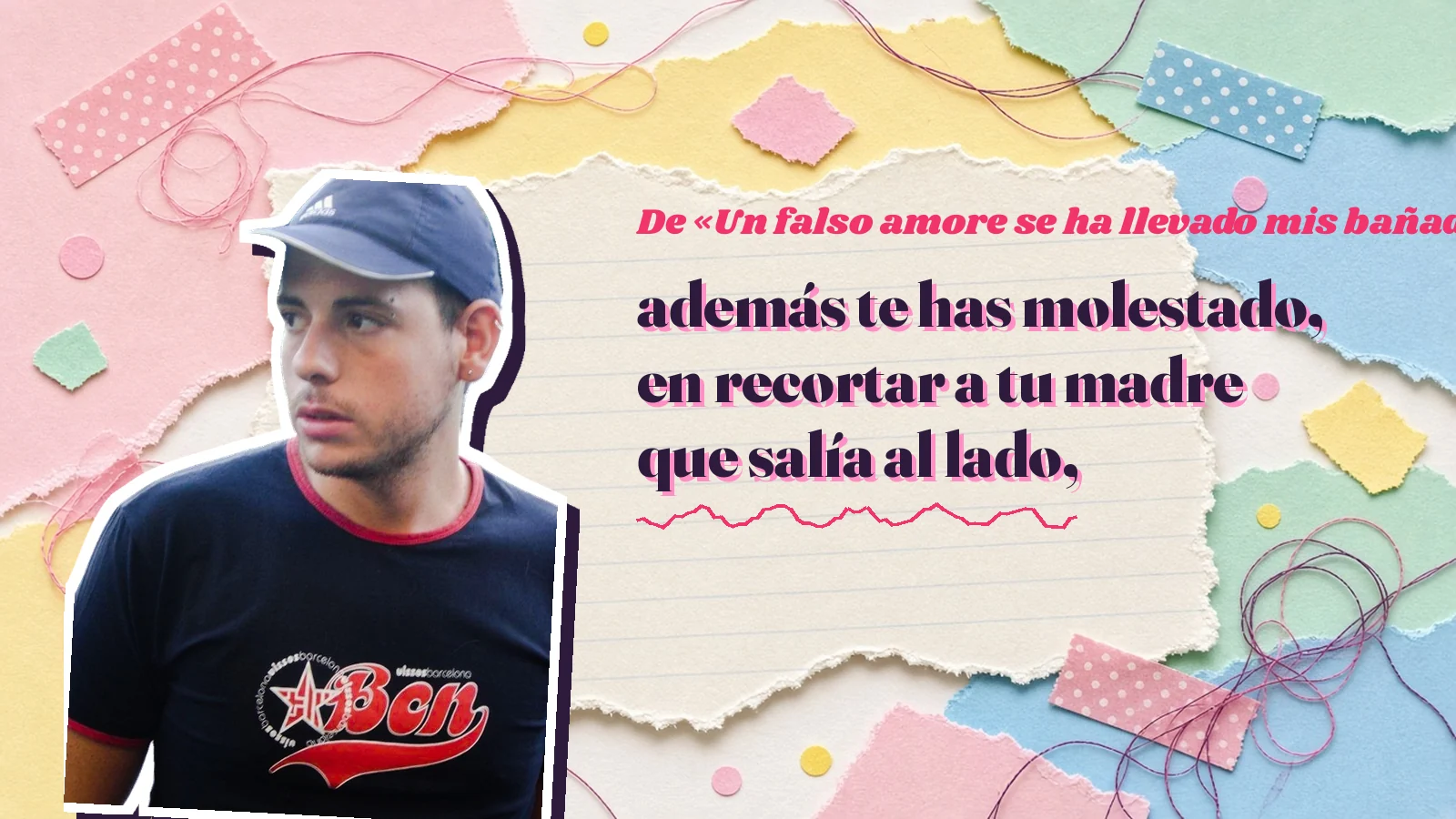
At first, the other was desirable. He was the dark, gorgeous one, the one with blue eyes like the sea, the one showing off his bulge on the beach in my designer trunks. The same songs that now say "you're disgusting" carry, in their verses, the trace of what once appealed. The eyes. The body. The photo where he looked stunning. Desire isn't erased from the lyrics: it stays there, like the pale patch left on a wall when a picture comes down.
And then, at some point, the same body that appealed starts to disgust. Not because the body has changed. Because what you know about it has. The contact lenses, the fake candles, the cropped selfie, the daily lies. What you know contaminates what you see. And what used to turn you on now turns your stomach.
That's very human, and very hard to tell without tipping into melodrama. That's why I like telling it with humour. Because the shift from desire to disgust has something of a cruel joke about it: the same person, the same trunks, the same beach. And you, who used to sigh, now wrinkle your nose.
Love doesn't always end in hatred. Sometimes it ends in a grimace.
Writing disgust without being disgusting
A question of craft, for songwriters wondering how to put something like this in without the listener recoiling too.
Disgust is contagious. If you describe something revolting in great detail, the listener feels disgust, and not necessarily towards whom you intend. They might feel it towards the song. Towards you. It's a real risk, and songs like «Esperma», with its A&E vocabulary, skirt it deliberately.
My trick, if you can call it that, is humour and exaggeration. When disgust is delivered with a theatrical exclamation, one synonym too many, a raised eyebrow, the listener understands it's a game. I'm not rubbing the Tupperware in their face. I'm showing it from a distance and pulling an exaggerated face, like a mime. And then they laugh, instead of recoiling.
The other key is the target. The disgust in my songs always has a clear owner: the fake lover, the thieves, the reflection on a bad day. It's never a vague disgust that stains everything. When disgust has a direction, the listener takes your side. When it doesn't, they protect themselves.
It's like throwing a bucket of water: aim, and you soak one person. Don't aim, and you soak everyone, and nobody forgives you.
«Qué asco, niño»
There's a phrase anyone who grew up in a Spanish home has heard at some point, tea towel in one hand and the other on the hip: «¡Qué asco, niño!», ugh, that's disgusting, child! It's said when the child picks his nose, leaves his socks under the bed, eats the dirt in the park.
It's an educational disgust, almost affectionate. It doesn't condemn the child: it condemns what he's done. And I think many of the times I write "you're disgusting" in a song, there's something of that mother's phrase underneath. It isn't a disgust that destroys. It's a disgust that corrects. That points out what's wrong and turns the page.
Which, if you think about it, is exactly what a break-up chorus does: point out what was wrong and turn the page.
Five everyday disgusts
So it doesn't all seem so solemn, here's a little catalogue of domestic disgusts, which are what really inspire me when I write these lyrics:
- Someone else's hair in the gym shower, coiled round the plughole like a snake.
- The chewing gum stuck under the school desk, a fossil from 1998.
- Milk that's curdled in your coffee, noticed on the second sip.
- A good-morning text from an ex, three months later, with a sun emoji.
- Your mum's Tupperware of lentils, left in the car boot in August.
The fourth disgusts me most of all, and it's the only one that doesn't smell. That's the point: emotional disgust works just like the physical kind. You recognise it before you think about it.
Disgust and camp
There's something else about disgust that interests me as a queer man who writes, and that's its quality as a gesture. Disgust is done with the face: the wrinkled nose, the curled lip, the hand held up. And it's a gesture with a long tradition in camp, what Spanish calls pluma.
The queen who pulls a face when she sees someone badly dressed at the club. The drag who swats the audience away with her fan. The lady on the celebrity gossip shows who says "how disgusting" with a toss of her hair. There's a theatrical, exaggerated, camp disgust that's almost an art form. And in my songs disgust has a lot of that: as well as an emotion, it's a pose. A pose through which you get your dignity back.
When I write «sinceramente das asco», I picture someone saying it hand on hip, eyebrow raised. Not someone crying. It's the difference between suffering and dismissing.
And to be clear, as always: I write those lyrics myself, without artificial intelligence. The music and vocals of my songs are made with AI tools such as Suno; I'm a lyricist, composer and producer, and I'm not the one on the recording. The raised eyebrow, though, is all mine.
When disgust has no place
So I don't sell you the idea that disgust fixes everything, a word of warning from the workshop. There are songs where disgust doesn't fit. In «Entre cuatro paredes» ("Between four walls"), for instance, there isn't a drop of it, because it's a song of sadness, and sadness doesn't push away: it sits still. Putting disgust there would be like cracking a joke at a funeral.
And there are uses of disgust I don't like. Disgust at bodies, at people for who they are, how they dress, who they sleep with. We queers have suffered that disgust for centuries, and I don't want it in my songs. The disgust I write is aimed at what someone has done, not at who someone is. At the man who took the trunks, not at his belly. At the man who steals, not at his accent.
It's a fine line, and I'm sure I've crossed it now and then for a joke. But I try to respect it. There's a piece on the blog about doing gay humour without doing harm that's about exactly this.
The clean fridge
Back to the Tupperware from the start. You've binned it. You've washed your hands. You've opened the kitchen window. And now the fridge is clean, with its white light and its empty shelves, waiting for Saturday's shop.
That's what comes after disgust in my songs. No revenge, no drama, no soap-opera hatred. A clean fridge. A drawer without designer trunks, yes, but also without the rotting Tupperware.
If you want to hear how that there-and-back disgust plays out, the songs are in the singles list and the lyrics on the lyrics page. Start with the fake lover and finish with the mirror. You'll see how the same word changes direction along the way.
And if someone ever tells you you're disgusting, remember what the song says: it isn't something to feel lucky about. But it isn't the end of the world either. It's just a fridge someone has decided to clean.
Frequently asked questions
Which Mike Sain't Louis songs feature the word «asco»? «Un falso amore se ha llevado mis bañadores de marca» («Amore, sinceramente das asco»), «Esperma», «Un político español» («Que asco de ladrones») and, turned on oneself, «El espejo de enfrente» («¡Ay! Qué asco me doy»).
Why disgust and not hatred? Because hatred turns the other person into an important enemy, whereas disgust sets them aside as something no longer of interest. In his lyrics, disgust marks the moment the narrator stops wanting to go back.
Who writes the lyrics? Mike Sain't Louis, lyricist, composer and music producer from Madrid, the first AI songwriter. The lyrics are his and written without artificial intelligence; the music and vocals are made with AI tools such as Suno.
Where can I read the full lyrics? At gayfolkplanet.com/letras, with a page for each song.