
By Mike Sain't Louis ·
Knowing the ending ahead of time: Spoiler, B-movies and the spell of immunity
Some people hate spoilers and some people go looking for them. The first group want the story to surprise them. The second would rather know how it ends so they can enjoy the ride without anxiety, or decide whether it's worth carrying on watching. Spoiler, the song, is written from the second group. Its narrator already knows how this ends, and says so.
On the song's own page I've already gone through the stages of the flirtation one by one, and the full lyrics are published. Here I want to talk about something else: the decision to tell a story of jealousy as if it were a cheap horror film, what it means to give away the ending as a defence mechanism, and that phrase repeated at the end until it loses its meaning, or gains it.
The pleasure of knowing how it ends
Giving away the end of a story has a bad reputation. It's considered rude, almost a crime against anyone who hasn't seen the series. But in real life, knowing how certain things end is a huge advantage. It saves time, saves tears and saves that horrible wait in which you still don't know whether you have reason to worry.
The narrator of Spoiler has reached that point. They've seen enough signs not to need to see the rest. And instead of waiting for the outcome, they announce it. It's their way of taking back control of a story in which, until then, they were only a spectator.
That's the first idea in the lyrics that interests me. The spoiler here doesn't ruin anything. Quite the opposite: it's the only tool available to someone watching their relationship slip away through a phone screen.
Why a B-movie
The lyrics don't pick just any genre. They pick B-movie horror. And the choice is very funny.
B-movies were born as the cheap second half of cinema double bills: quick, low-budget productions shown alongside the main feature. Over time the label came to cover all that low-cost cinema, predictable and often unintentionally comic. In B-movie horror you know from the start who's going to die, you know the group will split up at the worst possible moment and you know someone will go down to the basement without a torch.
Comparing a social-media flirtation to that is a way of saying: this is so predictable it's cringeworthy. There's no mystery and no unexpected twist. There's a worn-out script that repeats over and over, with different actors and the same ending.
And at the same time, horror is still horror. Even if the film is bad, the fear is real. That blend of mockery and dread is exactly what the narrator feels.
The lyrics as a notebook of evidence
What I enjoy most about Spoiler is its structure. The first part of the lyrics works like a list of exhibits presented to an imaginary court. Each line is one more clue, arranged in time order, with almost notarial precision.
First, likes on photos of a pop star. Then, boredom with that. After that, the new profile picture. Later, the frequent stories. And in between, a detail that says everything about the narrator's state of mind: they've counted the reactions on one particular photo. Not an estimate: a number.
That count is the key. Someone who counts likes is no longer living a relationship, they're investigating a case. And the lyrics know it, because they say it with a touch of self-irony. The narrator doesn't present themselves as a saint. They present themselves as someone who has done the dirty work of keeping watch and is now setting out their conclusions.
The grammar of suspicion
If you look at how the first part is written, almost every line starts the same way: with the verb «empezó», he started. He started liking, he also started, at first he started. That repetition creates a sense of process, of something advancing in stages.
It's the grammar of suspicion. Someone who suspects doesn't think in isolated facts, they think in sequences. Every gesture is the beginning of something. Every like is a first step. And once you look at things that way, everything fits the story you already have in your head.
That's what's unsettling. The lyrics teach us to look the way the narrator looks. And by the time we reach the end, we're convinced too that we know what's going to happen.
Madonna as the starting point
The first clue is a photo of Madonna. And I love that the story starts there, because if there's one innocent gesture in the social-media universe, it's liking a post by the Queen of Pop. Madonna has been an icon of gay culture for decades, and following her is almost a membership requirement.
That's why the detail works as a starting point. It's the most harmless thing there is. Nobody can be jealous of a like on a Madonna photo. And yet the lyrics make it the first link in the chain, the moment it all began.
That says a lot about the narrator. When a relationship goes wrong, you tend to look for the beginning, the exact moment things changed. And sometimes that moment, seen from a distance, is ridiculous. A like for a diva. A new profile picture. Nothing that, on its own, means anything.
If you're interested in Madonna's place in my lyrics, The Queen of Pop devotes a whole song to her.
The perfect boys
In the middle of the list there's a detail worth looking at closely: the livestreams, always surrounded by perfect boys. The word perfect appears twice in the lyrics, once for the lips in the profile picture and once for those boys. That's no accident.
Perfection is the language of social media. Filters, angles, carefully chosen light, sculpted bodies. Everyone seems to be at their best, all the time. And whoever looks on from outside, with their ordinary face and their ordinary day, is bound to lose that comparison.
That's why those perfect boys are so threatening. Not because anything has happened with them, but because they stand for a world in which the narrator can't compete. And the lyrics drop it in without drama, almost in passing, like someone jotting one more fact in the notebook.
The stages of the flirtation
The second part of the lyrics describes the escalation in the language of social media. There are stages, says the narrator, and we're now at the hearts stage. It's a very contemporary way of telling a flirtation: not with glances or touches, but with emojis.
For centuries literature told courtship with flowers, letters and serenades. Today it's told with reactions, comments and livestreams. What changes is the medium, not the logic. There's still a gradual advance, a calibration of interest, a game of seeing who makes the next move.
And the lyrics capture really well that feeling that everything is public and secret at once. The hearts can be seen. The comments can be seen. Anyone can read them. But only someone who knows how to read between the lines understands what they mean, and the narrator does.
«Totalmente involuntario»
One of my favourite lines says that «lo que surja es totalmente involuntario», whatever happens will be totally unintentional. It's pure irony. It's the excuse given by people who are doing exactly what they say they aren't doing.
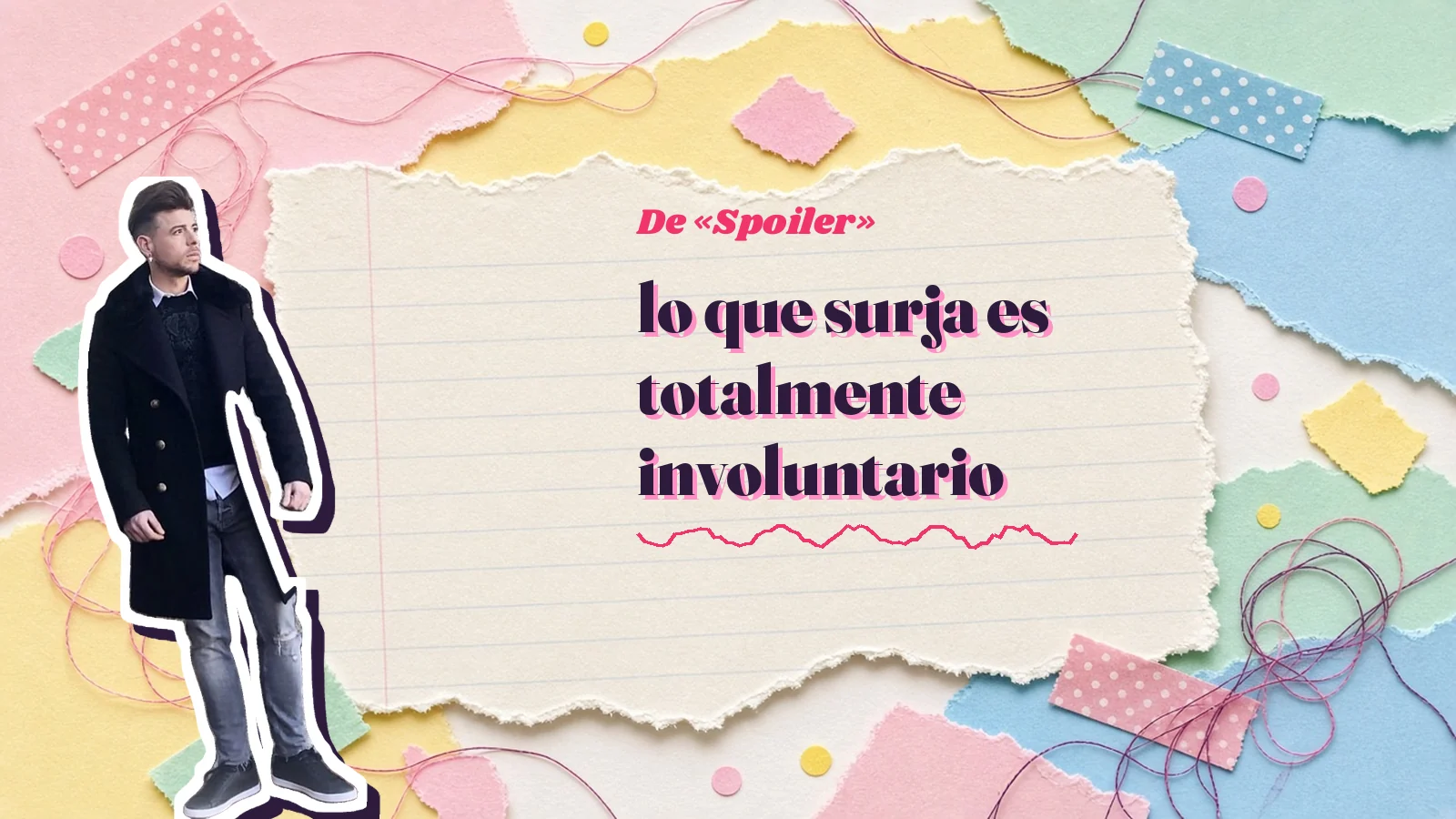
That phrase has a very recognisable ring. It's the language of someone covering themselves before anything happens: if something happens, I didn't go looking for it. And the lyrics put it in the narrator's mouth as a taunt, getting ahead of the defence the other person will use when they're caught.
There you see the spoiler mechanism again. The narrator doesn't only know how the film ends. They also know what excuses each character is going to give.
The profile as a shop window
Among the evidence the narrator gathers there's one item I find especially revealing: the new profile picture, posing with perfect lips. It isn't a like or a comment. It's a change in one's own image.
Changing your profile picture is a small gesture, but in the language of social media it says a lot. It's like changing a shop window. It signals that something has changed inside, that the person wants to project something else, that they're hoping for a different kind of look. And whoever lives with that person notices straight away, because the previous picture was of someone who already had a partner.
The lyrics don't explain what that change means. They just note it. But in the context of the list, the new picture is the moment the flirtation stops being passive. It's no longer about looking at what others post. It's about posting something so that others look at you.
Seducing the camera
Right after that comes another detail I love: stories uploaded frequently, «seduciendo a la cámara», seducing the camera and whoever is watching. The lyrics use a very precise verb. They don't say posing or showing. They say seducing.
That choice turns the phone camera into one more character. It's no longer an object, it's an addressee. And behind the camera there's a diffuse audience, a mass of anonymous viewers to whom every gesture is addressed. The narrator is part of that audience, but is no longer the main addressee.
That's one of the most painful things in the song, even if it's told with humour. The person you share your life with is performing for others, in front of you, and you see it the way everyone sees it: from outside, on the same screen, with no privileges at all.
When humour protects
Spoiler is a song about jealousy, but it doesn't sound like a song about jealousy. There's no shouting, no threats, no bedroom scenes. There's irony, counting, self-mockery. And that tone is a choice that also works as protection.
Telling something painful with humour lets you take some distance. The narrator laughs at the situation, laughs at the other person and laughs a little at themselves for having become a like detective. That laughter doesn't deny the pain, but it puts it in its place. It tells it: you're not going to be the lead in this story.
In that sense, humour is first cousin to the spoiler. Both serve the same purpose: not to be swept away by the film. If you know how it ends and you also laugh at the script, fear loses part of its power.
What the screen doesn't show
There's something the lyrics leave out that I think is important to point out. Everything the narrator knows, they know through the screen. Likes, photos, stories, livestreams, comments. There isn't a single scene outside social media. We don't know what the dinners are like, the conversations, the silences at home.
That absence is significant. It might mean the relationship now only exists on that plane, that life together has shrunk to looking at each other through a phone. Or it might mean the narrator has stopped looking at what's in front of them to look only at what appears in the app.
Both readings are sad, and the song doesn't choose between them. But both say something true about how we live today: much of what we think we know about the people close to us we know from what they post, and what they post is never the whole story.
Who's right?
And then comes the most interesting moment in the lyrics, the one that turns a complaint into something more complex. When the narrator lays out the evidence, the other person takes offence and shouts that they've lost the plot.
That reply opens a doubt the song doesn't resolve. Is the narrator right or paranoid? Are they seeing real signs or building a story out of loose data? The lyrics are told from one side only, and from that side everything fits. But the listener may wonder whether counting likes is evidence or a symptom.
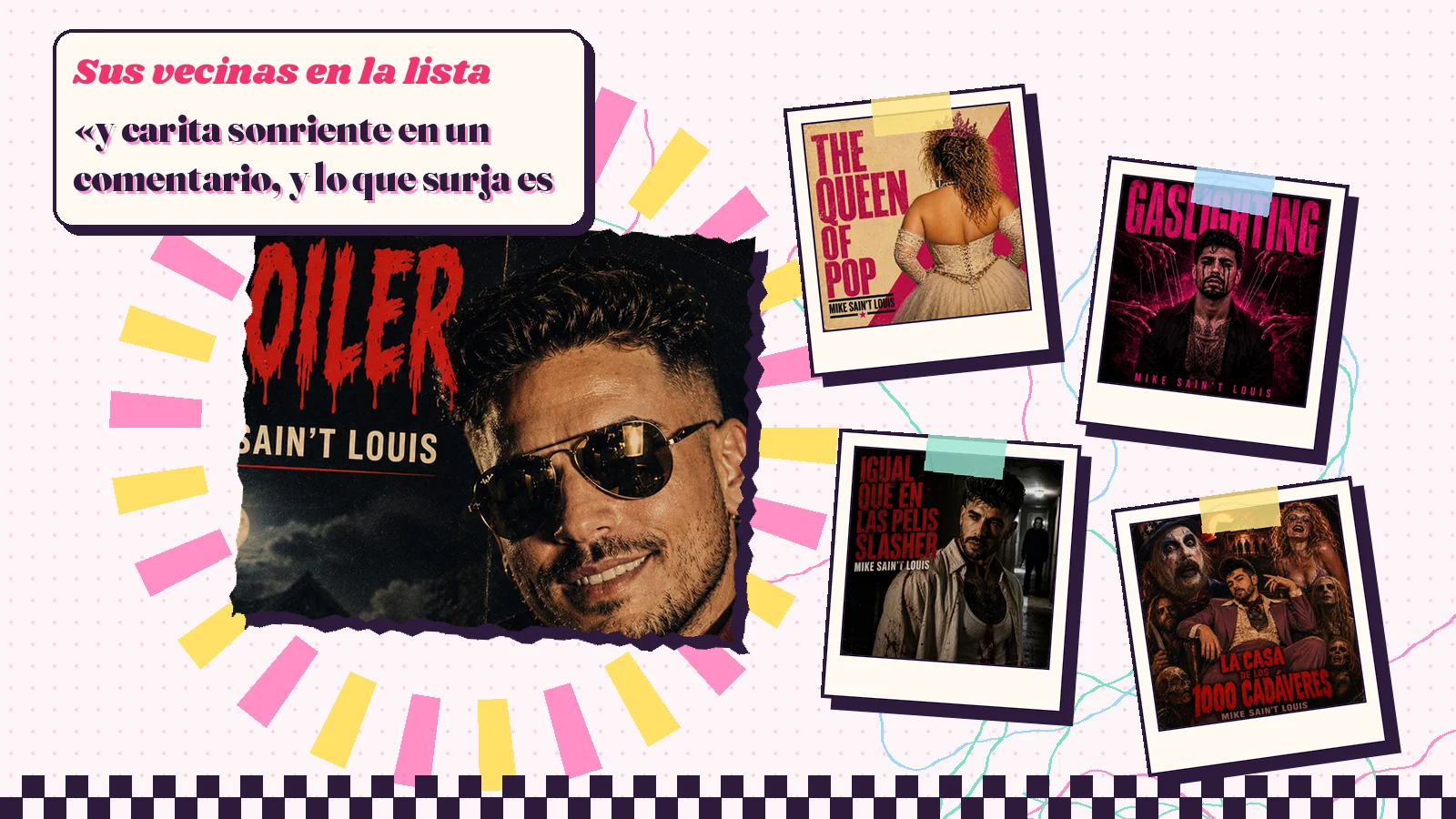
In other songs in the catalogue, such as Gaslighting, the other side appears: someone being made to doubt what they see. And it's impossible not to think of it here. Telling someone they've lost the plot can be a form of manipulation or a sincere warning. From outside, you can't always tell.
I like that Spoiler doesn't explicitly take sides. It leaves the tension there. The narrator is certain, the other person is offended, and the ending, whatever it is, is going to hurt someone.
Keeping watch is exhausting too
There's something the lyrics suggest without saying it outright: keeping watch wears you out. Checking profiles, counting reactions, following livestreams, analysing comments. All of that is a full-time job that leaves no room for living.
Social media has made that kind of watching very easy. Before, to know what your partner was up to, you had to ask or follow them down the street. Now all it takes is opening an app. And that ease has a price: the temptation to look is constant, and every time you look you find something to interpret.
I'm not saying the narrator is wrong. I'm saying the song portrays very well someone who has reached the limit of that watching and needs to stop. The spoiler is also a way of no longer looking. If you already know how it ends, there's no need to keep watching the film.
The spell of immunity
And we reach the end, the phrase repeated more than any other in the song: «esta vez soy inmune», this time I'm immune. The lyrics say it once as the logical conclusion of the story and then repeat it many more times, shorter and shorter, until only the promise that it won't hurt is left.
That repetition is what turns the song into more than a chronicle. When someone repeats a phrase that much, they aren't reporting anything. They're trying to convince themselves. It's like a spell, a magic formula spoken so that it comes true.
And the joke is that the repetition has the opposite effect. The more the narrator says it won't hurt, the clearer it becomes that it does. If they really were immune, they wouldn't need to say so that many times.
The word immune
I'm very interested in the word chosen. Immune is a medical term. It speaks of defences, of antibodies, of having already had the illness. And that metaphor fits the idea of the spoiler very well: the narrator has seen this film before, has been through this, and believes that protects them.
It's a comforting idea. Having suffered once prepares you for next time. But the heart doesn't work like the immune system. Having been left before doesn't vaccinate you against being left again. At most, it teaches you to recognise the symptoms sooner.
And that's exactly what the narrator does: recognise the symptoms. They see the likes, the hearts, the livestreams, and know what they mean. The immunity they proclaim is, in fact, experience. And experience doesn't prevent pain. It only makes it more predictable.
The horror that repeats itself
There's another reading of the B-movie that I find lovely. Cheap horror films repeat themselves. They have sequels, remakes, imitations. The same monster comes back again and again, and the audience pays for a ticket again knowing what they're going to see.
The narrator of Spoiler seems to be in one of those sequels. That's why they say «this time». This time, as if there had been others. This time, as if the story were a franchise they know by heart. And that tiny detail changes the song: this isn't the first time it's happened to them.
There are other songs in the catalogue that play with horror cinema. Igual que en las pelis slasher (Just like in slasher films), La casa de los mil cadáveres (House of 1000 Corpses) and Como en La matanza de Texas (Like in The Texas Chain Saw Massacre) use the genre as a dictionary for talking about relationships. Spoiler is the most everyday of them all: no chainsaws or masked killers here, just a phone and a list of notifications.
A song from the second album
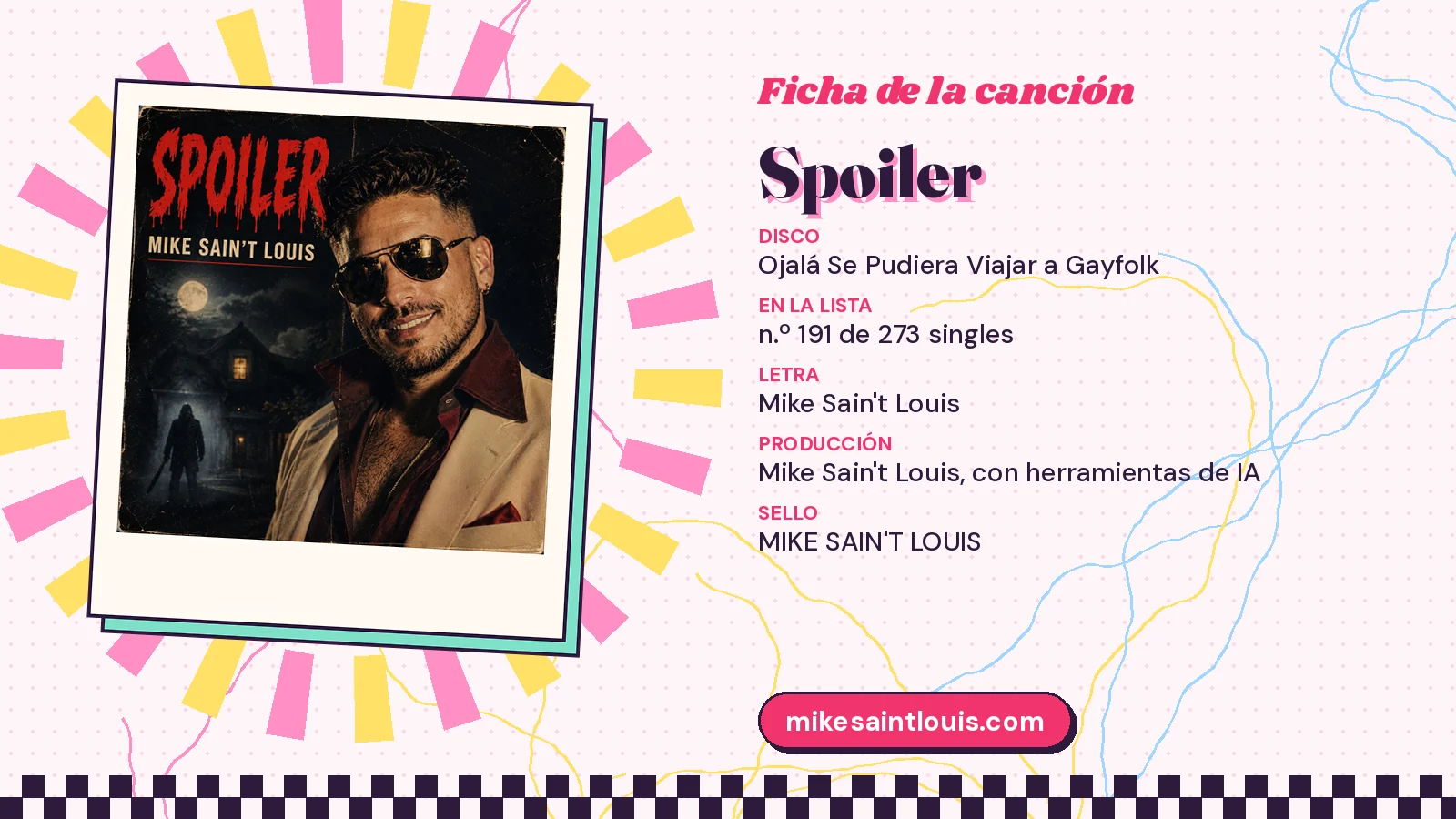
Spoiler is part of Ojalá se pudiera viajar a Gayfolk (If only you could travel to Gayfolk), the second album of the trilogy, which takes its name from its title song. It's an album full of heartbreak stories told with humour, and this one fits right in.
What sets it apart from its companions is the social-media theme. Many songs in the catalogue talk about exes, lies and break-ups. Few do it with a vocabulary so glued to the screen: likes, stories, livestreams, comments, profile picture. In that sense, Spoiler is very much a song of its time.
Who this song is for
For anyone who has ever checked their partner's activity and felt ridiculous doing it. For anyone who has seen the signs and preferred not to wait for the ending. For anyone who has said this time it wouldn't hurt and then it hurt just the same.
And also for whoever is on the other side of the screen, the one handing out the likes. Because the song, without saying so, asks them something awkward: was it really all so unintentional?
How to listen
The song is on the singles page and on every platform, and you can download it from the downloads section. Put it on when you feel the urge to open someone's profile for the umpteenth time. It might save you the rest of the film.
As a lyricist, composer and music producer, I really enjoy writing with the vocabulary of each era, and the vocabulary of social media is ours. The music and the vocal performances are generated with artificial intelligence, but jealousy, suspicion and the wish to believe yourself immune are about as human as it gets.
Frequently asked questions
What is Spoiler about? About a relationship cracking up through social media. The narrator notes down every sign (likes, new photos, stories, livestreams, hearts) and announces the end of the story before it arrives, comparing it to a B-movie horror film. It ends by repeating that this time they're immune and it won't hurt.
Why is it called Spoiler? Because the narrator gives away the end of the story, like someone revealing how a film turns out. They know how the flirtation is going to end and say so before it happens.
Which album is it on? It's part of «Ojalá se pudiera viajar a Gayfolk», the second album in Mike Sain't Louis's Gayfolk trilogy, available on Spotify and every other platform.
Who makes this song? Mike Sain't Louis, a lyricist, composer and music producer who presents himself as "the first AI songwriter": he writes the lyrics and directs the production, and the music and vocal performances are generated with artificial intelligence.