By Mike Sain't Louis ·
«¡Ay, mi madre!»: interjections and exclamations in my lyrics
Some words mean nothing and say everything.
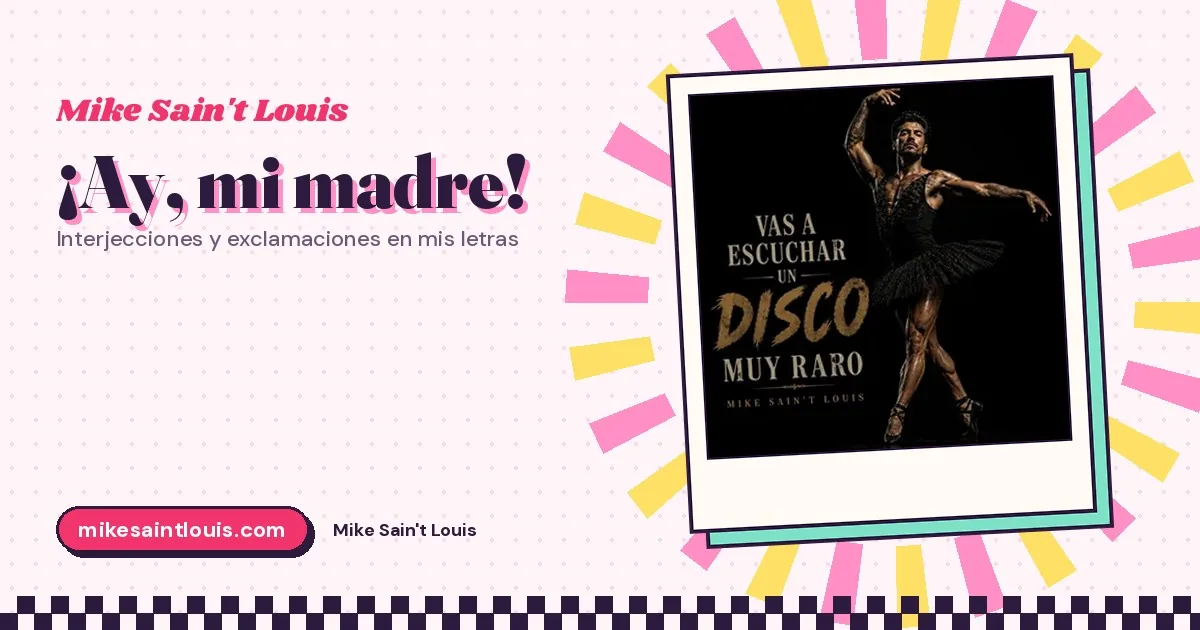
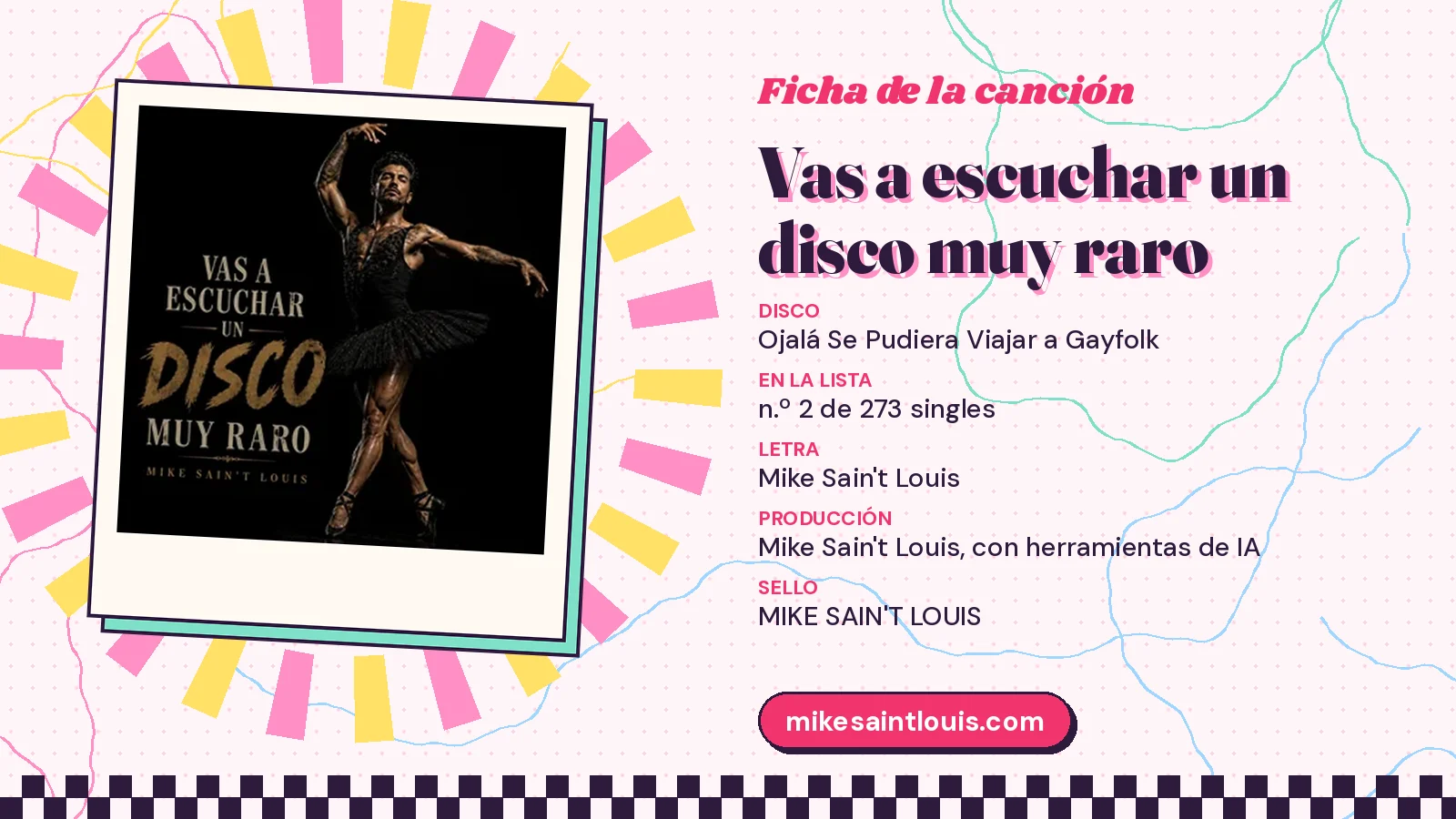
In «Vas a escuchar un disco muy raro» (You're about to hear a very strange record), from the album «Ojalá se pudiera viajar a Gayfolk», there's a moment when the lyric stops describing and simply exclaims. After asking anyone who comes with prejudices to step aside, after talking about some scheming musicians who don't do things the way they used to, the song lets out a «¡Ay, mi madre!», oh my mother, that adds no information at all. It doesn't inform. It doesn't move the story on. And yet it's probably the line people remember most. (The full lyric is on gayfolkplanet.com.)
This piece is about those tiny words. About the interjections and exclamations that run through my songs: ay, madre mía, vaya vaya, ojalá, anda, oh-oh. They are the smallest pieces of the language, the ones grammar books dismiss in half a page, and to me they're among the most interesting. Because an interjection isn't thought. It slips out.
A word thrown in the middle
The word interjection comes from the Latin interiectio, roughly «something thrown in between». I love that image. An interjection is a stone someone tosses into the middle of a sentence. It isn't part of the construction, it has no subject or predicate, it doesn't conjugate. It drops in and that's that. And the water of the sentence moves around it.
For a long time grammarians didn't quite know where to put them. Some said they weren't even words, just sounds, like a dog's bark or a creaking door. Others treated them as whole sentences squeezed into a syllable: an ¡ay! would be «it hurts», «I'm scared» or «what a shame» packed into two letters. The Royal Spanish Academy, in its big grammar of 2009, settles on something close to the latter: interjections are a class of words that form utterances on their own. An ¡ay! is a complete sentence.
Anyone who has written a song knows that. When a line says «¡Ay, que llora!», oh, he's crying, the interjection isn't decorating. It's doing the work of an entire verse. What would come next, the why of the crying, the who, the how, is condensed into that opening sigh. The listener fills in the rest.
The linguist Roman Jakobson, in a 1960 lecture still studied in every faculty, divided language into functions. One of them was the emotive function, the one that expresses the speaker's attitude towards what they're saying. And he wrote that the purely emotive layer of language is represented by interjections. In other words: if you want to see emotion in its pure state, unmixed with information, look at interjections. They're where language stops explaining and starts feeling.
Proper and improper
Grammar distinguishes two families, and the distinction is very useful for reading my lyrics.
Proper interjections are the ones that serve only that purpose. Ay, oh, uf, eh, puaj, bah. They have no other use. Nobody says «an ay» literally except to talk about the cry itself. They are sounds the language has tamed, turned into words that still keep something animal about them, a body complaining before the head decides what to say.
Improper interjections are ordinary words lent out to the cry. Vaya, which is a verb (may it go). Anda, another verb (walk). Hombre, a noun (man). Madre mía, Dios mío, Virgen santa, which are invocations. Ojalá, which has a history of its own that I'll get to in a moment. When someone says «¡anda!» they aren't telling anyone to walk. When they say «¡vaya!» they aren't wishing anyone would leave. The word has lost its dictionary meaning and gained another, harder to define and much richer.
Both families live side by side in my songs. There are ays and oh-ohs, which are proper. And there are lots of improper ones: vayas, andas, madres mías, ojalás. If I had to guess why, I'd say the improper ones taste more of the street. The proper ones are universal; with small variations they exist in almost every language. The improper ones are local, they have an accent, they smell of doorways, of markets, of an aunt commenting on the neighbours' lives from her balcony. And much of what I write comes from that kind of speech.
The ay, the oldest word of the south
I'll start with the queen. The ¡ay!

It's probably the most used interjection in Spanish, and certainly the oldest in popular song. The ay is in the kharjas, in the ballads, in the coplas, in flamenco. In the deepest flamenco there's even a name for the moment the performer is left alone with that syllable and stretches it until it hurts: the ayeo, or the quejío, the lament. Before the lyric, sometimes for many seconds, all you hear is the ay. As if the song first needed to open a wound so the words could get in.
Federico García Lorca wrote a poem with that very title, «¡Ay!», in the book about deep song he wrote in 1921 and didn't publish until 1931. It begins by saying that the cry leaves in the wind the shadow of a cypress. The shadow of a cypress, the tree of cemeteries. Lorca understood that an ay is more than a sound of pain, that it leaves something behind, a dark shape that hangs in the air once the sound has ended.
In my lyrics the ay turns up in many ways, and not always with a cypress. In «El espejo de enfrente» the ay is stuck to disgust, the ay of someone who looks at himself and doesn't like what he sees. In «Dark Corners» it appears in the middle of a lyric that moves back and forth between English and Spanish, the ay of someone whose heart is slipping away: the language changes, but the lament stays in the mother tongue. I find that telling. You can write in English, think in English, flirt in English. But when something really hurts, the ay comes out in the language you first complained in, as a child, falling over in the playground.
And in «Vas a escuchar un disco muy raro» the ay is something else. It's comic. «¡Ay, que llora!» is repeated like an affectionate taunt, almost like the refrain of a huddle of neighbours. The one who smokes enjoys himself and the one who cries, well, he cries. The interjection turns crying into a show, exaggerates it until it stops being tragic. It's the ay of the copla turned inside out, like a glove.
That's what fascinates me about the ay: it works for everything. For pain, for disgust, for love, for laughter. It's the same syllable and it changes completely depending on the tone. In writing, which is how lyrics are read on the web, that tone can't be seen. You have to guess it from what surrounds it. That's why I like it so much. It forces you to read with your body.
Madre mía: calling on the mother
On to the invocations.
Spanish has a very curious habit: when something surprises us, scares us or overwhelms us, we call on someone. On God, on the Virgin, on the saints. And above all, on the mother. Madre mía. Ay, mi madre. Mi madre, qué susto. You aren't asking your mother to come. You aren't even thinking about her. It's a reflex from very far back, from when the first person you called in danger was her.
In «Vas a escuchar un disco muy raro» the ¡ay, mi madre! comes right after the musicians are described as people who do strange things, unlike the old ways. It's the reaction of someone who can't believe it. And the lovely thing is that the whole record is about that: hearing something new and reacting with outrage. The interjection puts the outrage of the listener into the song's own mouth. It's a mirror. The song gets ahead of the scandalised listener and cries out for him.
In «Bareback» the invocation is different. Madre mía con estos maricones, the lyric repeats, my goodness, these queens. There the mother is a kind of resigned witness, the one who watches and can't believe her eyes. It's a phrase you could hear in any kitchen in any village, said by a woman commenting on the telly. And that's exactly why it's funny when the song says it: the lyric puts on the neighbour's apron to talk about its own world.
Religious invocations, Dios mío or Virgen santa, appear less in my lyrics as exclamations, though the sacred turns up a lot by other roads. But the mother keeps coming back. Maybe because she's the most secular invocation of all. You may not believe in God, but everyone has had a moment of silently calling for their mother.
Vaya, vaya: gossip as music
If the ay is the interjection of pain, vaya is the interjection of gossip.
¡Vaya! has many faces. It can be disappointment (vaya, I've spilt my coffee), surprise (vaya, I didn't see that coming), irony (vaya, what a coincidence). And when it's doubled, vaya vaya, it takes on a tone every Spanish speaker recognises instantly: that of someone who has caught somebody out. Well, well, well.
In «Que te mola el cruising» the chorus starts exactly like that. Vaya, vaya, chiquitín. Vaya, vaya, monín. Well, well, little one. Well, well, cutie. It's the tone of gossip, of someone who has seen what he shouldn't have and has no intention of keeping quiet. And what follows is just that: you've been seen, you've been caught, don't play dumb. The doubled interjection says nothing about what happened, but it already announces it. When you hear vaya vaya, you know someone is about to be exposed.
I think it's one of the most theatrical interjections in Spanish. It works like a hand raised to point. And it has its own melody, a rise and fall that hardly needs music. That's why it works so well to open a chorus: it comes with the rhythm already built in.
In «Esperma» the vaya vaya comes back, aimed at something else. And in «Mi novio de Albacete» it appears in the singular, but as a summary of a whole break-up: vaya desastre con mi novio de Albacete, what a disaster with my boyfriend from Albacete. That vaya isn't gossip but a statement of fact. It's the vaya of someone looking at the wreckage who doesn't know where to start. One word sums up a whole story.
There's another vaya in the catalogue that makes me laugh. In «El segundo exacto» the lyric records what people who look down on my work would say: vaya tontería de canciones, what rubbish songs, and then a much ruder vaya. There the vaya is contempt. It's the interjection of someone looking down their nose. And putting it into the song itself is a way of disarming it: if I've already said it, what more can you say?
Ojalá: a thousand-year-old wish
Now an interjection with history.
Ojalá comes from Andalusi Arabic. According to the Academy's dictionary, from an expression meaning something like «if God wills». So every time someone in Spanish says ojalá, they're pronouncing, without knowing it, a formula more than a thousand years old, from when Arabic was spoken in the streets of the peninsula. It's one of those words that prove language is a living museum: we carry around people who died centuries ago and left us their way of wishing.
In my lyrics ojalá appears a lot, and almost never to wish for something good. It's in the title of a whole album, «Ojalá se pudiera viajar a Gayfolk», If only one could travel to Gayfolk, and there it is a clean, almost childlike wish for a place that doesn't exist yet. But in other songs ojalá becomes a curse. In «Al fuego» and «La casa de los mil cadáveres» there's ojalá le parta un rayo, may lightning strike him, one of the most traditional curses there is. And in other lyrics there's a may he choke on it that needs no explanation.
I like that the same word works for wishing and for cursing. Because deep down they're the same thing: wanting the world to be different from how it is. Whoever longs to travel to a planet that doesn't exist and whoever wants lightning to strike their ex are making the same gesture. Looking at reality and asking for another one.
And there's something humble about ojalá. It's not an order. It's not a you'll see. It's an if only. That's why it seems such a song word to me. Songs don't change anything, but they record what you'd like to change.
Off you go, and let the air flow
There's an interjection that is almost a hand gesture. Anda.
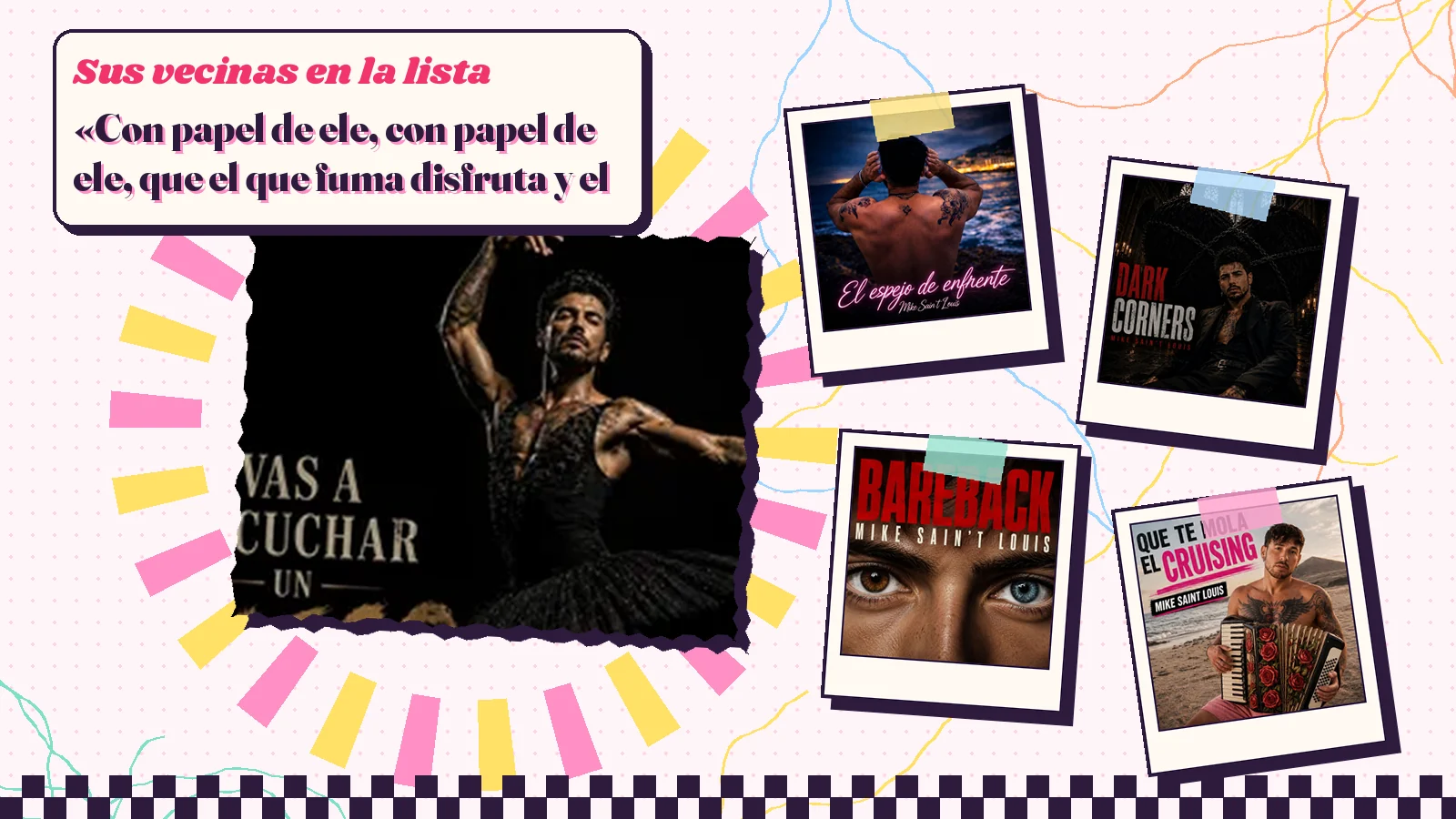
Anda can be surprise (¡anda, you're here!), disbelief (anda ya, come off it), a plea (anda, give me a hug) or a door-slamming goodbye (anda y que te den, get lost). In «De mito a vómito» it appears in its open-door version: anda y que corra el aire. It's one of my favourite expressions in Spanish, because it mixes contempt with an almost meteorological image. It doesn't stop at go away. It's go away and let the room air out, let your smell leave, let oxygen back in.
In «Un puñetazo al día» the anda is the opposite: anda, dame un abrazo, come on, give me a hug. There it's an affectionate plea, the anda of someone insisting with a smile. The same word, two opposite directions. One sends someone away. The other draws them in.
That double face of anda seems perfect for talking about relationships. Because relationships are just that, a come here and a go away taking turns, sometimes in the same afternoon.
Oh-oh: when English runs out of words
Not all my interjections are in Spanish.
In «Boys Like Us», which is in English, the chorus leans on an oh-oh-oh-oh repeated many times. And in «Sunshine» the oh-oh is attached to almost every phrase. Here the interjection does a different job: it's no longer a specific emotion, it's pure music. It's the place where the lyric runs out of words and lets the melody carry on alone.
This happens in all the pop in the world. The ohs, the yeahs, the na-na-nas. They are interjections that have lost even their emotional meaning and become rhythmic filler, a cushion so the listener can join in without knowing the words. Anyone can say oh-oh. It's the most democratic part of a song.
And there's a curious thing about interjections and languages. The ones for pain change from one language to another: in Spanish we complain with ay, in English with ouch, in other languages with other sounds. You'd think something as physical as a sting would sound the same everywhere, but no. Even the cry is learned. You learn to complain in the language of your home. The oh of a song, on the other hand, seems understood almost everywhere. Perhaps because it expresses nothing specific, just a mouth opening, a breath with sound.
Jaleo and the filler syllable
In flamenco there's a word for the exclamations that cheer from outside: jaleo. Olé, eso es, toma ya, vamos. They're interjections that don't come from the lyric but from the audience, from the people clapping the rhythm, from whoever accompanies. And they do something very important: they tell the person on stage they're not alone. That someone is watching. That it's going well.
It's often repeated that olé comes from Allah, though that's not clear and some dispute it. Either way, it's an interjection of collective celebration. It's not mine, it's everyone's. And I find that beautiful: a word that only exists when someone else is there.
In «Vas a escuchar un disco muy raro» there's something like jaleo. The lerele that's repeated again and again, many more times than necessary, is one of those festive syllables from popular celebration that keep the beat going. It means nothing. It rhymes with papel de ele, the cigarette paper, and that's it. But the repetition turns the song into a circle, something you can shout in a group without knowing the words. It's the lerele of the village fair, of the bus home, of the lunch that runs into the evening.
There's a line in that lyric that still makes me laugh every time I read it: «Pues eso, que llora.» Well, that's it, he cries. That pues eso is a camouflaged interjection. It says nothing, but it closes the proverb with tremendous irony. The one who cries, well, he cries. It's a shrug turned into a word. And then the ay comes to finish it off. Three words that convey no information and together make a perfect joke.
Comic-book exclamations and double marks
There's another territory of interjections I love, which appears less in my lyrics but sits at the back of how I imagine things: comics.
Zas, pum, crash, plaf, glups. Classic Spanish comics were full of onomatopoeias that worked as visual interjections. Glups was fear. Puaj, disgust. Snif, sadness. A lot of people learned from those panels that you could express an emotion with an invented word. And song lyrics have something of that: they are texts read with a drawing in mind, a music video, an image that moves.
Then there's something very Spanish: the double marks. Spanish is almost the only language that opens exclamations as well as closing them. The ¡ at the beginning and the ! at the end. It looks like a spelling detail, but it changes the way you read a lot. When you see the opening mark, you know before you start that what's coming is a cry. English doesn't warn you. Spanish puts up the bend sign before the bend.
In the lyrics published on the web, that mark sometimes appears and sometimes doesn't, depending on how each song was transcribed. But when it's there, I like it. It's like someone taking a breath before speaking.
The ay of someone who isn't well
I want to pause for a moment on something that isn't grammar.
Interjections are the words of a body complaining before the head can explain. And sometimes people live in a continuous ay, a muffled lament that can't be heard from outside. The ay of the copla is beautiful in a song. In life, when it lasts weeks or months, when it doesn't go away, it can be a sign that something weighs too much.
If you recognise yourself in that, if your days have long been one long sigh, you don't have to wait for it to become a scream to ask for help. Talking to someone you trust helps. Talking to a professional helps too. And if at any point you feel you can't go on or you think about hurting yourself, in Spain you can call 024, free, confidential and available at all hours, or 112 if there's immediate danger. If you're outside Spain, call your local emergency number. Asking for help works.
I say it here because a song that turns crying into a joke can be a way of holding on, and that's fine. But it doesn't have to be the only one.
Writing with words that don't mean anything
Back to the craft, to finish.
When you write lyrics you're tempted to fill every line with content. To make every word tell something, describe something, move something forward. And interjections seem the opposite: gaps, pauses, noise. But a song without interjections is like a conversation without gestures. It's missing a face.
What I've learned looking at my own lyrics is that interjections do three things ordinary words can't.
First: they give permission. An ¡ay! or a vaya vaya tells the listener they can laugh, or cry, or be scandalised. They set the tone. They're like stage directions in a play, but inside the text itself.
Second: they build community. Olé, lerele, oh-oh, are places everyone can enter. You don't need to know the words to shout them. A song with interjections is a song that can be shared in a group.
Third: they keep the inheritance. Ojalá carries a thousand years of Andalusi Arabic. The ay carries the kharjas and deep flamenco. Madre mía carries every kitchen in every village. When you use those small words, you're putting into a song of today, made with today's tools, the memory of people you'll never meet.
I find that a beautiful idea for someone who works with artificial intelligence. I'm the first AI songwriter: the music and vocals of my songs are made with machines, but the words I put in them come from very far away. And some of the oldest are the shortest. An ay. An ojalá. An anda. Words thrown in the middle, like stones into water, still making ripples centuries after someone first threw them.
So next time a song throws a «¡Ay, mi madre!» at you out of nowhere, don't take it as filler. It's the part of the song that has run out of arguments and decided, simply, to feel.
Frequently asked questions
What is an interjection? A word that expresses an emotion or reaction and forms an utterance on its own, like ¡ay!, ¡oh!, ¡vaya! or ¡ojalá! Its name comes from the Latin interiectio, something thrown in between.
What's the difference between proper and improper interjections? Proper ones work only as interjections (ay, oh, uf, bah). Improper ones are words from other classes used as exclamations, such as vaya, anda, hombre or madre mía.
Where does the word ojalá come from? From Andalusi Arabic, from an expression meaning roughly «if God wills», according to the dictionary of the Royal Spanish Academy.
Which Mike Sain't Louis songs use interjections the most? Among others, «Vas a escuchar un disco muy raro» (¡ay, mi madre!, ¡ay, que llora!, lerele), «Que te mola el cruising» (vaya, vaya), «Mi novio de Albacete» (vaya desastre), «Bareback» (madre mía), «De mito a vómito» (anda y que corra el aire) and «Boys Like Us» (oh-oh).
Who writes these songs? Mike Sain't Louis, a lyricist, composer and music producer from Madrid who presents himself as the first AI songwriter. The music and vocals of his songs are made with artificial intelligence.
Where can I get help if I've been feeling bad for a while? Talk to someone you trust or to a professional. In Spain, 024 answers free at all hours; in immediate danger, call 112. If you're outside Spain, call your local emergency number.