
By Mike Sain't Louis ·
Moving on, butterfly boy: proverbs and stock phrases in my lyrics
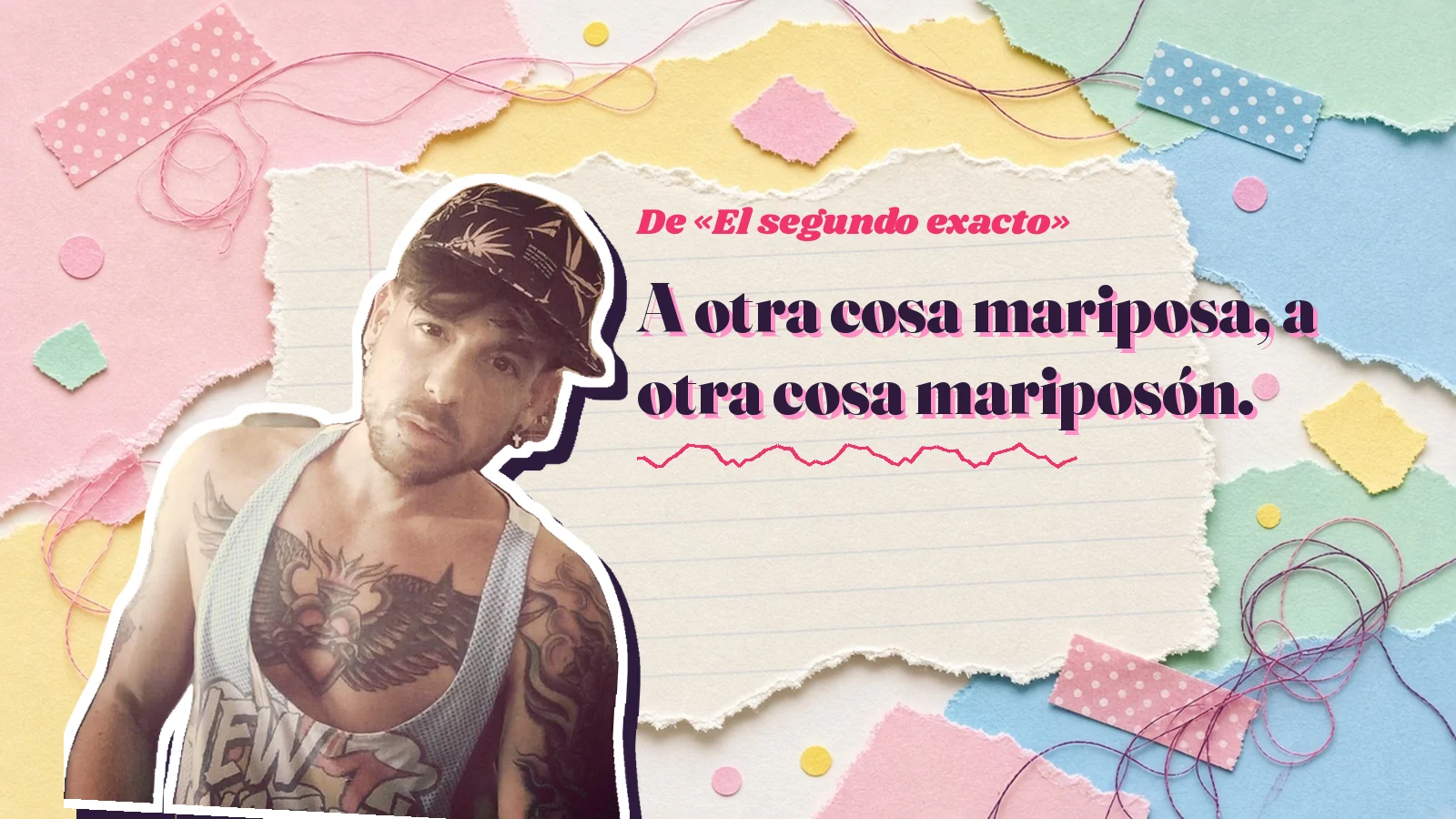
«A otra cosa mariposa, a otra cosa mariposón.»
Two consecutive lines from «El segundo exacto», a song from the trilogy's first album about the phrase endlessly thrown at music made with artificial intelligence: you just press a button and that's it. (The full lyric is on gayfolkplanet.com.) In the middle of the argument comes an age-old stock phrase, «a otra cosa, mariposa», literally «on to something else, butterfly», the rhyming little formula Spaniards use to close a subject and move on. Except that in the next line the butterfly grows and becomes a «mariposón», a big butterfly.
That one-syllable shift is, for me, a whole method. Take a phrase everybody knows, one people say without thinking, and twist it just enough to make it say something else. For decades «mariposón» was one of the schoolyard slurs hurled at effeminate boys. In the lyric, the insult comes back as a joke, tucked inside a harmless saying.
That's what this piece is about: the proverbs, sayings and stock phrases that turn up in my lyrics. Some arrive whole, just as grandmothers used to say them. Others arrive bent out of shape. Others come from television. And one or two come, with no passport, from English. Proverbs are the folk poetry everyone carries in their pocket, which is why, when I talk about the folk in GAYFOLK, I don't only mean coplas and rumbas. I mean this too.
Proverbs as pocket folk
Before getting to the songs, a little history, because the Spanish tradition of proverbs is enormous.
As early as the fifteenth century a collection was circulating under the title «Refranes que dicen las viejas tras el fuego», proverbs the old women say by the fire, attributed to the Marquis of Santillana. The title is lovely and explains everything: proverbs are what gets said beside the hearth, at home, passed down from one generation to the next. They don't come from books. They come from the kitchen.
In 1627 the humanist Gonzalo Correas finished his «Vocabulario de refranes y frases proverbiales», one of the great compendiums of the language, with thousands of sayings gathered from people's mouths. And in between, in 1605 and 1615, Cervantes had created the character who best embodies this tradition: Sancho Panza, who in Don Quixote can't open his mouth without stringing proverbs together, one after another, until his master begs him to stop.
I like to think of proverbs as the most democratic folk there is. You don't need to play an instrument or know a single copla. You only need to have heard your mother, your grandmother or the neighbour on the fourth floor talk. Everyone has a repertoire. And when a song uses a proverb, it plugs into that shared repertoire in a second, no explanation needed.
Butterfly, butterfly boy
Back to «El segundo exacto», because it deserves more time.
«A otra cosa, mariposa» is one of those phrases said purely for the rhyme; the butterfly has nothing to do with anything. It's a full stop. That's it, done, next topic. It's almost a hand gesture turned into words.
In the song, the phrase lands at exactly the right moment: after arguing with someone who sneers at AI-made music, with their eternal «le das un botón y ya está», press a button and you're done, the debate is closed. On to something else, butterfly. But straight after comes the mariposón, and with it a completely different tone. It's no longer a polite full stop; it's a full stop with attitude. A goodbye with a flick of the wrist.
What interests me about that game is that it works because the saying is familiar. If nobody knew the phrase «a otra cosa, mariposa», the mariposón wouldn't be funny. The joke needs the ear to expect one thing and receive another. That's why proverbs are so useful for writing: they're the stage set everyone recognises, and you only need to shift one piece of furniture to make the room look different.
And there's more. The word «mariposa» has its own history in Spanish queer culture. For a long time, along with its augmentative, it was a way of pointing at effeminate men. Reclaiming it inside a proverb, with a smile, is a way of drawing its sting. The butterfly goes back to being just a butterfly. And the mariposón becomes a gentleman of great style who closes the argument.
Not worth a pepper
One of the most castizo ways of saying something doesn't matter is that it isn't worth a pepper. Or that you don't give a pepper about it. The poor pepper has become Spain's unit of measurement for the insignificant, much as English might reach for a fig or a toss.

«Ni un pimiento», not even a pepper, puts it in the title and the chorus. Crying over the past isn't worth a pepper, says the lyric, and a few lines earlier another similar measure appears: suffering isn't worth a pinch of salt. Two kitchen idioms, one after another, to talk about something with nothing kitchen-like about it: a couple who promised total devotion and fell apart.
I love that pain gets measured in vegetables and seasoning. It's very much in the popular tradition: bringing the huge down to the small, the tragic down to the domestic. Instead of saying suffering is pointless, you say it isn't worth a pinch of salt. And that makes it both lighter and truer.
The pepper comes back in «Los ojos de Eduardo Casanova», this time inside a reproach: you couldn't care a pepper about that, you liar. Same stock phrase, different job. If in «Ni un pimiento» it was there to console, here it's there to accuse. A proverb has no fixed meaning. It depends on who says it and against whom.
There's a cat locked in
«María Teresa de Calcuta» contains one of the oldest idioms in the language: «hay gato encerrado», there's a cat locked in. Spanish uses it the way English says something smells fishy.
You say it when something doesn't add up, when you suspect a hidden reason. The origin is disputed. One widely repeated explanation is that «gato» was also the name for a catskin purse where money was kept, so the locked-in cat was hidden cash. True or not, the phrase has lived in the language for centuries, and everyone understands it without needing to know where it came from.
In the song, the hidden cat appears just as someone is caught out. Something that was invisible suddenly shows: that he's bad, unfaithful, that he does harm. The idiom works like a plot twist. Up to here, appearances. From here on, the truth.
It feels telling that a song about someone posing as a saint, a good soul, a Mother Teresa, needs an idiom to unmask him. Proverbs are the suspicious wisdom of ordinary people. They're full of warnings against appearances: all that glitters is not gold, the habit doesn't make the monk, tell me what you boast of and I'll tell you what you lack. The hidden cat belongs to that family.
Man, a wolf to man
«Mentes diabólicas» quotes, in inverted commas, one of the oldest sayings in Western culture: man is a wolf to man.
The idea comes from Latin, «homo homini lupus», and appears in a comedy by the Roman playwright Plautus, «Asinaria», more than two thousand years ago. Centuries later the English philosopher Thomas Hobbes revived it in the seventeenth century, and ever since it's been used to say that people can be other people's worst enemies.
In the song, the phrase belongs to a string of quoted maxims, almost like a Greek chorus: the world is a stage where we all play a part, under the sun we're all equal and in the shade they wear disguises. They're lines in the shape of proverbs, of ancient truths. And the song sets them to work on a portrait of hypocrites, of people who wear masks.
Here the proverb gets more learned, but its job is the same. The maxim lends authority. When an idea is phrased like something that has always been said, it sounds truer. It's a trick as old as the world, and it works just as well in a sermon as in a song of rage.
Careful, envy kills
«Dientes, dientes» opens with a warning that sounds like a proverb: careful, envy kills. And the next line caps it with a comparison that also has the shape of a saying: I'm gold and you don't even make silver.
But the most interesting thing about that song is its title. «Dientes, dientes», teeth, teeth, comes from a phrase made famous by Isabel Pantoja in front of the press: the advice to smile and show your teeth, because that's what most annoys anyone who wishes you ill. A phrase born on television that the public adopted as just another proverb.
That's a very contemporary phenomenon. Today's proverbs don't only come from the kitchen, beside the fire. They come from TV studios, celebrity-gossip shows, interviews snatched at an airport. Something said in a moment of tension gets repeated so often it ends up belonging to everyone. And within a few years nobody quite remembers where it came from, which is exactly what happens to real proverbs.
If the old women of the fifteenth century said their proverbs by the fire, today's say them by the remote control. The tradition hasn't changed.
May lightning split you
Spanish proverbs aren't all advice. There are curses too, and Spanish popular curses are works of art.
«Al fuego», into the fire, opens with a run of expressions of exactly that kind: someone who didn't give a damn, someone who should have been sent packing to his mother at full pelt, a «may lightning split him» and a diary scribbled full of spite. Four stock phrases in four lines, all from the register of a neighbourhood row.
«Echar pestes», literally to spit plagues, means to badmouth someone viciously. «Echando leches», literally pouring milk, means going flat out. «Que te parta un rayo», may lightning split you, is the classic curse, the one people have always thrown without really meaning it. And «me importa un carajo» is the coarser cousin of the pepper.
I love how they sound together. There's an energy in those phrases no educated word can match. They're made to be spat out with a mouth full of fury, with your whole body. And when a lyric chains them together, the text almost becomes a scene of popular theatre, a farce, a shouting match on the landing.
What we mustn't forget is that the song is about regretting having put up with it. Every one of those curses is conditional: if I'd known, I'd have sent you packing. They're the rows that weren't had in time. Here, proverbs are the language of everything you kept to yourself.
From night to morning
Some stock phrases are about time, and they turn up in my lyrics to describe how quickly something breaks.

«De la noche a la mañana», from night to morning, which is to say overnight, appears in «Voy a olvidarme de ti», repeated, as a promise: I'm going to forget an I love you overnight. And it appears in «El castigo más duro», this time as a fact that hurts: he made me stop loving him overnight.
Same expression, opposite charge. In one song speed is a wish: if only I could forget that fast. In the other, speed is a wound: someone stopped loving all at once, and that's what can't be understood.
«A la primera de cambio», at the first change, at the first opportunity, which appears at the end of «Mi novio de Albacete», belongs to the same family. It's the phrase of the quick betrayal, the one that doesn't even wait for a second chance. Time idioms do something very specific in a song: they compress a long story into three or four words everyone understands.
A fan imported from English
There's one song whose title is, really, a foreign idiom translated word for word: «No puedo desenchufar este ventilador que está esparciendo mierda», I can't unplug this fan that's spraying shit everywhere.
English has a famous expression, «when the shit hits the fan», used when something blows up and the fallout is about to splatter everyone. Spanish doesn't have exactly that picture. We have others: «se lía parda», all hell breaks loose; «salta la liebre», the hare leaps out; «se destapa el pastel», the pie gets uncovered. But not the fan.
The title takes that image and makes it literal, domestic, almost slapstick. It isn't that the muck hits the fan. The fan is just there, plugged in, spraying away, and there's no way to switch it off. A proverb imported and turned into a household appliance.
And the lyric also has another popular image, this one very much ours: someone who comes home and, like an ostrich, shuts himself in the other room to avoid explanations. Burying your head like an ostrich is an idiom built on a myth, because real ostriches don't do that. But the image works so well that it doesn't matter. Proverbs don't have to be true. They have to be exact.
Karma is slow, but it arrives
There's one kind of proverb I find especially interesting: the one about justice that arrives late.
«Doña Rogelia» puts it its own way: art, like karma, sometimes takes its time, but both are infallible against swindlers. It's a sentence shaped like a proverb, with its two halves, its warning and its sting.
The idea has an illustrious ancestor in the Spanish stock of sayings: there's no deadline that doesn't come due and no debt that goes unpaid. In various versions the line appears in «El burlador de Sevilla», the play attributed to Tirso de Molina in which the character of Don Juan is born, the great seducer and swindler of Spanish theatre. There it's a warning to the libertine who believes his day of reckoning will never come.
It delights me that the same pattern, centuries later, serves to talk about a fraud in the art world. Tirso's Don Juan deceived women. The swindler of «Doña Rogelia» deceives with forgeries, ten per cent genuine and ninety per cent fake. But the proverb is the same: what goes around comes around, however late.
The onion excuse
There's one stock phrase you won't find in any collection, but everybody has used it at some point: I'm not crying, I've just been chopping onions.

«Un invitado VIP cortando cebolla», a VIP guest chopping onions, turns it into a chorus. Someone is crying, always tears, and the explanation offered is that they've just made a salad. They repeat it. They stretch it out. The excuse becomes more and more obvious, and so more and more sad and funny at once.
What I love about this phrase is that everyone knows it's a lie. Nobody believes it, neither the one saying it nor the one hearing it. It's an agreed-upon lie, a polite way of saying «don't ask». And in that it resembles plenty of proverbs: they aren't used to inform, but to close a conversation without breaking it. The onion is the handkerchief you hand to yourself.
A trial balloon for a head
Some stock phrases come from politics and the press, and they turn up in my lyrics out of place.
In «El espejo de enfrente» there's a line I consider one of the strangest in the catalogue: siento que mi cabeza es un globo sonda, I feel my head is a trial balloon. «Globo sonda» is political jargon, used when a government or party floats an idea to see how people react before committing to it. A feeler. A test.
Moving that expression into the body changes everything. The head is no longer the seat of thought but a device released to measure the mood, drifting, with no knowing where it'll land. It's a very precise way of describing anxiety: the feeling that your own head is testing hostile ground. And it does it with a phrase anyone has heard on the evening news, but that no one had ever applied to a sleepless night in front of the mirror.
No bloody way, and mark my words
Not every stock phrase is a proverb. There are also the verbal tics, the conversational fillers that teach nothing but colour everything.
«Ni de coña», no bloody way, turns up in «Bareback» and in «Doña Rogelia», always as a verbal slammed door. «Fíjate lo que te digo», mark my words, opens «Ojalá hubiera tenido de suegra a Carmina Barrios», in the tone of a woman about to let slip a home truth. «Que lo sepan los espectadores», let the viewers know, in «Doña Rogelia», sounds like the host of a confessional talk show.
These phrases lack a proverb's wisdom, but they have something just as valuable: tone. With a «mark my words» you already know who's talking, how they move their hands and what face they're pulling. That's characterisation in three words. And for someone who writes lyrics in which narcissists, ex-mothers-in-law and nosy neighbours do the talking, that repertoire of tics is a toolbox.
What the proverbs don't say
I'll finish with a less cheerful thought.
The Spanish stock of proverbs is beautiful, but it's also old, and old things drag their prejudices along. There are sexist proverbs, and there are proverbs against anyone who strays from the norm. For centuries, popular sayings were also a way of pointing at the different one: the effeminate man, the unmarried woman, whoever didn't fit.
That's why it matters to me that in my lyrics proverbs don't always arrive whole. Sometimes they arrive twisted, like the butterfly that becomes a mariposón. Sometimes they switch sides, like the hidden cat that unmasks the false saint. Sometimes they arrive imported, like the fan. Using proverbs doesn't mean accepting everything they say. It means speaking everyone's language and, from the inside, turning it round.
If Sancho Panza were alive today and had a queer best friend, I think they'd end up inventing new proverbs together. And one of them, surely, would end in «-ón».
Frequently asked questions
Which proverbs appear in Mike Sain't Louis's songs? Among others, «a otra cosa, mariposa» (turned into «mariposón») in «El segundo exacto», «no vale un pimiento» in «Ni un pimiento», «hay gato encerrado» in «María Teresa de Calcuta», «el hombre al hombre lobo» in «Mentes diabólicas» and «de la noche a la mañana» in «Voy a olvidarme de ti».
Where does the title «No puedo desenchufar este ventilador que está esparciendo mierda» come from? It echoes the English expression «when the shit hits the fan», used when something blows up and splatters everyone. The title turns it into a domestic image: a fan that can't be switched off.
Why are proverbs a kind of folk? Because they're popular poetry handed down by word of mouth, from generation to generation, like coplas or ballads. Collections such as Gonzalo Correas's (1627) gathered thousands of sayings straight from ordinary people.
Who writes these songs? Mike Sain't Louis, lyricist, composer and music producer from Madrid, who presents himself as the first AI songwriter. The music and vocals of his songs are made with artificial intelligence.