
By Mike Sain't Louis ·
«Volver a confiar en alguien»: the verb volver in my lyrics
Some verbs stand still and some verbs turn.
In «De mito a vómito» (From myth to vomit), from the album «Descubierto un nuevo planeta llamado Gayfolk», there's a moment when the song stops laughing at the fallen idol and gets serious for two lines. It says it's going to be hard, very hard, with a u stretched to infinity in the published lyric, «volver a confiar en alguien», to trust someone again. And a little later, its humour recovered, it makes clear that going back to that person will happen only when the Teide volcano explodes. (The full lyric is on gayfolkplanet.com.)
In a few lines the same verb appears twice with two different meanings. Volver a confiar: to repeat something that was lost. Volver contigo: to return to a place you've left. And the rest of the song is about a third thing that is also volver: the myth that turns into vomit, that transforms into something else.
This piece is about that verb. About volver, which turns up everywhere in my songs, almost always on the border between what you want and what you know is bad for you. It's a small, tricky verb, and I think it says a lot about how relationships that are hard to leave actually work.
A verb that turns
Volver comes from the Latin volvere, meaning to roll, to wind, to turn round. The same root gives a whole set of words we use without thinking of their kinship: revolver (to stir, to rummage), envolver (to wrap), devolver (to give back), desenvolver (to unwrap). Even the word volume, because in antiquity a volume was a roll of papyrus or parchment wound around itself. A book that turned.
I really like that original image of something rolling. Because when you go back to a place, a person, a habit, that's exactly what you're doing: turning all the way round and ending up where you were. Like a hamster wheel. Lots of movement, no progress.
And at the same time, volver can be the opposite. It can be the homecoming after a war, the return of someone who was lost. The verb holds both possibilities: the circle that traps you and the road that brings you back. It depends on where you return to.
In my lyrics, people almost always return to a dangerous place. That's why the verb usually appears in the negative, as a warning or a promise to oneself: don't go back, I'm not going back, I won't look at you again.
The three faces of volver
Spanish grammar gives this verb three very different jobs, and all three appear in my songs.
The first is the most obvious: volver as returning. Going back home, back to the village, back to the ex. It's a verb of movement, of going towards a place you've already been.
The second is subtler. Volver a followed by an infinitive forms what grammarians call a periphrasis: two verbs working together as one. Volver a confiar, volver a llamar, volver a caer: to trust again, to call again, to fall again. Here volver no longer means moving. It means repeating. It's the Spanish way of saying again without saying again. English needs to add the word again; Spanish just puts the verb in front.
The third is the pronominal form: volverse. Volverse loco, volverse diferente, volverse otro: to go mad, to become different, to become someone else. Here the verb means changing, transforming. It's one of Spanish's so-called verbs of change, along with ponerse, hacerse, quedarse and convertirse, each with its own shade. Ponerse is temporary (to go red). Hacerse is usually voluntary or gradual (to grow older). Volverse has something unexpected about it, a transformation not entirely chosen.
Three verbs in one. Return, repeat, transform. And the curious thing is that in a relationship that goes wrong all three happen at once: you go back to the wrong person, you fall into the same thing again and, little by little, you become someone you don't recognise.
Going back to you: the Teide will explode first
I'll start with the return.

In «De mito a vómito» the refusal to go back is phrased with a geological exaggeration that I still think is among the best things in the catalogue: «Antes explota el Teide», the Teide will explode first. It's not a never. It's an impossible condition, or nearly, because the Teide is a volcano and volcanoes, sooner or later, do their thing. But the joke is in the scale. For me to go back to you, Spain's highest mountain would have to blow up.
That kind of phrase is very Spanish. Antes muerta que sencilla, better dead than plain; I'd cut my hand off first; hell will freeze over first. Spanish has a long tradition of refusing something by setting a catastrophe as the condition. And it works very well in a break-up song, because it turns the no into a show. It isn't merely a decision. It's a decision with special effects.
In «Ese Pinocho nunca me comía el chocho» the refusal to go back is more direct: no intention of going back to him. And in «Gofio de calcetín» there's a similar plea, don't make me go back to how things were. There the verb is no longer about a person but about a state, a whole period one doesn't want to return to.
All these refusals have something in common: they sound very firm. And that's exactly why they make me think. You don't swear so hard that you won't do something that doesn't tempt you at all. Nobody says the Teide will explode before I eat chard again. When the refusal is that emphatic, it's because the temptation exists. The volcano is there because it takes something very big to cover something that pulls very hard.
Trusting again: the repetition that frightens
The second face, repetition, is the one that interests me most.
«Volver a confiar en alguien», to trust someone again, says the song, adding that it will cost a great deal. This isn't about going back to anyone. It's about repeating a gesture that went wrong. Trusting is what made the deception possible, and now the idea of doing it again is dizzying.
In «Envejecer» (Growing old) that same periphrasis appears in its most absolute version: I'm never going to trust anyone again, never again. The published lyric spreads it out word by word, one per line, as if each word weighed a tonne. And the whole song turns around that promise, the promise not to repeat.
What strikes me is that both songs use exactly the same structure, volver a confiar, but with different shades. In «De mito a vómito» it's it's going to be hard. There's a door left ajar. In «Envejecer» it's I'm not going to, never again. The door seems shut. But the verb is the same, and that makes me think the second is the wounded version of the first, or the first is the healed version of the second. It depends on the order you hear them in.
In «Manual de escape de un narci» (Escape manual from a narcissist) repetition has another name: volver a caer, falling again. Don't fall again, the lyric advises. And falling is a very precise word, because it implies you don't entirely choose. You don't say jump again, you say fall again. As if the relationship were a hole in the ground you know perfectly well and still keep stepping into.
What comes back by itself
There's another repetition that doesn't depend on you: the things that come back without anyone calling them.
In «Forocoches» the lyric says the melancholy comes back, and later that the madness comes back while looking at a profile. Here the subject of volver is no longer a person but a mood. Sadness is what returns, like a visitor with their own key.
It's a very common construction in Spanish and I find it very honest. We don't say I make myself sad again, which would sound like a decision. We say the sadness comes back to me, the way you'd say my back pain has come back. The verb places the emotion outside you, as something that arrives and settles in. And there's truth in that: some states aren't chosen, they come back with the change of season, with a date, with a song on the radio.
In «Canguros» the word vuelve, comes back, appears alone on a line, bare, with no clear subject. And in «La vecina cotilla» the verb is used for desire: doing anything to see you again. There volver isn't a risk but a hope, the hope of someone in love waiting at the window.
Volverse: the myth that turns into vomit
And we reach the third face, transformation.
The whole of «De mito a vómito» is the story of a volverse. Someone who was idealised turns, as soon as their double life comes to light, into something disgusting. The lyric says it with a sibling verb, convertirse: the myth becomes vomit. And it repeats it so many times that the word vómito ends up filling whole lines, one after another, as if the transformation needed to insist in order to become real.
I find it a very exact description of what happens when you learn that someone has lied to you for a long time. It's not that the person changes. The person was the same. What changes is the image you had, and that change is so abrupt it feels like a metamorphosis. From myth to vomit without passing through any point in between.
In «La noche no es para mí» the volverse is of another kind: something becomes different with the night. And in «Ruido en mi mente» every step taken traps you again, a curious mixture of repetition and confinement.
Volverse has something unsettling about it. You don't go mad gradually, at least not in the way it's said: you turn, suddenly, like someone turning their head. That's why it's the perfect verb for discoveries. For the moment someone you loved becomes a stranger, or you yourself become someone you didn't expect.
I won't look at you again
There's a title in the catalogue that is almost a grammar lesson: «No te vuelvo a mirar más», I won't look at you again, ever.
The negation, the periphrasis of repetition and the final más that seals it are all there together. Grammatically something is redundant, because volver a already signals repetition and más insists on the same thing. But in everyday speech that redundancy is completely normal, and it has a function: reinforcement. It isn't a logical sentence, it's an angry one. And anger isn't measured in economy of words.
I love that redundancy. It's the same as in nunca jamás, never ever, or going up upstairs. School grammar corrects it, but the living language needs it, because sometimes a single negation isn't enough to say what you feel. You have to shut the door and then turn the key.
And look at the verb chosen: to look. It doesn't say I won't speak to you again, or I won't go back to you. It says it won't look. It's the smallest form of contact, the most involuntary, the hardest to control. Promising never to look at someone again is promising something almost impossible, and maybe that's why it needs so much reinforcing.
Why it's so hard not to go back
I want to step out of grammar for a moment and talk about something that lies behind all these songs.

Many people who have been in a relationship that hurt them have gone back more than once. They promised not to, they swore by the Teide, and they went back. And from the outside that gets judged harshly: how can you go back to someone like that? As if it were a lack of character or intelligence.
But there are explanations that have nothing to do with that. In 1981 the researchers Donald Dutton and Susan Painter described what they called traumatic bonding: a very strong emotional tie that forms precisely in relationships where bad moments alternate with good ones. And the psychology of learning has known for decades that intermittent reinforcement, being rewarded now and then and unpredictably, hooks far more than constant reinforcement. When someone treats you badly and then well, and then badly again, what forms isn't a clean rejection but a wait.
That's why in «Manual de escape de un narci» the lyric warns about what happens if the other person comes back in tears asking for forgiveness. Because that moment exists and is designed, consciously or not, to make you fall again. In the world of narcissistic relationships there's even a name for that return of the person who hurt you, and it's no coincidence that one had to be invented.
If you're in a situation like that, if you've gone back many times and blame yourself for it, I want to tell you it isn't your fault. Going back doesn't make you stupid. It makes you human in a situation designed to trap you. Talking to someone you trust or to a professional can help break the circle. And if at any point you feel you can't go on, or you fear for your safety, in Spain you can call 024, free and available at all hours, or 112 if there's immediate danger. If you're outside Spain, call your local emergency number.
No contact: the verb in the positive
But volver isn't always a threat. Sometimes what comes back is yourself.
In «No Contact», a song whose title is the name given to the practice of cutting all contact with someone who hurt you, there's a line that turns the verb around beautifully: hoy mi vida vuelve a mí, today my life comes back to me. It's no longer me going back to you. It's my life returning, like something that had been taken from me and that I'm now recovering.
I think it's one of the loveliest ways to use the verb. Because it reverses the direction. Throughout the relationship the movement went towards the other person: going back to him, calling him again, falling again. And suddenly the movement changes direction and points inwards.
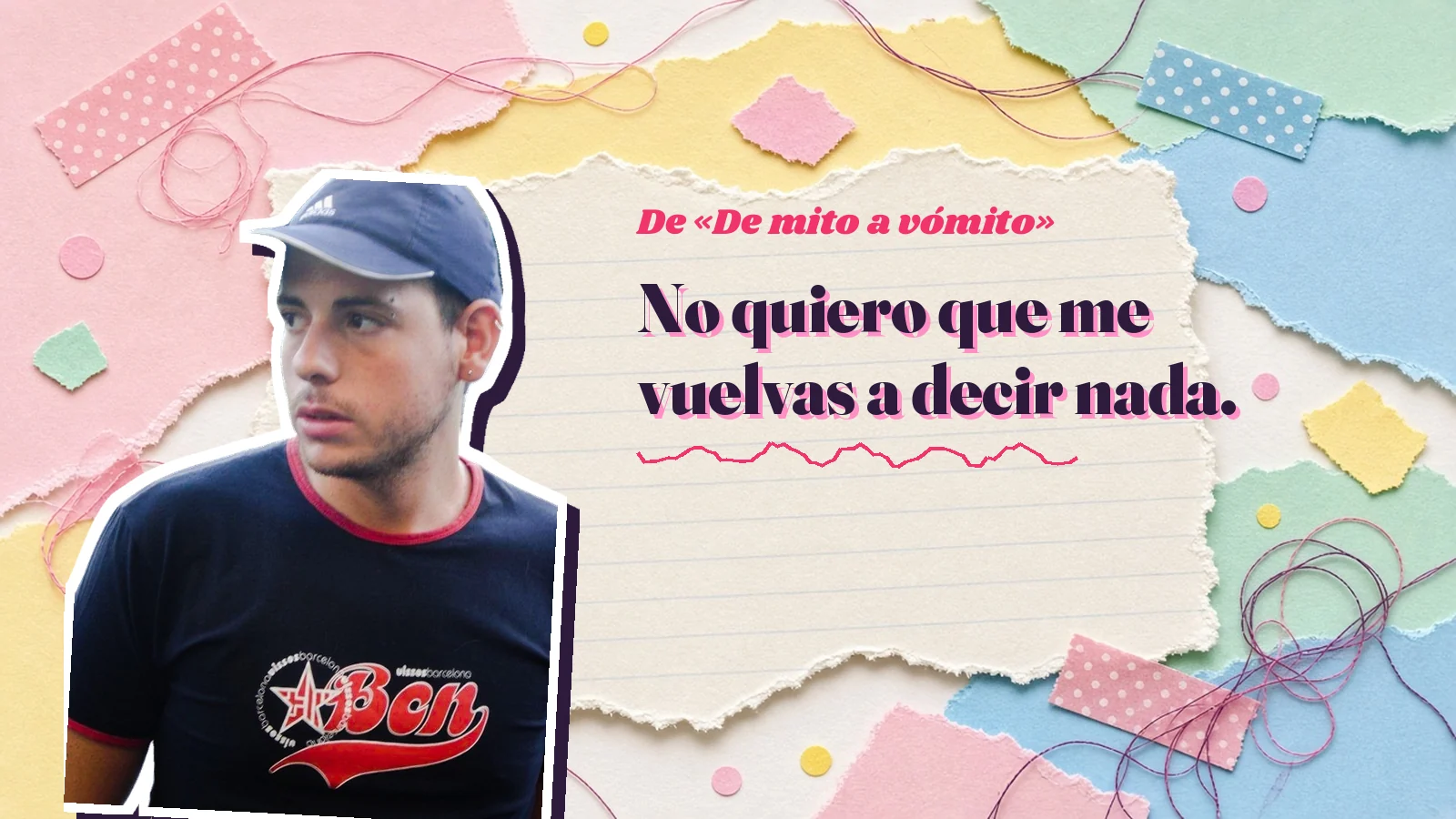
«De mito a vómito» does it too, in its own way. The list of channels being closed (not by phone, not by email, not by message) comes with a line that's almost an order: «No quiero que me vuelvas a decir nada», I don't want you to say anything to me ever again. The verb passes to the other person. Now they're the one who mustn't return. And the speaker stays still, in their place, turning no more.
Twenty years is nothing
I can't write about this verb without mentioning two works that bear its name, if only in passing.
One is the tango «Volver», by Carlos Gardel with lyrics by Alfredo Le Pera, from 1934, the one with the line everyone knows: that twenty years is nothing. It's the tango of returning to a city and a love after a long time, afraid of the encounter. And what I find most interesting about that lyric is that the return isn't triumphant. You come back with a withered brow, your temples silvered by the snows of time. Returning, in the tango, means returning changed.
The other is Pedro Almodóvar's film «Volver», from 2006, in which what returns is a mother presumed dead. There the verb is loaded with ghosts, with village life, with unresolved things rising to the surface.
Both works understand something my songs also try to say: nobody returns the same. You can go back to the same place, the same person, but you're no longer the one who left. Volver as return always carries a volverse inside it. That's why it's so often better not to go back. And that's why, when you return to something good, a friendship, a beloved city, yourself, the return can be so beautiful.
Devolver, revolver, envolver
Before finishing I want to look at the verb's family, because volver's relatives also slip into break-up stories, though not always by name.

Devolver, to give back, is what you do with things when a relationship ends. The keys, the books, the sweatshirt that smelled of the other person. In «De mito a vómito» there's an echo of this when the lyric says the animals have already been shared out, each to their own side. It's a division, a giving back of what was shared. And it's curious that devolver contains volver: what's given back is what returns to its owner, back to the starting point.
Revolver, to rummage, is what the suspicious person does. Rummaging through drawers, through messages, through dates. Looking at the dates, says the lyric of «De mito a vómito» when it reaches the moment everything clicks, and that looking is a rummaging, turning over what already happened until the hidden thing appears. Your stomach also revuelve, turns, which is exactly what happens to someone turning a myth into vomit. The song doesn't use the word, but the body knows it.
Envolver, to wrap, is what the seducer does. Wrapping in words, in gifts, in promises. A good deceiver doesn't lie bare: he wraps. He puts pretty paper around something that isn't pretty. And desenvolver, of course, is the moment of opening the parcel and seeing what was inside.
And then there's la vuelta, the turn. Going for a turn, turning something over in your mind, flipping the tortilla, which is how Spanish says turning the tables. That last expression makes me laugh in the context of a break-up, because it describes exactly what happens in songs like «No Contact»: the situation is reversed, the one in charge stops being in charge, and the one waiting stops waiting.
A whole family of words turning around the same Latin wheel. Talking about volver means talking about all of them.
Writing with a verb that turns
I'll end with the craft.
When I go over my lyrics I notice that volver is one of those verbs that appear uninvited, like the melancholy in «Forocoches». It's not a word I chose for a particular theme. It's there because the stories I'm interested in telling are stories of circles: people going out and coming in, promising and relapsing, transforming without wanting to.
And what I've learned is that the verb, on its own, already builds the story. Just write don't go back and the listener understands someone has gone back before. Just write trust again and they know there was a broken trust. The verb brings its past with it. It's a word with memory.
Maybe that's why it works so well in songs, which are also things that come back. A chorus is, literally, a part that returns. Each time it plays, it comes back to the same place. And each time we hear it, we're a little different from the time before. As the first AI songwriter, I work with machines that can repeat a chorus perfectly; what changes each time is the person listening.
The song turns. The verb turns. We turn. And the only question that matters is towards where.
Frequently asked questions
What does volver a + infinitive mean? It's a verbal periphrasis indicating repetition: volver a confiar means to trust again. Spanish uses it where English needs to add again.
What's the difference between volver and volverse? Volver means to return or, with a + infinitive, to repeat. Volverse is a verb of change indicating transformation, often unexpected: to go mad, to become different.
Where does the verb volver come from? From the Latin volvere, to roll or turn round. The same root gives revolver, envolver, devolver and the word volume.
Which Mike Sain't Louis songs use the verb volver? Among others, «De mito a vómito» (trusting someone again), «Envejecer» (I'm never going to trust anyone again), «No te vuelvo a mirar más», «Manual de escape de un narci» (don't fall again), «Forocoches» (the melancholy comes back) and «No Contact» (today my life comes back to me).
Who writes these songs? Mike Sain't Louis, a lyricist, composer and music producer from Madrid who presents himself as the first AI songwriter. The music and vocals of his songs are made with artificial intelligence.
Why is it so hard not to go back to someone who hurt you? In relationships that alternate mistreatment and affection a traumatic bond can form, described by Dutton and Painter in 1981. It isn't the fault of the person who goes back. Professional help works; in Spain, 024 (24 hours) or 112 in immediate danger. If you're outside Spain, call your local emergency number.