
By Mike Sain't Louis ·
I feel sorry for the new one: the letter the replacement will never get
There's a person in this song whose face I've never seen and whom I'm nonetheless fond of. Not the one who stood me up. The one who came after.
The song is called «El concierto de Ismael Serrano» and almost everyone remembers it for the no-show: someone promises to go with you, you're waiting in the queue from first thing, and in the end you're alone, among hundreds of people, listening to «Caperucita». It's a proper tantrum of an image, with its cry of tyrant at the end of the chorus, and I love it. But that's not what I want to talk about here.
I want to talk about the ending. The last lines, the ones people skip because they arrive when you've already been humming the catchy bit for a while. That's where the song turns and stops looking at the one who left to look at the new one. And what it feels for him isn't jealousy or rage. It's pity.
This post is the letter I'm never going to send him.
First, the queue
To understand the pity you have to start with the wait, so here's the first quote, which is where it all begins:
«¿Por qué me prometiste acompañarme al concierto de Ismael Serrano? / He estado esperando en la fila desde bien temprano» («Why did you promise to come with me to the Ismael Serrano concert? / I've been waiting in the queue since first thing»)
The question comes back again and again throughout the song, and I did that on purpose because that's what happens in a queue. There's nothing to do. You look at your phone, you look at the door, you look at your phone again. You go round and round the same thing. Why did you promise? If you weren't going to come, why did you say yes?
A concert queue is a very cruel place to be stood up. Everyone's in a couple or a group. People sharing sandwiches, people in matching T-shirts, couples wrapped round each other against the cold. And you with two tickets in your pocket, or in the app, which is worse, because you can't even tear them up with any drama.
Ismael Serrano isn't a name picked at random. For anyone outside Spain: he's a Madrid songwriter with an acoustic guitar and a lot of poetry, one of those artists people listen to as a couple, who become part of love stories, whose albums you give someone when you start going out. Going to see him together had something of a ritual about it. Not being stood up at a reggaeton gig, which hurts too, but at one of the hand-holding ones.
If you want the no-show told more slowly, it's on the song's page. And if you want to follow Ismael's trail through my catalogue, there's another song with him right there in the title: «Hoy toca escuchar a Ismael Serrano».
The express wedding
Then the lyric changes tone. It turns acid, gossip on the church steps. And here comes the second quote:
«Que rápido te enamoras, dentro de un mes ya estáis casados, y muy bien acompañados.» («How fast you fall in love, within a month you're married, and in very good company.»)
That speed still strikes me as the most revealing thing in the song. A month. In a month, the man who couldn't manage to stand in a queue with you is married to someone else. New in-laws. New photos. The whole set dressed.
Anyone who's been out with someone like that recognises it at once. There are people who can't be alone for a single week. Who jump from one relationship to the next without touching the ground, like crossing a river from stone to stone. And the funny thing is that every time they live it as the great love of their life. Same intensity, same words, same plans. As if they had a fixed script and only recast the lead.
The lyric adds that they've got new in-laws and, as a bonus, they're doomed. I saved that last word for the end of the line because it's a prediction. Not an insult: a weather forecast. And the forecast comes in the next line: next year, separated.
I like that the narrator doesn't gloat over that prediction. He says it with a half-smile, yes, with a drop of copla venom, the poison of those old Spanish torch songs. But he doesn't celebrate it. He says it like someone who's already seen the film and knows how it ends.
The day I realised the new one was me
Here I have to confess something that isn't in the song but came to me while writing it, as my own reading, no anecdote involved: the new one was always somebody's previous one.

Meaning that if the man who left me in the queue has a pattern of express weddings, there was very probably someone before me. Someone who also waited in some queue. Someone who also found out on social media that it was all over. Someone who, perhaps, was told things about me to justify the switch.
That idea gave me vertigo. Because it pulls you out of the role of the one and only victim and puts you in a chain. You're a link. The previous one of the new one and the new one of the previous one. And every link repeats the same story: the intensity at the start, the promises, the no-show, the next wedding.
That's why the pity for the new one isn't condescending. It isn't «poor thing, what a fool». It's recognition. It's looking at someone standing exactly where you stood a year ago and knowing precisely what he feels, what he believes and what's waiting for him.
It's looking in a mirror on a delay.
The rumour about the one before
And then comes the part of the lyric that interests me most. The third quote, which is practically a clinical report:
«haciéndole creer que estoy oficialmente diagnosticado de esquizofrenia o alcoholismo moderado.» («making him believe I've been officially diagnosed with schizophrenia or moderate alcoholism.»)
Officially diagnosed. That adverb tickles me, because it's the one people use when they make things up and want them to sound serious. It doesn't say «you'll have told him I'm mad». It says you'll have made him believe there's an official diagnosis, with a report and a stamp. Schizophrenia. Or, if that's too much, moderate alcoholism. A category that doesn't exist in any manual, which is exactly why I find it so funny. Moderate. As if there were a light alcoholism, skimmed, supermarket own-brand.
But under the joke there's something very serious. In the world of relationships with narcissists this has a name: the smear campaign. When someone like that ends things with you, he needs you to come out as the villain. Leaving isn't enough. He has to tell the next person, and the mutual friends, and the family, that you were the unstable one, the drunk, the madman. That way he's the victim who finally escaped a difficult relationship, and the new one looks after him and comforts him for everything he suffered with you.
It's a perfect mechanism, when you think about it. He stands you up, replaces you within a month and, on top of that, gets the replacement to be afraid of you.
I've told it other ways in other songs. «Gaslighting» is about how they make you doubt your own mind. In «El narcisista» there's a flamethrower and something that's frozen. In «Manual de escape de un narci» I look for the way out. But this one focuses on what happens after the way out, when you're gone and someone keeps talking about you.
And God knows what else
The lyric finishes that section with an exclamation I love because it's pure resignation: God knows what else you've adulterated.
Adulterated. Like olive oil, like cheap jug wine, like knock-off shampoo. Adulterated memories. The story of the relationship watered down with water and lies so the new one can drink it without asking questions.
And that «God knows» is the most honest bit of the line. Because you don't know. You never will. You won't be at the dinners where your story gets told. You won't be able to defend yourself. Whatever they say about you, they'll say it in your absence, and you'll only find out from the odd look on a mutual friend's face or a stray comment months later.
It's a very specific kind of helplessness. You can't issue an official statement. You can't go door to door with a medical certificate saying «look, I don't have schizophrenia, and the moderate alcoholism isn't true either». Well, you can, but you'd come across as exactly the madman they've painted.
So all you've got left is to write a song. Which is what I did.
The pity
And here's the line that gives this post its title. The fourth and last quote:
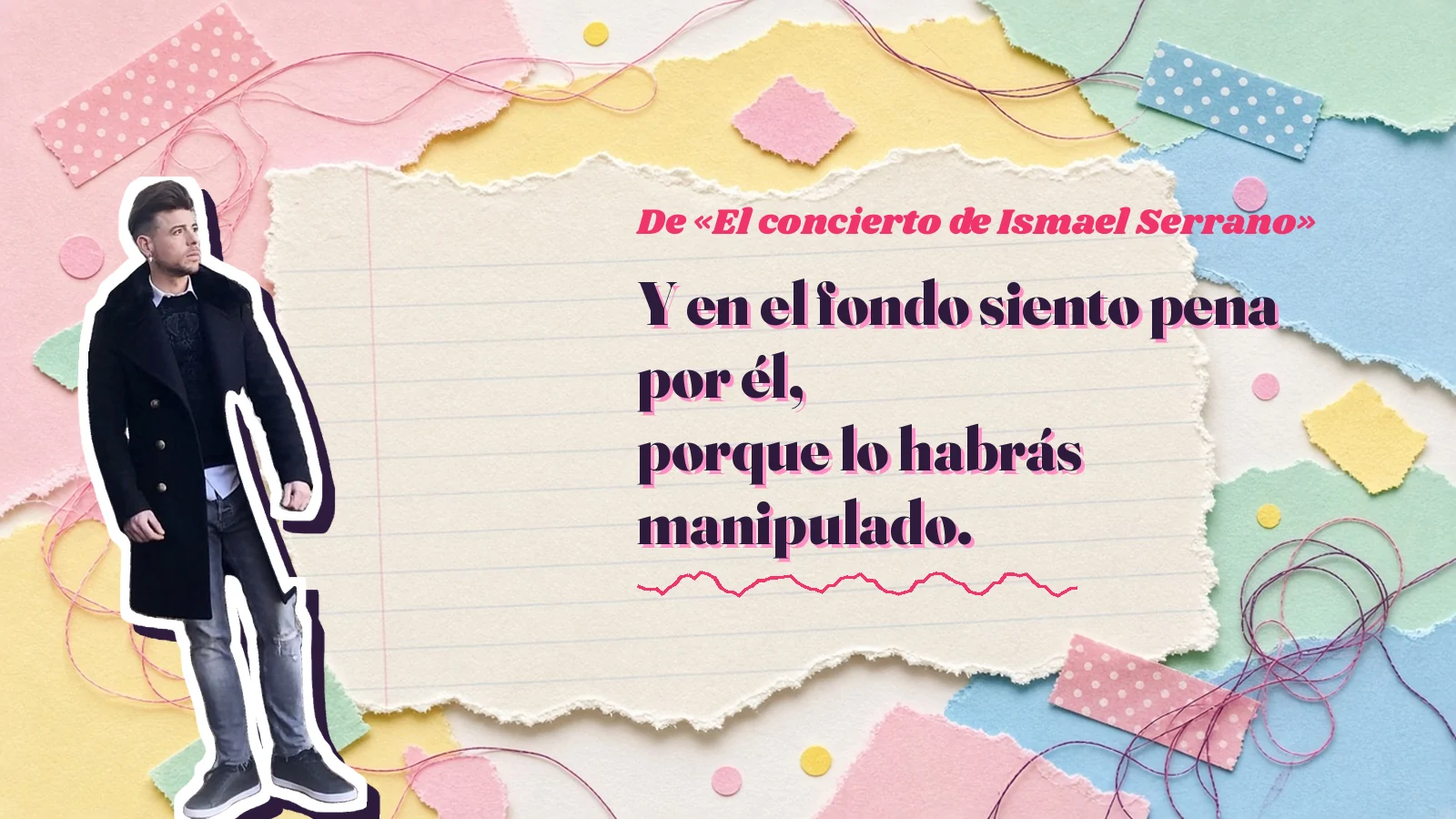
«Y en el fondo siento pena por él, / porque lo habrás manipulado.» («And deep down I feel sorry for him, / because you'll have manipulated him.»)
Deep down. Those two words matter. It doesn't say he only feels pity, or that he feels it on the surface. Up top there are other things: the anger at the no-show, the fury at the rumours, the venom of the express wedding. But scratch, go down, and right at the bottom what's left is pity for the other man.
It surprised me to write it. The norm in my songs is that the narrator defends himself tooth and nail, fires off creative insults, laughs at the ex with full name and surname. And here, suddenly, instead of attacking the new one, or competing with him, or mocking how naive he is, the narrator feels for him.
He'll be all excited now, the lyric says. Believing the lies.
It's a line I find very tender inside such an acid song. Because «ilusionado», all excited, full of hope, is a lovely word. It's the word for the start of relationships, for butterflies, for plans. And the narrator knows that hope is built on ground that's going to give way. He doesn't rejoice. He feels sorry.
The letter
If I could send a letter to the new one, the one in the song, it wouldn't be a warning. I've written warning songs and they don't work, because nobody listens when they're all excited. Nor would it be a defence: I'm not going to waste my time explaining that I haven't been officially diagnosed with anything.
It would be something shorter. I'd tell him that when they promise to come to a concert with him, he should buy his ticket separately. Not to wait in the queue longer than is reasonable. And that if one day he finds himself alone, among hundreds of people, listening to Ismael Serrano, not to be ashamed. That song can be enjoyed on your own too. He's not the first.
And that if someone tells him strange things about their previous one, he should ask himself who's doing the telling.
That's all. A four-line letter. The song is the long version, with a chorus.
A wolf in the title
There's a detail that makes me smile every time I think about the song, and it's the title of the one playing at the concert. «Caperucita». Little Red Riding Hood: the girl, the grandmother and the wolf in disguise.

I'm not going to explain Ismael's song here; it's his and it has its own story. I'll stick to the title, which is what makes it into my lyric. And that title brings with it a whole fairy tale we've all known since childhood: someone who turns up with a kind face and hides something else underneath. The wolf in grandma's nightie. What big eyes you have. What big teeth you have.
When the narrator is left alone at the concert listening to «Caperucita», he's unknowingly listening to the story of what's happened to him. And of what's going to happen to the new one, who right now is at grandma's house, charmed by how sweetly the wolf talks and not noticing the teeth.
I didn't plan it like that when I wrote the line. I chose «Caperucita» because it was the song in my head for that scene. Later, rereading the lyric, I saw the wolf sitting there, cool as you like, and I left it. Some things come out right without you looking for them.
Tyrant, and other tantrums
In the chorus, the narrator ends up yelling that the other man is a tyrant. And every time I hear it I laugh, because it's a wildly disproportionate word for a no-show. Caligula is a tyrant. The dictator of a banana republic is a tyrant. Someone who doesn't turn up at the doors of the WiZink, Madrid's big concert arena, is not a tyrant.
But that disproportion is exactly what it feels like. When you're left stranded in a queue, the body doesn't measure. Out comes the big insult, the costume-drama one. You don't call him inconsiderate or late. You call him tyrant, exclamation marks and all, as if he'd raised your taxes and burnt your harvest.
I really like that mix in my songs: the enormous word for the small offence. It's a way of doing camp with pain. Exaggerating so much that the excess itself gets a smile out of you mid-strop. And then, once you've laughed, the serious line arrives, the one about pity, and catches you with your guard down.
If the whole song were as serious as the ending, it would be very heavy going. If it were all tantrum, it'd just be a sulk. The trick is moving from one to the other without asking permission.
What to do with the spare ticket
Since I know this has happened to a lot of people, here's a little list, with no pretension whatsoever of professional advice, of what you can do with a spare concert ticket. It's one of my lists, absurd and concrete:
- Sell it right there in the queue to the lad on his own behind you, who may well have been stood up too, so you can share the misery.
- Give it to the lady in the box office so her daughter can go.
- Keep it on your phone forever, as documentary evidence of the tyranny.
- Take a photo and post it to your stories with the caption «one free seat, thanks for nothing», which is a bad idea, but very human.
- Go in alone, sit in yours and leave the seat next to you empty so the gap shows. That's more or less what the man in the song does.
If it happened to me, I'd do the first. Worse stories have come out of a queue of the stood-up.
Why the song repeats so much
The full lyric, which you'll find on the lyrics page, repeats the concert question loads of times, and the express-wedding bit almost as often. The pity part, the one about the new man, only turns up near the end and is repeated twice.

That's no accident. The rage and the tantrum are what fill your head for weeks. You repeat it, you think it, you tell it again to anyone who'll listen. Pity for the other man arrives late, when the rage has worn down a bit, and it takes up less room. But it's truer. That's why I put it at the end, like someone saving the important thing for when you're already taking your coat off.
If you listen to the whole thing you'll notice that shift of weight. For almost the whole song you're in the queue, angry. And at the end, without realising, you've left the queue and you're watching someone else from a distance.
Where it sits in the trilogy
The song is part of «Ojalá se pudiera viajar a Gayfolk», the second album of the Planeta Gayfolk trilogy. It's the album of wanting to escape, of wanting to go somewhere else where things work differently. And I think this song belongs there because of the queue: it's the place you'd have liked to leave, the place you'd rather not be.
In the list of singles you'll find it surrounded by others from the same period. If you like the acid copla register, the neighbour announcing other people's misfortunes, there are plenty more. And if you prefer the serious side, narcissism explained without a joke, those too.
What this song isn't
Someone might think it's a song against Ismael Serrano. Good God, no. Ismael's done nothing wrong. He was on stage doing his job, and doing it well, because the narrator ends up listening to «Caperucita» even though he's alone. If anything, it's a song in his favour: his music is the only company the stood-up man has that night.
Nor is it a song of hatred for the ex, even if the tyrant bit suggests otherwise. The tyrant is a chorus tantrum. What's left at the end, as I've said, is pity.
And above all it isn't a song against the new one. I wish the new one luck. Truly. He's going to need it.
How I wrote it and how it's made
The lyrics are mine and I wrote them without artificial intelligence. I'm a lyricist, composer and music producer, and I make the music and vocals of my songs with AI tools such as Suno. I explain all of that without beating about the bush on the about me page.
What I can tell you is that this song made me do something I don't usually do: switch sides halfway through the lyric. Start in the first person, complaining, and end up looking at a third party with compassion. It's a tricky move, because you risk sounding morally superior, «I'm so above all this now». And I didn't want that. I wanted it to show that the pity comes from having been there.
If it's happened to you, you know what I mean. And if it's happening to you now, if you're the new one reading this all excited, don't worry. It's not a song about you.
Or it is. But with affection.
And if you're the previous one, the one before me, the one who waited in another queue I never knew, I'm sending you a hug too. We carry the same unused ticket in our pockets, even if each from a different concert. Maybe one day we'll end up at the same one and sit together, in the two seats that were going spare. With «Caperucita» playing, ideally. For old times' sake.
Frequently asked questions
What is «El concierto de Ismael Serrano» about? About being stood up: someone promises to go with the narrator to an Ismael Serrano concert and never shows. The song moves on to the ex's express wedding to someone else and ends with the narrator feeling sorry for the new man, whom he imagines being manipulated with lies about him.
Which Ismael Serrano song is mentioned? «Caperucita». The lyric says the narrator ends up alone at the concert listening to it.
Which album is it on? «Ojalá se pudiera viajar a Gayfolk», the second album of Mike Sain't Louis's Planeta Gayfolk trilogy.
Who wrote the lyrics? Mike Sain't Louis, a lyricist, composer and music producer from Madrid. The lyrics are his, written without AI; the music and vocals are made with artificial intelligence tools such as Suno.