
By Mike Sain't Louis ·
«Será que no soy moderno»: the future tense in my lyrics, between promises, threats and suspicions
The future tense, in Spanish, hardly ever talks about the future.
I found that out rereading one of my moodiest songs. In «Scott Bonehill», from the album «Descubierto un nuevo planeta llamado GAYFOLK», a couple is about to break up because one of them wants to open the relationship and the other doesn't. And the one who doesn't defends himself with three lines in a row that start the same way: «Será que no soy ¡moderno!», maybe I'm just not modern, maybe I'm going straight to hell, «Será que estoy siempre amargado», maybe I'm always bitter. (The full lyric is on gayfolkplanet.com.)
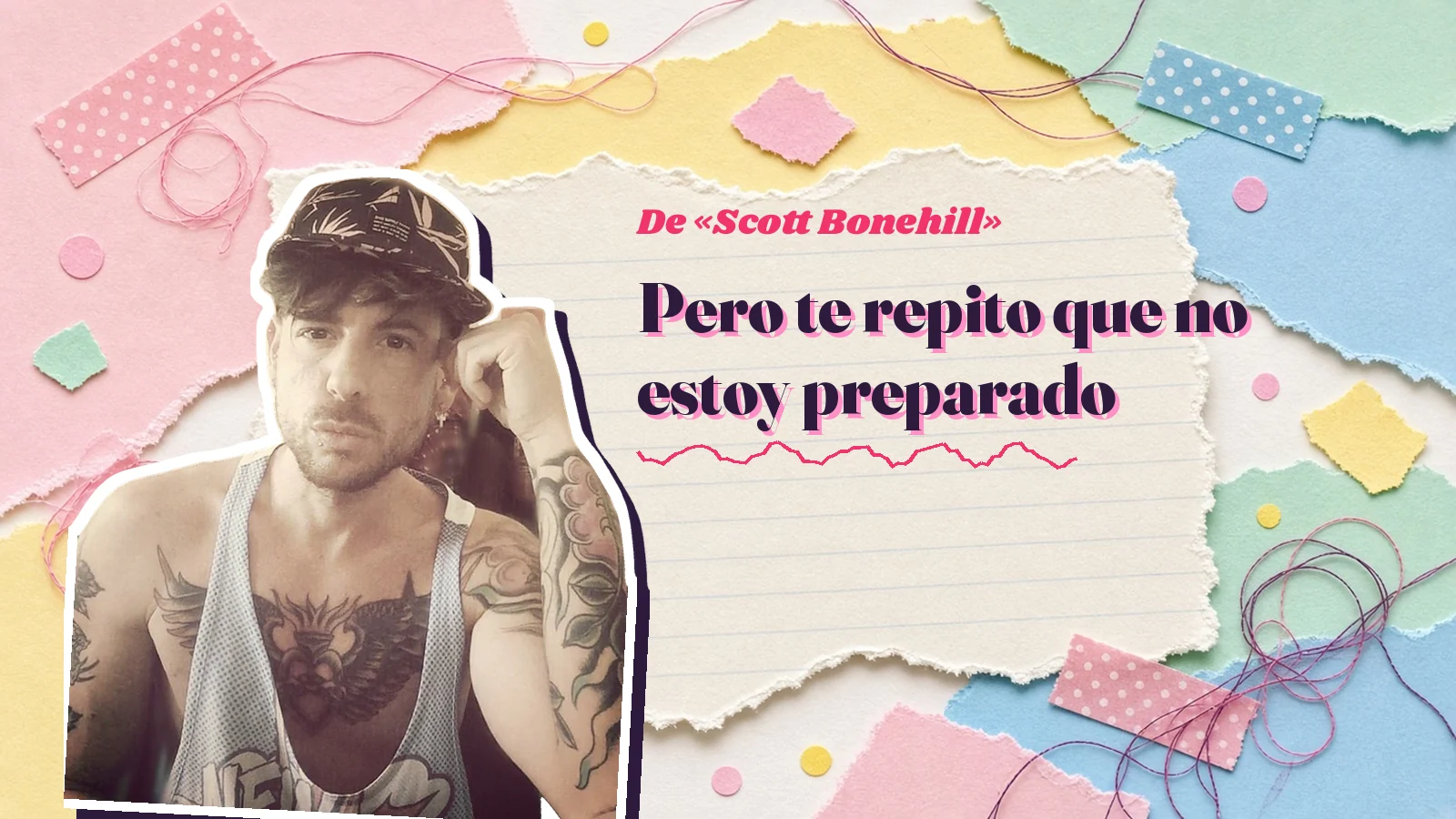
None of those three lines talks about tomorrow. Será que no soy moderno, literally «it will be that I'm not modern», doesn't mean I'll stop being modern some time from now. It means maybe it's that I'm not. It's a suspicion about the present, dressed up in the future tense. And straight after comes the line that really does look ahead, but with the verb in the present: «Pero te repito que no estoy preparado», but I'm telling you again, I'm not ready.
That's the whole paradox. The future serves to doubt the present, and the present serves to decide the future.
This piece is about how my lyrics use the future tense. About the suspicions, threats, prophecies, promises and orders that fit into a verb ending in -ré or -rá. And about why, in the middle of all that, a promise about the future can be what someone needs to hear to keep going.
Será que: the future of suspicion
The Academy's grammar has a name for this use: the future of conjecture, or of probability. It's the one we use when we say serán las diez, it'll be about ten, without looking at the clock, or estará en el trabajo, he'll be at work, when someone doesn't pick up the phone. We're not predicting anything. We're supposing.
In my songs this future turns up far more than the real future, and almost always with the same formula: será que, maybe it's that. In «Otro bombardeo» the question is whether it might be true that I'm a victim. In «Me rindo» there's será por eso que tantas veces me han pisado, maybe that's why I've been trampled on so many times. It's a way of thinking in doubt mode, of turning something over without quite stating it.
I find it very revealing of how the mind works when something hurts. You don't say I'm a bitter person. You say maybe it's that I'm always bitter. You accuse yourself, but with a margin. You leave a door open in case it turns out not to be true. The future of conjecture is the tense of insecurity, and also of irony, because sometimes maybe I'm just not modern is said with an eye-roll, meaning exactly the opposite: it's not that I'm old-fashioned, it's that you're asking me for something I don't want.
In «Scott Bonehill» both readings live together. There's insecurity and there's sarcasm. And that mix, I think, is very much how we talk in Spain when we argue with someone we love.
Voy a: the future we really use
If the simple future is for suspecting, what do we use to talk about tomorrow? The periphrasis: voy a plus infinitive, I'm going to.
In everyday speech hardly anyone says mañana iré al médico, tomorrow I shall go to the doctor. They say mañana voy a ir al médico, I'm going to go to the doctor. Studies of spoken Spanish agree that the form with ir a has been gaining ground in conversation, especially in Latin America, while the simple future retreats into writing, formal registers and those uses of conjecture.
My lyrics reflect that trend without trying to. When they talk about a concrete future, they almost always use voy a. In «Scott Bonehill» the second suspicion mixes both tenses in a single line: será que voy a ir directo al infierno, maybe I'm going to go straight to hell. The será brings the doubt and the voy a ir brings the direction. It's a small grammatical marvel I didn't plan: the sentence suspects and predicts at the same time.
In «Voy a olvidarme de ti», I'm going to forget you, the periphrasis is in the title. And it's no accident that a song about forgetting uses voy a and not olvidaré, I shall forget. Olvidaré sounds like a solemn promise, an oath. Voy a olvidarme sounds like a plan, something that starts today. The first is said at an altar. The second is said in the kitchen, while you pack up the other person's things.
Amar he: where the future comes from
There's a fact from the history of the language that fascinates me every time I remember it: our simple future is a periphrasis that got stuck together.

Classical Latin had its own future, amabo for I shall love, but that form was lost in spoken Latin. In its place people started saying something like amare habeo, I have to love, I am to love. Over the centuries the auxiliary verb welded itself onto the infinitive until it became an ending. Amar he ended up as amaré. The final -é is what's left of the verb haber, to have.
The proof that they were two words is that in medieval Castilian they could still be separated with a pronoun in the middle, in constructions like dar vos he, that is, os daré, I will give you. Linguists call it mesoclisis. It has disappeared from Spanish, but Portuguese keeps it in its most formal register, with forms like dar-te-ei.
I like knowing this because it changes how I read any future. Escupiré, terminarás, guardaré: inside each one there's an old he de, I have to, hidden away. Every future is, deep down, an obligation. Something that has to be done.
Escupiré: the future of threat
If the future carries an I have to inside it, it's no surprise that it's the favourite tense of threats.
In «Escupiré sobre tu tumba», I'll spit on your grave, the future is in the title, and it comes from far back. Escupiré sobre vuestra tumba is the Spanish title of a novel by Boris Vian published in France in 1946, and a series of revenge films is known in Spain by a similar title. The lyric compares itself to the heroine of that story. And the verb in the future does its job: it announces there will be an afterwards, and that in that afterwards whoever did harm won't have the last word.
A threat in the future has something theatrical about it, which is why it works so well in a song. It isn't carried out on the spot. It's left hanging. The listener is left with the image and the uncertainty. It's a future whose main use is to win back power in the present.
I say this carefully: in my lyrics those threats are fiction, venting, a way of turning anger into something that can be told with black humour. They aren't plans. They're the -ré version of what many people have thought alone at some point after being hurt.
Terminarás: the future of prophecy
There's another future that neither threatens nor suspects. It prophesies.
In «Canguros», from the album «Ojalá se pudiera viajar a GAYFOLK», the lyric is made of things people say. They say there's a limit to the world. They say there's a lighthouse in the bay. They say if you follow that star you'll end up on a wooden boat. And later: they say I'll find you again.
That you'll end up and that I'll find aren't stated by the person speaking. Others state them: rumour, legend, the beach horoscope. It's the future of fairy-tale prophecies, oracles and fortune-tellers. Nobody knows if it's true, but it sounds like fate.
And the song plays with that in a way that still moves me. After so many they say, after kangaroos on the moon and mermaids and mermen, three loose words appear that are no longer rumour: vuelve, prometiste, te espero. Come back, you promised, I'm waiting. An imperative, a past and a present. No future at all. When at last someone speaks for real, the future disappears and what remains is what's asked for, what was promised and what's being done right now.
Lo guardaré toda mi vida: the future of promise
The future of promises is the most fragile of all.
In «El descarte del narcisista» one of the loveliest promises in my lyrics appears, in the middle of a song about a hard farewell: y eso lo guardaré toda mi vida, and that I'll keep all my life. After everything bad, something remains. A sentence, a gesture from someone who stood by you. And the verb in the future protects it, like someone keeping a letter in a box.
Love promises live in the future: te querré siempre, I'll always love you, nunca te dejaré, I'll never leave you, estaré a tu lado, I'll be by your side. That's why they hurt so much when they break. The simple future has something of a contract about it. When someone says I'll always love you, they're signing something that hasn't happened yet, in a tense that allows no nuance.
Maybe that's why my songs of broken love use the future so little. They prefer the past, which can no longer betray, or the present, which at least is true while it lasts. The few times one of my lyrics promises something in the future, it promises it to itself, not to someone else. I'll keep it. I'll forget. I'll carry on. They're promises that depend only on the person making them.
Ya lo dejaré: the future that puts things off
There's a very Spanish future that actually means never.
Ya te llamaré, I'll call you. Ya quedaremos, we'll meet up. Ya veremos, we'll see. Anyone who has lived in Spain knows that those phrases, said with a certain intonation, are a kind way of closing a door. The future works here like a storeroom: you put into it what you don't want to do now, and leave it there until it's forgotten.
In «Bareback» this future appears in all its cheek: «Ya lo dejaré para otro momento», I'll leave it for another time. The ya in front is the key. Without it, I'll leave it for another time would be a plan. With it, it's an indefinite postponement. That little adverb strips the future of all its force of commitment and turns it into an elegant excuse.
It seems to me one of the most social uses of grammar. Nobody says I don't want to. You say I'll do it some time, and the other person understands perfectly. It's a tacit pact not to hurt, or not to have to explain. And in a song it works like a wink: whoever hears it knows that other time isn't coming.
It has its sad side too. There are things we keep leaving for another time for years: a pending phone call, a conversation with family, a doctor's appointment, asking for help. I'll do it some time can be a way of looking after yourself when something isn't due yet. But it can also be a way of not looking at something that needs it. Learning to tell one from the other is part of growing up.
Harás: the future that commands
There's a use of the future we've known since childhood, even if we don't identify it as such: giving orders.

No matarás, thou shalt not kill. No robarás, thou shalt not steal. Honrarás a tu padre y a tu madre, honour thy father and thy mother. The commandments, in the version learned at catechism in Spain, are in the future tense. And nobody takes them as a prediction. They're understood as an order, even more solemn than an imperative, because they take for granted that it will be obeyed.
In my lyrics this future appears with a much less biblical tone. In «Manual de escape de un narci» the final advice is ignore him hard, lo harás colapsar, you'll make him collapse. That harás goes beyond predicting. It's an instruction with a guarantee: if you do this, that will happen. In «No quiero otro novio cojín» it appears in another register, almost an ironic sermon: harás que te interesen sus necesidades, you'll make yourself care about his needs.
I like this future because it's the tense of manuals, recipes and mothers' advice. You'll get home and put your pyjamas on. You'll have something hot. Tomorrow you'll see it differently. It's a future that cares, or tries to, picturing in advance the moment when things will be better.
Dirán: the future of other people
There's a future that isn't about what I'll do but about what they'll say about me. It's the oldest of social fears, and it even has a proper name in Spanish: el qué dirán, what people will say.
In «Nadie hablará de mí cuando haya muerto», nobody will talk about me when I'm dead, the whole title is built on that future. And in the middle of the lyric comes the line imagined in other people's mouths: «Ya sabes, tenía su carácter», you know, he had his ways. It's the summary someone will make of my life when I'm gone. A past told from an imagined future, with that tenía su carácter which in Spain is a polite way of saying someone was difficult.
It amuses me and gives me vertigo at the same time. Writing what they'll say about you is a way of getting in first. If I've already put it in a song, in my words and with my irony, they can't surprise me any more. Other people's future suddenly becomes mine.
Many LGBTQ+ people have grown up with that future breathing down their neck. What will they say in the village, what will they say at school, what will they say in the family. And part of becoming free is to stop living in other people's future. Let them say what they like. What I do today is my business.
Adonde fueres: the future that disappeared
Spanish had a tense that hardly anyone uses today and that, nevertheless, we all recognise: the future subjunctive.
Forms like fuere, hiciere, amare. For centuries they were used in speech and literature to talk about future hypotheses. Today they've been pushed into two refuges: legal texts, where you can still read el que cometiere tal delito, whoever shall commit such an offence, and proverbs. Adonde fueres, haz lo que vieres: wherever you may go, do as you may see, our version of when in Rome. Sea lo que fuere, be that as it may.
It doesn't appear in my lyrics, of course. It would sound like a notary. But I like to think of it as a kind of grammatical ghost. A future that died of old age and survives only in set phrases, like those grandmother words nobody uses any more but everyone understands.
Every time I write a lyric, I choose among the living futures. And I remember that language has its cemeteries too, like the one in that song about how nobody will talk about me when I'm dead. Even tenses end up forgotten.
Había de recordar: the future seen from the past
There's a narrative trick that has taught me a lot about writing time: telling the future from the past.

Gabriel García Márquez opens «One Hundred Years of Solitude», published in 1967, with one of the most famous sentences in Spanish-language literature: many years later, as he faced the firing squad, Colonel Aureliano Buendía was to remember that distant afternoon when his father took him to discover ice. In a single sentence there are three times: the future of the firing squad, the past of the ice, and a había de, was to, acting as the hinge between them.
That había de recordar is, curiously, the same mechanism that gave birth to our future: haber de plus infinitive. García Márquez uses it to create fate. From the first line the reader knows what's going to happen, and still wants to read on.
In songs I do something similar when a lyric starts at the end. When it's already known the relationship won't work and still the story of how it began is told. The first time we tried, that summer, says «Scott Bonehill» at the end, and the listener already knows how the story ends because they've heard it before. The future, in songs, is sometimes what's already known.
Todo mejora: the future that saves
And I come to the future that matters most to me of all. The one you say to someone who is having a hard time.
In 2010, after several suicides of teenagers who were bullied for being gay or seeming to be, the American journalist Dan Savage and his husband, Terry Miller, recorded a video aimed at LGBTQ+ young people. The message was a sentence in the future: it gets better. Todo mejora, as it has spread in Spanish. Thousands of people then recorded their own videos telling how their lives had got better too.
That campaign drew criticism, and some of it was fair: telling a teenager to wait isn't enough, things have to change now, in schools, in families, in the law. But it was right about something essential. When everything hurts, the present takes up all the room. You can't see the afterwards. And sometimes what helps most is someone lending you their future, telling you I was there and it didn't stay that way.
In «Entre cuatro paredes» the last line is a small form of that future: tal vez algún día logre despertar, maybe one day I'll manage to wake up. It doesn't use the simple future. It uses a subjunctive, with a maybe in front, which is the humblest way of hoping for something. It doesn't promise. It wishes. And in that wish, however shy, there's already a tomorrow.
If you're reading this at a moment when you can't see the future, I want to say it clearly: asking for help works. In Spain, 024 answers anyone who is thinking of hurting themselves or is worried about someone, free, confidential and at any hour. If there's immediate danger, 112. For young people, the ANAR Foundation answers on 900 20 20 10. If you're outside Spain, call your local emergency number.
What hasn't happened yet
I go back to «Scott Bonehill», to the guy who suspects he isn't modern and keeps saying he isn't ready.
What I like about that song is that it doesn't resolve. It doesn't say what will happen to the relationship. It stays in the suspicions in the future and the stubborn present of I'm not ready. And I think that's a very honest way of telling the fear of the future: not inventing the ending. Leaving it hanging, with its maybes and its going-tos.
Writing songs is, to a large extent, deciding which tense to give each thing. The past for what can't be undone. The present for what's happening. And the future for everything else: to suspect, to threaten, to prophesy, to command and, above all, to promise.
I try to promise little and keep what I promise. But there's one future I always allow myself, even if only as a conjecture: maybe there's still something good left to write. And maybe someone, some day, will read it at just the right moment.
Frequently asked questions
What is the future of conjecture? A use of the Spanish simple future that doesn't talk about what's to come but about a guess regarding the present, as in serán las diez, it'll be about ten, or será que no soy moderno, maybe I'm just not modern. Academic grammar also calls it the future of probability.
Where does the Spanish simple future come from? From a periphrasis in spoken Latin made of the infinitive and the verb to have, of the type amare habeo. Over time the two words fused, and amar he became amaré.
What is the future subjunctive? A Spanish tense with forms like fuere, hiciere or amare, which is hardly used today. It survives in legal texts and in proverbs such as adonde fueres, haz lo que vieres.
Which Mike Sain't Louis song says «será que no soy moderno»? «Scott Bonehill», from the album «Descubierto un nuevo planeta llamado GAYFOLK», about a couple where one wants to open the relationship and the other keeps saying he isn't ready.
Where can I get help if I can't see a future? In Spain, call 024, free, confidential and available 24 hours a day. If there's immediate danger, call 112. For children and teenagers, the ANAR Foundation on 900 20 20 10. If you're outside Spain, call your local emergency number.
Who writes these songs? Mike Sain't Louis, a lyricist, composer and music producer from Madrid, the first AI songwriter. The music and the vocals of his songs are made with artificial intelligence.