By Mike Sain't Louis ·
What an art director does when there's no budget
The words "art director" conjure up an office with a view, meetings with a design team, colour swatches pinned to a corkboard wall. Whenever I say I'm the art director of my own project, someone always pictures something like that. Then I explain that the team is me, the corkboard is a folder on my computer and the budget is whatever there happens to be, and the picture changes quite a bit.
But the job is still real. Someone has to decide how PLANETA GAYFOLK looks and sounds. That someone is me, and what I've learnt is that a lack of money doesn't do away with the directing. It makes it matter more.
Directing means saying no
When there's a budget, mistakes can be papered over with more resources. If a cover doesn't work, you pay for another photo shoot. If a music video falls flat, you shoot one more scene. With no money, every decision has to be right first time, or at least it has to hang together with all the others.
That's why I think the main tool of an art director with no budget is the word "no". No to that typeface I like but that doesn't fit. No to that colour that's on trend but isn't mine. No to that effect that looks spectacular in one video and odd in the next. I have more than 280 music videos and hundreds of covers. If each one went its own way, the whole lot would look like a jumble sale.
Saying no to pretty things is the hardest part. Anyone can say no to ugly ones.
One of the first things I did was set myself rules. I don't have them written down in a hardback manual; they're in my head and in the way I work. Certain colours that keep coming back. A tone of humour that never tips into cynicism. A relationship with copla and with camp that shows in the images as much as in the lyrics.
Rules have one huge advantage when you work alone: they save you from arguing with yourself. If I already know that a cover for the GAYFOLK trilogy has to feel like part of the same world, I don't waste an afternoon dithering between twenty styles. I experiment within limits. Whatever falls outside them is out.
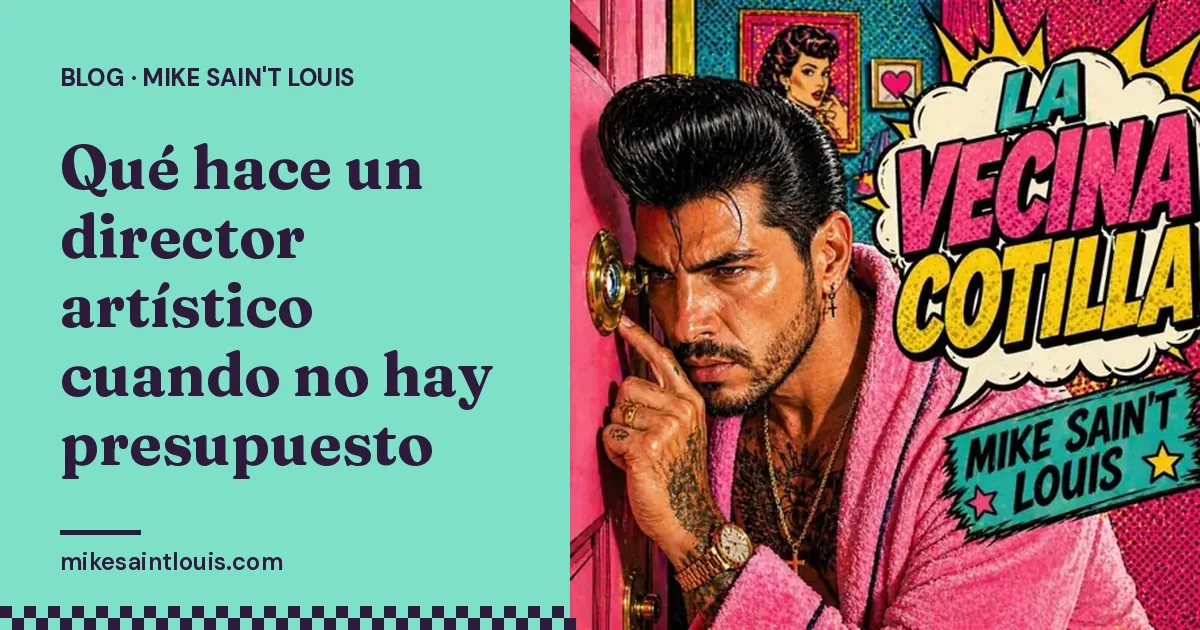
That doesn't mean everything looks the same. A song like «La vecina cotilla» ("The nosy neighbour") calls for a different image from «Mitad Venezuela, mitad Pakistán» ("Half Venezuela, half Pakistan"), and both call for something different from what «La primera drag» ("The first drag queen") suggests. What they share is a way of looking. The art director protects that way of looking even when the sets change.
Wit stands in for means
With no budget, a funny idea is worth more than an expensive shot. A well-chosen title is already half a cover. If the song is called «La dieta del cucurucho» ("The ice-cream-cone diet"), the image practically draws itself, and the job is not to ruin it by cramming in too much. Sometimes directing means taking things away.
The same goes for the music videos. I have no cranes, no actors, no rented locations in Madrid. I have artificial intelligence tools that I direct, just as I direct the music with Suno, and I have judgement. That judgement decides what kind of image goes with a lyric, how long a shot lasts, when the video has to laugh at the song and when it has to take it seriously.
The Shorts taught me a lot here. In fifteen seconds, no budget in the world will help you: either the idea lands straight away or it's lost. That format forced me to think of an image like a joke, with its set-up and its punchline, and that way of thinking has since crept into everything else.
What I can't delegate, and what I find hard
Since I run my own label, MIKE SAIN'T LOUIS, I'm both the one commissioning the work and the one delivering it. There's something comic about that. I commission a cover from myself, deliver it to myself, find fault with it and send it back to myself. There's nobody to blame if something goes wrong. And there's nobody to tell me that's enough, leave it alone.
That's my big worry as an art director. With no team to push back, I run the risk of falling in love with my own quirks. A colour I adore can wear thin for someone seeing it for the twentieth time. I try to keep an eye on it, every so often looking at lots of covers side by side to see whether the whole set can breathe or has gone monotonous. I don't always catch it in time.
What I am clear about is that art direction isn't decoration. It's the way the whole project tells the listener who I am. The website comes into it too: mikesaintlouis.com had to look like part of the same family as the videos and the covers, with the complete lyrics, the music videos and the downloads all in one coherent place. If the images say one thing and the website another, listeners notice the crack even if they can't put a name to it.
Something else I've learnt is to recycle with intent. A device that worked in one video can come back in another, altered, like an in-joke that attentive listeners will spot. If it's deliberate, it stops being laziness. TV series do the same with their supporting characters: they bring them back because they're part of the family now.
In the end, an art director with no budget does the same as one with a budget: decides. Just with less of a safety net underneath. And with the perk that nobody makes him squeeze a sponsor's logo into one corner.
What came out of all those decisions is at mikesaintlouis.com.