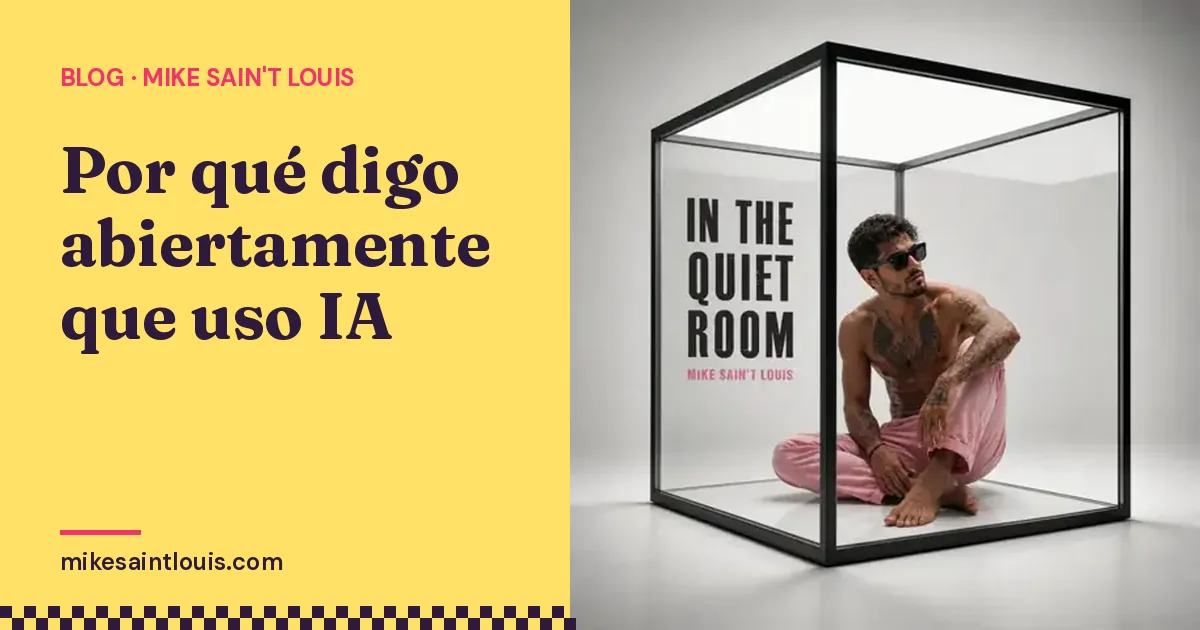
By Mike Sain't Louis ·
Why I say openly that I use AI
It would have been easy to keep quiet about it. Lots of people do. They upload songs produced with artificial intelligence, invent a studio photo with big headphones and let everyone imagine whatever they like. Nobody asks, or hardly anyone does, and life goes on.
I decided to do the opposite. I introduce myself as the first AI songwriter, and the letters AI are right there, stuck to my name, from the start. I want to explain why, because it wasn't as obvious a decision as it seems now.
The temptation
I'll tell you about it unashamedly. There was a moment when I thought saying it would hurt me. That people would hear "AI" and stop hearing the rest. That the word would swallow the lyrics, the titles, the humour, everything I care about. And to some extent I was right: some people don't get past that word. They close the tab and never come back.
The temptation to keep quiet didn't come from wanting to fool anyone. It came from wanting to be judged on the songs before the tool. That seemed a legitimate wish to me. It still does.
Why I didn't keep quiet
For several reasons, and not all of them noble.
The first is practical. These things come out in the end. Always. And when someone finds out on their own that what they were listening to was made with AI, they don't get angry about the AI. They get angry because they feel stupid. You can't fix that afterwards with a long explanation. I'd rather lose someone at the start, over something I told them, than lose them later because I hid it.
The second reason is temperament. I write songs with humour, with camp, about exes and self-esteem. Almost all of them have something of a confession about them, even when it's dressed up as a joke. It would seem very odd to me to write like that and then be opaque about how I work. It would be like spilling your secrets at a dinner party and refusing to say what's in the sauce.
The third is more selfish. By saying it, I take a weight off. I don't have to watch what I say in every conversation, or remember which version I gave to whom. The truth is easier to keep up. Anyone who's been in a relationship with secrets knows that.
And there's a fourth, which weighs more than the other three put together. I make queer pop. Many of the people who listen to me know very well what it is to hide: keeping quiet about who you're seeing, changing a pronoun in a conversation, weighing every word in front of the family. Some have done it for years. I write for those people, and it didn't feel right to ask them to trust songs about pride while I hid something as simple as the tool I work with. It would be a small inconsistency, but the kind that shows. A trilogy that ends with «El día de la liberación» (Liberation Day) can't come from someone going through life with a factory-fitted secret.
What it's cost me
I won't pretend it came free. There are probably doors closing on me without my knowing. Some people will think what I do isn't music, and they're entitled to. Some think the label is a provocation to get attention. It is a bit, I won't lie to you. But a provocation that tells the truth seems better to me than a discretion that lies.
It's also cost me something subtler. Sometimes the conversation stays stuck on AI and never reaches the songs. It happens more than I'd like. Someone talks to me for half an hour about the tool and doesn't once ask why a song is called «No quiero otro novio cojín» (I don't want another cushion boyfriend). That makes me a bit sad, because that's the interesting part.
I've learnt to steer those conversations patiently. I answer the questions about the tool, which are reasonable to ask, and then I try to bring the chat round to what really fills my days: a word that doesn't fit, a chorus that won't cooperate, a title that still doesn't make me laugh. I don't always manage. But when I do, the conversation gets much better.
In return, the people who stay, stay knowing. There's no misunderstanding. When someone writes to tell me a lyric touched them, I know they're saying it with all the information in front of them. That message is worth more than ten that came from a misapprehension.
And it's given me a way of explaining precisely what I do. I write every lyric. I produce the music with Suno, which I direct: I decide, I discard, I choose. I direct the more than 280 music videos. I run my own label, MIKE SAIN'T LOUIS. The vocals are made with AI; they aren't mine. Saying I use AI forced me to separate carefully what's mine from what isn't, and that separation has helped me before it's helped anyone.
What I don't know
I have a doubt I haven't resolved. More and more people use these tools, and there'll come a time when saying "I use AI" is as unremarkable as saying "I use a computer". I don't know whether the label will still make sense then, or whether it'll sound dated, like when people used to boast about having a website.
Maybe it will. If that day comes, I'll drop it without any drama. For now, while so many people hide it, saying it still means something. It means you don't have to guess.
And one last thing, in case anyone thought this was a carefully calculated strategy. Some days I regret it a little. Days when I think that, without that word up front, «Tan Cateto» or «La primera drag» would have reached more people. Then it passes. I'd rather reach fewer people and not have to look at any of them sideways.
Everything I do, with its lyrics and music video, is at mikesaintlouis.com.