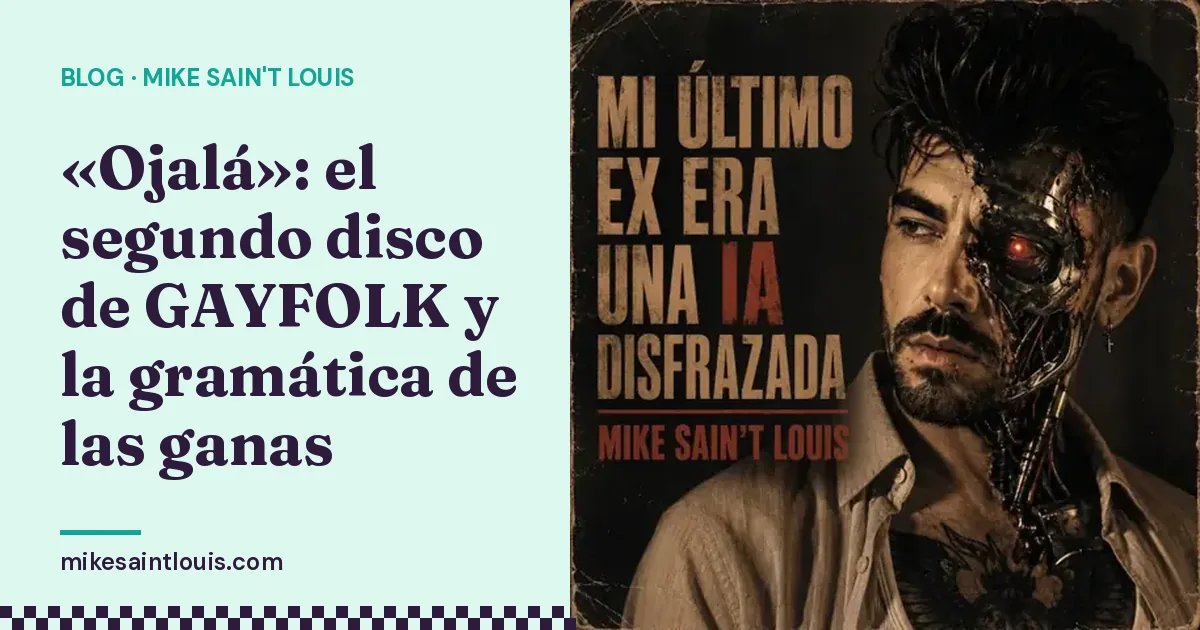
By Mike Sain't Louis ·
«Ojalá», if only: the second GAYFOLK album and the grammar of longing
The second album in the trilogy is called «Ojalá se pudiera viajar a GAYFOLK», If only you could travel to GAYFOLK. When I first wrote it down on paper, I realised it was a whole sentence, verb and all, and that it was in the subjunctive. That tickled me. An album in the subjunctive.
For anyone who's forgotten their school grammar: the subjunctive is the verb mood for what hasn't happened. For what you wish, fear or imagine. «Ojalá venga», if only he'd come; «ojalá llueva», if only it would rain; «ojalá me llame», if only he'd call. Spanish has a whole mood just for talking about what isn't yet. I think it's one of the language's great inventions, and I wanted the middle album to live inside it.
The most honest word in the language
«Ojalá» is a strange word. It isn't a verb, it isn't a noun, it's barely anything. It's a sigh with letters. And it's the word you use when you know what you're asking for isn't up to you.
Some words promise and some words ask. «Ojalá» promises nothing. Nor does it demand. It stays in a very humble middle ground, the place of someone who says what they want without kidding themselves they'll get it tomorrow. I love that such a short word carries so much. And I love that it's used the same way in Latin America and in Spain, with the same face of hopeful resignation, because I conceived this album for both sides of the ocean.
That's the very heart of the second act. In the first, someone finds out there's a planet where they can be who they are. In the second, knowing isn't enough any more. They want to go. And they can't, or not yet. The reasons don't matter. It might be family, the village, work, fear, money. Every listener brings their own. What matters is the distance between knowing it exists and being there.
Notice the «se pudiera» too. It's impersonal. It doesn't say "if only I could". It says "if only one could", as if the problem belonged not to one person but to everyone. That choice was no accident. Longing to reach a place like that isn't a private whim. It belongs to a great many people at once.
The album I find hardest
I won't repeat here what I've said in another piece, that it's the album I find hardest to listen to. I'd rather try to explain why it exists, which is a different thing.
The story could have been told in two albums: discovery and liberation. Finding the place and arriving. It would have been neater and easier to sell. But it would have been a whopping lie. Between knowing and arriving there's almost always a long season, and that season is where most of many people's lives happen. Skipping it would have been like making a romantic film that jumps straight from the meet-cute to the wedding.
The wait deserved an album of its own. Even if it was the most uncomfortable one.
Longing with a sense of humour
Here's a doubt I had throughout the process. Can you talk about waiting with humour without making it weigh less?
I don't know how to write without humour. I've tried and it comes out like a condolence card. But unfulfilled desire is delicate ground: crack too many jokes and it looks like you don't care; crack none and the album becomes an hour of sighing. I looked for a middle point, the one I know from real life. When you wait for something a long time, you end up joking about it, because otherwise it's unbearable. The jokes don't take the longing away. They make it bearable.
Copla, the old Spanish torch song, helped me a lot here. It's a genre that knows how to complain with style, that turns sorrow into a show without ceasing to take it seriously. And it understands something we sometimes forget: wishing out loud is already a way of existing. Whoever says «ojalá» in front of others is no longer completely hidden.
There's an idea that's been circling me since I finished the album, and I don't know whether it's a good one or just a way of consoling myself.
I think waiting is a place too. One where you live, sometimes for years. Where you make friends, have boyfriends, write songs. It isn't just the corridor to something else. Many people in the second act feel they're in no man's land, as if their real life will begin further on. And I wanted to tell them, without preaching, that their life has already begun. That the subjunctive is also a tense you conjugate.
Then I think that's too pretty, and that waiting is very often just a drag. Both things are true. The album tries not to choose.
How it fits with the other two
If the first album is a news headline and the third is a date on the calendar, the second is a state of mind with no date. It has no clear beginning and no clear end. That's why it makes sense to hear it right after the first and right before the third, without changing the order. Out of that position it loses part of what it says, like a sentence beginning with «ojalá» with the rest cut off.
I suppose some people will skip this album to go straight to the party. That's their right. But I think the party tastes of less.
The whole trilogy is free to download, no sign-up, at mikesaintlouis.com/descargas and at gayfolkplanet.com. If you're only going to listen closely to one of the three, I'd say make it this one. Though I'd regret saying so afterwards.
Everything else is at mikesaintlouis.com.