
By Mike Sain't Louis ·
«You said you weren't looking for anything»: the dialogues inside my songs
«Me dijiste “no busco nada” y yo dije “yo tampoco”.»
You told me «I'm not looking for anything» and I said «me neither». Two lines from «Me mola Zeus», a song from the third album of the GAYFOLK trilogy, «El día de la liberación». (The full lyric is on gayfolkplanet.com.) Zeus Vargas is a character, a boy who pops up on the TikTok «For You» page and turns everything upside down. And in those two lines there's an entire conversation. He says one thing. The narrator answers with another. And both of them are lying.
We know because the next line gives the game away: I haven't eaten in three days, watching your TikTok with red eyes. The «me neither» was a pose. What the character says and what he does don't match, and the song doesn't need to spell it out. It's enough to set the two sentences side by side.
That's what this piece is about: the dialogues inside my lyrics. The lines spoken not by the narrator but by someone else: an ex, a friend, a hook-up, a psychologist, a civil servant. Many of my songs aren't monologues. They're scenes with several characters, and direct speech, the «he told me», the «I told him», is what turns them into theatre.
A conversation instead of a monologue
Most pop songs are monologues. Someone talks to another person, or to themselves, or to the world. I've already written elsewhere about the «you» my lyrics address. But there's a step further, which is when the «you» talks back. Or when a third party butts in. Then the song stops being a letter and becomes a scene.
I love that step, because it changes the relationship with whoever's listening. In a monologue the listener only gets one version of events. In a dialogue they get two, and can judge for themselves. When in «Me mola Zeus» he says he isn't looking for anything and the narrator says neither is he, the listener knows more than the characters. They know at least one of the two is lying. That advantage is the foundation of comedy, and of tragedy too.
Dialogue also brings other ways of talking into a song. Each character has a register. The clerk talks like a clerk. The friend talks like a friend. The hook-up talks like a hook-up. And that blend of registers is one of the things that most brings a lyric to life. It's no longer just the narrator you hear. It's the whole neighbourhood.
The old ballads did it first
In the Spanish tradition there's nothing new about telling stories with dialogue inside a song. It's actually one of its oldest forms.
The romancero, the narrative ballads passed down by word of mouth for centuries, is full of conversations. Ballads often open in the middle of a scene, with no introductions, and the characters speak to each other directly: a knight asks, a lady answers, a king commands. The great scholar of the romancero, Ramón Menéndez Pidal, stressed the dramatic nature of these poems, the way they leap to the decisive moment and let the protagonists speak.
Later, in Madrid's popular theatre, the sainete and the género chico carried that taste for dialogue onto the stage. Characters from tenement courtyards, street fairs and markets, talking the way people talked in the street, with their stock phrases and their barbs. Zarzuela alternated spoken and musical passages, and audiences knew the wittiest comebacks by heart.
I like to think that when one of my lyrics slips in a «he told me» and a reply, it's doing something very old. Not so different from a ballad in which two characters argue. Only now the knight is a fuck buddy from Toledo and the lady is a friend telling you you look awful.
You told me, but I saw you
Back to «Me mola Zeus», because it has an even clearer dialogue.

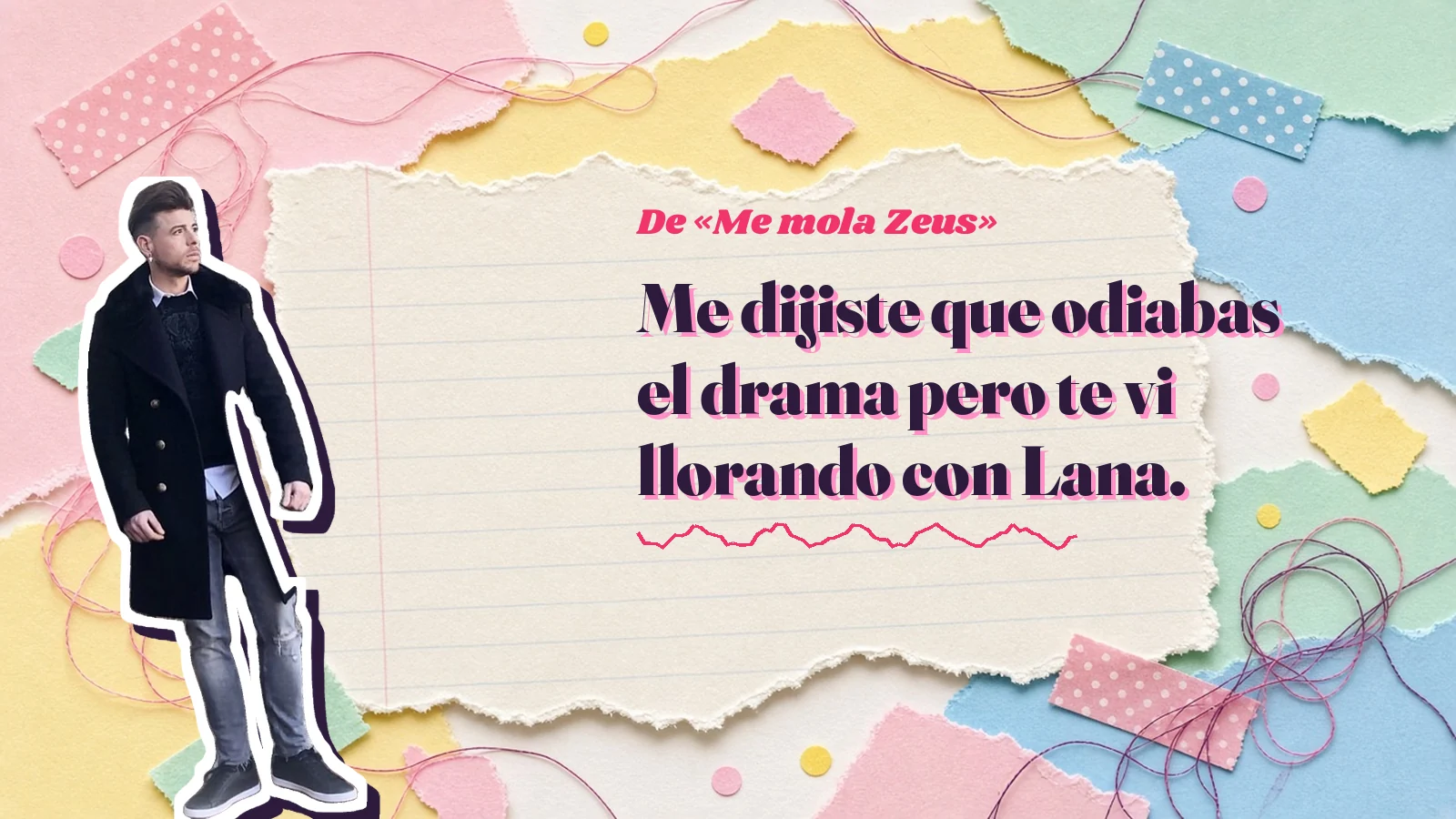
«Me dijiste que odiabas el drama pero te vi llorando con Lana.» You told me you hated drama, but I saw you crying to Lana. The structure is the same as in the opening lines: a sentence of his, quoted, and then the proof it wasn't true. He says he hates drama. The narrator has seen him weep over a song. The contradiction goes unremarked. It's simply shown.
This device strikes me as one of the most effective ways of drawing a portrait. Instead of saying someone is inconsistent, or acts tough but is soft inside, you give their line and then what they did. The listener draws the conclusion alone. And draws it with a smile, because we all know someone who swears they hate drama and then sobs at any ballad.
Then comes the clincher: «me hiciste un café aguado y fue la mejor cita de la semana», you made me a watery coffee and it was the best date of the week. After all that talk, action. A bad coffee, a tiny detail, worth more than every line spoken. It's a lesson I love: in a song, what characters say matters, but what they do matters more. Dialogue serves, above all, to expose the gap between words and deeds.
You tell me baby it didn't happen
Dialogue can be comic, but it can also be a tool for unmasking someone.
In «Gaslighting», a song from the second album, the first line is a quote: me dices baby no pasó, you tell me baby it didn't happen. And the second completes it: that I dreamed it, that it was all me. It's the textbook gaslighting line, the manipulation technique of denying what the other person lived through until they doubt their own memory. The song opens by putting it in the manipulator's mouth, word for word, «baby» and all.
What's interesting is what follows. The answer isn't a counterargument but a statement: I know full well what I saw, and what I felt as well. Against the other's sentence, one's own experience. Here the dialogue is a fight between two versions of reality, and the song decides from the start which one wins.
Further on comes another quote from the same character: me dices you're too much to love. It's a cruel line, the kind that stays lodged for years. And putting it into a dance-floor track has something of an exorcism about it. What someone said to sink you becomes a line people dance to. The sentence no longer belongs to you. It belongs to the song, and in the song, you're the one who wins.
In «No te vuelvo a mirar más» something similar happens: you told me one day I'd regret it. The other person's threat, quoted, to make it clear it never came true. Farewell songs do a lot of that: handing back the lines people said to us, the way you'd return a parcel you never ordered.
My brutally honest friend tells me
Not every dialogue in my songs is with an ex. Some are with friends, and those are among my favourites.
In «Toxina coreana» two friends speak, each with her nickname: my soul-sister friend tells me, «hey girl, you look awful». My brutally honest friend tells me, «hey girl, your dark circles are showing». It's café-terrace dialogue, mid-morning coffee talk. The lines are age-old ones, the kind anyone has heard from a friend with no filter.
And the protagonist answers the way you answer in those situations: don't start on me, I haven't slept a wink. The comeback has the tone of someone fed up but not quite angry, because she knows her friend has a point.
The best thing about that song is the final twist, when the dialogue flips over. The moment to confess arrives: the friend is me. The one who'd had the jabs, the one with the raised eyebrow, wasn't the other woman. It was the narrator. The whole preceding dialogue changes meaning. That only works because there's been dialogue first. Had the song been a monologue, the twist would have had nothing to lean on.
Friends who speak in songs have something of a Greek chorus about them. They say what the audience is thinking. They tell you you look awful when you don't dare look in the mirror. And in queer culture, where so often the family that matters is the one you choose, friends play that role of witness and loving judge.
The advice of the fuck buddy from Toledo
There's one song where dialogue takes up almost an entire verse: «Buscando el polvo perfecto», from the first album.
The song opens with a list of cruel rejections, the kind you read on any hook-up app. And suddenly a new character appears: a good fuck buddy I had in Toledo until I moved away. And the fuck buddy speaks. He told me sincerely: I'll give you some advice I learned here. If you're looking to get married, this isn't the app. And if you don't look after yourself, you'll have to lower the bar.
What I love about that verse is that it's a real conversation, with its back-and-forth. The narrator replies: I told him that sounded depressing to me. And the other comes back: it's not me saying it, it's obvious. Three turns of speech, like a scene in a play. The advice, the complaint and the verdict.
The fuck buddy from Toledo is a very recognisable character. He's the one who's been through it all and delivers his lesson without anaesthetic. He isn't nasty. He's realistic, with a slightly sad realism. And his advice is, deep down, the harshest criticism in the whole song, because it comes not from an enemy but from someone who's fond of you. Playing the innocent is out of fashion, he tells you. And you know he's right, and that's why it stings.
It's telling that, right after that dialogue, the song jumps somewhere else: to planet GAYFOLK, where there are no apps and no hang-ups. As if the only possible answer to the fuck buddy's advice were to invent a world where that advice wasn't needed.
The psychologist told me
Sometimes the person speaking inside the song is a professional.
In «Forocoches» there's a line anyone who's been in therapy will recognise: the psychologist told me to start doing some exercise. It's sensible advice, the kind given with the best of intentions. And the narrator's answer is that of someone at rock bottom: but I've got no strength left, I've lost my way.
That mismatch between what's recommended and what you can actually manage rings very true. The advice isn't bad. The trouble is there are days when you can't even get out of bed, and exercise sounds like another planet. The song doesn't mock the psychologist. It simply records the distance between the consulting room and life.
«Forocoches» is a song about a very dark night. If you ever feel like that, drained of strength, asking for help matters. In Spain you can call 024, the suicide crisis line, free and at any hour. If there's immediate danger, call 112. If you're outside Spain, call your local emergency number.
The clerk tells me
At the opposite end from the drama lies dialogue with bureaucracy.

In «3 años de garantía», the narrator has bought a boyfriend with a warranty, the boyfriend starts to malfunction, and he goes to complain at the consumer-rights office. There he talks to a clerk: the clerk tells me there's not much to be done about the dark-haired guy. The line has the exact tone of a service counter: polite, resigned, no solution.
That dialogue makes me laugh because it mixes two worlds that never touch: heartbreak and public administration. The clerk answers a sentimental grievance as if it were a broken washing machine. And the song carries on in the language of forms: complaint sheet, reference number, the regional government signing it off from Madrid.
It's a dialogue with very little emotion on one side and a great deal on the other, and the humour springs from that contrast. The narrator is desperate. The clerk, unruffled. Anyone who's ever queued at a government counter knows that imbalance.
I told him: don't worry, I'm fine
There are dialogues where what's said is the exact opposite of what's felt.
In «Me he enamorado de un policía que es dueño de una lavandería» the policeman politely invites the narrator for a coffee. And he, so flushed he can't hide it, tells him: don't worry, I'm fine. It's one of the falsest sentences in the language, and the song uses it beautifully. Nobody saying «don't worry, I'm fine» with a beetroot face is fine.
That kind of reply feels very human to me. When we fancy someone and can't say so, we answer with anything at all. Whatever comes out first. And what comes out first is usually a stock phrase that means nothing and only serves to get you out of the moment. The song turns that flash of awkwardness into a little joke. But it's a tender joke, because we've all said an «I'm fine» that really meant «I'm dying».
The neighbour said
And then there are dialogues with the outside world, with the people who watch and pass judgement.
In «Marica chill» there's a street scene full of other people's remarks. The neighbour said: that boy's too much. A tourist asks if he can kiss a hand. And the narrator answers: I told him, only if you dance flamenco, man. It's a dialogue in two languages, in Spanglish, like the whole song, and it has the rhythm of a summer comedy on the coast.
What I love about those dialogues is that the narrator doesn't get defensive. The neighbour opines, the tourist approaches, and the protagonist answers with humour, without going to war. If they criticise me from the balcony, I blow them little kisses and put on reggaeton. The answer to criticism isn't an argument. It's a gesture. And that gesture says everything about the character: someone who no longer needs to justify himself.
For many LGBTQ+ people, remarks from neighbours, strangers and onlookers at the window were for years a form of control. Putting those lines into a song and answering them with a wink is a way of draining their power. The neighbour still says the same thing. But now the song has the last word.
How a conversation fits into three lines
Writing dialogue into a song has a practical problem: the listener can't see the quotation marks. In a book, a dash or inverted commas warn you another character is speaking. In a song, everything arrives through the ear, in one stream, without typographical signals. So dialogue has to announce itself some other way.

The simplest way is the verb: he told me, I told him, she tells me, he answered. Humble, almost invisible words, but they do enormous work. They signal that what follows is no longer the narrator's opinion but someone else's line. In «Buscando el polvo perfecto» several follow in a row, he told me, I told him, he answered, and thanks to them the listener follows the conversation without getting lost.
Another way is the vocative. «Oye, tía», hey girl, is an unmistakable sign that someone is addressing someone. In «Toxina coreana», every time that «oye, tía» comes round, we know one of the friends is speaking. No need to say which. The vocative works like a cut in a film.
And the third way is register. When the clerk speaks, he sounds like a service counter. When the neighbour in «Marica chill» speaks, she sounds like balcony gossip, and in English to boot. Each character has their way of saying things, and that way is their ID card. If a line sounds like someone else, the ear understands someone else said it.
I like to think of these tools as those of a playwright with very little room. A song has few lines, and each has to do several things at once: tell, rhyme, sound good and, if there's dialogue, say who's speaking. That's why song dialogues are so short. One comeback, two at most. Enough for the scene to be seen, and nothing more.
There's a special pleasure, too, in the economy. In a novel a conversation can run for pages. In a song, «you told me I'm not looking for anything, and I said me neither» tells in two lines what in prose would take a chapter: the first meeting, both sides' caution, the shared lie and, underneath, the longing. That all of that fits into two lines is one of the things about the craft of writing lyrics that still amazes me.
Do you remember what I told you?
I'll finish with a special kind of dialogue: the one that points back to an earlier conversation.
In «El narcisista» there's a question that might come straight from a film: do you remember what I told you about karma? We don't know what was said. We don't need to. The question implies there was a warning, it went unheeded, and now it's coming true. It's a dialogue with a past that never appears in the song but can be sensed.
And in «Envejecer» there's a similar echo, this time a sad one: why did you use to ask me whether I could picture the two little old men holding hands. The other person's question, remembered. There's no dialogue anymore, because the other person is gone. Only their sentence remains, replaying in the head of the one left behind.
These two songs seem to me to show the two extremes of what dialogue can do in a lyric. In one, the line from the past is a weapon: I warned you. In the other, it's a wound: you used to ask me that, and now you're not here. Either way, what was once said keeps on speaking. And that is perhaps what songs do best: they keep the sentences people say to each other, so those sentences go on sounding when nobody says them anymore.
Frequently asked questions
Which Mike Sain't Louis songs contain dialogue? Among others, «Me mola Zeus» («you told me I'm not looking for anything»), «Gaslighting» («you tell me baby it didn't happen»), «Toxina coreana» (the soul-sister friend and the brutally honest friend), «Buscando el polvo perfecto» (the advice of the fuck buddy from Toledo) and «3 años de garantía» (the consumer-office clerk).
Who is Zeus Vargas? He's a character in the song «Me mola Zeus», a boy who shows up on the TikTok «For You» page. He isn't a real person.
Why put dialogue in a song? Because it turns the lyric into a scene: the listener hears more than one version, each character speaks in their own register, and the gap between what's said and what's done becomes visible. It's a very old device, already present in the Spanish ballad tradition.
Who writes these songs? Mike Sain't Louis, lyricist, composer and music producer from Madrid, who presents himself as the first AI songwriter. The music and vocals of his songs are made with artificial intelligence.