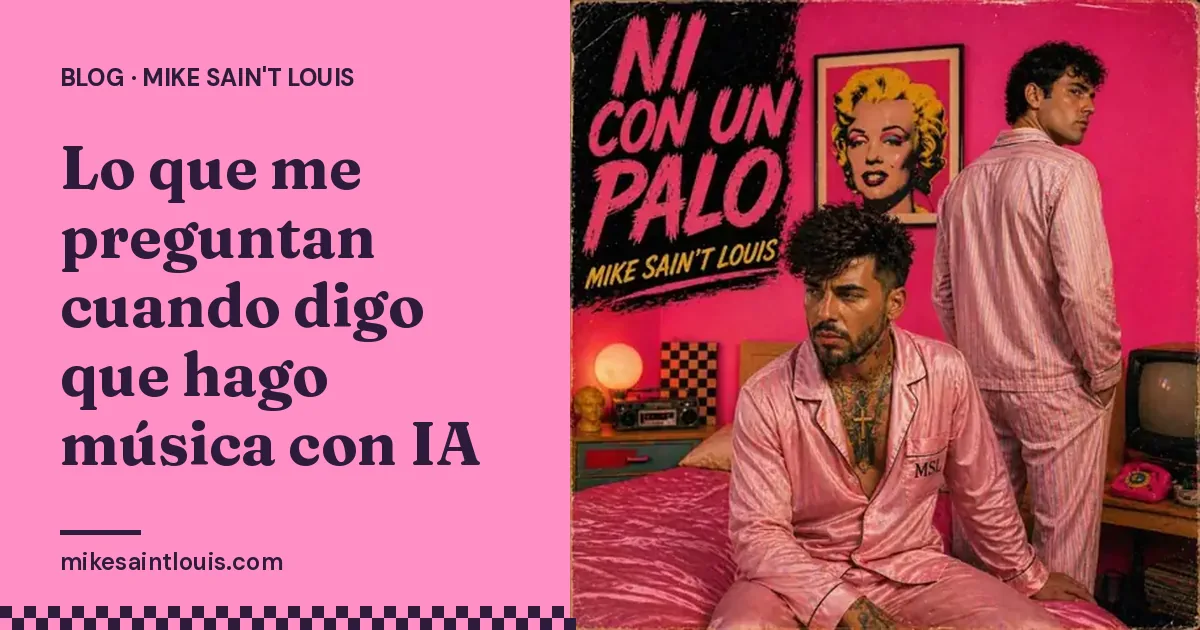
By Mike Sain't Louis ·
What people ask me when I say I make music with AI
I introduce myself as the first AI songwriter. I chose that label myself, knowing full well it would raise questions. Some arrive curious and others arrive with a knife between their teeth. That's fine by me. They're reasonable questions, and I'd rather answer them here, calmly, than in a ten-word comment.
A warning before I start: I'm not going to explain how I make a song step by step. I've told that story elsewhere. What's here are the objections, and what I think of them, including the parts I'm not sure about.
Is that real music?
Depends what you mean by "real", and I'm not saying that to wriggle out of it.
If for you real music requires someone playing an instrument in front of a microphone, then mine isn't, and I won't try to convince you. It's a respectable definition. It would also leave out a lot of electronic music, a lot of studio pop and almost everything ever made with samples.
If for you real music is music that does something to you when you hear it, then the question can't be answered in the abstract. It gets answered by putting a song on. Maybe it tells you nothing. But if it tells you something, that something is real, even if the tool is new.
What amuses me is that the question almost never comes after listening. It comes before. And a question about music asked before you've heard it is usually a question about something else.
Who's the author?
The lyrics are mine. All of them. I don't argue that with anyone, because I write them myself, with my own hands and my own obsessions.
The music is another matter, and here I want to be precise. I produce it with artificial intelligence tools, Suno specifically, which I direct. The machine generates; I decide. I throw out far more than I keep. I choose what stays, what repeats, what goes in the bin. That judgement is mine, just as a film director's judgement is theirs even though they didn't build the camera.
Does that make me the author of the music in the same sense as someone who composes it note by note? Honestly, not entirely. It makes me an author in another way: of the direction, of the choices, of the final result. It seems honest to put it like that. That's why I sign as producer, writer, composer and artistic director, and not as a performer. The vocals are made with AI, not by me. I've never claimed otherwise.
Isn't it cheating?
This is my favourite, because it hides a very particular idea of what merit is.
Cheating would mean deceiving someone about how the thing I'm giving them was made. If I claimed to be a vocalist with a gorgeous voice while secretly using a machine, that would be cheating. But I say it in the first line. It's in my label. There's no hidden trick because nothing's hidden.
It's another thing if someone believes merit lies in physical effort, in years at the conservatoire, in blisters on your fingers. I have a lot of respect for that. But the merit of a song, for the person listening, almost never lies there. Nobody enjoys a bolero more because they know how many hours the guitarist rehearsed.
That said, there's an unease I don't want to cover up. I worry about what these tools mean for musicians who live by their craft. I don't have a clean answer to that. All I know is that hiding what I use would be worse.
So what do you actually do?
Almost everything you can't hear.
I write the lyrics, which is where the ideas are: gay love, exes, pride, self-esteem, everyday life. I come up with the titles, which in my case are half the song. A title like «Mitad Venezuela, mitad Pakistán» (Half Venezuela, half Pakistan) or «Mi novio de Albacete» (My boyfriend from Albacete) sets the tone before a single note plays.
I decide what gets released and what doesn't. I direct the music videos, more than 280 of them, and the hundreds of short clips. I run my own label, MIKE SAIN'T LOUIS. And I organise all of that into something that makes sense, like the GAYFOLK trilogy, which is designed as a story in three acts rather than a pile of loose songs.
If you want the short answer: I bring the judgement. The machine brings possibilities. Without judgement, possibilities are just noise.
And what if one day AI does it all?
It could happen. I won't pretend otherwise.
Even today anyone can ask a tool for a song about anything and get something passable. What they can't ask it for is something to say. That still comes from someone. And what interests me isn't that a song exists, but that it says one particular thing in one particular way, with my humour and my obsessions.
My honest doubt is whether that will go on mattering. If people get used to made-to-measure songs by nobody, maybe a signature stops being worth anything. I don't know. Maybe it will. Or maybe the opposite happens, and surrounded by songs with nobody behind them, we go looking for someone again.
I'm betting on the second. But it's a bet; I don't know.
One last thing
In about two years I've released 273 singles. That number sometimes gets used against me: "well, with AI anyone can put out that many." Maybe. But putting them out isn't the hard part. The hard part is writing 273 lyrics that say something, and deciding 273 times that this version, and no other, is the right one. If you're curious, listen to one and judge afterwards. That's the only answer that really counts.
The songs, with their lyrics, are at mikesaintlouis.com.