By Mike Sain't Louis ·
Running a one-person record label: what I'm learning by working without middlemen
Next to my name it says CEO, and every time I read it I have to stifle a giggle. CEO of MIKE SAIN'T LOUIS, my own record label, in Madrid. It sounds like an office with a view and a Monday morning meeting. In reality, the staff is me, the Monday meeting is also me, and the view is of my screen.
Even so, the CEO bit isn't a joke. It's a fairly accurate description of what I do, even if the company is tiny. I want to explain here how it works from the inside, because I think it's useful for anyone who works for themselves, whether or not they're in music.
What I do
A traditional label has departments. Someone scouts artists, someone produces, someone thinks up the image, someone coordinates releases and someone does the sums. At mine, all of that goes through the same head.
I write all the lyrics for PLANETA GAYFOLK, my queer alternative pop project in Spanish. I produce the music with artificial intelligence tools that I direct: I decide, discard and choose. I act as art director, so the look of every release is my job too. I direct the music videos, which now number more than 280, and the short videos, which run into the hundreds. I decide when each single comes out and in what order. And I make sure everything reaches Spotify, Deezer and YouTube.
Put like that, it looks like a to-do list. Day to day, it's more like changing hats every half hour.
What it means to decide with nobody beside you
The obvious advantage of having no middlemen is speed. If I want to release something, I release it. No committee, no email awaiting approval, nobody telling me the title is too weird. In about two years of work I've put out 273 singles. In a normal set-up, that volume would have had to cross a lot of desks, and I doubt they'd have signed off on all of it. Probably with some reason.
That's the flip side. When there's nobody to rein you in, you have to rein yourself in. And that's harder than it sounds. The toughest role at a small label is the person who says no, and in my case that role falls to me as well. Saying no to a song I wrote, to a video I directed, to an idea that seemed brilliant at two in the morning.
I've learnt to create artificial distance. I let things rest before deciding. I make myself look at what I did yesterday with fresh eyes, as if it were someone else's work being brought to me for approval. It doesn't always work. But it's the closest thing to a boss I've got.
Another lesson: without middlemen, there's nobody to blame. If a release doesn't work, it wasn't the distributor, or the marketing team, or the label that didn't back you. It was me. At first that weighs on you. Over time it becomes rather liberating, because it also means that whatever goes well goes well because of decisions I understand and can repeat.
Giving music away is a business decision too
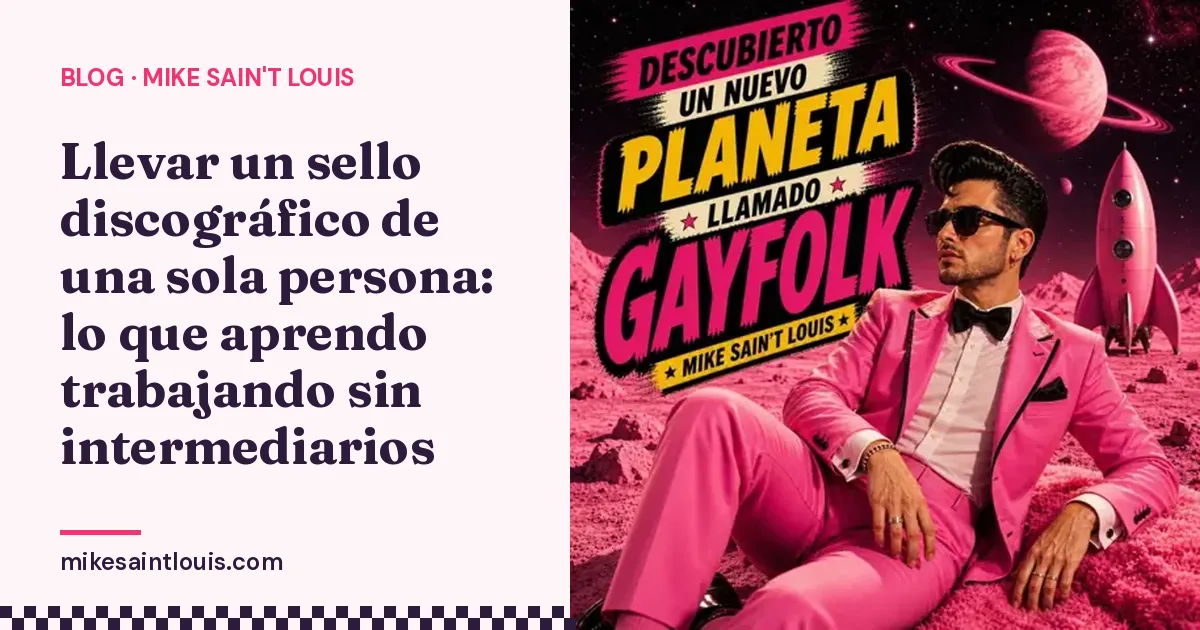
One of the decisions I thought hardest about was letting the GAYFOLK trilogy be downloaded for free, with no sign-up. It's three albums, «Descubierto un nuevo planeta llamado GAYFOLK» ("New planet called GAYFOLK discovered"), «Ojalá se pudiera viajar a GAYFOLK» ("If only we could travel to GAYFOLK") and «El día de la liberación» ("Liberation day"), designed to be heard as a single story in three acts.
Asking for an email address in exchange for the download would have been the norm. I considered it. In the end, putting up a barrier, however small, felt like it contradicted the very thing those albums are about: reaching a place where you can be who you are. So I took the barrier down. It's a decision you can only make quickly when you are the label. At a company with more people, it would have been weeks of debate.
Am I wrong not to collect data? Maybe. I'm noting it down as an open question and I'll revisit it.
The website as a catalogue
The piece that has most changed how I see the label is the website. In October 2026 I launched mikesaintlouis.com, in Spanish and English. I thought of it less as an artist page and more as a record label's catalogue.
Every song has its own page, with its music video, its complete lyrics and its Spotify link. There's a search box, a lyrics section in A-to-Z order, a press area and an FAQ. And the trilogy's download page.
With 273 singles and no ordered catalogue, the music exists but can't be found. Streaming platforms are great for listening and pretty poor for understanding someone's whole body of work. The website is where the label puts things in order and says: this is everything there is, and this is how it all connects.
For me it's been a lesson in pure management. Producing is the flashy part. Archiving, tagging, linking and maintaining the back catalogue is the part that gives what you've produced a life beyond release week. I regret not building it sooner.
Working alone has taught me that independence works like a trade with its own routines, and that freedom without method quickly turns into chaos. It's also taught me that you can run a small label with a business head without losing the artistic side, as long as you keep the moments for creating and the moments for deciding well apart.
If you work without any structure around you too, I'd love to know how you set yourself limits. I'm still learning.
The label's catalogue is at mikesaintlouis.com.