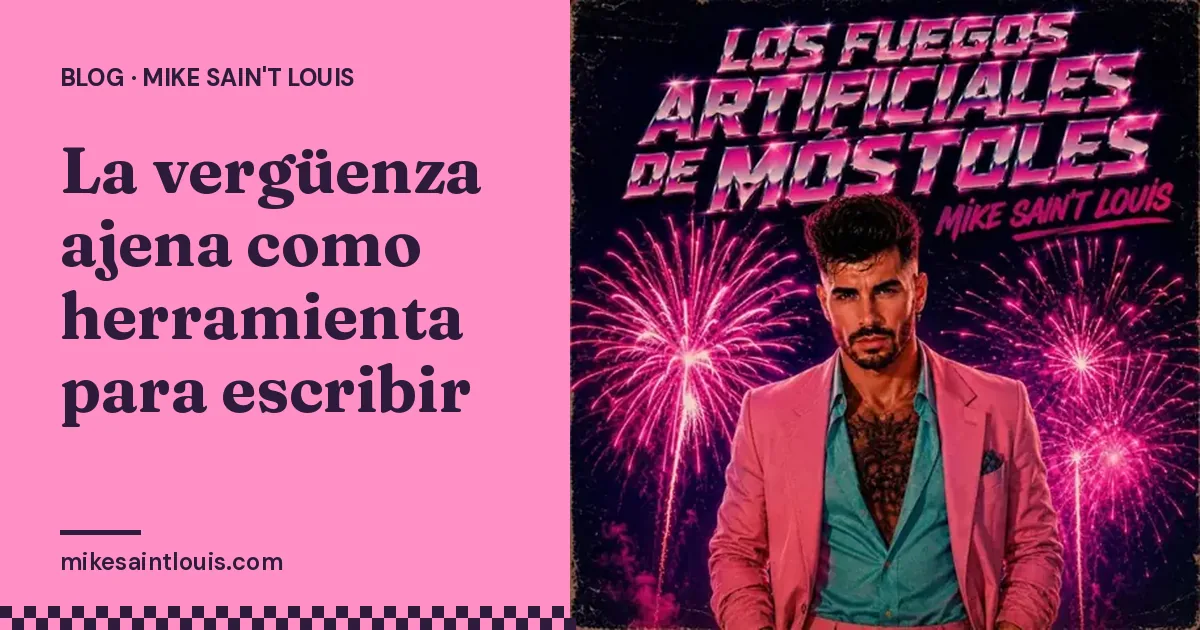
By Mike Sain't Louis ·
Second-hand embarrassment as a writing tool
There's a physical sensation we all know. Someone at a wedding grabs the microphone for a speech nobody asked for. He starts strong. By the third sentence he's lost the thread. He tells an anecdote only he understands. He laughs on his own. And you, in your chair, feel a heat creeping up the back of your neck and a huge urge to look at your phone, even though there's nothing interesting on it.
That's second-hand embarrassment, what Spanish calls vergüenza ajena. And I use it to write.
A very sensitive detector
Second-hand embarrassment is one of the most precise emotional detectors we've got. It goes off exactly when someone crosses an invisible social line, the one nobody has written down but everybody respects. Talking too much about yourself. Insisting when the other person has already said no. Declaring your love at the worst possible moment. Crying at the office dinner.
For someone who writes funny songs, that detector is gold. Wherever the embarrassment goes off, there's a scene. There's a character who has done something others wouldn't dare do, or shouldn't, and who's paying the price in front of everyone. You don't need to invent the conflict. It's already there, hanging in the air, with everyone squirming in their seats.
I think about scenes like that all the time. The one who turns up at his ex's party with a ridiculously expensive present. The one who starts dancing on his own when nobody else is. The one who says "I love you" for the first time and gets a "thanks". Each of them is a song waiting to happen. I don't need to exaggerate them much, because reality comes pretty exaggerated straight from the factory.
Taking the side of the one making a fool of himself
Now, there are two ways to use it. The easy one is to laugh from your chair at whoever's making a fool of himself. Point at him. Make the audience feel superior. It works, but it's a slightly cowardly kind of humour, and it has a very short shelf life.
The other way, the one I try, is to get up on stage with him. To write from inside the ridiculousness. To tell the scene from the point of view of the man holding the mic who can feel it all slipping away. That's where second-hand embarrassment turns into something else: shared embarrassment. And shared embarrassment is very close to tenderness.
Lots of my songs about exes work like that. I don't laugh at the one sending messages in the small hours. The one sending them is the narrator, and the narrator is written from the inside, not looked down on. The listener feels the heat on the back of their neck, yes, but also recognises themselves, because we've all sent that message. And recognising themselves, they laugh differently.
The read-aloud test
I have a habit. When I finish a lyric, I read it out loud, alone, at home. And I pay attention to where it embarrasses me. Not in the sense that it's badly written, but in the sense that it makes me uncomfortable to say it.
Those are nearly always the best lines. If it makes me uncomfortable, I'm saying something people usually keep quiet. If nothing makes me uncomfortable, the lyric is probably correct and boring, like a well-prepared wedding speech nobody will remember the next day.
There's one exception, and I keep it very much in mind. Embarrassment that comes from cruelty is no use. If a line makes me uncomfortable because it humiliates someone who doesn't deserve it, it goes. You can tell the difference quickly, or you can if you're honest with yourself. Exposing yourself is one thing; exposing someone else is another.
I direct my music videos, more than 280 of them, and second-hand embarrassment is a visual tool too. A shot that lasts two seconds longer than is comfortable. A look to camera at the wrong moment. A dance that never quite comes off. The audience feels that heat on their neck exactly as they do with a lyric.
I've learnt this above all from short videos, of which I've made hundreds. In a few seconds there's no time for nuance, and second-hand embarrassment is one of the emotions that travels fastest. If someone does something ridiculous with total conviction, people keep watching. They can't look away. It's like a car crash, but with glitter.
Embarrassment at yourself, the hardest kind
And then there's embarrassment at my own old stuff. With 273 singles released in two years, I've got plenty of material to be embarrassed about. There are lyrics I'd write differently today. There are rhymes that make me clench my teeth. There are music videos where I made decisions I can't understand.
I haven't deleted them. They're on the website, every song with its own page. At first I found that hard to accept. Now I think that embarrassment is useful too. It reminds me that writing means getting things wrong in public, and that if I froze for fear of looking ridiculous I'd never have released anything. What's embarrassing today was a sincere attempt yesterday.
It also helps to think that the people I admire most in any art have work that embarrasses them now. It's almost a condition of the job. Anyone with nothing to be embarrassed about has probably never taken a risk, or hasn't put out enough. I'd rather be in the other group.
There's something liberating about accepting that you're going to make a fool of yourself. Once you accept it, you stop wasting energy trying to avoid it. And you can spend that energy on writing.
So if any song of mine gives you a touch of second-hand embarrassment, please don't skip it straight away. Sit with that heat on the back of your neck for a bit. Maybe, underneath, there's something you recognise.
All the songs, including the ones that make me clench my teeth, are at mikesaintlouis.com.