By Mike Sain't Louis ·
The loneliness of the independent AI artist
There's a loneliness I know well and have written about before: spending the whole day with lyrics, versions and videos, and nobody else in the room. Anyone who works for themselves shares that one. Today I want to talk about another kind, stranger and a good deal harder to explain over dinner. The loneliness of being an AI artist and, on top of that, an independent one.
"The first AI songwriter" is the label I gave myself, and I'm not taking it off. The lyrics of PLANETA GAYFOLK come out of my notebook; I get the music out of artificial intelligence by directing it hard and binning far more than ever gets released. So far, so clear. The trouble starts when I try to decide which table to sit at.
Between two tables
At one table sit the music people. Songwriters, producers, lifelong musicians. People I could talk to for hours about choruses, about rhymes that grate, about why a copla lasts for decades while a summer hit doesn't make it to autumn. I have almost everything in common with them. Until the word comes up. Then something shifts in their face, an eyebrow rises by a millimetre, and the conversation moves from the songs to the method. We're no longer talking about what I've made; we're talking about how I made it and whether that counts.
I understand. It doesn't offend me. But it shuts me out of a place where, by trade and by taste, I ought to belong.
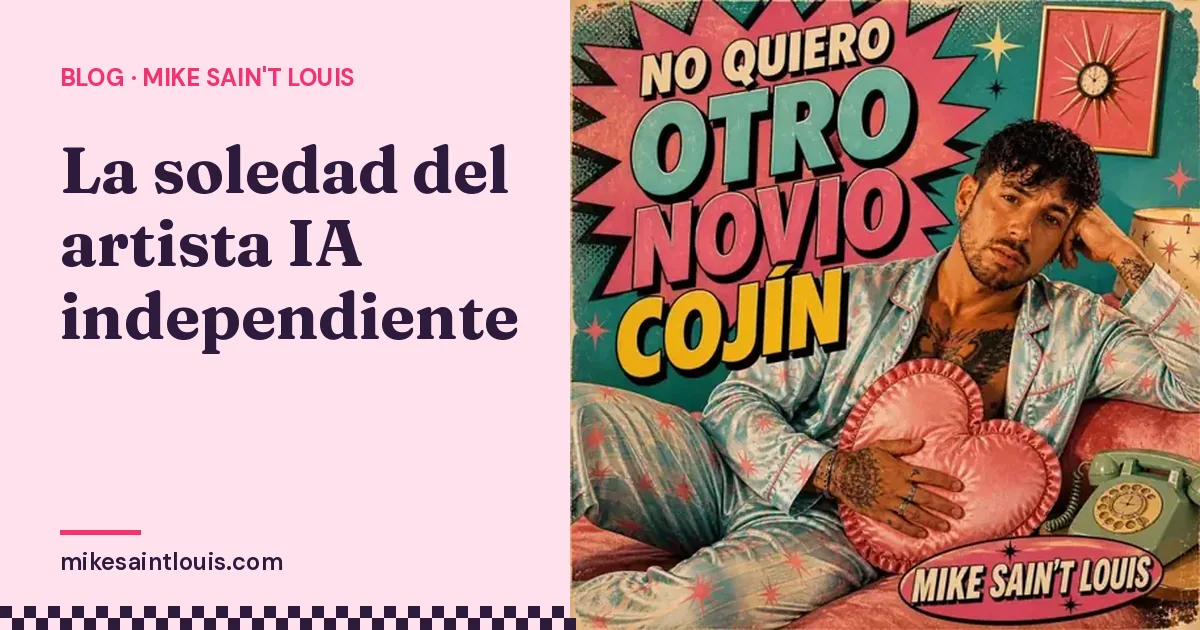
At the other table sit the tech people. There, the word doesn't frighten anyone; quite the opposite. They ask which tool I use, how many versions I generate, how I organise my files. They're interested in the process with an enthusiasm that's almost sweet. What they're not that interested in is the song. I tell them I've just released «No quiero otro novio cojín» ("I don't want another cushion boyfriend") and they ask about my workflow. The cushion, the boyfriend and everything behind the title leave them completely cold.
So I spend my evenings standing up, plate in hand, between the two tables. For one lot I'm too much machine. For the other, too much copla.
Explaining myself, again
The second thing this trade brings is that you have to explain yourself. Always. A songwriter with a guitar doesn't have to justify the guitar every time he puts something out. I do have to spell out which part is mine, what the tool does, why I say so openly, whether it makes me uncomfortable. I'm happy to do it, and there's a FAQ section on the website precisely so I don't have to repeat the same thing forty times. Even so, I repeat it forty times.
Explaining yourself wears you out in a very particular way. It turns you into the spokesperson for something bigger than you. When someone asks me about AI in music, they rarely ask about my songs; they ask about the future of the industry, about copyright, about whether musicians are going to be out of work. I came here to write about ex-boyfriends and nosy neighbours. I don't have a settled opinion on the future of the industry. I have 273 singles and quite a few doubts.
And this is what I miss most: someone to share those doubts with. I don't mean an audience; I have one, and I'm grateful for it. I mean colleagues. People doing the same thing I do, with the same mix of their own lyrics, a new tool and a one-person label, people to have a coffee with and say, "Listen, does this happen to you too...?" When you say you're the first at something, there aren't many people left standing beside you. I meant it as a label, and it turned out to be a fairly literal description as well.
I know there are other people working with these tools. What I can't find is that workshop conversation, no posing, about the small problems. How to choose between two nearly identical versions. What to do when a lyric you love won't fit any of the music that comes out. How to give a project like this a face. I answer those questions myself, and then I answer them again, just in case.
Nobody to tell me no
My label is called MIKE SAIN'T LOUIS, in capitals, and I run it. I'm producer, writer, composer and artistic director, all in the same body and on the same coffee. That has one obvious advantage: I decide fast. No meetings, no persuading a marketing department that «Mitad Venezuela, mitad Pakistán» ("Half Venezuela, half Pakistan") is a brilliant title. It is because I say so, and out it goes.
The disadvantage is exactly the same sentence. It is because I say so.
At a label with more people, someone would put their hand up. In a band, someone would refuse to play it. In my case, the only person who can stop me is me, and I'm very keen to release things. I've learnt to distrust my midnight enthusiasms and to look at things again the next morning, but that's a trick, not a partner. A trick doesn't laugh with you, and it doesn't tell you when you've gone too far either.
Some days that freedom feels like a luxury, and some days it feels like a very big room with a very loud echo. Both are true and I refuse to choose.
So what do I do with all this? I don't have a solution. I have a couple of habits that help.
I write. This blog, for instance, already has seventy articles, and a good many of them exist because I had nobody to say those things to out loud. Writing in public is thinking with a touch of exhibitionism, but it forces me to put in order what rattles around loose in my head, and every now and then someone reads it and replies.
I release. It may sound odd, but releasing is the most direct way I have of leaving the room. A finished song sitting in a folder is poor company. A released song starts living on other people's phones, and that changes the temperature in here.
And then there are the songs themselves, which keep you more company than you'd think. After two years, the GAYFOLK trilogy is almost a neighbourhood. There's the nosy neighbour, the boyfriend from Albacete, the first drag queen. They're characters I made up, granted, but when I go back to them I feel as if I'm visiting people I know.
What really breaks the loneliness comes from outside. It's the people who write to me after hearing a song. Not the ones who ask about the tool, but the ones who talk about the song: that it made them laugh, that they saw themselves in it, that they sent it to someone. Those messages don't solve the two-tables problem. What they do is remind me why I sat down to write in the first place.
It's all there, with the lyrics and the videos, at mikesaintlouis.com.