By Mike Sain't Louis ·
Copla inside queer pop: why the old drama suits today's gay love so well
When someone asks me how I'd define PLANETA GAYFOLK, I usually say it's queer alternative pop in Spanish with a touch of copla. The first part makes sense straight away. The second leaves some people looking puzzled, especially younger ones, who associate copla with Sunday-afternoon telly at their grandmother's.
That's why I want to write about it properly. Because to me, copla is a huge clue to how to tell love stories between men in 2026.
A genre that tells stories
Copla, or canción española, had its golden age in Spain in the 1930s, 40s and 50s. It draws on cuplé, tonadilla and flamenco, and it had songwriters so famous that their surnames are reeled off almost as a single word. But what interests me isn't its history in the books. It's how it's built.
A copla is a three-minute film. It has characters with names, sometimes with trades, nearly always with a hometown. It has a conflict, usually a love that can't be. And it has an ending, often tragic, told with an intensity that would strike us as over the top today. Copla doesn't hint. It declares. If someone suffers, they suffer in public, handkerchief in hand, with the whole village watching.
That taste for storytelling is exactly what I miss in a lot of today's pop, which tends to deal in loose sensations. A copla, by contrast, tells you who she was, where he came from and what happened that night.
The loves that couldn't be named
There's another, deeper reason why copla and the gay world have got on so well for decades. Many of those songs are about forbidden love, about people singled out for loving the wrong person, about passions that had to be lived in secret or paid for dearly. In a Spain where being homosexual was persecuted, many LGBT people heard those stories and recognised their own, even if the lyric was about a woman and a man.
That reading between the lines is part of Spanish gay culture. Copla became a refuge and, over time, a badge of identity. It's performed in gay bars, reinvented in drag shows, carried along to Pride. There's something of an inheritance in all that, like a song handed down from one generation to the next without anyone formally teaching it.
What I do is take one very small step: drop the disguise. If copla told gay love stories with a hand over its mouth, I can tell them with my mouth wide open. The drama stays. What goes is the need to hide it.
Excess as a language
Plenty of people think the exaggeration of copla is a flaw, something old-fashioned and a bit twee. I think it's a language, and that queer pop has always spoken it fluently.
Camp, that way of revelling in the excessive and the theatrical, has a lot of copla in it. The impossible dresses, the hand gestures, the gaze to the heavens, the lament that fills the whole stage. When a gay man suffers for love and tells it with the intensity of a tonadillera, he isn't being ridiculous. He's using an emotional language his culture has spent many years refining.
Excess also has a very practical use. The emotions of gay love have often been lived in hushed tones. Copla gives you permission to turn the volume up. To say that someone has wrecked your life even if all he did was stop answering your messages. That disproportion is theatrical, yes, but it's also true, because that's how it feels inside.
My touch of copla
I'm not going to explain song by song where the copla is in what I write. I'd rather everyone found it for themselves. But I can say where I notice it.
I notice it, first, in the characters. A title like «La vecina cotilla» ("The nosy neighbour") could belong to an old-school copla: a woman from the neighbourhood, a balcony, a secret passing from mouth to mouth. «Mi novio de Albacete» ("My boyfriend from Albacete") has that very copla habit of giving the beloved a hometown, of putting him on a map. And «La primera drag» ("The first drag queen") sounds like a name on a poster, an artist treading the boards for the first time. They're not coplas, and they don't pretend to be. But they share that urge to tell you who someone is before telling you what happens to them.
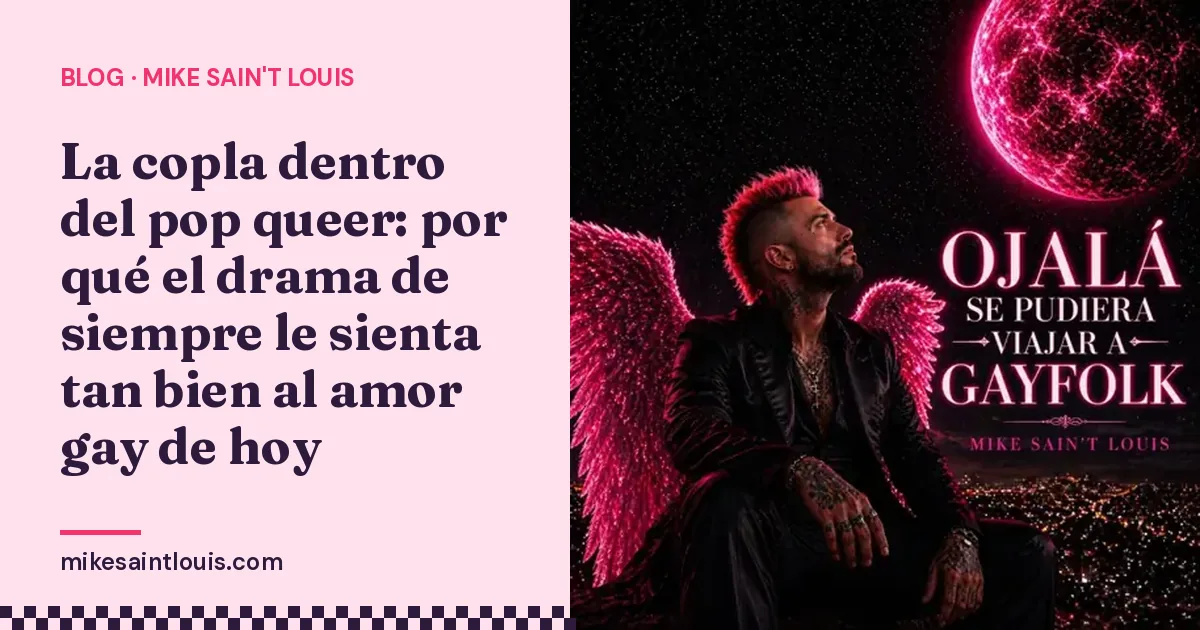
I notice it in the big structure too. The GAYFOLK trilogy plays as a single story in three acts: discovering a place where you can be who you are, longing to get there, and liberation day. The album titles say it all: «Descubierto un nuevo planeta llamado GAYFOLK» ("New planet called GAYFOLK discovered"), «Ojalá se pudiera viajar a GAYFOLK» ("If only we could travel to GAYFOLK") and «El día de la liberación» ("Liberation day"). That «ojalá», that "if only", on the second album is pure copla, with its yearning for something still far away. The difference is the ending. Many coplas ended badly for their protagonists. I wanted this story to end in liberation, although at first I wondered whether a happy ending would take the punch out of the whole. I still wonder sometimes.
Mixing copla with alternative pop and production made with artificial intelligence tools may look like a contradiction. To me it's the opposite. Copla was always a genre that adapted to whatever was to hand, and it survived because each generation retold it in its own way. This is mine.
The complete PLANETA GAYFOLK lyrics are at mikesaintlouis.com.