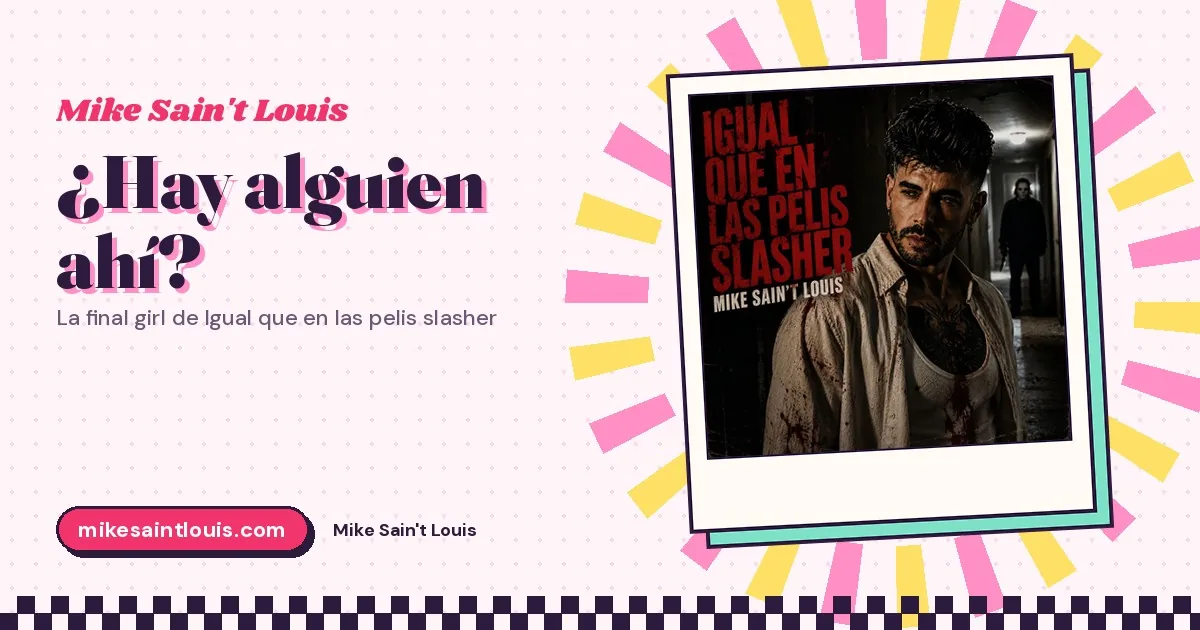
By Mike Sain't Louis ·
"Is anybody there?": the final girl of «Igual que en las pelis slasher» and why queer audiences root for the survivor
Every horror film has that scene. The house is dark. There's been a noise downstairs, or upstairs, or behind a door. And the heroine, instead of running, does what nobody in their right mind would do: she steps into the hallway and throws the question into the void. Hello. Hello. Is anybody there?
The audience yells at the screen not to do it. She does it anyway.
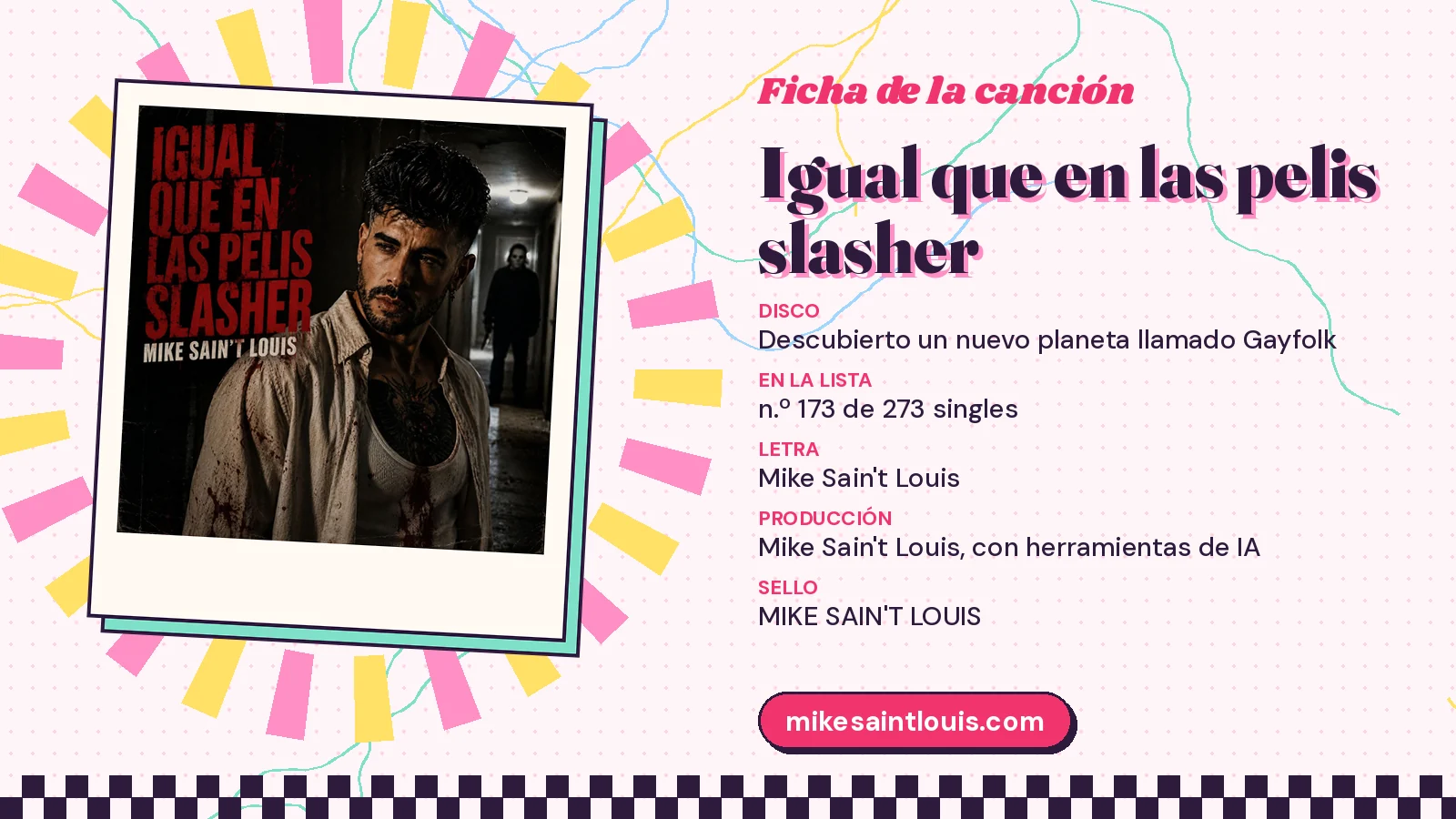
«Igual que en las pelis slasher» turns that scene into a chorus. It is track 173 on the singles list and belongs to the first album of the trilogy, «Descubierto un nuevo planeta llamado Gayfolk». Its full lyrics are published on gayfolkplanet.com, and the planet's journal has already read it three times: as terror in pyjamas and a dressing gown, as a flea-market auction with its lots and its patter, and as one shelf in the horror video shop of my lyrics.
This post picks up a different thread. The figure who drives the song without anyone naming her: the final girl. The girl who survives. The one who asks if anyone's in the house, who runs through the woods, who picks up the knife at the end. And, along the way, a question I've been asking myself for years: why queer audiences, generation after generation, have always been on her side.
A label from 1992
The phrase "final girl" has a date and an author. It was coined by the American scholar Carol J. Clover, of the University of California, Berkeley, in a 1987 essay she later expanded into her book «Men, Women, and Chain Saws», published in 1992. Clover took seriously something critics sneered at: the masked-killer films that filled the video shops of the eighties.
Her observation was simple and devastating. In almost all those slashers, the killer picks off a group of young people one by one, and at the end a single person is left alive. Nearly always it's a girl. She tends to be the most observant of the group, the least interested in the party, the first to notice something is wrong. And in the last act she stops running and faces the monster.
Clover added something even more interesting. The audience for those films was mostly young and male, and yet the person they identified with by the end was neither the killer nor the boys in the group, but her. For ninety minutes, plenty of viewers put themselves in the shoes of a frightened girl. She called it cross-gender identification. And that, for me, is where the queer history of the slasher begins.
Laurie Strode steps onto the porch
The final girl par excellence has a name: Laurie Strode, the character Jamie Lee Curtis played in John Carpenter's «Halloween», released in 1978. Laurie is the responsible babysitter who spends the night minding children while her friends have fun. She's the one who sees the figure in the white mask from the school window, and nobody believes her. She's the one who, in the end, defends herself with a knitting needle and a coat hanger.
What I love most about Laurie is her loneliness. The whole film turns on someone who sees the danger and can't get anyone else to see it. Her friends laugh. The adults aren't there. The police arrive late. When she finally screams for help on a street of houses with their lights on, nobody opens the door.
The song has that same centre of gravity. The three questions in the chorus could be a summary of «Halloween»: «¿Hay alguien ahí?», is anybody there; can anyone help me; «¿Estoy yo sola?», am I alone. The last one is the worst. It doesn't ask whether there's a killer. It asks whether anyone is on her side. In the slasher, as in life, the big fear isn't the monster. It's that nobody will believe you.
The call is coming from inside the house
Four years before «Halloween», in 1974, the Canadian film «Black Christmas», directed by Bob Clark, came out, and many consider it the first modern slasher. A group of students in a sorority house receive obscene, threatening phone calls over the Christmas holidays. The police are slow to take it seriously. And the final reveal, later copied by half the industry, is that the calls are being made from inside the house itself.
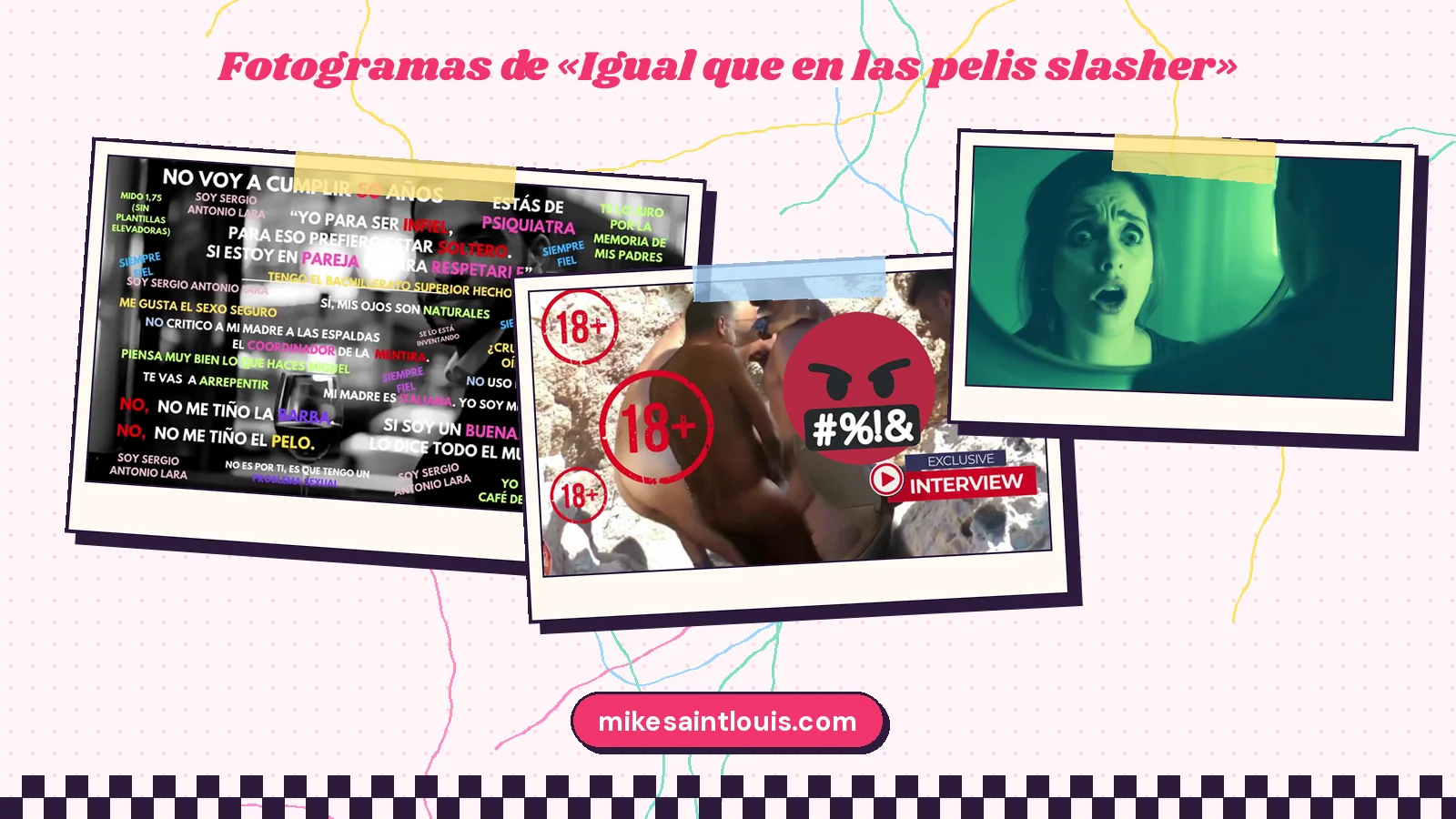
That idea, the threat that doesn't come from outside but is already in, upstairs, came back in 1979 in «When a Stranger Calls», with the famous babysitter who gets the same question over and over on the phone. It's the genre's great insight: the hardest danger to bear is the one close by, the one who knows your schedule, the one who knows where you sleep.
The lyrics of «Igual que en las pelis slasher» carry that same domestic chill. The villain isn't a masked stranger stepping out of the woods. He's someone from her circle, a small-minded character the song nicknames the "miserable half-metre", who threatens her yet again and knows exactly where to strike. That's why the heroine doesn't flee into the woods but out onto the landing. Her haunted house is a block of flats.
Why the pet dies first
There's a line in the song I find terribly precise. The villain threatens her with the animals, because he knows it's the only thing that hurts her, and that's exactly why he does it. He doesn't attack her head-on. He attacks what she loves.
Horror cinema knows that mechanism well. In plenty of films the first victim isn't a person but the family dog, cat or canary. It's such a well-worn device that there's even a website, «Does the Dog Die?», where people check whether the animal dies before they watch a film. The dead pet is the warning: the monster is inside and knows where it hurts.
Off screen, that mechanism has a less cinematic name. Using someone's animals to frighten them is a form of control, and people who work with victims of abuse know it well: some abusers threaten pets precisely because the victim won't leave without them. The song tells it with black humour and pyjamas, but it doesn't laugh at that. It points at it. And it puts it in the mouth of a heroine who's sick of being threatened again.
A half-metre villain
The classic slasher killers are huge. Michael Myers walks slowly because he has no need to run. Jason Voorhees, who first wore his hockey mask in the third «Friday the 13th» in 1982, is built like a wardrobe. Leatherface fills the whole doorframe. Size is part of the fear: the victim is small and the monster gigantic.
The song turns that rule on its head from the first verse. Its villain is tiny. It calls him the half-metre, and the nickname is part playground insult, part diagnosis. The monster in this film isn't frightening because of his strength. He's frightening because of his pettiness. Small in size and small in soul, and that's exactly why he goes for the other person's weak spot: he can't win face to face.
Horror has its small villains too, and the most famous is a doll. In 1988 «Child's Play» came out, with Chucky, a possessed toy the height of a four-year-old who terrified an entire generation. His creator, the screenwriter Don Mancini, is openly gay, and over the years he steered the series towards the most shameless camp. In «Seed of Chucky», from 2004, the doll has a child who fits no gender at all, and the film laughs out loud at parents' fear of a different kind of kid.
I like to think the song's half-metre has a bit of Chucky in him. Ridiculous and dangerous at once. Look at him from a distance and you laugh. Have him on your landing threatening your animals and it isn't funny at all. The lyrics hold both without choosing: they humiliate him with the nickname and at the same time admit he knows how to hurt.
That ambivalence is very useful for talking about a certain kind of harassment. Real-life harassers are hardly ever movie giants. They tend to be ordinary people, sometimes petty, sometimes charming in public, who have learned where the other person's wound is. Giving them a nickname and a B-movie soundtrack doesn't make them less dangerous. But it helps you remember they aren't invincible.
The audience that shouts at the screen
I've watched horror films in cinemas packed with queer crowds, and it's an experience all of its own. People shout, applaud, cheer the heroine when she finally turns round and stands her ground. The lines get celebrated. The handsome boy who doesn't believe her gets booed. Watched in a group, and with plenty of flamboyance, the slasher turns into something close to a gala.
It's no accident. For decades mainstream cinema offered very few characters a young gay kid could identify with wholeheartedly. The final girl was one of them. Someone different from her group, more alert, less interested in pulling, whom nobody listens to and who survives on her wits. Someone who spends the whole film hiding and, in the last act, stops hiding.
Read that way, the final girl is a fairly exact allegory of a lot of adolescences. You hide, you keep quiet, you notice before anyone else what's going on, nobody believes you. And one day you step out of the film's closet, quite literally, with the coat hanger in your hand.
The song's scream
The chorus stretches a "hola" to the limits of reason, with an elongated vowel that is part cry for help and part parody. It's the "hello" of the heroine peering down into the basement. But it's also the camp "hello" of someone who knows they're in a film and decides to overplay it.
That double register is very much the genre's own. The slasher has always had one foot in fear and the other in laughter. The fans themselves laugh at the characters' absurd decisions, at the fake blood, at killers who get up again and again. And the song plays on both fields: it is genuinely frightened and, at the same time, puts on its dressing gown to go out onto the landing.
On planet Gayfolk, excess doesn't dilute fear. It makes it bearable. There's a difference between saying "he threatens me and I'm scared" and staging the fear as a film, with flea-market patter, basement screams and a trip out to the landing «con pijama y bata», in pyjamas and dressing gown. The second way doesn't deny the fear. It takes away its power.
«Scream» and the survivor who knows the rules
In 1996 came «Scream», directed by Wes Craven and written by Kevin Williamson. It was the film that reinvented the slasher for the nineties, and it did so with a brilliant idea: its characters had seen every horror film and knew the rules. They knew you never say "I'll be right back", never split up, and that the killer always comes back one last time.
Sidney Prescott, the heroine played by Neve Campbell, is a final girl who knows she is one. And that changes her. She no longer just survives: she understands the script and uses it against the villain. Williamson, who has spoken publicly about being gay, was an avowed horror fan, and it's no wonder so many queer viewers felt the film was theirs.
The heroine of the song knows the script as well. The lyrics say it almost literally at the end, comparing what's happening with what a good script of «La que se avecina» demands, the Spanish TV comedy about neighbours. She's a heroine who sees herself from the outside, who knows her life has become a mix of slasher and stairwell sitcom, and decides to tell it that way. That awareness is her way of surviving.
The survivor who turns the camera round
In the middle section of the song the tone shifts. The heroine stops asking whether anyone's there and addresses the people on the landing in the tone of a market trader, offering detailed information about the villain, his timetables and his activities. This is the moment the final girl turns round.
In Clover's films, the last girl goes from being looked at to looking. For most of the running time, the camera follows her through the killer's eyes, hidden behind a tree or a window. At the end she takes up the weapon and the gaze switches sides. Now she's the one who chases, who watches, who knows where the other one is.
The song makes the same reversal, as satire. The villain who watched and threatened suddenly finds that he's the one exposed, turned into a flea-market lot. It's a fantasy, and it should be read as one. The characters in the lyrics are invented, and the auction is as real as the rubber knife in a B-movie. What the song tells isn't a plan, it's a feeling: the wish that, just once, the one who frightens might be the one afraid.
The monsters of the scene
The slasher and the LGBTQ+ community have an uneasy relationship. For a long time horror cinema used characters with non-normative gender identities or sexualities as monsters. Alfred Hitchcock's «Psycho», released in 1960, ended with a killer dressed in his mother's clothes, and that image was repeated in many films that followed. Queer critics have been pointing it out for decades.
At the same time, the genre filled up with subtexts that queer audiences read hungrily. The most famous case is «A Nightmare on Elm Street 2: Freddy's Revenge», from 1985, whose male lead takes the place of the final girl in a film loaded with homoerotic winks. Its actor, Mark Patton, told his story years later in the 2019 documentary «Scream, Queen! My Nightmare on Elm Street».
The song takes sides without hesitation. On planet Gayfolk, the frightened heroine belongs to the community and the monster is the one making threats. It's the reversal the genre had long been waiting for: a final girl who's queer, who steps out in a dressing gown and gets the last word.
A horror film in a block of flats
There's a detail in the lyrics I adore: the heroine leaves home suddenly, without getting dressed, in pyjamas and dressing gown, to ask the people around her. She doesn't head into a forest, she heads onto the landing. This horror film isn't shot at a summer camp or in a Victorian mansion. It's shot in an ordinary block, with a peephole, a lift and an entryphone.
Neighbour horror has its own tradition. Roman Polanski's «Rosemary's Baby», released in 1968, turned a New York building into a nest of friendly, sinister neighbours. «REC», by Jaume Balagueró and Paco Plaza, from 2007, locked an entire Barcelona block inside a nightmare quarantine. And Spanish television has spent years telling the comic side of the same thing, with the residents' association as a battlefield.
The song brings both together: the fear of the building and the comedy of the building. The final girl of this block has no forest to run through. She has a landing and a set of neighbours to ask for help. Another song in the catalogue has a neighbour who knows everything, «La vecina cotilla». In this one, it's the heroine who steps out onto the stairs, and she's the one carrying the information.
If the fear isn't a movie
This post is about film and a song, but the threats told here in horror code exist off screen too. If someone is threatening you, following you, tracking your movements or threatening your animals to hurt you, you're not exaggerating and you don't have to face it alone.
In Spain, if there is immediate danger, call 112. For gender-based violence, 016 answers twenty-four hours a day, is free and leaves no trace on your phone bill. If the fear is getting the better of you and you need to talk to someone, 024 is also available at any hour. If you're outside Spain, call your local emergency number. Keeping messages, dates and witnesses helps you report it through the channel that actually protects you, which is the law and not the landing.
The final girl in the film saves herself alone because the script gives her no other option. In real life, it's better to have someone on the other end of the line.
Neighbours on the list
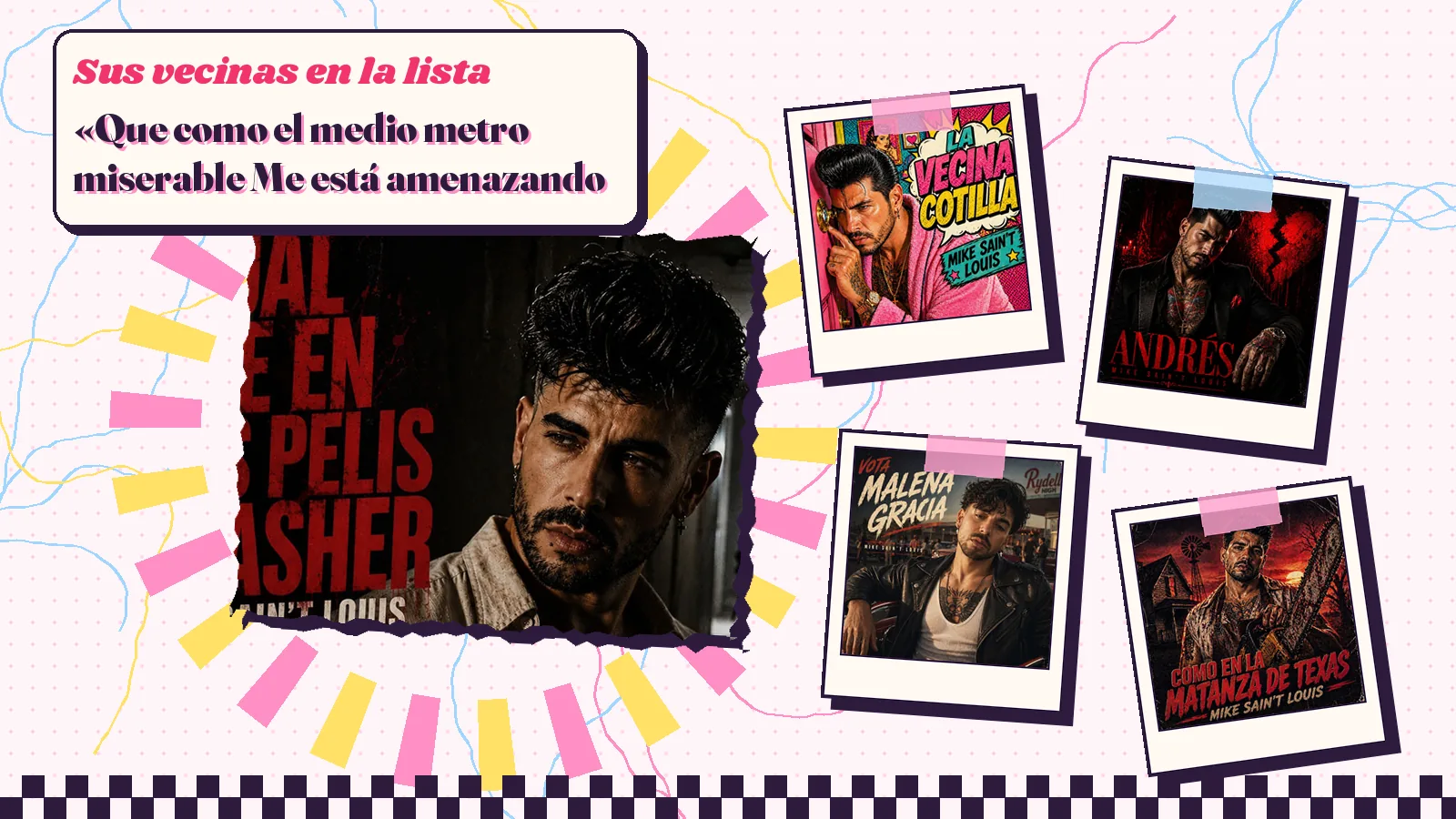
On the list of 273 singles, «Igual que en las pelis slasher» sits at number 173. Right before it comes «Andrés», a song about the right not to stay friends after a relationship, and right after it comes «Vota Malena Gracia», with its impossible election campaign on planet Gayfolk. From a no-compromise goodbye to stairwell horror and on to camp politics: that sequence sums up the first album's humour pretty well.
Horror is almost a genre of its own in my lyrics. One song borrows the title of a seventies classic, «Como en la matanza de Texas», with an emotional vampire dragging chains through a bar. Another shares its name with Rob Zombie's film, «La casa de los mil cadáveres», and another throws insults straight from the video shop's horror aisle, «La boca». And «Spoiler» plays with knowing how the film ends before it starts.
Nor is it the only lyric with two-faced villains. There's a coordinator of lies in «Asqueroso coordinador» and a whole gallery of masquerades in «Mentes diabólicas». They're all characters, and they all share one idea: the real monster hardly ever wears a hockey mask. He wears a smile.
Who this song is for
For anyone who has ever stepped into the hallway to ask if someone was there, heart in mouth. For anyone who saw the danger coming and couldn't get anyone to believe them. For anyone who grew up cheering on the girl who survives because, without quite knowing why, they recognised themselves in her.
And for anyone who'd rather tell their fear in a dressing gown, with market patter and a stretched-out vowel, than keep it to themselves. The final girl has fifty years of history. On planet Gayfolk she steps out onto the landing, looks into the camera and asks the question in this post's title. And this time, someone answers.
Frequently asked questions
What is «Igual que en las pelis slasher» about? About a heroine who feels threatened yet again by a small, cruel character who attacks her through her animals. The song tells it as a B-movie horror film mixed with flea-market patter and a sitcom about neighbours.
What is a final girl? It's the term the scholar Carol J. Clover coined for the last survivor in slasher films: the girl who senses the danger before anyone else, survives and ends up confronting the killer. Laurie Strode in «Halloween» is the classic example.
Are the characters in the song real? No. The half-metre, the two-faced dark-haired man and the rest of the characters are invented, like the villains of any horror film.
Which album is it on? On «Descubierto un nuevo planeta llamado Gayfolk», the first album of the Gayfolk trilogy. It is track 173 on the singles list.
What should I do if someone is really threatening me? In Spain, call 112 if there is immediate danger and 016 for gender-based violence. 024 answers at any hour if you need to talk to someone. If you're outside Spain, call your local emergency number.
Who makes this song? Mike Sain't Louis, lyricist, composer and music producer from Madrid, the first AI songwriter. He writes the lyrics and directs the production; the music and vocals are generated with artificial intelligence.