By Mike Sain't Louis ·
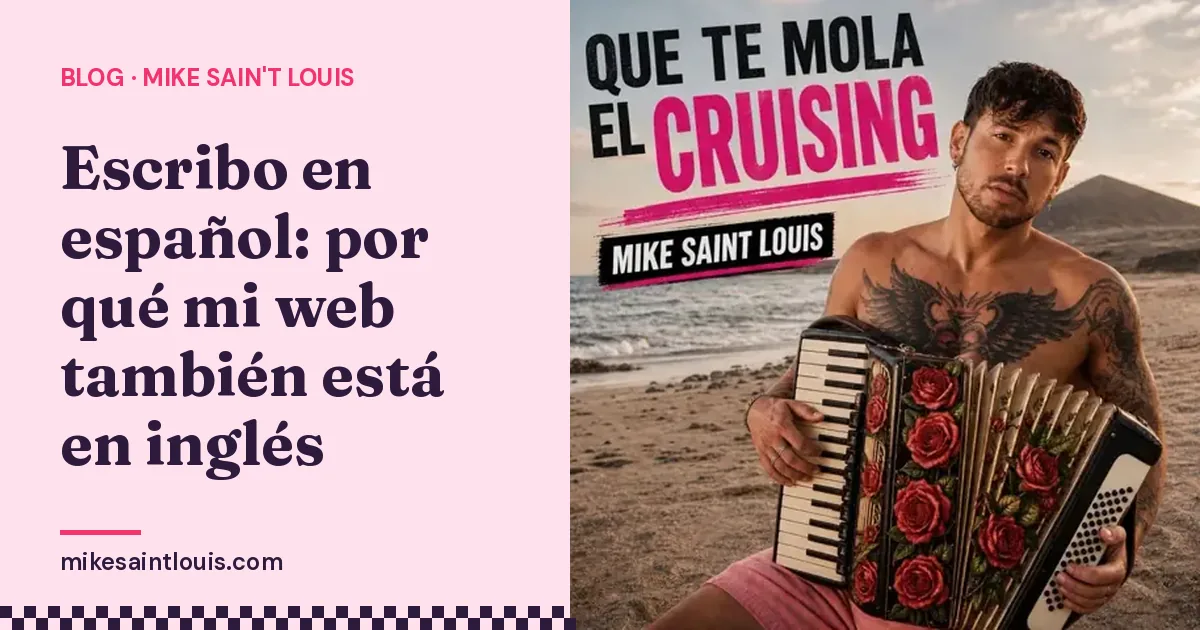
I write in Spanish: why my website is in English too
I write every lyric of PLANETA GAYFOLK, and I write them in Spanish. I produce the music with artificial intelligence tools that I direct, but the words come out of my head, my notebook and the way I talk, which is the way of someone who lives in Madrid and thinks in Castilian Spanish even in his dreams. I call myself the first AI songwriter, and I chose that label carefully. The lyrics will stay in Spanish. So why does my website, mikesaintlouis.com, also have an English version?
It's a question I asked myself many times before deciding, and the answer isn't as obvious as it looks.
My songs won't be translated
First, what it isn't. It isn't an attempt to switch languages or chase an English-speaking audience at the expense of what I do. My music is queer alternative pop in Spanish, with humour, camp and a whiff of copla, the old Spanish torch song, which has no English equivalent. If I tried to write in English, I'd lose exactly what makes me different. The double meanings, the street register, a certain way of exaggerating we have in Spanish. That doesn't travel well.
I'm mainly thinking of two audiences: Spain and the rest of Europe on one side, and Latin America on the other. With the second I share a language. With the first, in large part, I don't.
The door and the house
I like to think of it this way. The songs are the house, and the house is in Spanish. The website is the front door, and a front door has to open for anyone. Someone who doesn't speak Spanish can listen to one of my songs and feel something without understanding the words. It happens with music all the time. What they can't do is find their way around a website they don't understand, find out who I am, how many songs there are, where to download the trilogy.
The English version sorts that out. The sections, the explanations, the FAQs, the press page. Everything around the songs. The lyrics stay what they are, in Spanish, and anyone who wants to understand them will have to make an effort, as we've all always done with songs in other languages.
The hard part to translate isn't the songs
Translating the website taught me something I didn't expect. The tricky bits weren't the long texts. They were the short labels. Camp, luckily, is the same word in English, and they invented it anyway, or so they say. Copla was another story: explaining it to someone who's never heard it took more than one sentence, and I still felt I was describing a flavour. «Cantautor IA» gave me the hardest time. I settled on "the first AI songwriter", and realised that in English it sounds more technical, more lab-coat. In Spanish, «cantautor» carries a hint of acoustic guitar and a tiny bar that doesn't carry over. I kept it because I couldn't find anything better, but it still doesn't fully convince me.
Song titles, for me, don't get translated. «No quiero otro novio cojín» stays as it is. Translated, the joke dies or turns into a different joke that isn't mine. I'd rather someone saw the title in Spanish, didn't understand it, and got curious. That curiosity is worth more than a rough translation. Besides, a translated title stops being the same title, and on the platforms the song is still called what it's called. I'd rather it had one name everywhere.
There's a more practical reason too. People who write about music, who curate playlists, who are putting together a piece on artificial intelligence and creativity, often work in English, even if they live in Amsterdam or Milan. If that person lands on my site and can't understand it, they leave. And whatever they say about me, they'll get from somewhere else, with facts that may well be wrong.
That's why the press section is in both languages. The correct facts are there: 273 singles, more than 280 music videos, the GAYFOLK trilogy, my label MIKE SAIN'T LOUIS. I want it to be easy to talk about me accurately in either language. And I want it clear what I do and what the tool does, because that confusion exists in English too, and it spreads fast.
The doubt
I don't know whether the English version will get much use. Maybe most people who come to my site speak Spanish and never open it. If so, it'll have been work for a handful. I accept that. Keeping two versions has a cost: every time I change something in one, I have to remember the other, and with my release rate that's no small thing.
But I'd rather have it and see few people use it than not have it and lose someone who would have stayed. A website in a single language tells visitors, without saying so, that it isn't for them. I don't want to send that message. My songs are about reaching a place where you can be who you are, and the trilogy tells exactly that, in three acts. It would be odd for the front door to be shut to half the world.
There's some reciprocity in it too. Many of us grew up listening to songs in English without fully understanding them, hunting down lyrics, guessing at lines. It seems fair to return the favour and leave the door open the other way.
So the house is still in Spanish. I've just hung a sign in two languages by the entrance.
In Spanish or in English, the website is mikesaintlouis.com.