
By Mike Sain't Louis ·
The suspension bridge and the roadside check: «Ese chulito» and the body that mistakes love for fear
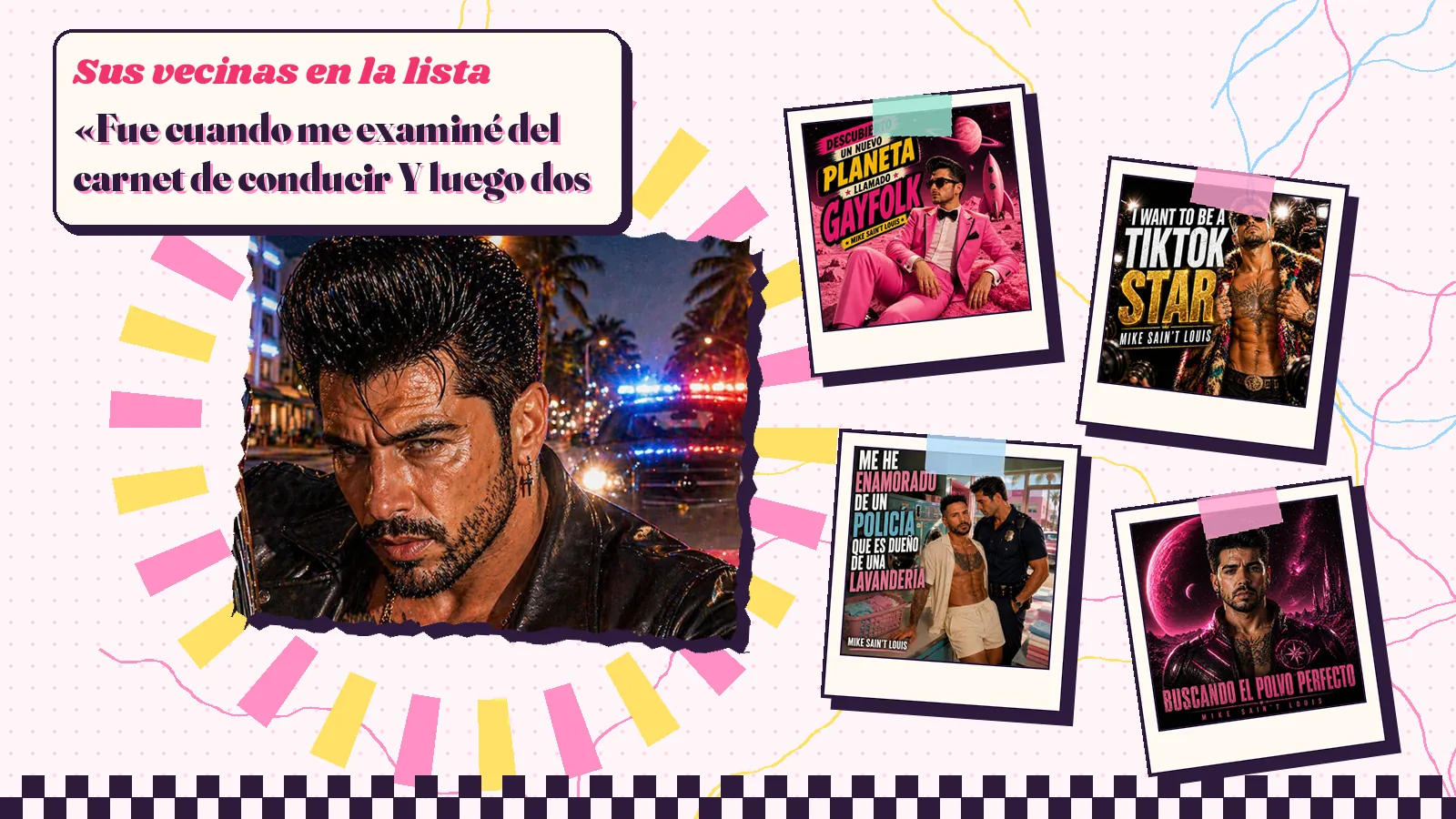
A man with a rocker's quiff, black hair slicked back with pomade and one lock falling over his forehead. A black leather jacket open over a bare, tattooed chest, a cross dangling from one ear, a few days' stubble and a don't-mess-with-me stare. He's leaning on a classic car, its chrome wing mirror in the foreground. Behind him, a wet street at night with palm trees, a neon-lit hotel and two police cars with their blue and red lights flashing. At the bottom, in hot-pink letters that look painted with a brush, the title.
That's the cover of «Ese chulito», «That cocky boy», and the first time I saw it I noticed the sirens before the guy. Because those lights in the background aren't there by chance. The song has a police check in it too. In the lyrics it's the Guardia Civil, on a Spanish road. On the cover it looks like an avenue in Miami. But it's the same idea: your pulse shooting up when you see blue lights in the rear-view mirror.
The song is on «Descubierto un nuevo planeta llamado Gayfolk», the first album of the trilogy. It came out on 27 May 2026, and it's number 226 in the full list of singles, just before «I want to be a TikTok star». Its page on the blog already covers the fun of measuring love with such unromantic nerves, and the chorus with its stretched-out syllables. Here I want to get to the underlying question the lyrics raise almost by accident: why does the body feel the same in front of a guy you fancy as it does in front of an exam or a police officer?
The comparison that changes everything
The lyrics open like any crush song. I fancy that cocky boy far too much, I can only think of him, I can't sleep, that smile makes me dizzy. Nothing so far we haven't heard a thousand times.
And then comes the line that turns the song into something else: «Otra vez mariposas en el estómago», "Butterflies in my stomach again". Again. Which means he's felt them before. And the lyrics, with all the honesty in the world, tell us when. The last time was at his driving test. And two years later, in a car, with Melendi playing, when Patry warned that there was a Guardia Civil check ahead.
In other words, the narrator is saying that falling for someone feels like those two moments. And he says it to make us laugh, of course. But the curious thing is that, without meaning to, he's absolutely right.
What happens inside the body
When something makes us nervous, the body always reacts in a fairly similar way. The stress response kicks in: adrenaline rises, the heart speeds up, breathing quickens, hands get sweaty, the mouth goes dry. Blood heads to the muscles in case you need to run, and the stomach, which isn't a priority at that moment, feels as if it's shrinking. That hollow, fluttering sensation is what we call butterflies.
The interesting thing is that this reaction doesn't distinguish much between causes. Your heart beats just as fast whether you're about to take the practical test, you've spotted a check on the road, or the guy you fancy smiles at you from the bar. The body prepares the same response: something important is happening, pay attention.
What changes is the story we tell ourselves afterwards. If it's an exam, we call it nerves. If it's a police check, we call it a fright. If it's a cocky boy, we call it love. But the butterflies are the same.
The bridge experiment
There's a very famous psychology experiment that fits perfectly. It was published in 1974 by the researchers Donald Dutton and Arthur Aron, and it was carried out in Canada, on the Capilano Suspension Bridge, near Vancouver. It's a narrow bridge of wooden planks and cables that sways high above a river.
The idea was simple. A woman approached men who had just crossed that bridge, asked them to fill in a short questionnaire, and at the end gave them her phone number in case they wanted to know more about the study. The same was done with men crossing a low, solid bridge that wasn't frightening at all.
The result: the men from the swaying bridge called the researcher afterwards considerably more often than the ones from the safe bridge. The explanation given was that they interpreted part of the nervousness they felt from the height as attraction. Their hearts were racing because of the drop, and their heads decided it was because of her.
This is usually called misattribution of arousal. Or, as you might put it in Madrid, mistaking a fright for a fancy.
The driving test
Back to the lyrics with that in mind. The first comparison is the driving test. Anyone who's done it knows what I mean. The driving-school car, the examiner in the back seat with his clipboard, the instructor beside you with his own brake pedal. You gripping the wheel with sweaty hands, trying to remember to check your mirrors.
It's one of those moments when your whole body is on alert. And it has something very like a date about it: someone is assessing you. They watch you, judge you, decide whether you're up to it. Just like when you meet someone you fancy and don't know whether they fancy you back.
I think it's a very sharp comparison, even though it's made for laughs. A crush is an exam too. The difference is that nobody tells you at the end whether you've passed.
The Guardia Civil check
The second comparison is even better, because it's a whole scene. A car, Melendi on the radio, Patry tucking something into her cleavage and warning, calm and composed, that there's a check coming up. What a pain.
The lyrics don't say what that something is, and I'm not going to either. What matters is the feeling. That moment when you see the cones, the lights, the high-vis vest, and your stomach drops to your feet even though you haven't done anything. The body reacts before the head has time to think.
And I love the contrast between the two characters. The narrator, with his butterflies. Patry, calm and composed. Some people are like that: in the middle of a mess they keep their cool with astonishing ease. Patry is an invented character, but we've all got a Patry in our group of friends.
Contagious calm
Let me go back to Patry for a moment, because I think she's the song's secret character. While the narrator's stomach is turning somersaults, she points out the check with total serenity. «Tranquila y serena», "calm and composed", say the lyrics, and they repeat it several times, as if it had impressed the narrator as much as the check itself.
There's something very true in that scene. Nerves are contagious, but so is calm. When someone next to you keeps their composure, your own body tends to slow down a little. That's why, in tense moments, we instinctively look for the calmest person in the group. They're the one who helps us not lose our heads.
When you're falling for someone there usually isn't a Patry beside you. It's just you and your butterflies, and nobody calmly telling you everything will be fine. Maybe that's why the narrator's memory goes back to that car. Because there, in the middle of the fright, someone had things under control.
The cover as a checkpoint
Now the cover makes more sense. Behind the guy there are patrol cars with their sirens on. In front, him, looking as if butter wouldn't melt, or as if he's broken every rule there is.

It's the exact image of the song. The guy you fancy and the police check in the same scene, sharing the frame. The two things that make your pulse race, one in front of the other. If you were the narrator, you wouldn't know whether your heart was pounding because of the blue lights or because of that stare.
The look is pure cinema, too. The palm trees, the hotel neon, the wet street, the vintage car: everything recalls cop films and series set in Miami. It's a backdrop of danger and seduction at the same time, which is exactly what the lyrics mix together.
The rear-view mirror
There's a detail on the cover I took a while to notice: in the foreground, in the corner, there's a round, shiny chrome wing mirror. It belongs to the classic car the guy is leaning on.
It makes me smile because the mirror is exactly where you see the lights of a police check coming. And it's also where you check yourself before getting out of the car, to make sure your hair looks right. The song's two things, the fright and the vanity, in a single object.
And the guy's quiff, by the way, is the kind you touch up in the wing mirror. Pomade, a carefully placed lock, everything in its place. That cocky boy knows perfectly well he's being looked at.
Melendi in the car
There's a detail in the lyrics I think is spot on: the music playing in the car is by Melendi. The Asturian rumba-pop artist made his debut in the early 2000s with «Sin noticias de Holanda», and since then he's been the soundtrack to countless car journeys around Spain.
That detail places the scene with enormous precision. It's not just any car; it's a car full of mates, windows down and music loud, on the way somewhere. Anyone who grew up in Spain recognises that atmosphere in two seconds.
And it gives the scene the feel of a memory. It's not happening now. It happened a while ago and comes back, the way the butterflies come back when the cocky boy appears.
Two years later
There's a small detail in the lyrics that almost goes unnoticed: the police check comes two years after the test. It's a calendar detail that wasn't needed and that, even so, makes the scene ring very true.
Two years on, you've long since left behind the L plate of a new driver and you're starting to feel confident behind the wheel. Your legs no longer shake when you pull away. And then, just when you thought car nerves were a thing of the past, the lights of a check appear and you feel like it's your first day all over again.
Love works in a similar way. You think you've got experience, that you know how this goes, that it won't happen to you again. And along comes a cocky boy with a smile and leaves you sleepless again, as if it were the first time.
The memory of nerves
This is what interests me most about the lyrics. The narrator doesn't compare love with other loves. He compares it with other nerves. The butterflies he feels now bring back the earlier ones, even though they came from places that have nothing to do with it.
I think memory works a lot like that. We remember with the body. A specific physical sensation, a knot in the stomach, a tremor in the hands, suddenly takes us back to other moments when we felt the same. The smell of the driving-school car. The click of the indicators. The Melendi song.
That's why the butterflies chorus repeats so many times in the song. The narrator is in love, yes, but being in love has also opened a drawer of memories he didn't expect, and there they all are, jumbled together: the test, the check, Patry, the cocky boy.
The word chulito
It's worth pausing on the word in the title. In Madrid, «chulo» has a long history. There are the «chulapos» and «chulapas» of the traditional street fiestas, with their flat caps and neckerchiefs. And there's the everyday use: a «chulo» is someone full of himself, who looks at you defiantly, who knows he's good-looking and shows it. It can be a compliment or a reproach, depending on the tone.
Adding the diminutive changes everything. «Chulito» is no longer threatening. It's affectionate, teasing. It's the guy who acts tough but who, deep down, you find endearing. And the guy on the cover is exactly that: quiff, leather, tattoos and a bad-boy face, but with a touch of posing that makes him sweet.
Then the lyrics add another word: «bebecito», "baby boy". That one comes from the vocabulary of reggaeton, where it's used constantly to address someone you fancy. So the song brings old-school Madrid and Latin pop together in the same guy. A «chulapo» who twerks.
From fright to dancing
The song's structure has a clear turn. For much of the lyric, the narrator is at the mercy of his nerves: dizzy, sleepless, full of butterflies. But towards the end the tone changes. «Que empiece el bailoteo, que empiece el perreo», "Let the dancing start, let the grinding start". I'm going to get that cocky boy. I'm taking him home nice and warm.
It's as if the narrator has understood something. If his body is going to be revved up anyway, he might as well use that energy to dance. Better to go from fright to action. The same butterflies that froze you in the exam push you onto the dance floor.
I actually think that's a very healthy reading. You don't have to shake off the nerves of falling for someone. You have to do something with them. And dancing is certainly one of the best options there is.
Mistaking a fright for a fancy
That said, the bridge experiment also has a cautionary reading. If the body confuses fear with attraction, we can sometimes feel we're in love with someone who really just makes us nervous. Someone unpredictable, someone we're not sure will love us or ignore us.
The cocky boy on the cover has a bit of that. The classic bad boy, all leather and sirens. There's a kind of attraction that feeds precisely on insecurity, on not knowing where you stand. And it's worth knowing that, if only so as not to mistake a rollercoaster for a relationship.
The song doesn't go into this, because it's a party song and it's fine that it is. But I like that, between jokes, it drops the hint. Love feels like fear. Sometimes because it's intense. And sometimes because it is fear.
The stretched syllables
The song's page already mentions the chorus with its stretched syllables: «chuuu-liii-tooo», «beee-beee-cito». I'd only add that this stretching has a lot to do with what the song is about.

When someone is nervous, time stretches. The seconds before the exam, the wait while the officer walks up to the window, the moment the guy at the bar looks at you and you don't know if he's coming over. Everything lasts longer than it lasts. And the chorus does that with words. It stretches the syllables the way those seconds stretch.
It's a small writing trick that works without you noticing. The words get longer exactly where the narrator is dizziest.
Laughing to slow the pulse
One last idea. Why write a funny song about something that sets the heart racing like this?
I think because humour is one of the best ways to bring your pulse down. When you laugh at what makes you nervous, you make it smaller. The driving test, told with wit, stops being a trauma and becomes an anecdote. The Guardia Civil check, with its final «qué putada», "what a pain", becomes an after-dinner joke.
And the same goes for falling for someone. Laughing at your own butterflies, admitting they're like the ones from the practical test, is a way of taking away their power. They don't stop being there, but they're not so much in charge. The song does that for whoever listens: it lets you laugh at your own racing heart while you're feeling it.
Love in uniform
There's another song in the catalogue that brings together falling in love and the forces of law and order in a very funny way: «Me he enamorado de un policía que es dueño de una lavandería», «I've fallen for a policeman who owns a launderette». There, the uniform is the object of desire. Here, the uniform is just the fright, and the desire goes elsewhere.
It can also be heard alongside «Buscando el polvo perfecto», «Looking for the perfect shag», or «Me mola Zeus», «I fancy Zeus», other songs where desire is told without beating around the bush and with plenty of humour. Together they make up the most light-hearted side of the first album: the night, the dance floor and the wanting.
Who this song is for
For anyone who has fallen for someone all of a sudden and can't tell whether what they feel is love or palpitations. For anyone who remembers their driving test perfectly. For anyone with a Patry in their group who never gets flustered. For anyone who's heard Melendi in a car full of mates with the windows down.
And for anyone about to go out, looking in the mirror, with butterflies, who needs someone to tell them those nerves are a good sign. Or, at least, that you can dance to them.
The sirens, in the end
Back to the cover one last time. The blue and red lights are still there in the background, and the guy is still looking at the camera as if they had nothing to do with him. I like to think that's the attitude the song ends up proposing. Let the sirens wail, let the butterflies go wild, let the body do what it has to do. And meanwhile, onto the dance floor.
As a lyricist, I really enjoy the fact that a crush song ends up explaining the psychology of fear without setting out to. I call myself «the first AI songwriter», so let me be clear: the lyrics and the production are mine, and the music and vocals were made with artificial intelligence tools. If you want to play it while you get ready, it's in downloads.
Frequently asked questions
Which album is «Ese chulito» on? On «Descubierto un nuevo planeta llamado Gayfolk», the first album in Mike Sain't Louis's GAYFOLK trilogy. It came out on 27 May 2026 and it's number 226 in the full list of singles.
What do the lyrics compare falling in love with? With the nerves of the driving test and with the fright of a Guardia Civil roadside check during a car trip with friends, with Melendi on the radio.
What is the suspension bridge experiment? A study by Donald Dutton and Arthur Aron published in 1974. Men who crossed a frightening suspension bridge were more likely to call a female researcher afterwards than men who crossed a solid bridge, as if they mistook the vertigo for attraction.
What's on the cover? A guy with a quiff, a leather jacket and tattoos leaning on a classic car, on a street at night with palm trees, neon and police cars with their sirens on.
Who made the song? The lyrics are by Mike Sain't Louis, a lyricist, composer and music producer from Madrid. The music and vocals were made with artificial intelligence tools.