
By Mike Sain't Louis ·
Two Friends, Counted: friendship and its impostors in my lyrics
«Dos amigos contados, familia de sangre, mi madre, mi padre» («two friends, if you count them, blood family, my mother, my father»).
It is a line from «Eso es lefa». And almost the same line appears in «Nadie hablará de mí cuando haya muerto», a touch bleaker still: «Dos amigos, como mucho, / tal vez uno» («two friends, at most, / maybe one»).
Two friends. At most. Maybe one.
In my songs the boyfriends take up nearly all the room. The exes, the narcissists, the false loves, the ones who run off with your swimwear. But look in the margins and the friends appear. Few of them. Counted on the fingers of one hand, with fingers to spare. Sometimes false, sometimes self-serving, sometimes the kind who tell you the truth even when it hurts. And one, every so often, who is almost a brother.
This piece is about them. About what friendship looks like in my lyrics. And about why, in a culture like ours that makes so much of chosen family, my songs count their friends so carefully.
The honest friend
I will start with the song that best portrays a friend, even if it is to laugh at her. «Toxina coreana» («Korean toxin»).
There are two friends. The soulmate and the honest one. And the song opens with the line no friend should ever say and every friend ends up saying: «Mi amiga del alma me dice / Oye tía tienes mala cara» («my soulmate of a friend tells me / girl, you look awful»).
The reply is earthy and I will not repeat it in full here, but it comes with an excuse: I haven't slept a wink.
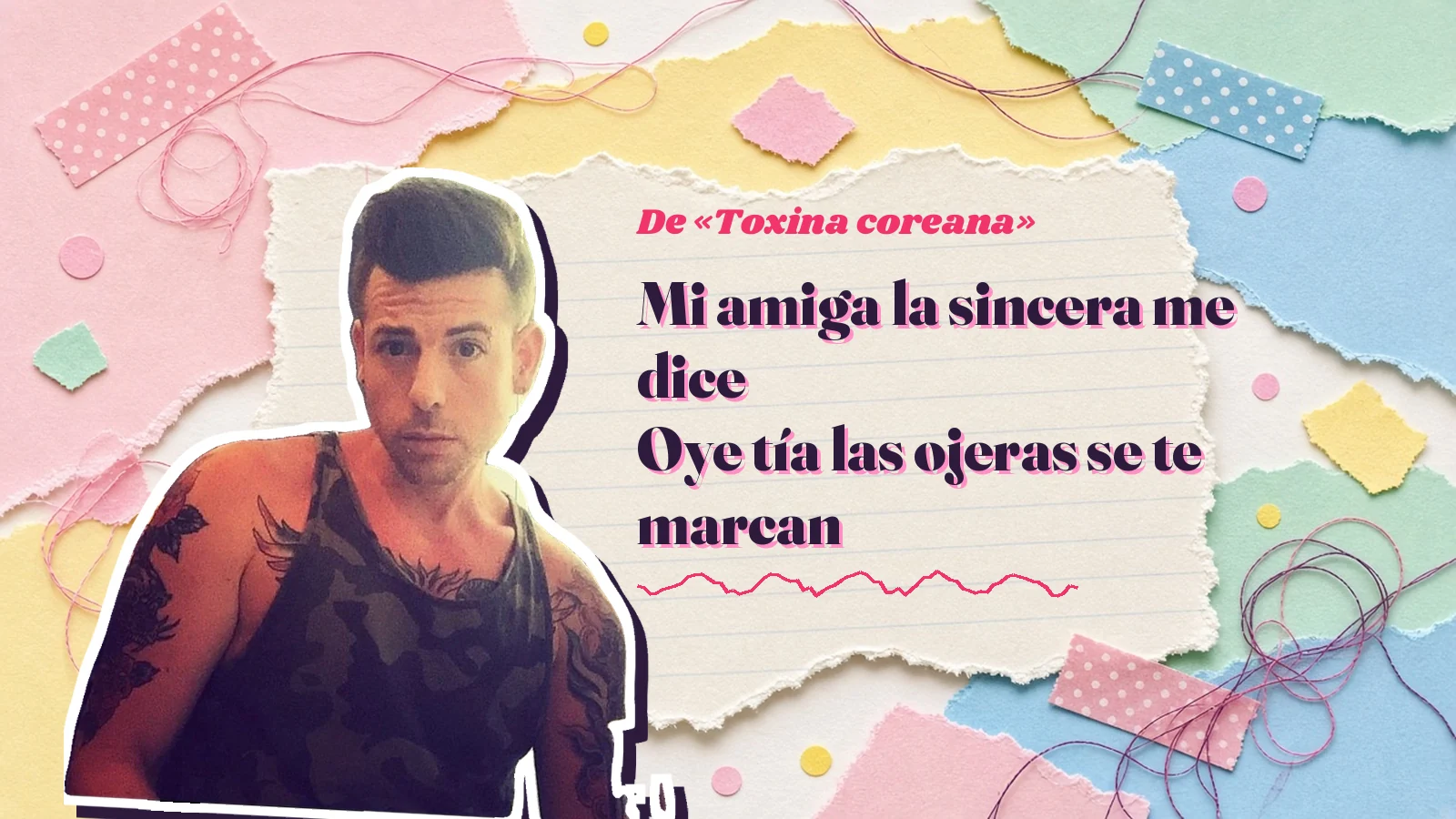
Then the other one chimes in: «Mi amiga la sincera me dice / Oye tía las ojeras se te marcan» («my honest friend tells me / girl, your dark circles are showing»).
And the honesty keeps climbing until it lands the final thrust: you have three thousand euros injected into your face. And another line that is almost worse: I've got you saved in my phone as «the Botoxed one».
I love this song because it portrays a very particular kind of friendship, very much ours. The friend who tells you everything. Who loves you, yes, but will not let a single dark circle pass. Who notices your raised eyebrow before your sad face. Among gay men and among girlfriends, that brutal honesty is almost a form of affection. I tell you that you look awful because I care. Or because it amuses me. Or both.
The Botoxed one in my phone
There is a detail in «Toxina coreana» that strikes me as very much of our time, and it has more to do with friendship than with Botox.
«Te tengo en el móvil como la embotada» («I've got you in my phone as the Botoxed one»).
We all do it. We save our friends in our phones under nicknames. The one from the gym. The one from Albacete. The mad one. Juan's cousin. And those nicknames say a great deal about what we think of them, far more than we would say to their faces. The honest friend, on the other hand, does say it to her face. I've got you saved as the Botoxed one. There you go.
There is something very tender in that cruelty. You only give a nickname like that to someone you love. A stranger gets a first name and a surname. A friend gets «the Botoxed one».
The friend is me
But the best of «Toxina coreana» comes at the end, and it is what makes it more than a joke about Botox.
The protagonist decides to confess. The moment has come, she says, to tell the truth. She will not keep quiet any longer. Why deny it?
And she says it: «Mira, la amiga soy yo» («look, the friend is me»).
The song's page explains it like this: the finger that was pointing turns round. It is exactly what we all do. Laugh at what we do ourselves, until we get caught.
The friend is me. To me it is one of the most honest lines about friendship in my catalogue. Because in every friendship there comes a moment when you realise that what you criticised in her, you have too. The eyebrow, the tired face, the vanity, the fear of ageing. And real friendship begins, perhaps, when you are able to say: the friend is me.
The song's page calls it mirror humour. Criticism that includes itself, and so does no harm.
Two friends, at most
Back to the beginning. To that very short count.

In «Nadie hablará de mí cuando haya muerto» («nobody will talk about me when I'm dead») the narrator does something nearly all of us have done on a bad night: count who would come to your funeral. And the list is brief. Two friends, at most, maybe one. Blood family. The last partner, who in the end also drifts away, and rightly so.
It is a sad song dressed up as black comedy. And what it says about friendship is very hard: that when it comes to it, friends are counted on your fingers. And perhaps not even that.
In «Eso es lefa» the same list returns, almost identical: «Dos amigos contados, familia de sangre, mi madre, mi padre, / el buenazo de mi última pareja, algún vecino cotilla» («two friends, if you count them, blood family, my mother, my father, / my last partner, the big softie, some nosy neighbour»).
Some nosy neighbour. I love that it is there. On the list of people who will talk about you when you are gone, between the two friends and the family, there is the nosy neighbour. Not because he loves you. Because he talks about everyone.
That short count is not a complaint. Or not only. It is also a way of valuing the little there is. If you have two friends, you have two friends. And now that everybody boasts of hundreds of contacts, that is a lot.
What they'll say
«Nadie hablará de mí cuando haya muerto» has another passage that says a lot about friendship, though it may not look like it. It is what the people left behind will say about you.
«Y dirán: / "Ya sabes, tenía su carácter"» («and they'll say: / "well, you know, he had his temper"»).
He had his temper. It is what people say of the dead who did not get on with everyone. What acquaintances say, not friends. Friends would say something else. They would say how you laughed, what you loved, what you did for them. Acquaintances say you had your temper.
And then comes a question and an answer I think are brilliant. Someone asks: «¿Por qué me diría eso?» («why would he have said that to me?»). And another replies: «No te preocupes, / seguro que iba borracho, / o tal vez muy puesto» («don't worry, / he was probably drunk, / or maybe off his face»).
That is how many people dismiss what you said to them while you were alive. They did not listen then and they do not listen now. He was probably drunk. The song does not say it, but you can tell: a real friend would have listened. Would know why you said it. And would not need the excuse.
That is why the list is so short. Two friends, at most. Because the rest are the kind who will say you had your temper.
Neither friends nor family
The same «Eso es lefa» has another line that goes even further: «Nadie me apoya, ni amigos ni familiares, / ni pareja, ni polvos, ni similares» («nobody backs me, not friends, not family, / not a partner, not a shag, nor anything similar»).
And straight after, the image that comes back so often in my lyrics: twenty WhatsApp statuses viewed by the boyfriend, his mother, my sister, my father-in-law, my ex. Not a single «like». Not one comment.
Here friendship appears through its absence. There are no friends to back you. There are people who watch and say nothing. Who see your statuses, who know what you are up to, and do not comment. It is a very modern kind of loneliness: surrounded by people who see you and do not keep you company.
In «La música me está salvando» friends appear on the list of things that did not work: «Ni psicólogos, ni amigos, ni hermanos» («not psychologists, not friends, not brothers»). It is an exaggeration, like almost everything in that song. But there is something recognisable behind it. There are moments when not even friends can reach you. When what pulls you out of the well is something else.
Best friend and almost a brother
But it is not all loneliness. There is one song in which the true friend appears. And he appears at a funeral.
In «Un puñetazo al día» the narrator is «celebrando un entierro / en Madrid con mi mejor amigo y casi hermano» («celebrating a burial / in Madrid with my best friend, almost my brother»). And it is not a sad burial. It is a celebration of the end of someone who did him a great deal of harm. A symbolic funeral, with wine and roses, in a Madrid dive.
What I like about that scene is how the friends are. «Ya les veo desde lejos, / haciendo bromas como siempre» («I can see them from afar, / cracking jokes as always»). As always. That is the word. The true friend is the one who cracks jokes as always, who does not change, who is beside you when you bury someone who broke you.
Best friend and almost a brother. The «almost» matters. He is not a brother. He is something very like one, but chosen by you. And in gay culture that «almost a brother» is an enormous figure. The friend who took you in when your family would not. The one who was there for the first break-up, the first night in Chueca, the first time you said out loud what you were.
Self-serving friendship
And then there are the impostors. The ones who seemed like friends and were not.
In «Tu mendigo» («your beggar») there is a scene that sums it all up: «Me abriste la puerta / con llave prestada, / y dijiste que era mi refugio, / pero era una celda alquilada» («you opened the door for me / with a borrowed key, / and said it was my refuge, / but it was a rented cell»).
And then: «Me ofreciste un rincón / con alfombra manchada / y un silencio lleno de / amistad interesada» («you offered me a corner / with a stained rug / and a silence full of / self-serving friendship»).
Self-serving friendship. A silence full of it. I find that image brutal. It is not that the other person says false things. It is that they stay quiet, and the self-interest lives in that silence. Friendship offered as a refuge that turns out to be a cell. The kind that helps you so it can say it helped. That saves you so it can sweep you away later.
«Tu mendigo» is about more than friendship. It is about a long bond, twelve years long, in which one person took advantage of another. But that line about self-serving friendship can be lifted out and applied to plenty of other things. We have all had a friend like that. One who opened the door for us with a borrowed key.
Those friends you slag off behind their backs
There is another impostor in my catalogue, and he is in a song about an ex. In «No quiero otro novio cojín» the narrator goes over the intentions of someone who has had his eye on another man's money first, on his property, on his car. And he does it «para presumir con esos amigos / que luego, a las espaldas, pones a caldo» («to show off to those friends / you then tear to shreds behind their backs»).
Those friends. The ones who are useful for showing off, and whom you criticise as soon as they turn round. Friendship as a shop window. As an audience. You do not love them. You need them to see you.
That figure interests me a great deal because it is so of the moment. The friend as follower. The group as audience. And the backbiting as the price they pay for being in the photo.
Not even a friendship
And then there is a song that does something almost forbidden in gay culture: refuse to stay friends.

In «Andrés» the chorus says it without anaesthetic: «Andrés, / no / va / a / haber / ni tan / siquiera / una amistad» («Andrés, / there / won't / be / so much / as / a friendship»). And then, in capitals, the word repeated to the end: «NUNCA», «NEVER».
Among gay men, staying friends with an ex is almost an obligation. We have told each other so many times: the ex becomes a friend, the friend a confidant, the confidant the one who introduces you to the next boyfriend. It is part of the folklore. And it is fine when it works.
But sometimes it does not. Sometimes someone has hurt you so much that friendship would be one more lie. And that song defends the right to say no. Not even a friendship. Thank your own honesty, says the lyric. And that is that.
It seems to me a way of protecting friendship, even if it looks like the opposite. Because if you call anything at all a friendship, the word stops meaning something.
Making new friends
It is not all loss. There is a moment in my catalogue where friends appear as a reward.
In «Escupiré sobre tu tumba» («I spit on your grave»), after a relationship with someone looking for a weak and trusting victim, the narrator rebels, like the heroine of the film in the title. And he describes his new life like this: «Yo subiendo como la espuma y haciendo nuevos amigos» («me rising like froth and making new friends»).
Making new friends. It is a small line in the middle of a revenge song. But it is the one I like best. Because when you leave a relationship like that, one of the things you get back is the ability to make friends. Those relationships isolate you. They leave you with nobody. And getting out of them also means having someone to go for a drink with again.
The other person, meanwhile, is exposed for what he is. And the narrator tells him: don't count on me.
Why do people go out with friends?
There is a line in my catalogue that asks the question many people ask in silence. It is in «Como Macaulay Culkin en El buen hijo»: «¿Por qué la gente sale con amigos, tiene citas / Sexo y encuentros con extraños / Y a mí me cuesta tanto» («why do people go out with friends, go on dates, / have sex and encounters with strangers, / and for me it's so hard»).
That «so hard» is another form of loneliness. Not the loneliness of someone who chooses to be alone, but of someone who wants to be with people and does not know how. Who watches others go out, meet up, pull, and wonders what they have that he does not.
That song looks for the answer in childhood, and I will not go into that territory, because it is delicate and the song already says what it needs to say. I will keep only the question. Because it is a question many gay men have asked ourselves at some point. Especially at the start. When everyone seemed to have a group and you had nobody to talk to about what you were.
The ones who'll always be there
And then there is the other way of having friends: few, and for ever.
In «Antisocial» the narrator who chooses his own solitude explains it like this: «Solo me importan aquellos que ya conozco / y siempre van a estar» («I only care about the ones I already know / and who will always be there»).
And later: «Pero a los pocos elegidos, mi lealtad es eterna, / a esos pocos les doy todo, hasta que el mundo se detenga» («but to the chosen few, my loyalty is eternal, / to those few I give everything, until the world stops turning»).
The chosen few. That is the friendship my lyrics defend, when they defend it. Not hundreds of contacts or the enormous group. The two friends, counted. The ones who will always be there. The ones you have known for years, who leave you no need to know anyone else.
I think that ties back to the count at the beginning. Two friends, at most. It can sound sad. But said from inside «Antisocial», it sounds like a choice. Few, but real.
My brother
There is a song in my catalogue in which the narrator speaks to someone like a mate at the bar. «Ni un pimiento».

After going through every way love can go wrong, the lyric turns to whoever is listening and says: «Pero si algo malo viene no te asustes mi hermano / Eres un ángel caído un buen samaritano» («but if something bad comes, don't be scared, my brother, / you're a fallen angel, a good Samaritan»).
My brother. It is how you address a friend when you want him to feel accompanied. Don't be scared. And then the idea that gives the song its title: crying over the past isn't worth a pepper, so laugh out loud.
I like that my songs sometimes do that: speak to the listener as if he were a friend. Not as an audience. As someone you put a hand on the shoulder of and tell not to be scared.
Chosen family
In gay culture there is an expression you hear a great deal: chosen family. The one you build when your blood family does not understand you, rejects you or simply is not there. Friends who stand in as brothers, mothers, eccentric uncles.
My lyrics hardly ever use that expression. But chosen family is there, in the «almost a brother» of «Un puñetazo al día», in the «chosen few» of «Antisocial», in the «my brother» of «Ni un pimiento». And also in the honest friend of «Toxina coreana», who tells you that you look awful because she is family.
What my lyrics add to that idea is a warning: not everyone who calls himself a friend is one. There are self-serving friendships, rented cells, friends for showing off. There are exes who want to stay friends and do not deserve to. Chosen family has to be truly chosen. With care. And with few.
The final count
I will finish with the count from the beginning, because I think it now reads differently.
Two friends, if you count them. At most. Maybe one.
Read on its own, it is a sad line. Read beside all these songs, it is almost a statement of principles. I would rather have two real friends than a hundred who view your statuses and never comment. I would rather have an almost-brother cracking jokes as always at a funeral than a whole group who tear you to shreds behind your back.
And I would rather have a friend who tells me I look awful, even if it turns out that the friend is me.
I think my lyrics count their friends so carefully for the same reason they count their boyfriends so furiously: because they have lost them, because they have watched them pretend, and because they know what a real one is worth. Friends are rarely the protagonists of my songs. But many of them have one hidden in a line, watching from the margin, cracking jokes as always. And perhaps that is the best place for a friend: not at the centre of the song, but beside it, as in life.
I write the lyrics myself, and the music and the vocals are made with artificial intelligence. But what these songs say about friendship was not invented by any machine. It is what anyone knows who has ever counted, on a bad night, how many friends they have.
The lyric of «Toxina coreana» is at gayfolkplanet.com/letras/toxina-coreana. Dedicate it to your honest friend. Or to yourself, if you are the one with the raised eyebrow.
Frequently asked questions
How does friendship appear in Mike Sain't Louis's lyrics?
It appears in the margins of the love stories: very few friends («two friends, if you count them»), the honest friend in «Toxina coreana», the best friend and almost-brother in «Un puñetazo al día», the self-serving friendship in «Tu mendigo» and the refusal to stay friends in «Andrés».
What is «Toxina coreana» about?
Two friends, the soulmate and the honest one, who comment on the protagonist's face: tired looks, dark circles, time passing and three thousand euros' worth of injections. Then comes the twist: «la amiga soy yo» («the friend is me»). The lyric is at gayfolkplanet.com/letras/toxina-coreana.
What is chosen family?
An expression widely used in LGBTQ+ culture for the friends who become family when blood relatives are absent or unsupportive. In these lyrics it appears in figures such as the «almost a brother» and the «chosen few».
Who writes these songs?
Mike Sain't Louis, the first AI songwriter: a lyricist, composer and music producer based in Madrid. The lyrics are always his own; the music and the vocals are made with artificial intelligence.