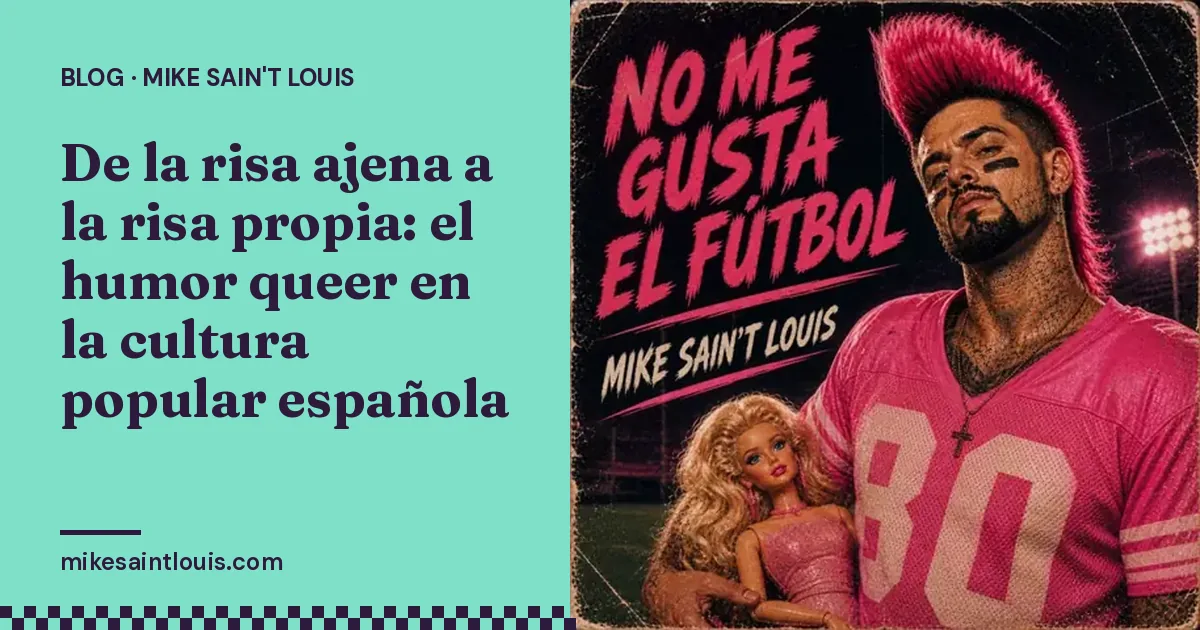
By Mike Sain't Louis ·
From being laughed at to laughing first: queer humour in Spanish popular culture
Think back over Spanish television and film of the last few decades and you'll keep running into the same character. An effeminate man, limp of wrist, who walks on so the audience can laugh. He doesn't say much. He has no boyfriend, no job that matters, no home to go back to. He's there for the joke, and the joke is nearly always him.
For a long time that character was the only way gay people appeared on screen in Spain. I think it matters to talk about him without bitterness and without nostalgia, because he explains a fair bit of what came afterwards, and of what I'm trying to do.
The comic sidekick with the limp wrist
The popular comedies of the seventies, the double-bill, neighbourhood-cinema kind, were full of those supporting roles. The hairdresser, the dressmaker, the neighbour on the fifth floor. They were caricatures, often cruel ones. But they were also, odd as it sounds, a form of visibility. Somebody watching those films in a village somewhere recognised something. Even if it came wrapped in mockery.
That ambiguity fascinates me. The audience laughed at that character, but sometimes he was the cleverest person in the scene. He had the quick line, the sharp comeback, the remark that made the leading man look a fool. The comedy used him as a target and, without noticing, handed him the wit.
I think that's where something very Spanish begins: the idea that the queer man, however low he's been placed, has the fastest tongue in the room. It's a cliché, but it was born of real survival.
The small-hours stages
While the big screen was laughing at us, a very different humour was being made elsewhere. The drag and female-impersonation shows, in cabarets and tiny clubs, had their own language. There the laughter came from inside. The performer mocked the audience, the married men who'd come to look, herself, the copla she was sending up with a fan in her hand.
That humour was dirtier, freer and far more intelligent than anything in the films. It ran on winks only insiders understood. A double meaning, a gesture that meant nothing in any other context. Complicity was half the joke.
I like to think a good part of today's Spanish queer humour comes from those small hours more than from television. From the stage of a bar with four spotlights, not from the studio set.
When the laughter changed hands
At some point I couldn't date exactly, things began to turn. Television series in the nineties and two-thousands brought gay characters with lives of their own: overbearing mothers, exes, trouble at work. They still made people laugh, but the joke was no longer them. They were characters with jokes, which isn't the same thing.
Then came the internet, and with it something new: queer people could make comedy without asking any producer's permission. A thirty-second video shot in a kitchen could travel further than an entire film.
The biggest change, for me, is one of direction. The laughter used to travel from outside in: they laughed at us. Now it almost always travels from inside out. We laugh at ourselves, yes, but also at the family that doesn't get it, the boss playing at being modern, the brand that puts on the rainbow flag in June and takes it off in July.
What I inherited without asking
When I write the lyrics for PLANETA GAYFOLK, I'm not consciously thinking about any of this history. But it's there, like an accent. Titles such as «La vecina cotilla» (The nosy neighbour) or «No quiero otro novio cojín» (I don't want another cushion boyfriend) come from that tradition of the quick line and the recognisable character. They're comedy of manners, in a way. People you know, situations you've lived through or heard about.
What I try to change is who stands at the centre. In my songs the gay man isn't the funny sidekick who pops in for a gag and leaves. He's the lead. He has a boyfriend, he has exes, his self-esteem is good or bad depending on the day. The humour comes from his life, not from the way he moves his hands.
I've inherited a doubt as well. Some people are still uncomfortable with a certain kind of camp queer humour because it reminds them of those films. I understand. There are jokes I make myself that, written by someone else in another era, would have hurt me. The difference lies in who's speaking and from where, but it isn't always as clear as I'd like.
And there's something else I haven't resolved. Spanish queer humour has a very cabaret tradition: night-time, adult audiences. Lots of young people now come to this kind of song through TikTok, in broad daylight, on their phone on the bus. Plenty of people found me that way, with «Tan Cateto» (Such a bumpkin). I sometimes wonder whether that leap from the dark club to the small screen changes the joke. I think it does. I don't yet know if it's for the better.
What I'm sure of is that, for LGBT people in Spain, humour has been more than entertainment. It's been a way to endure, to recognise each other in a bar, and to say things that couldn't be said any other way. Every generation has picked it up and changed it a little.
I join that chain with what I've got: lyrics I write, music I produce with artificial intelligence tools, and more than 280 music videos. I call myself the first AI songwriter, and I know the label is a bit of a joke in itself. Fine by me. It comes from a tradition that always knew how to laugh first.
All the lyrics are at mikesaintlouis.com.