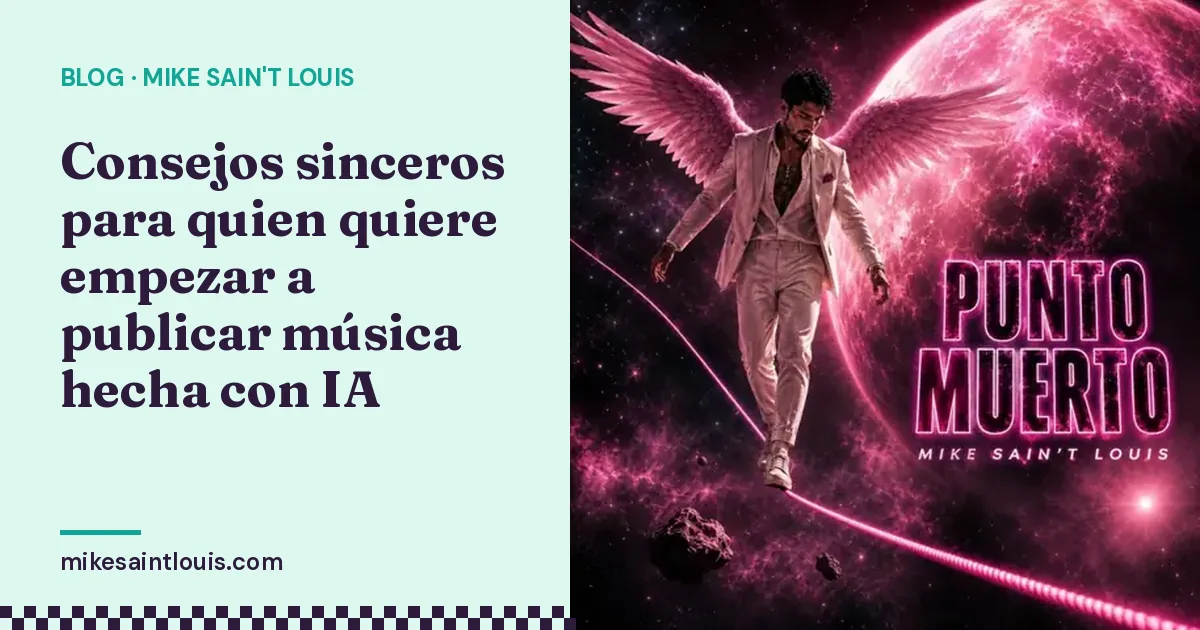
By Mike Sain't Louis ·
Honest advice for anyone who wants to start releasing music made with AI
Every so often someone writes to me with a version of the same question: I want to do what you do, where do I start? I don't have a course or a method with a name. I have two years of work, 273 singles released, more than 280 music videos and a fair number of mistakes. That I can talk about.
What follows aren't rules. They're things I wish someone had told me, and one or two you may already have been told and didn't want to hear.
Have something to say before you open the tool
The most important advice comes first, because if you don't follow it the rest doesn't matter.
Artificial intelligence tools for making music turn out acceptable songs very easily. That's their strength and their trap. If you arrive with nothing to say, they'll give you perfectly correct songs about nothing, and the world already has plenty of those. The hard part isn't making a song exist. The hard part is making it say something specific in a specific way.
In my case, that's the lyrics. I write every one of them myself, about gay love, exes, pride, self-esteem and everyday life. With humour and a whiff of copla, the old Spanish torch song. You don't need to write your own, but you do need to know what you want to tell and why you're the one to tell it. If you don't know yet, write in a notebook before you produce anything. For weeks, if need be.
The tool will hand you versions non-stop. The temptation is to keep the first one that sounds good. Don't.
My job, on the musical side, is mostly saying no. I direct the tool, which in my case is Suno, and I decide, I discard and I choose. One version has a lovely melody but stresses the wrong word. Another has the right energy but doesn't suit the lyric. Another is fine, full stop, and "fine, full stop" isn't enough. If discarding doesn't hurt, you're probably not listening closely.
Say how you do it, from day one
For me this isn't negotiable, though everyone decides for themselves.
If you use artificial intelligence, say so. In your bio, on your website, wherever. I put it in my own label: I introduce myself as the first AI songwriter. And I never claim the vocals are mine, because they aren't. Hiding it might work for a while, but the day it comes out, and it always comes out, everything you've done gets looked at with suspicion. There's also a simpler reason: if you're ashamed to say it, maybe you should ask yourself why you're doing it.
Saying it also takes a weight off. You don't have to police what you tell people. You can talk about your work like anyone else.
And a related point: don't invent a persona you're not. I've seen projects that present themselves with a face, an age and a backstory that don't exist, as if there were a flesh-and-blood performer behind them. Maybe it works for a while. To me it sounds exhausting. Having to keep a lie standing while you make songs is working twice as hard to be believed half as much.
Read the tool's terms
Boring. Necessary.
Every tool has its own terms about what you can do with what it generates, whether you can release it on platforms, whether you can earn money from it. They change over time. Read them before you upload anything to Spotify or anywhere else, and read them again every so often. I won't tell you what they say, because I'm not a lawyer and because what holds today may not hold tomorrow.
The same goes for distribution platforms. Some have their own rules on music made with artificial intelligence. Find out before a release of yours gets taken down.
Get organised from the start
This is advice I could have done with earlier.
When you start releasing often, songs pile up very fast. If you don't organise them from day one, there comes a point where even you don't know what you've got. Give your files consistent names. Keep the final lyrics in one fixed place. Note which version was released and when.
And once you have a few, make yourself a website of your own, even a simple one. Social media buries what you post within days. A website with a page for each song, with its lyrics, is somewhere people can find you two years from now. I opened mine, mikesaintlouis.com, in October 2026, and with 273 singles behind me, getting things in order was a huge job.
You'll read news about songs made with artificial intelligence going viral, with enormous numbers. Those stories aren't your life. Most of what you release will be heard by almost nobody at first, and that's normal, whatever it's made with.
A lot of people discovered me through «Tan Cateto» on TikTok. I didn't plan it. It happened after a lot of work nobody saw. If I'd compared myself with the headlines during that time, I might have given up.
Not everything is clear, and I don't want to finish as if it were.
It unsettles me what all this means for people who make a living playing or producing for others. I don't have an answer. I think that if you're going to use these tools, you should at least think about it. Not to feel guilty, but to do it with your eyes open. And maybe to treat your critics with respect, because sometimes they're partly right.
The rest you'll learn by doing. Like everyone.
If you want to see how I do it, it's all at mikesaintlouis.com.