Estados Unidos ·
Thirty-Nine Words and a Beauty Serum: Why My Shortest Lyric Taught Me the Most About Writing
Mike Sain't Louis, the Madrid-based alternative indie artist who calls himself \"the first AI singer-songwriter,\" reads his club track \"Flash\" line by line and argues that a tiny vocabulary can carry a whole night out
By Mike Sain't Louis
Madrid, October 25, 2026 — "Flash" fits on a cocktail napkin. Eight lines of verse, three lines of chorus, and everything else is repetition. For a long time I thought that made it one of my slighter songs. Now I think it is the one that taught me the most about what words can do when you give them almost nothing to stand on.
Let me get one thing out of the way early, because it matters for everything that follows. I call myself the first AI singer-songwriter. I am a lyricist, composer and music producer. I put down the words and direct the production; the music and the vocal performance were made with AI. That is precisely why I care so much about every word. The words are the part that is entirely mine.
Do the math first
I counted. The published lyric of "Flash" has fifty-one lines with text, including the three times the label "Estribillo:" (Chorus:) appears. Only twelve of them are different. There are around two hundred eighty words in total, but just thirty-nine distinct ones. Few of my songs run on such a short vocabulary.
The most repeated word is the title. "Flash" shows up twenty times: eight in the verses, twelve in the chorus. A small squad of words appears exactly twelve times each, among them the Spanish for night, camera and action. Another group appears eight times, including every word of the opening line.
In other words, the lyric is built like a game with two dice. One die carries the arrival line, the one that opens every verse. The other carries a movie-set formula in the chorus. Everything else is small variation around those two dice. I find that liberating. When you can only roll two dice, every throw counts.
A man in a pond
I uploaded the video to YouTube on November 20, 2024, at two minutes to five in the afternoon, Madrid time. It runs three minutes and twenty seconds. It opens at night, in a pond. A guy in a black jacket with shiny lapels stands waist-deep in the water, among palm trees, under strings of light bulbs hanging from wooden poles. The lights shimmer on the surface, and the title appears in huge neon letters, "FLASH," with my name in cursive underneath.
It is a strange way to open a dance track. No dance floor, no mirror ball, no crowd. Just a man in a suit standing in a puddle, as if he took the wrong road to the party. And yet it already holds everything the lyric will say: night, light, and a little mud underneath.
Line one: arriving
Hoy vengo a darlo todo
"Today I've come to give it everything." Today, not tomorrow, not someday. "I've come," in the present, like someone who just walked through the door. And "give it everything" is an expression Spaniards use for soccer, for exams and for nights out. It's obvious which of the three applies here.
That line appears eight times, always at the start of each half-verse. It is the entrance line, the thing you say when you arrive, which is why it repeats every time the song starts over. It works like a stamp at the club door. Every time it comes back, somebody has just arrived again.
Line two: the serum
Me he puesto una ampolla flash
"I've put on a flash ampoule." The tense shifts. Now it's the present perfect, something that happened before arriving, at home, in front of the mirror. A flash ampoule is one of those beauty treatments that promise an instant effect on the skin, a good-night face in ten minutes. Putting that vanity-bag gesture in the second line, before the song even mentions dancing, is my way of saying the night starts before you leave the house.
Here is the first trick of the lyric. The word "flash" enters the song as the name of a beauty product, not as a camera burst. By the time the chorus arrives, the word is already in the air, ready to change meaning without anyone noticing. That is the kind of small sleight of hand I live for as a writer.
Why short is not shallow
There is another way to read "Flash," and I have written it elsewhere: the mud and the flower that grows from it, the history of magnesium flash photography, ballroom culture. I won't repeat it here. What I want to defend in this column is simpler. A short lyric is not a lazy lyric. When you only have thirty-nine words, a capital letter, a line break or a comma becomes a decision. Repetition is not padding. It's rhythm, it's insistence, it's the way a night out actually feels: arriving, arriving again, the same light hitting you over and over until it means something.
American readers raised on club anthems know this instinctively. The greatest dance records say very little and say it many times. I just wanted to look under the hood and show how the engine runs.
Where to find it
"Flash" belongs to PLANETA GAYFOLK, my catalog of 273 singles and more than 280 music videos, made over roughly two years. You can stream and download all of it for free, with the lyrics for every song, at https://mikesaintlouis.com. It's also on Spotify, Deezer and the major platforms. My full line-by-line reading, in Spanish, lives on my blog: https://mikesaintlouis.com/blog/una-ampolla-y-un-fogonazo-flash-verso-a-verso-del-lodo-a-la-conexion
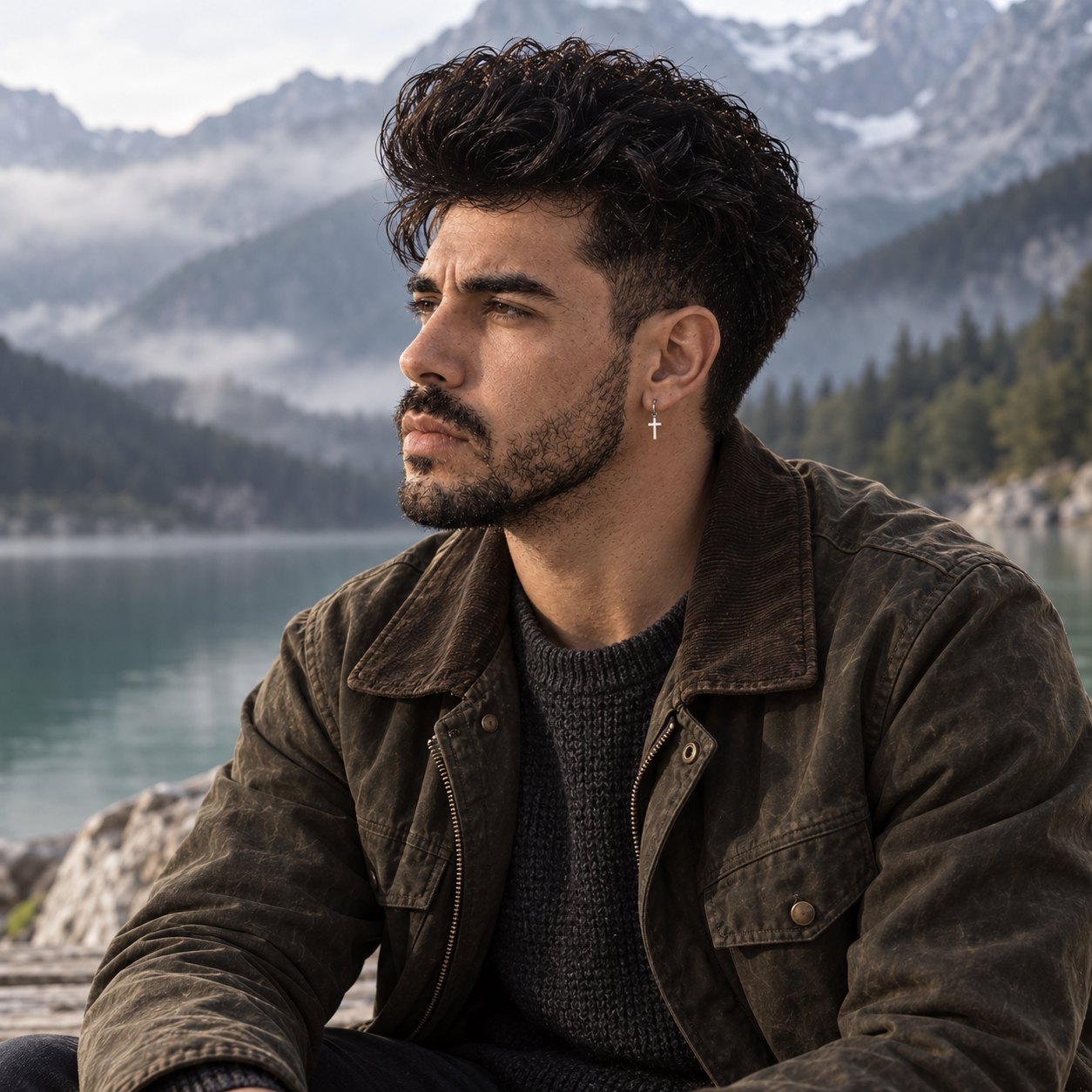
The photo with this column shows me by a mountain lake, about as far from that neon pond as you can get. Same water, different night.
About the author
Mike Sain't Louis is an alternative indie artist based in Madrid and the self-described first AI singer-songwriter. He writes every lyric, directs AI tools for the music and vocals, and runs his own independent label, MIKE SAIN'T LOUIS, with no record company involved. His queer alternative pop, irreverent and campy, ranges from electropop to copla and is anchored in the GAYFOLK trilogy, a journey to a planet where everyone can live as they are. Many listeners found him in 2024, when "Tan Cateto" went viral on TikTok.
Press contact
Email: info@mikesaintlouis.com Website: https://mikesaintlouis.com Instagram: @planetagayfolk