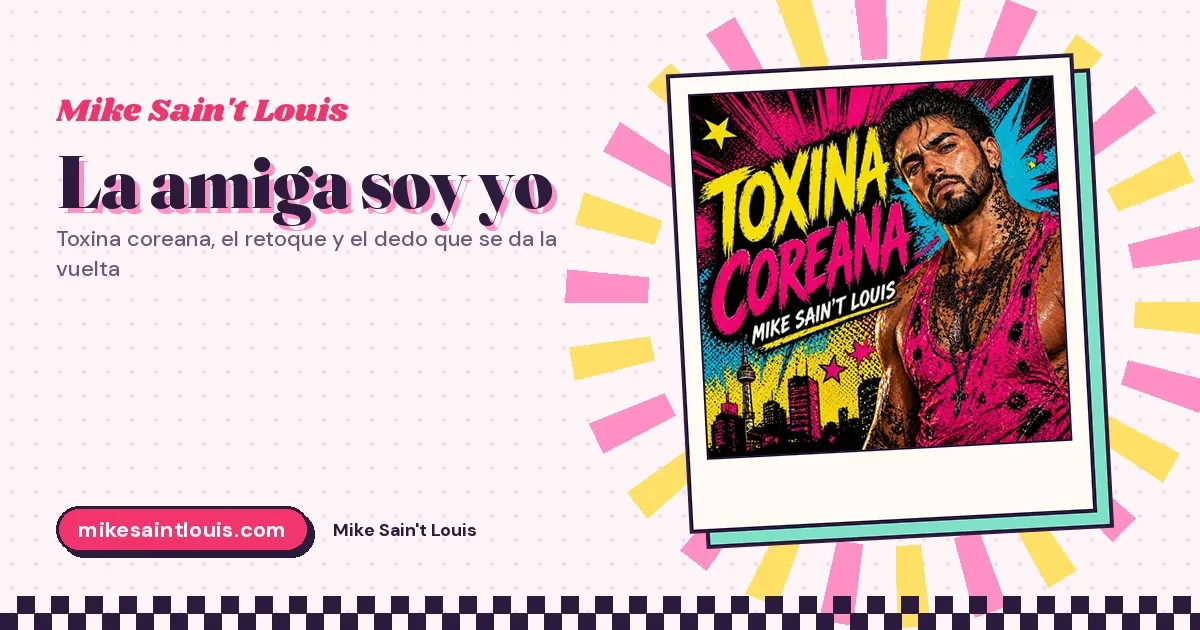
By Mike Sain't Louis ·
I'm the friend: Toxina coreana, cosmetic tweaks and the finger that turns around
Some songs make sense the first time you hear them, and some only make sense in the last verse. Toxina coreana (Korean toxin) is the second kind. For most of its length it sounds like gossip at a café table: two friends, a face that isn't at its best, a list of excuses and a chorus that pokes fun at the needle. And then, just when you think you know what it's about, someone confesses.
On the song page I gave a quick outline of the lyrics and explained why the ending makes me laugh so much. Here I want to take a different route. I want to talk about cosmetic tweaks as a neighbourhood phenomenon, about why a medicine ends up with a nationality in everyday conversation, about friendships where everything gets said, and about that very human habit of pointing out in someone else exactly what we're wearing on our own face. The full lyrics are published, so I'll quote little and comment a lot.
Gossip shaped like a courtroom
If you look closely, the song works like a small trial. There are two witnesses for the prosecution, the soulmate friend and the honest friend. There's a defendant, the main character. And there's evidence: the dark circles, the scowl, the passing of time. Every verse adds one more clue, as if someone were laying photos out on the table.
The defence is always the same. A blunt line to shut the topic down and a homespun excuse: I didn't sleep, I didn't have time. It's the defence of anyone who has ever turned up somewhere wearing yesterday's face. Nobody believes those excuses, not even the person making them, but they're part of the ritual. You say them to end the conversation, not to win it.
The funny thing is that this court has no judge. Nobody hands down a sentence. The friends accuse, the main character defends herself and the chorus, playing the public gallery, just laughs. Until the defendant decides to plead guilty all on her own. At that point the trial is over, because there's nothing left to prove.
Two kinds of friend
The lyrics separate the soulmate friend from the honest friend, and the distinction says a lot. We all have both. The soulmate loves you unconditionally and tells you things gently. The honest one loves you just as much but has decided that the truth, served raw, is also a form of love.
In the song, both say similar things. The soulmate thinks you look rough. The honest one notices your dark circles. But as the verses go on, the honest one raises the stakes. First it's tiredness. Then it's the anger showing on your face. And finally comes the price tag, the lowest and funniest blow in the whole lyric.
I really like that escalation because it's true to life. Conversations between girlfriends, and between gay friends, who work exactly the same way, start with the innocent stuff and end with what nobody dared to say. You need trust to get there. With a stranger you never get past the first remark.
The line that cuts it short
Every accusation gets the same reply, a crude, very Madrid expression that everyone in the city understands without translation. It's a cousin of "don't get on my nerves", only with a far less polite piece of anatomy. It means "leave me alone" with the force of someone who has no intention of continuing the chat.

That repetition gives the song the feel of a courtyard ballad between neighbours. One says something, the other answers, and the answer is so fixed that it becomes a chorus inside the chorus. The listener starts waiting for it. And when it arrives, they laugh, because the line doesn't answer anything; it just shuts the door.
What's interesting is that the shut door is the clearest clue of all. If you have nothing to hide, you don't need to cut people off so sharply. The bluntness gives it away. And the song knows it, which is why it saves the twist for right after that line has been repeated several times.
The nickname in the contacts
There's one detail I love that captures this generation better than any sociology essay. The honest friend admits she has the main character saved in her phone under a nickname. Not her name, but a label that sums up her face.
Let whoever has never done that cast the first stone. We all have someone in our contacts saved as "gym guy", "Pedro Tinder" or "girl from my cousin's wedding". It's a way of remembering who's who, but it's also a little private nastiness nobody else sees. Until someone picks up your phone.
In the song, the nickname works as documentary evidence. It's no longer a comment whispered at a café table. It's written down. It's in the contacts. The friend saved it that way and now she's telling, which is like showing your hidden card halfway through the game.
The chorus and its question
The chorus is where the song's humour is concentrated. On one side, affection: my dear friend. On the other, the diagnosis: frozen-faced. And in between, a question that sounds like it came out of a clinic brochure:
«Toxina tipo A o toxina coreana»
That line ("type A toxin or Korean toxin") is gold because it mixes medical vocabulary with the language of the bargain shop round the corner. Botulinum toxin type A is the technical name for what people call Botox, which is actually a brand name. And the add-on "Korean" slips in a very Spanish suspicion: that maybe you didn't get the good stuff, but the cheaper version.
The lyrics don't answer the question, and they don't need to. The joke is that someone asks it like that, as if they were asking whether the handbag is designer or from the street market.
Why Botox has a surname
It's worth lingering on this for a moment, because it explains why the title works. Botulinum toxin is a substance that temporarily relaxes the muscles it's injected into. It was first used in medicine to treat conditions such as squints, and its cosmetic use was later approved to soften frown lines between the eyebrows. The effect isn't permanent: it lasts a few months and then has to be repeated.
Over time, different brands and manufacturers came onto the market, and some of them are from South Korea, a country that has become a powerhouse in everything to do with beauty and cosmetics. That's where the expression in the title comes from. In street talk, "Korean" works as shorthand for the alternative, for whatever isn't the famous brand.
You don't need to know any of this to enjoy the song. But knowing it helps you get the tone. The joke is that the main character hasn't just had injections; the gossip goes all the way down to where the product was made. It's gossip taken down to the level of the label.
The eyebrow that stays up
The punchline of the chorus is the most visual image in the whole song. The raised eyebrow. Anyone who has seen a fresh tweak up close knows what I mean. Sometimes the result isn't symmetrical and one eyebrow sits a little higher than the other, giving the face a permanent look of surprise or suspicion.
The wonderful thing about that image is that it works two ways. On one level it's literal: the side effect of the needle. On another it's a gesture. Raising an eyebrow is what you do when you don't believe something. And the main character, with her frozen brow, looks as if she's listening sceptically to her own excuses.
I love the idea that the tweaked face ends up betraying exactly what it was meant to hide. The toxin is supposed to make you look rested and relaxed. And what you get is an expression of suspicion that won't go away for months.
Three thousand euros
The verse that finally takes things over the edge is the one about money. The honest friend is no longer talking about dark circles or tiredness. She's talking about euros. A specific sum injected into a face. And the number does what numbers always do in a song: it turns an impression into a fact.
Saying someone has had something done is an opinion. Saying how much it cost is something else. It's accounting. It means somebody has done the maths. And in a conversation between friends, putting a price on the other one's face is the point of no return.
This ties in with one of the things I like most about the way I write: the everyday and the tacky dropped right into the middle of the drama. A face isn't described with pretty adjectives, it's described with its bill. Just as heartbreak can fit on a supermarket receipt, a crisis of self-esteem can fit on a clinic quote.
The twist
Then comes the bridge. The rhythm of the lyrics changes, the lines get longer and someone announces that it's time to confess. She won't keep quiet any more. There's no point denying it. And she drops the bomb:
«La amiga soy yo»
With that line ("I'm the friend"), everything before it rearranges itself. The one who looked rough, the one with the dark circles, the eyebrow, the three thousand euros, wasn't someone else. Or rather, the one talking and the one listening were the same person. The whole song becomes a monologue dressed up as a dialogue.
I like leaving it open to interpretation. Maybe the main character is admitting she gets injections too. Maybe she's admitting that the honest friend, the one putting prices on faces, is her. Maybe the whole thing was a conversation in front of a mirror. The lyrics don't settle it, and a good part of the fun lies in that ambiguity.
Laugh first
There's an unwritten rule of humour that we queer people know very well: if you laugh at yourself before anyone else does, nobody can hurt you with that laughter. It's a survival strategy we learned early, in the school playground, when people could tell you were a bit camp and you had to beat them to the comment.
Toxina coreana applies that rule to looks. For three verses it seems we're laughing at someone else. In the fourth, the laughter turns on whoever started it. That defuses any cruel reading. This isn't a song against women who get work done, or men who get work done. It's a song about how easy it is to spot the speck in someone else's eye when you're the one with the raised eyebrow.
Self-parody is one of the most recurring traits in my lyrics. I like laughing at myself, at my quirks, at my romantic disasters. And here the self-parody arrives as a parting gift, after letting the listener laugh at someone else for a good while.
The pressure nobody names
Under the joke there's something serious, even though the song never turns solemn. We live surrounded by perfect faces on screens. Filters, lighting, digital retouching and real retouching too. It's hard not to compare yourself. And when a friend tells you that you look rough, the comment lands on ground already prepared by thousands of images.

The song doesn't preach. It doesn't say that getting injections is right or wrong. What it does is show the full circle: the pressure, the comment, the excuse, the tweak and, finally, the confession that we're all playing the same game. The person criticising also inspects themselves in the mirror with a magnifying glass.
I think that's more honest than any speech. Beauty pressure isn't something only other people suffer. It runs through all of us, and we usually apply it without noticing, through comments that seem innocent and then keep going round in the head of whoever receives them.
The hand mirror
The friends in this song act as mirrors. Each one hands the main character back an image of herself she doesn't want to see. And as with real mirrors, that image is slightly reversed and slightly exaggerated by the light.
In other songs in the catalogue the mirror is much harsher. In El espejo de enfrente (The mirror opposite) the reflection is a small-hours nightmare, someone who can't stand the sight of himself. Toxina coreana is the light version of that same tension. Here the mirror talks, gossips and quotes prices, and in the end it turns out it was speaking with its own mouth.
I like the catalogue having both sides. Anguish and laughter about the same subject. Because that's how most of us live with our image most days: a bit of drama and a bit of a laugh, sometimes on the same morning.
Café-table humour
Toxina coreana has something of a conversation overheard at the next table. Those stray phrases you catch while waiting for a coffee that make your day because they're pure theatre. "Oye, tía", roughly "listen, girl", opening every accusation, is the watermark of that register.
That language really interests me. Not the Spanish of books, but the Spanish of the street, of WhatsApp audio messages and neighbourhood café terraces. It has its own rhythm, its own verbal tics and a gift for the short, sharp blow that few ways of speaking can match. Writing lyrics in that language is like planting a hidden microphone in a café and keeping the best bits.
That's why the song doesn't need complicated metaphors. The phrases of the conversation are already images. A raised eyebrow, dark circles, a nickname in a phone. Nothing needs dressing up.
Friendship with the good kind of venom
Some people might hear this song and think it's about toxic friendships. I don't see it that way. The friends in Toxina coreana are too honest, yes, but you can tell they love each other. Nobody makes remarks about the face of someone they don't care about.
Real friendship includes a touch of harmless venom. The comment only someone who has known you for years can make. The joke that only makes sense if you've shared a lot of hangovers. That frankness is uncomfortable, but it's also a privilege. It means someone is paying close attention to you.
In the queer world, where so often our real family is the one we choose, that frankness between friends is especially valuable. Your friends are the ones who tell you not that shirt, not that boyfriend either, and maybe you should get more sleep. And then they go to the clinic with you if needed.
An album that laughs in earnest
The song is part of Descubierto un nuevo planeta llamado Gayfolk (A new planet called Gayfolk discovered), an album where heartbreak, anger and fun live side by side. Toxina coreana brings the pure fun, the kind that comes from everyday life and needs no villains.
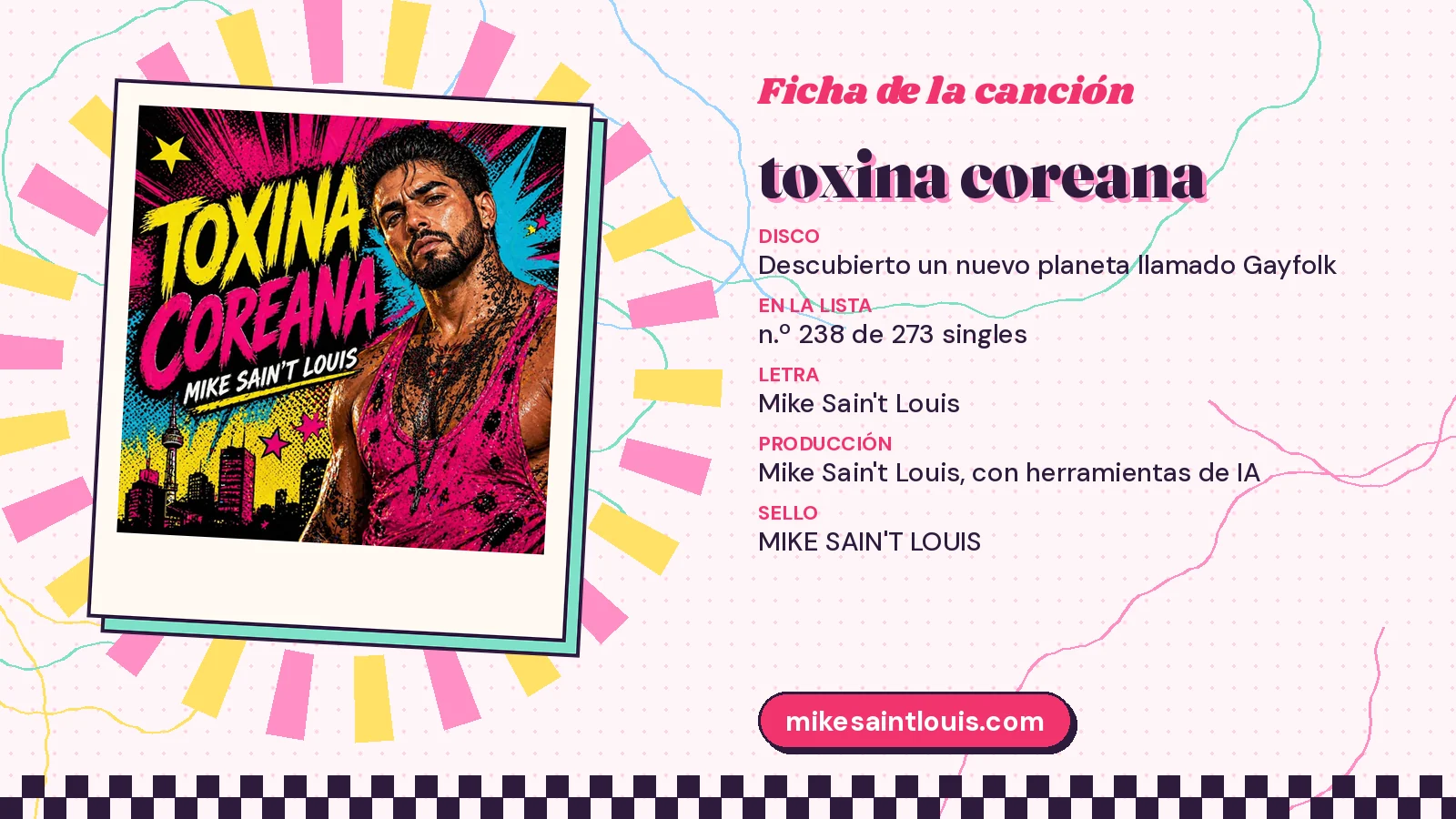
On the same album you'll find Voy a olvidarme de ti (I'm going to forget you), with a very different tone, and Yo apoyo públicamente a Ylenia Padilla (I publicly support Ylenia Padilla), which also draws on pop culture. Toxina coreana sits in the middle as a break for a laugh, a breather between heavier songs.
I like an album to have those moments. Not everything can be a wound. Sometimes a song just wants you to laugh at an eyebrow, and that's also a way of telling who we are.
Other faces in the catalogue
Faces, and what we say about them, turn up in other songs too. In Los ojos de Eduardo Casanova (Eduardo Casanova's eyes) someone else's gaze is used to fire a dart at someone who doesn't measure up. In Carta de recomendación (Letter of recommendation) there are coloured contact lenses that are hiding something too. And in La vecina cotilla (The nosy neighbour) gossip turns into desire behind a window.
They all share a sharp eye for what people show and what they hide. Contact lenses, eyebrows, shorts, dark circles. Physical details that work as clues to what's going on inside. In my lyrics the body is hardly ever just a body: it's a message, sometimes an unintentional one.
How long a jab lasts
There's a practical detail that makes the song even funnier. The toxin's effect isn't forever: it wears off over the months and, if you want to keep it, you have to go back. That turns the tweak into a standing appointment, almost like going to the hairdresser or renewing your travel pass.
Seen that way, the honest friend's figure takes on another meaning. It isn't a one-off expense, it's a subscription. And the raised eyebrow isn't eternal either: in a few months it will settle back into place, or stay up again if the next session goes the same way. There's something very comic about that cycle, about paying regularly to look as if you've had nothing done.
It has a tender side too. People who go back to the clinic again and again don't do it out of vanity, but because that face gives them the confidence to walk out the door. The song doesn't go there, but it leaves the door open to think about it.
Who this song is for
For the friend who always asks whether you've had something done. For the one who has had something done and swears she just slept well. For anyone with half their contacts saved under nicknames. And for anyone who, hearing the ending, felt just a little bit called out.
It's also for anyone who enjoys humour that includes itself, gossip that ends in a confession and songs that save the surprise for the last minute.
How to listen
The song is on the singles page and on every platform, and you can download it from the downloads section. Listen all the way through and don't skip the bridge, because that's where the punchline is.
As a lyricist, composer and music producer, I especially enjoy writing lyrics that change meaning at the end. The music and the vocals are generated with artificial intelligence, but the gossip, the raised eyebrow and the last-minute confession are as human as anything I know.
Frequently asked questions
What is Toxina coreana about? About a main character whose friends, the soulmate and the honest one, keep pointing out her tired face, her dark circles and an obvious cosmetic tweak. She defends herself with excuses until, at the end, she confesses: «la amiga soy yo» ("I'm the friend").
What does "toxina coreana" mean? It's a colloquial way of referring to botulinum toxin from alternative manufacturers, some of them South Korean, as opposed to the best-known brand. In the song it's a joke about the suspicion that the tweak wasn't done with the famous brand.
Is it a song against cosmetic procedures? No. The song laughs at the situation and, with the final confession, includes itself in the joke. It's more about beauty pressure and frankness between friends than about judging anyone.
Who makes this song? Mike Sain't Louis, a lyricist, composer and music producer who calls himself "the first AI songwriter": he writes the lyrics and directs the production, and the music and vocals are generated with artificial intelligence.