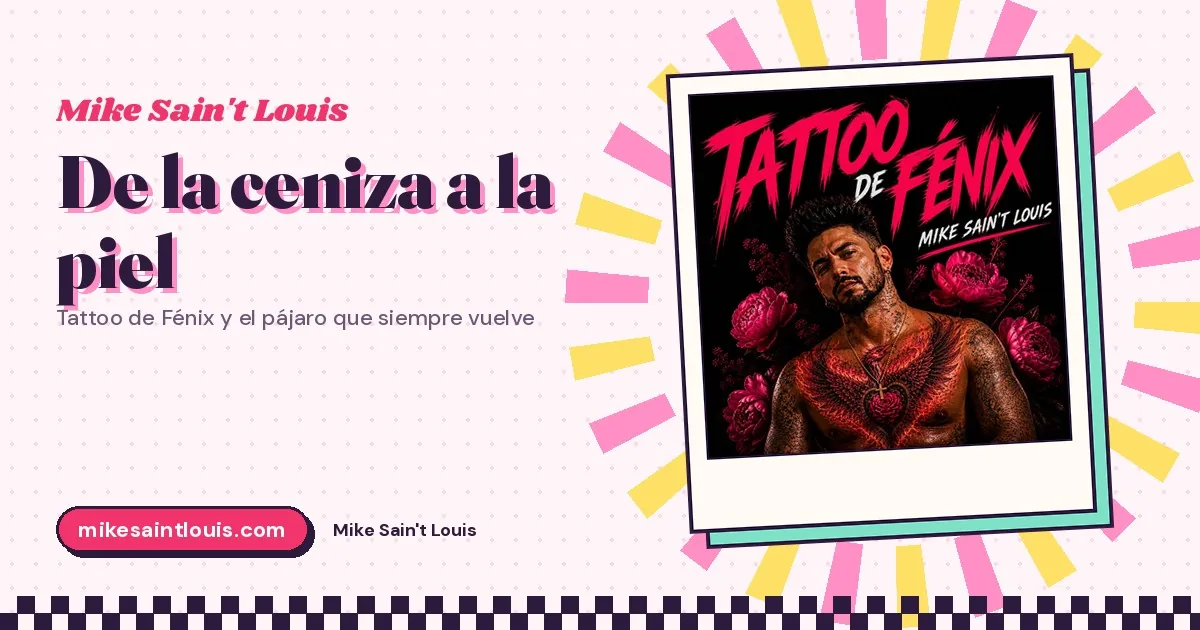
By Mike Sain't Louis ·
From ash to skin: Tattoo de Fénix and the story of a bird that always comes back
Few symbols have travelled so far through time as the phoenix. It has been in ancient texts, on coins, on city coats of arms, in children's novels and on millions of tattooed arms, backs and chests. And in Tattoo de Fénix (Phoenix tattoo) it lands somewhere I love: on the chest of someone dancing in a club in the small hours.
On the song's own page I've already explained what the lyrics are about and how they work on the dance floor, and the full lyrics are published. Here I want to do something else: tell the story of that bird, explain why it has meant the same thing for so many centuries, think about what happens when someone decides to have it inked into their skin, and defend an idea the song takes for granted: that a dance floor is a perfect place to be reborn.
A bird nobody saw
The first thing that fascinates me about the phoenix is that, from the very beginning, it was a bird people talked about without having seen it. Herodotus, the Greek historian, mentions it in his Histories when writing about Egypt, and admits quite honestly that he only knew it from paintings. He passed on what he'd been told, and warned that he didn't quite believe it.
That mix of fascination and doubt strikes me as lovely. The phoenix is born as a rumour, as other people's story. And over the centuries, writers such as Ovid took it up in their verse and turned it into one of the best-known images of antiquity: a unique bird that, at the end of its long life, dies and is born again.
The versions change depending on who tells them. In some, the bird burns and is reborn from its own ashes. In others, a new bird emerges from its body. But the underlying idea is always the same: something that ends doesn't entirely end. It comes back.
Why the ashes
The version that has won out in popular culture is the one with fire. The phoenix burns, turns to ash and rises from that ash again, whole. And it seems natural to me that this version won, because it's the most dramatic and the easiest to grasp.
Fire has one advantage as a metaphor: it really destroys. It isn't tiredness, or a wound that closes by itself. It's razing everything. And for something to come out of that alive has a special value. Whoever identifies with the phoenix isn't saying they've had a bit of a rough time. They're saying they burned to the ground.
That's why the image works so well for talking about break-ups, illnesses, crises of every kind. It's the symbol of someone who has hit rock bottom and climbed back up. And it's also a very optimistic symbol, because it takes for granted that coming back is possible.
From myth to skin
For centuries the phoenix was above all an emblem. It appeared on coats of arms, in books, on seals, in the decoration of churches and palaces. It was a symbol of what endures. Over time it moved to a far more intimate medium: skin.
Today the phoenix is one of the classic motifs in tattoo studios. There are traditional-style ones, with flat colours and bold outlines. There are watercolour ones, with splashes that look like flames. There are ones inspired by the Japanese tradition, which has a mythological bird, the hō-ō, usually translated in the West as phoenix and carrying its own meaning. And there are minimal versions, a fine line that can barely be seen.
What almost all of them have in common is the reason people get them. Very few people get a phoenix tattoo just because. There's usually a story behind it of something that ended and something that began afterwards.
Tattooing a memory
A tattoo is a strange decision if you think about it. You put on your skin, for ever, something that means a great deal at one particular moment in your life. And you do it knowing the moment will pass but the drawing will stay.
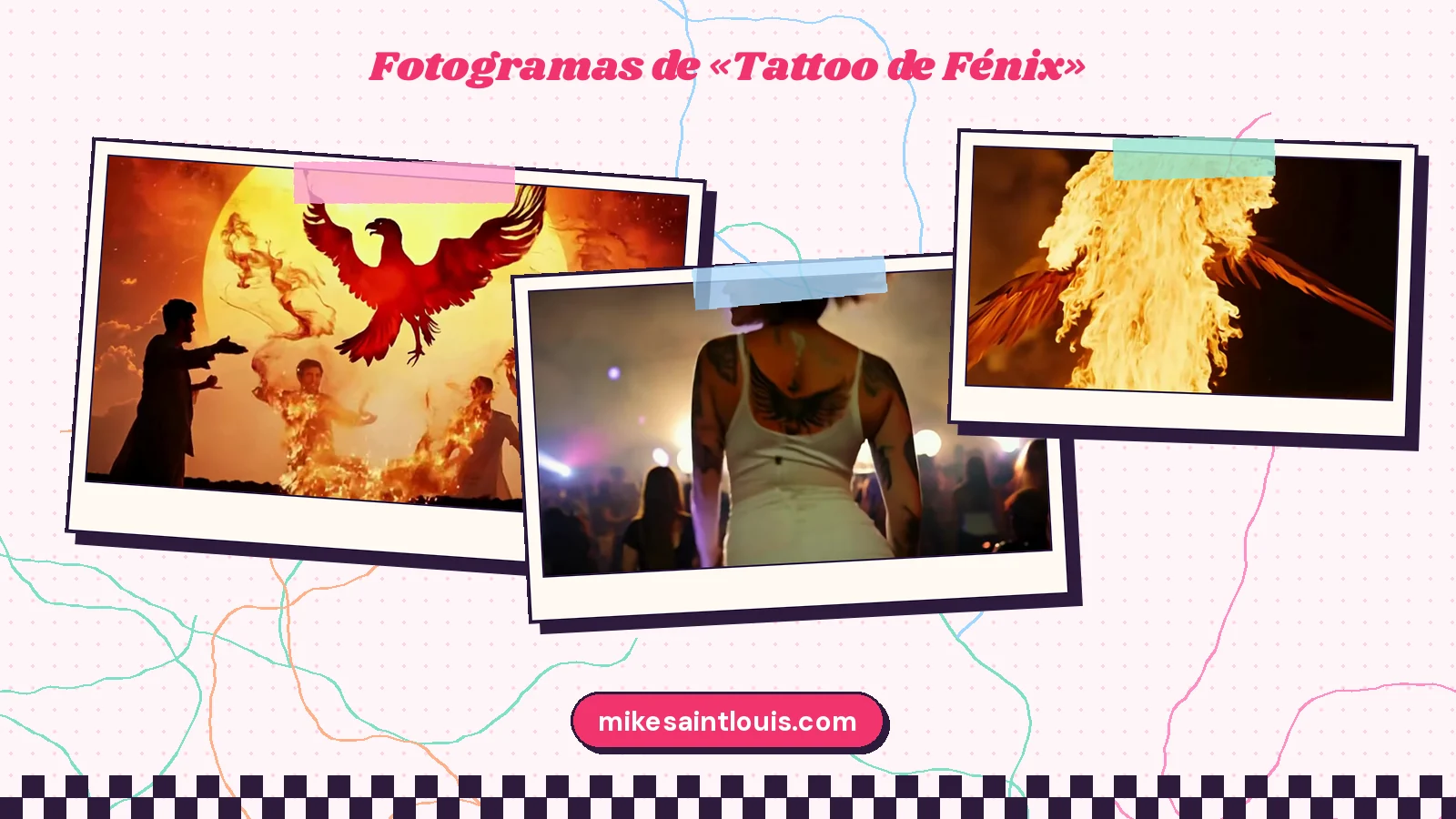
With the phoenix that decision has a very particular logic. You get the symbol of rebirth tattooed just as you've been reborn. And from then on, every time you look in the mirror, you see the reminder that you've already come through once. It's a kind of emotional insurance: if you made it out then, you'll make it out next time too.
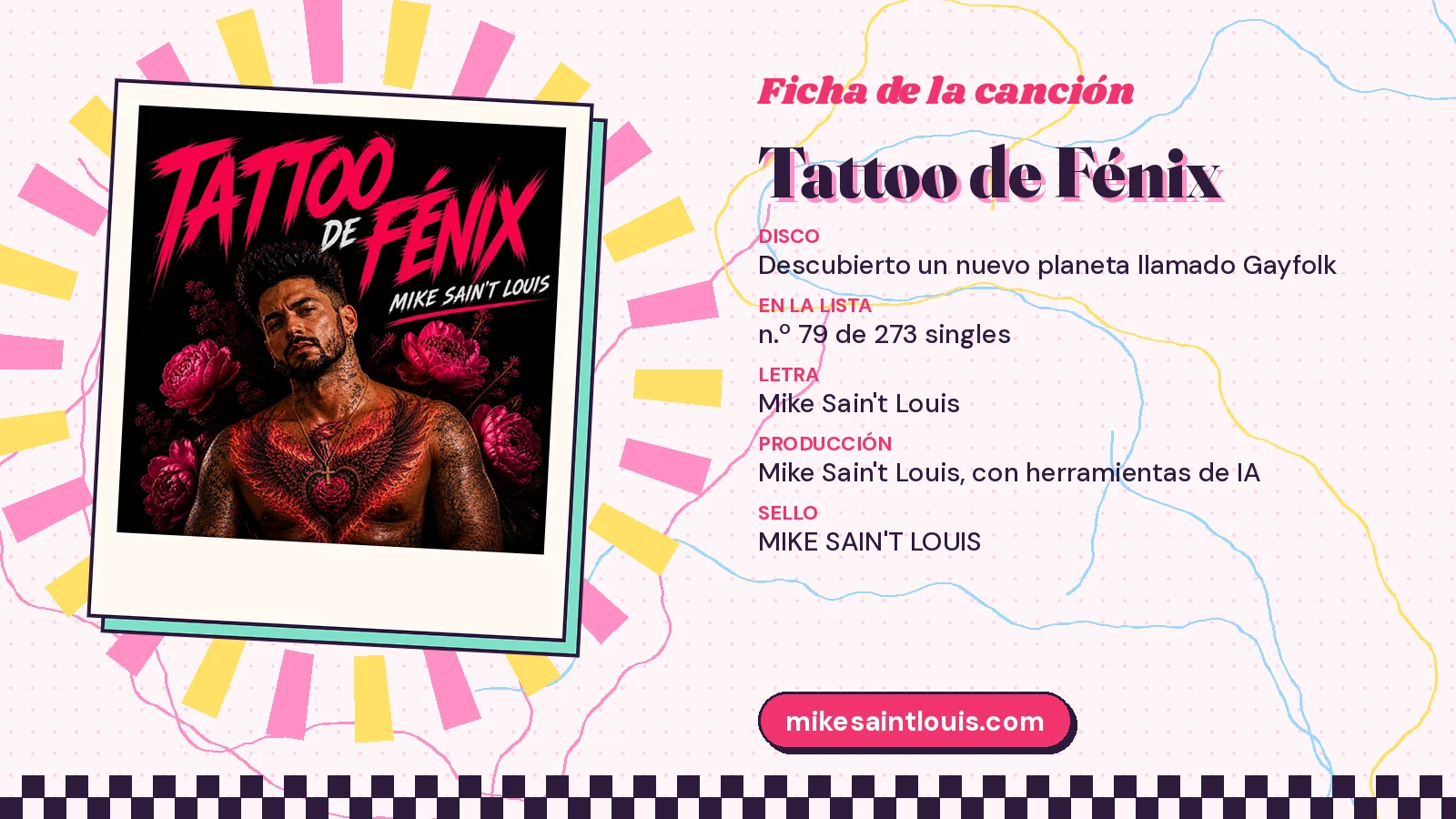
The song puts the tattoo on the chest, and I don't think that choice is accidental. The chest is the place of the heart, of breathing, of what shows when someone takes their T-shirt off on a dance floor. It's a place that's visible and intimate at once. Wearing a phoenix there is like wearing the story of your life in plain view for anyone who wants to look.
«Llevo tatuado en el pecho»
The lyrics open with exactly that image: a phoenix the protagonist says «llevo tatuado en el pecho», I have tattooed on my chest, in the first person and with no further explanation. We aren't told what happened before, or why they got it, or when.
That lack of explanation is part of its charm. The phoenix already carries the whole story inside it. There's no need to tell of the break-up, the crisis or the bad patch. Anyone who sees the tattoo understands there was a fire. And the song, instead of telling us about the fire, takes us straight to what happens afterwards: the night the bird flies again.
It seems a very smart decision for a dance song. Dance-floor songs don't need a biography. They need a mood. And the phoenix gives that mood in a single image.
The heartbreak club
And then comes the expression I like most in the whole lyric: the protagonist flies between beats «en el club despecho», in the heartbreak club. Not in just any club. In the heartbreak club.
The word «despecho» has a long history in Spanish. It's the resentment of someone who has been scorned, the rage of lost love. In much of Latin America it also names a whole kind of music: «despecho» songs, heard with a drink in hand after a break-up and belted out with friends at the top of your lungs.
Turning that word into the name of a club strikes me as a beautiful idea. It's as if there were a venue you could only get into with a broken heart. A place where everyone is in the same boat and nobody asks you for explanations. Nobody cries there. People dance there. And dancing, in that context, is a form of elegant revenge on whoever hurt you.
The dance floor as a place of rebirth
There's an idea the song takes for granted that is worth defending: that a dance floor is a good place to be reborn. It may seem frivolous. It isn't.
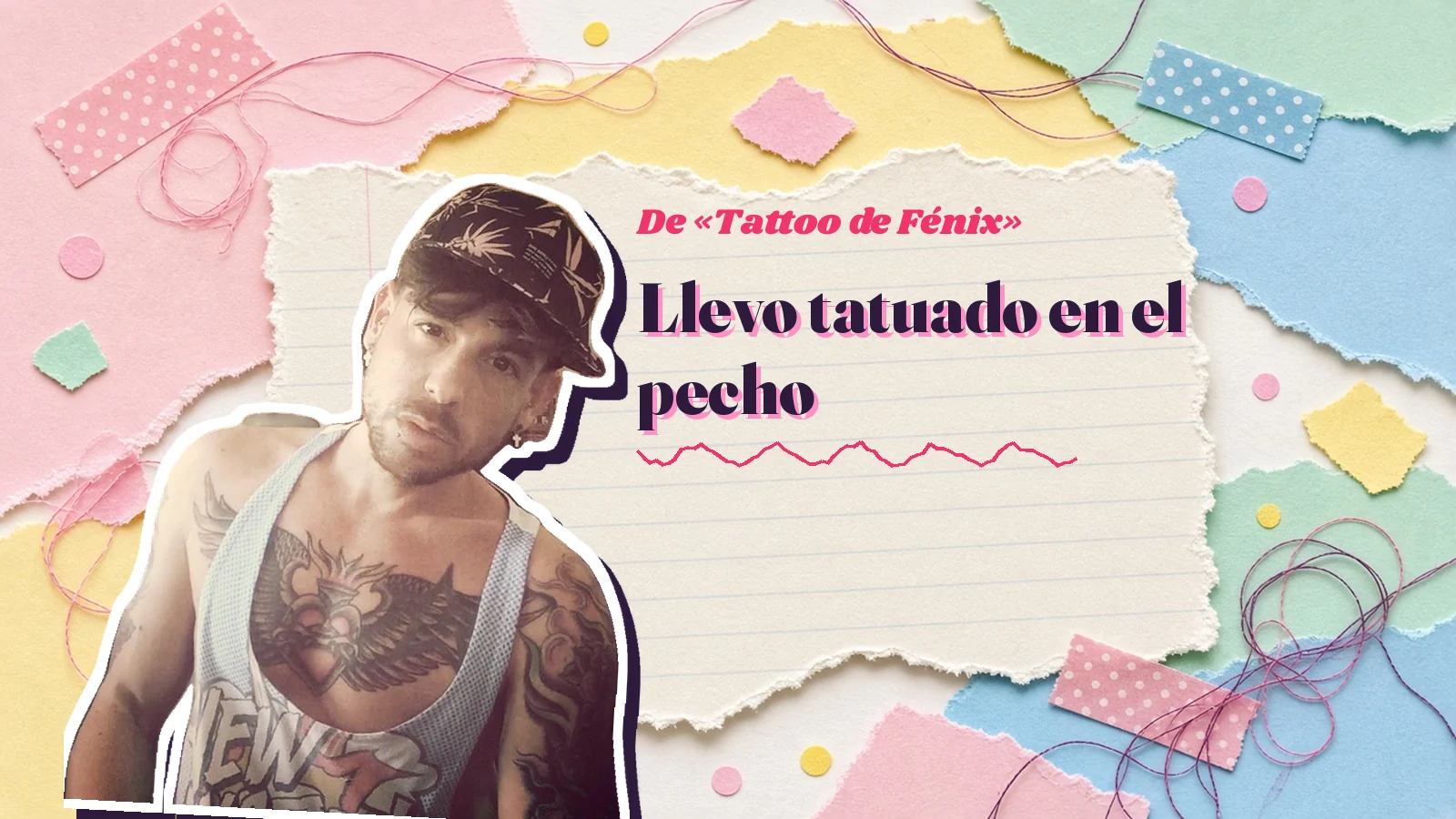
In queer culture, discos and clubs have for decades been much more than places to have fun. They've been refuges, spaces where you could be who you were without hiding, where you found others like you and where your body stopped being a source of shame. Many stories of the LGBTQ+ community pass through a dance floor.
That's why it makes perfect sense for the phoenix to be reborn right there. It isn't reborn on a meditation retreat or in couples therapy. It's reborn in the place where many queer people learned to love themselves. Surrounded by lights, loud music and strangers who, for a few hours, form something like a family.
There are other songs in the catalogue that celebrate that refuge. Pura magia (Pure magic) is a whole night of dancing without drama, and La música me está salvando (Music is saving me) says, from its very title, something very close to what the phoenix says.
The body that comes back
The rebirth in Tattoo de Fénix isn't abstract. It's physical. It goes through the body. The tattoo is on the chest, the chest burns, the body flies between beats, the floor vibrates. Everything that happens in the song happens on the skin.
And that makes a lot of sense after a bad patch. When you've had a hard time, the body is the first thing to switch off. You stop looking after yourself, stop going out, stop wanting to be touched. Dancing again is a way of getting that body back. Of telling it: you're still here, you still work.
That's why it matters to me that the song doesn't stay in the metaphor of the bird. It brings it down to earth. It turns it into sweat, spins, contact. Being reborn, here, means wanting to dance with someone again.
«Agárrame de la cintura»
That contact appears very directly in the middle of the song, when the protagonist asks to be held tight by the waist and spun round. It's the moment the night stops being solitary.
At the start of the lyrics, the protagonist dances alone. They follow their impulse, ask for the volume to go up, nobody stops them. But then another person appears. And that step from dancing alone to dancing with someone is, deep down, the story of the whole rebirth: first you get yourself back, then you open up to others again.
The way it's said has that playful reggaeton touch, with its «papito» and its «baile movidito», its swaying little dance. And I like it that way. Rebirth doesn't have to be solemn. It can be fun, cheeky, even a bit tacky. What matters is that the desire comes back.
Mixing languages
The title already warns that this song mixes worlds. Tattoo, in English, and fénix, in Spanish. And inside the lyrics the same thing happens: beats, vibe and club sit alongside cintura, papito and ave fénix ardiente, blazing phoenix.
That mix is very much of our time and very much of the dance floor. In any club in Madrid people talk like that. They say the vibe is good, that the DJ has dropped an absolute tune, that the beat is building. English has slipped into the vocabulary of the night quite naturally, and the lyrics reflect that unapologetically.
And it has something symbolic too. The phoenix is a myth that has passed from one culture to another for centuries. A song about it that mixes languages is almost a way of honouring that history of travels.
Lyrics that repeat
Tattoo de Fénix repeats its parts many times. The same verses, the same bridge, the same chorus, over and over. And that, which in another kind of song might seem thin, makes complete sense here.
Dance-floor songs work through repetition. What you're after at three in the morning isn't a new story in every line, but something you recognise, that you can shout along to with your eyes closed and that keeps you moving. Repetition is what turns a song into a physical experience.
And there's another reading I like. The phoenix is repetition too. It dies and is reborn, dies and is reborn, always the same. Lyrics that keep returning to the same words are, in a way, lyrics shaped like a phoenix.
Burning in the good sense
In Spanish, «arder», to burn, has two faces. It can mean destruction, as in a fire. And it can mean desire, energy, appetite. We say someone «está que arde», is on fire, when they're looking really hot, or really angry, or really fired up.
Tattoo de Fénix plays with both. The phoenix burns because that's its mythical destiny, the fire that destroys it and brings it back to life. But on the dance floor, fire is something else. It's the atmosphere lighting up, the body warming up, the night rising in temperature.
I really like that the song turns a tragic fire into a festive one. It's like saying: I got burned badly once, now I'm burning because I want to.
The phoenix in popular culture
If the phoenix is still so alive today, it isn't down to ancient myths alone. The popular culture of the last century has brought it back on stage again and again. In the Harry Potter saga, the headmaster of Hogwarts has a phoenix called Fawkes that bursts into flames and is reborn before the hero's eyes. In the X-Men comics, Phoenix is the name of one of the most powerful and tragic characters in the history of the genre.
There are cities that have adopted it as an emblem, sports teams that wear it on their crest and brands that use it to talk about what lasts. Each of those appearances reinforces the same meaning. You see a phoenix and you know, without anyone explaining, that someone is talking about coming back.
That clarity is a huge advantage for a song. There's no need to build the symbol from scratch. Naming it is enough for the listener to understand everything. Tattoo de Fénix draws on that inheritance and takes it onto its own turf.
Following the impulse
In the first verse there's a line that defines the song's mood very well: the protagonist follows their impulse and warns that «no hay quien me frene», there's no stopping me. It's the sentence of someone who has spent too long held back.
After a bad patch, impulse is usually the first thing to go. Deciding is hard, going out is hard, doing anything without thinking it over a thousand times is hard. Getting your impulse back is getting back the feeling that you can move without asking permission. And the dance floor is an ideal place for that, because nobody there asks you to think. Only to move.
That line also has a touch of defiance. There's no stopping me sounds like a warning aimed at someone specific, perhaps whoever caused the heartbreak. As if the protagonist were saying: you kept me still for a long time, but that's over.
Heartbreak and pride
The word «despecho» and the word pride are more closely related than they seem. «Despecho» is born from wounded pride: someone has scorned you and it hurts. And the most common way out of it is precisely to win back your pride, to show they haven't sunk you.
In queer culture, the word pride also carries enormous weight. It's the name of the celebration, of the march, of a whole way of being in the world. Pride as opposed to the shame imposed on LGBTQ+ people for so long.
I'm not saying the song is about Pride with a capital P. But I do think the heartbreak club the protagonist walks into has some of that same energy: turning a wound into a party, and the party into a way of saying here I am.
What the tattoo doesn't tell
There's something the song leaves hanging that I think matters. The tattoo is there, but we don't know its story. We don't know what burned the protagonist, or when they got it, or whether the phoenix is the memory of something specific or a promise for the future.
That lack of information leaves room for the listener. Anyone can put their own fire behind that bird. A break-up, an illness, a bereavement, a lonely period, a coming-out that cost too much. The song doesn't choose, and by not choosing it becomes a song for everyone.
And it also respects something many tattoos have: their meaning is private. The drawing can be seen, but the story isn't told to just anyone. Whoever wears a phoenix on their chest decides who they explain it to.
Flying between beats
The phoenix is a bird, and the song doesn't forget it. The protagonist doesn't walk or simply dance: they fly between beats. It's a very physical, very clubby image, the feeling that the music lifts you off the floor when the rhythm builds.
Anyone who's been on a dance floor at the right hour knows what I mean. There's a moment when you stop thinking about the steps and the body moves on its own, as if it were floating. The lyrics turn that moment into the flight of the phoenix after its rebirth. It doesn't fly towards the sky of myth. It flies between basslines, lights and sweaty people.
It strikes me as a beautiful way of joining the ancient and the everyday. The same bird described by classical writers now glides over a dance floor in Madrid on any given Saturday.
Neighbours on the album
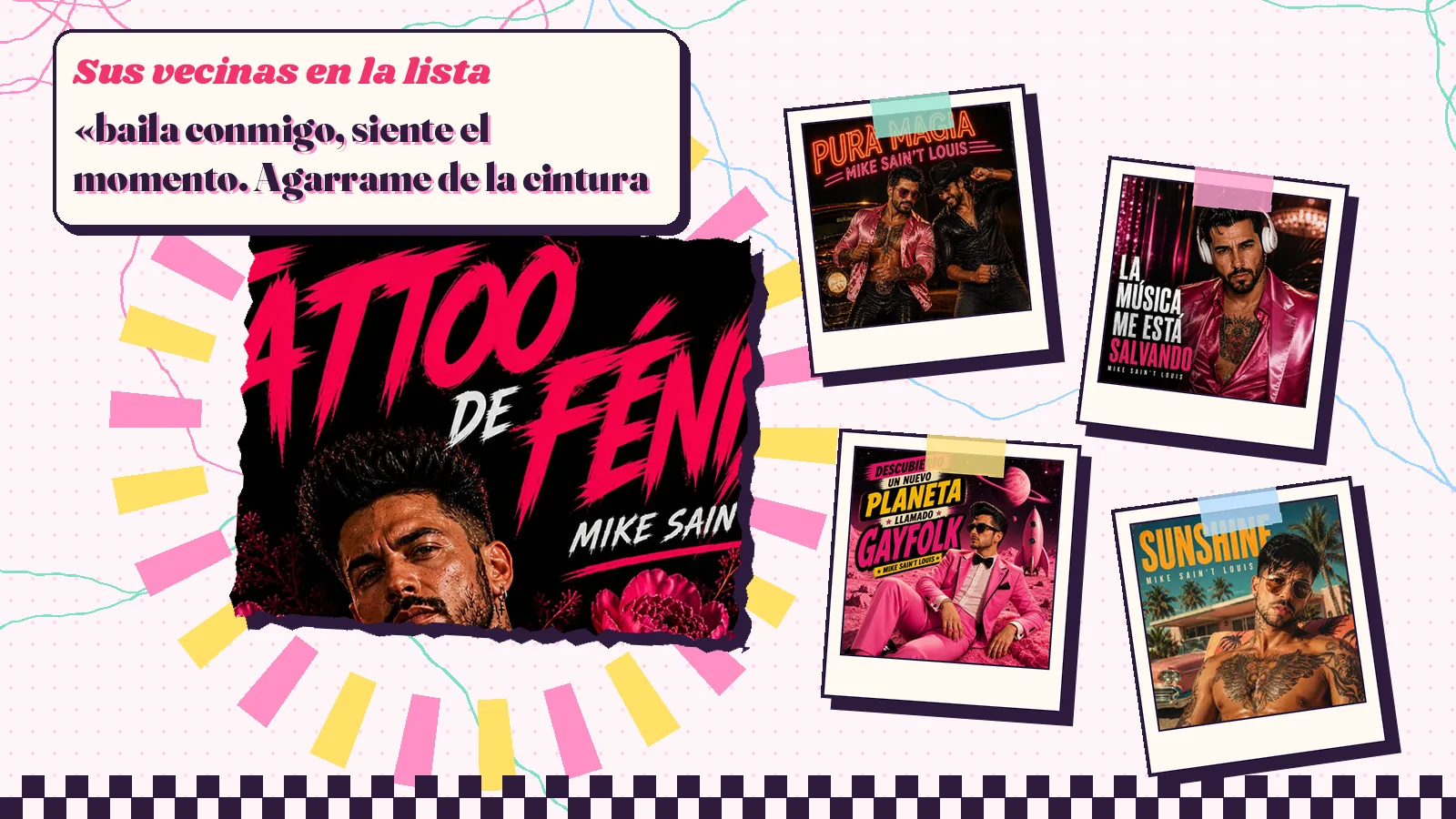
Tattoo de Fénix is part of Descubierto un nuevo planeta llamado Gayfolk (A new planet called Gayfolk discovered), an album with plenty of heartbreak and plenty of partying, often in the same song. In the catalogue it has close cousins on the dancing and summer side, such as Sunshine or Me gusta el verano (I like summer), and an opposite sister in La noche no es para mí (The night isn't for me), which looks at the night from the other side.
Who this song is for
For anyone who has just come out of something and decided they're not staying in tonight. For anyone with a tattoo that says more than it seems. For anyone who needs reminding that they've been reborn before.
And for anyone still in the ashes, with no desire for anything. Maybe it isn't the moment to go clubbing. But it might be the moment to put the song on at home, turn up the volume and see what happens.
How to listen
The song is on the singles page and on every platform, and you can download it from the downloads section. Put it on before you go out, while you get ready. Or play it at full blast in the living room, which is a dance floor too.
As a lyricist, composer and music producer, I really enjoy taking such an ancient symbol and bringing it somewhere so present-day. The music and the vocal performances are generated with artificial intelligence, but the urge to dance again after a bad patch is about as human as it gets.
Frequently asked questions
What is Tattoo de Fénix about? About someone with a phoenix tattooed on their chest who goes out dancing at a club after a bad patch. It's a dance-floor song about rebirth: the fire of the myth becomes the atmosphere lighting up the night.
What does the phoenix mean? In ancient mythology, the phoenix is a bird that dies and is born again, in the best-known version from its own ashes. That's why it has become a symbol of rebirth and of the ability to recover after a crisis, and it's one of the most classic tattoo motifs.
Which album is it on? It's part of «Descubierto un nuevo planeta llamado Gayfolk», one of the albums in Mike Sain't Louis's Gayfolk trilogy, available on Spotify and every other platform.
Who makes this song? Mike Sain't Louis, a lyricist, composer and music producer who presents himself as "the first AI songwriter": he writes the lyrics and directs the production, and the music and vocal performances are generated with artificial intelligence.