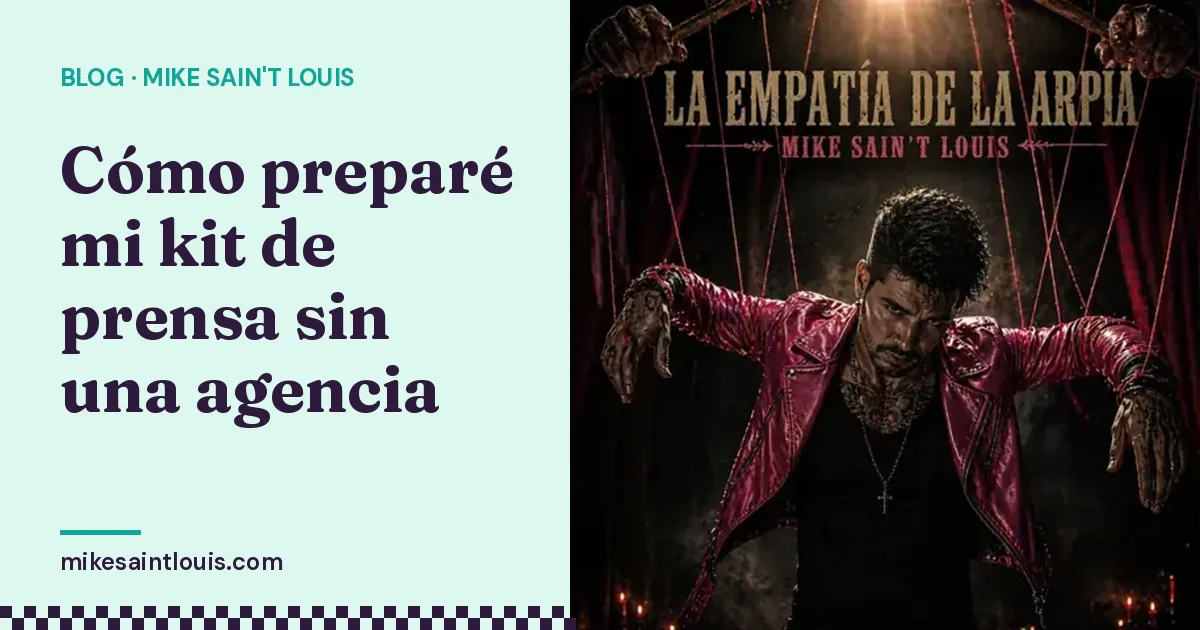
By Mike Sain't Louis ·
How I put together my press kit without an agency
When someone writes about an artist without the facts to hand, they fill in the gaps. They round numbers, spell the name the way it sounds, assume. In my case there's plenty to assume wrongly. My name has an apostrophe in an unusual place. I have a lot of songs, and it's easy to get the number wrong. And what I do with artificial intelligence lends itself to confusion: I write the lyrics and produce the music with tools that I direct. So I put it this way: I'm a lyricist, composer and music producer, with music and vocal performance made with AI.
None of those mistakes has to be malicious. They usually happen because there's no obvious place to look up the right facts. So I decided to do what an agency would have done in a bigger operation: put together a press kit. I did it alone, from my label, MIKE SAIN'T LOUIS, and I'm sharing it in case it helps you.
Start with what gets repeated wrong
My first step wasn't writing. It was collecting mistakes, the ones I'd already seen and the ones I could imagine. I noted down every fact that invites an error. That list told me what I had to make clearer. A beautiful press kit is useless if it doesn't answer exactly the questions people have.
In my case the list was pretty clear. The apostrophe in Sain't. The number of songs. The difference between what I do and what the tool does. The name of the project, PLANETA GAYFOLK, in capitals. And what the three albums of the trilogy are called and what order they go in.
The facts, no frills
The heart of the kit is the facts, and that's where I learnt to be dry. No adjectives. 273 singles. More than 280 music videos, all directed by me. Hundreds of short videos. About two years of work. Madrid. The GAYFOLK trilogy: «Descubierto un nuevo planeta llamado GAYFOLK», «Ojalá se pudiera viajar a GAYFOLK» and «El día de la liberación», free to download, no sign-up.
The temptation to inflate is huge, especially when you have nobody representing you and feel you have to sell yourself. But a journalist spots an inflated text instantly and starts doubting everything else. I'd rather the numbers spoke for themselves. Whether they're few or many is for the writer to decide.
I also learnt not to put in anything I can't back up. If a fact isn't checked, it stays out, even if the kit ends up shorter. An empty section beats one stuffed with smoke, and it's far better than having to issue a correction later.
The explanation of how I work with artificial intelligence took me several drafts. Talk about artificial intelligence and music and you get strong reactions, for and against, and any ambiguous sentence gets read in the worst possible way. I needed one clear paragraph that could be copied as it stands, with nobody having to interpret it.
What I ended up writing says, more or less, what this post says: I write all the lyrics, I produce the music with artificial intelligence tools that I direct, and I'm the one who decides, discards and chooses. I'm a producer, writer, composer and art director. I left it at that, without defending myself or apologising. Anyone who wants an opinion on whether that's all right is welcome to one, but about what I actually do.
I wrote two versions of the bio. One a paragraph long, for people who need something quick. The other just a few lines, almost a headline, for people with room for one sentence. Both say the same thing at different sizes.
Writing them took me longer than many song lyrics, which is funny in its own way. A song allows exaggeration, play, double meanings. A press bio asks for the opposite: sentences that can't be misread, that survive being cut in half without changing their meaning. Each version went through many rounds of taking words out.
The short one was the hard one. Summing up what I do in one sentence forced me to choose what matters most, and that's a decision about identity, not about wording. In the end the sentence turns on three ideas: queer alternative pop in Spanish, humour with a touch of copla, and music and vocal performance made with AI. Everything else can wait for the second paragraph.
Where the kit lives
I used to have these texts scattered across files. Now they're in the press section of my website, mikesaintlouis.com, which I opened in October 2026, in Spanish and English. There are FAQs there too, which deep down are another part of the press kit: they answer the same things a journalist would ask me before writing.
Putting it on the website instead of emailing it changes something important. The kit can be updated. When I release new songs, I change the figure and that's that. No old versions floating around in attachments with numbers that no longer hold.
What an agency would do better
I don't want to give the impression that you don't need an agency. An agency has contacts, knows who to send what to and when. No document replaces that. My press kit doesn't reach anyone on its own. It sits there for when someone comes looking.
Nor do I have the distance an outsider has. An agency looks at you and sees what's odd, what's newsworthy, what makes a story. I'm too far inside to see it clearly, and I've probably chosen to highlight things a journalist barely cares about.
What I can control is that, when they arrive, they find the right information. It's not much, but it's the foundation. If nine out of every ten articles written about me get the apostrophe right and explain properly what I do and what the tool does, I'll be satisfied.
The press kit is in the press section of mikesaintlouis.com.