Reino Unido ·
“The cover isn't there for me to enjoy on my computer”: Mike Sain't Louis on art-directing 273 singles
The Madrid alternative indie artist who calls himself “the first AI singer-songwriter” talks thumbnails, house style, literal titles and why he won't hand the first impression of a song to anyone else
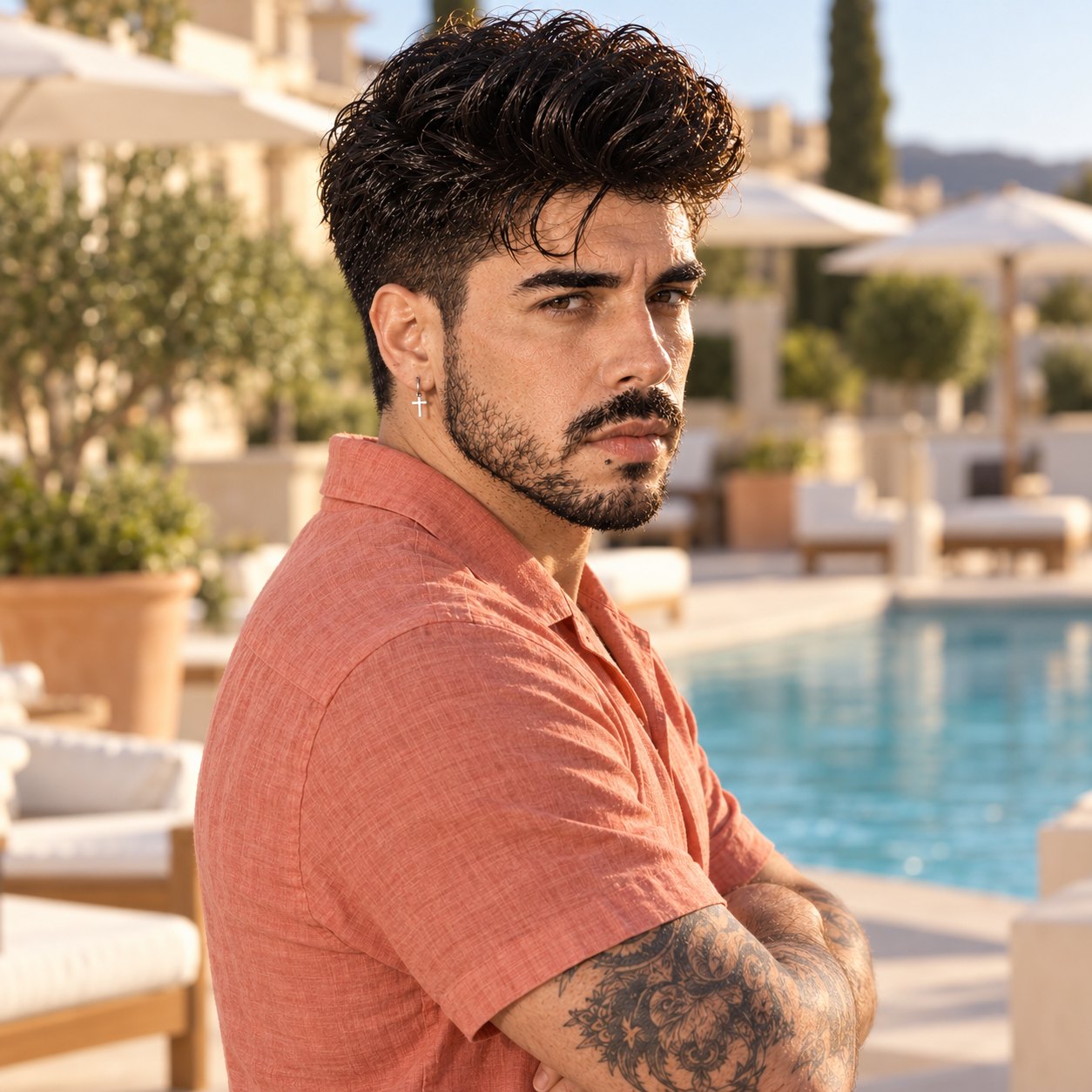
Madrid, 25 October 2026 — Do the maths and it is slightly alarming: 273 singles means 273 covers. Mike Sain't Louis, the Madrid-based alternative indie artist who presents himself as “the first AI singer-songwriter”, is the art director of everything released on his own independent label, MIKE SAIN'T LOUIS, so every one of those images has crossed his desk. He writes all his own lyrics; the music and vocal performance are produced with artificial intelligence, which he treats as a production tool. The words and the artistic direction are his.
After he published a blog post about how he keeps hundreds of covers looking related without boring anyone, we put some questions to him. His answers below are drawn from and adapted from that post.
Let's start with the number. Do you actually remember all 273 covers?
No, and I'd be lying if I said otherwise. Some I still love. Others I'd change tomorrow. And there are a few that, honestly, I don't remember approving, which tells you something about the volume. But they've all been through my hands. That's the deal when you run your own label.
What's the real problem you're trying to solve?
It's the problem anyone who makes a lot of things has: how do you make everything look like it came from the same person without each piece being a photocopy of the last one? Repeat too much and the catalogue turns into wallpaper. Everything the same, nothing stands out. Repeat nothing and every song looks like it's by a different artist, and nobody builds an image of you. Between those two there's a narrow strip, and I've spent two years moving around inside it, sometimes too far one way, sometimes too far the other.
You talk about the “real size” of a cover. What do you mean?
The first thing I learnt is that a cover is almost never seen big. I design it on a wide screen, I look closely, I fuss over details. Then people see it on their phone, in a list, the size of a fingernail. The details vanish. What's left is a patch of colour and, if you're lucky, a shape.
So now, before I sign off on a cover, I shrink it until it's tiny and ask myself if it can still be told apart from the one next to it. If it can't, I go back. A gorgeous cover that gets lost among forty others in a list is no use to me.
Has that cost you ideas you liked?
Plenty. Busy compositions, small text, visual games that only worked up close. It hurt. But the cover isn't there for me to enjoy on my computer.
Is there a house style? A set of rules?
There are a few things I decided would always stay fixed. I'm not going to give you the exact recipe, partly because I keep adjusting it and partly because I'd rather people feel it than have it explained. The idea is simple: a handful of elements that always repeat, and everything else free.
Have you always got the balance right?
No. Some stretches the covers looked too alike; other times I let go so much the whole thing lost its face. These days I try to correct by looking at the entire catalogue at once, not cover by cover.
Your titles are very visual already. “La dieta del cucurucho”, “No quiero otro novio cojín”, “Mi novio de Albacete”. Does that help?
In my songs the title is often half the joke, and titles like that already put a picture in your head. That's an advantage and a risk. The advantage is I almost always have a starting point. The risk is going literal, illustrating the title word by word like a rebus. If the title already says ice-cream cone, maybe the cover doesn't need to show the cone again. It can go for the tone, the feeling, something sideways. I like it when the image and the title complete each other instead of saying the same thing twice.
And when that doesn't work?
Sometimes I give up and go with the obvious. Sometimes the obvious works, and that's fine.
The GAYFOLK trilogy must have been a different challenge.
The opposite one. With singles I want each to stand apart. With “Descubierto un nuevo planeta llamado GAYFOLK”, “Ojalá se pudiera viajar a GAYFOLK” and “El día de la liberación”, which you listen to as one story in three acts, I wanted the three covers to belong to each other. You should be able to look at them together and understand there's a before and an after. The third one couldn't go first. That was easier, because the story already marked the path. Three moments, three different temperatures.
Why not hire someone to do the covers?
People have suggested it, and I understand why. But the cover is the first thing anyone sees of a song, before they hear a single note, and I don't quite want to let go of that first impression. When I decide it, I know that what someone sees and what they then hear come out of the same head. There's a bit of vice in it too, I admit. It's the part of the job where I think with my eyes instead of with words, and after writing a lyric that change rests me.
Why British readers might care
For a UK audience raised on record-sleeve culture, where a band's visual identity has often mattered as much as its sound, Sain't Louis's thumbnail test is a very current version of an old question. His catalogue is mostly in Spanish, with songs in English, French and Portuguese too, but a cover works before any language does.
Where to listen
All of Mike Sain't Louis's music can be streamed and downloaded free at mikesaintlouis.com, with lyrics for each song. It is also on Spotify, Deezer and the main streaming platforms. The original post: more on his blog.
About Mike Sain't Louis
Lyricist, composer, music producer and self-described “first AI singer-songwriter”, Mike Sain't Louis is an alternative indie artist working from Madrid without a record company or middlemen. His project PLANETA GAYFOLK gathers 273 singles and over 280 music videos made across roughly two years: queer alternative pop that is cheeky, camp and uncensored, moving between electropop, copla and ballads, about love, exes, nosy neighbours, queer life in Spain and mental health. His song “Tan Cateto” went viral on TikTok in 2024.
Press contact
Email: info@mikesaintlouis.com Web: https://mikesaintlouis.com Instagram: @planetagayfolk