Australia ·
Five boys in a shoebox Polaroid: an afternoon listening to Mike Sain't Louis's “Boys Like Us” and the pronoun that changes everything
A listener's chronicle of the one track in the Madrid alternative indie artist's catalogue that speaks in the plural from start to finish. The self-described “first AI singer-songwriter” explains why that tiny word, “us”, is half of what the song has to say
Madrid, 25 October 2026 — I came to “Boys Like Us” through the cover, which is how a lot of people meet a song now: a small square on a phone screen, half a second of attention. This one held me longer. It is a Polaroid, white frame worn at the edges, the kind you would find in a shoebox at an uncle's place. Inside it, five young men are squeezed into a small room.
One has a black feather boa across a tattooed chest. Another wears a mesh shirt and a leather dog collar. A third has a hat with a white feather and strings of pearls. There are seventies moustaches, a teased blond mane, round blue sunglasses. Photos and posters taped to the wall. A pink neon glow in one corner. It looks like the best night of somebody's life, caught by accident.
Mike Sain't Louis, the Madrid-based alternative indie artist who calls himself “the first AI singer-songwriter”, wrote recently on his blog that this is one of the few covers in his catalogue without a lone figure in it. “There's a gang,” he says. That is the whole point.
A word you don't notice
I pressed play on a grey afternoon. The song comes from “Ojalá se pudiera viajar a GAYFOLK”, the second album in his GAYFOLK trilogy, and the first thing I clocked was the pronoun. The opening word is “we”, in a line about shining, rising and refusing to hide.
It sounds like a grammatical footnote. Sain't Louis insists it isn't. Go through his songs, he points out, and nearly all of them speak in the first person or shout at a “you”: the ex, the narcissist, the hater, the mother-in-law. “Boys Like Us” speaks in the plural from beginning to end. “And that plural,” he writes, “is half of what the song has to say.”
For context: Sain't Louis writes every lyric himself. The music and the vocal performance are produced with artificial intelligence, which he uses as a production tool; the words and the creative direction are his. Listening, you can hear a writer who knows exactly which word is doing the heavy lifting.
The day “I” became “we”
What he wrote next is what stayed with me. When you are a gay kid in a small town, or a particular suburb, or a strict school, he says, the first thing you learn is that you are the only one. Nobody in your class, your street, your family. Television, if anything, offers you someone as a punchline.
Then one day you find out there are others. It might be a bar at eighteen with your legs shaking, an online forum at two in the morning, an app, a summer camp, a first Pride you go to almost in secret. Before the internet, he remembers, it was a magazine bought with embarrassment far from home and hidden inside a newspaper on the bus, a late-night radio show, a library book with the cover wrapped, an Almodóvar film watched with the volume on minimum and a finger on the stop button.
Small windows, he calls them. And then the window becomes a door: you walk into a room and see twenty boys like you laughing at things you understand too. “That first night you never forget,” he writes. “It's the night you stop being an oddity and become part of something.”
“Boys Like Us,” he says, is written from after that moment.
Pride and fear in the same afternoon
The second thing I noticed, on the second listen, was a contradiction tucked into the first verse. Two lines after declaring that nobody here hides, the song admits something smaller:
“He holds my hand / Where no one sees”
Sain't Louis does not pretend to resolve it. You can go to Pride, cover yourself in glitter, scream the chorus from a float, and the next day let go of your boyfriend's hand when you pass a group of lads at a bus stop. Anyone who has lived it knows. “Pride and fear don't cancel each other out,” he writes. “They live in the same body, sometimes in the same afternoon.” The song puts the two side by side and keeps going, “like we all do”.
His notes on the track also point to the rest of its imagery: heels worn as armour, a bridge where people stare and the gang doesn't care, and an oh-oh-oh chorus built to be yelled from a float. By the third listen I was doing the oh-ohs under my breath at my desk.
Why it lands in Australia
This is a country that knows the float-and-glitter version of Pride well, and also knows the quieter version that happens in country towns and outer suburbs, far from the parade route. “Boys Like Us” is about the distance between those two, and about the first time someone discovers it can be crossed. It is in English, too, which makes it an easy entry point into a catalogue that is mostly in Spanish.
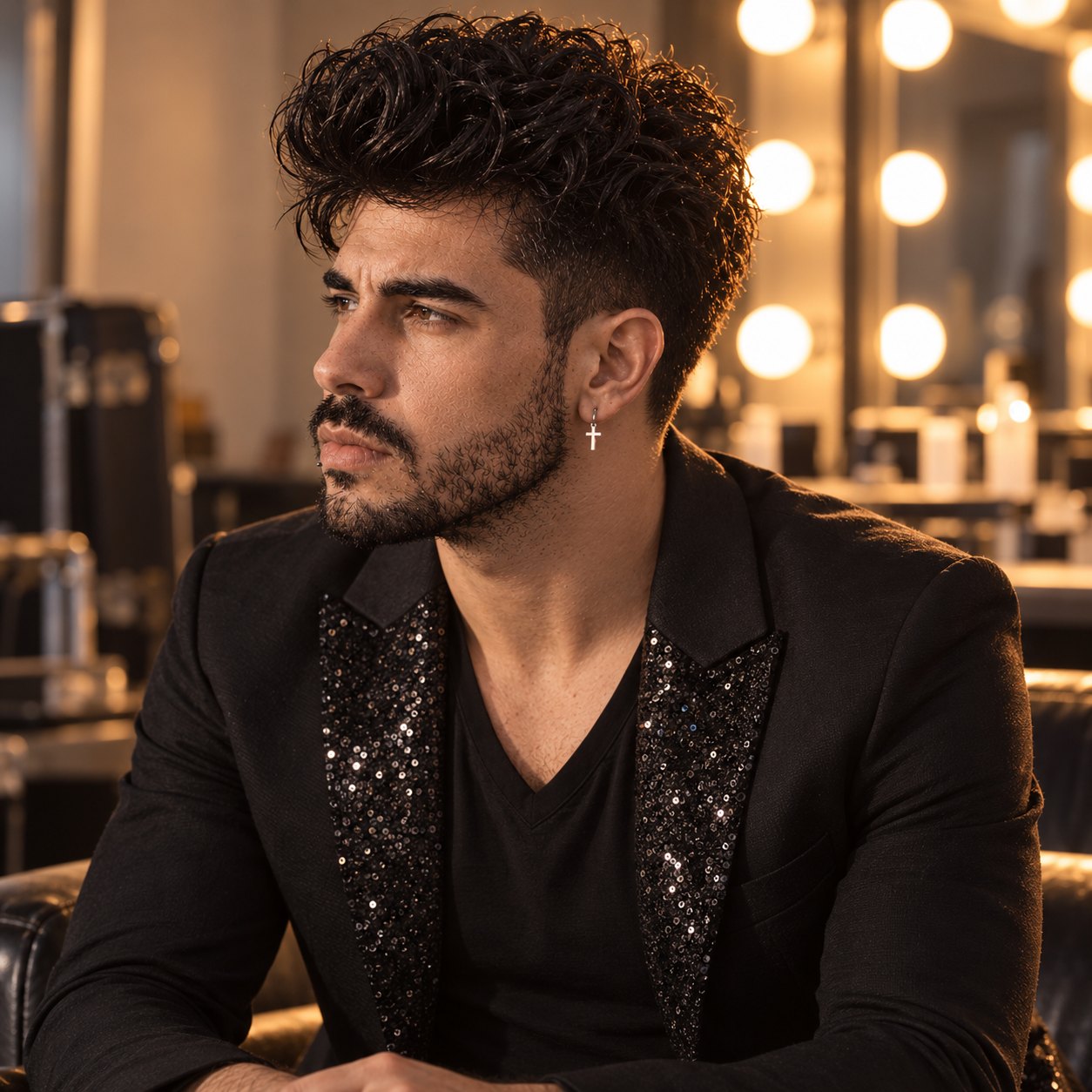
The photo with this piece shows Sain't Louis in a dressing room, lit by mirror bulbs. It suits the song: the room just before you walk out and join the others.
That plural also connects to what he has said publicly about his work as a whole: with professional support, he turns years of relationships with narcissistic partners into songs, so that people who have lived through psychological abuse feel seen and believed. Not alone, in other words. Part of an “us”.
Where to hear it
Every song by Mike Sain't Louis is free to stream and download at mikesaintlouis.com, with the lyrics for each track. His music is also on Spotify, Deezer and the major platforms. The full essay: more on his blog.
About Mike Sain't Louis
Based in Madrid, Mike Sain't Louis is an alternative indie artist and self-styled “first AI singer-songwriter”: lyricist, composer, producer, art director and CEO of his independent label, MIKE SAIN'T LOUIS. PLANETA GAYFOLK, the project he built over about two years, holds 273 singles and more than 280 videos, plus a trilogy of albums imagining a planet where everyone can live as they are. Expect cheeky, camp, uncensored queer pop that swings from electropop to copla and ballads. “Tan Cateto” went viral on TikTok in 2024.
Media enquiries
Email: info@mikesaintlouis.com Website: https://mikesaintlouis.com Instagram: @planetagayfolk