Press release ·
El día de la liberación closes Mike Sain’t Louis’s GAYFOLK trilogy
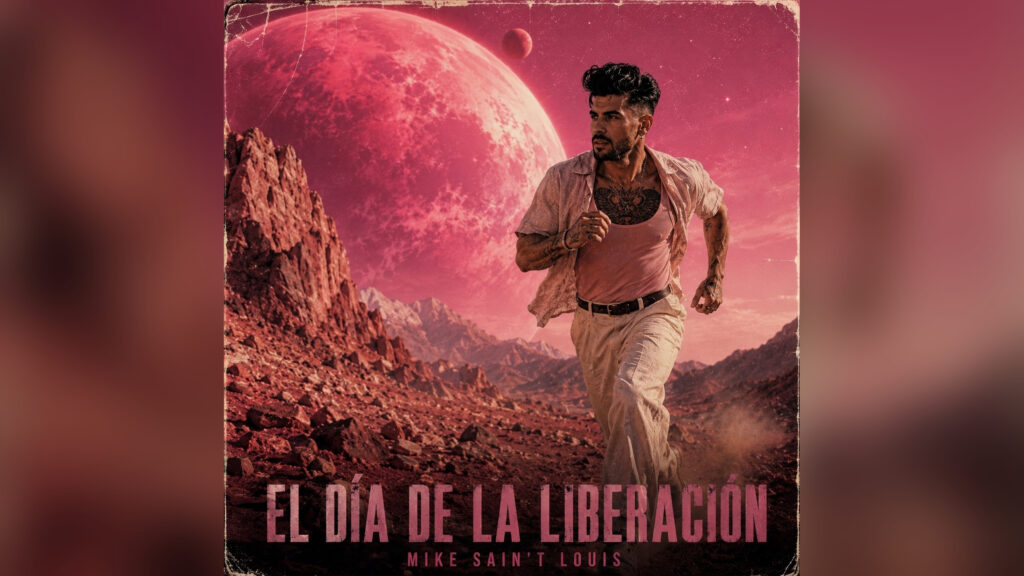
Four songs from the end of Mike Sain’t Louis’s third GAYFOLK album, the running order reaches The Great Depression. It then moves through Cara de asco and Hoy es el último adiós before arriving at the title song. Those neighbouring titles give the ending a particular weight. A record called El día de la liberación carries the difficult parts of the journey right up to its final stretch, where a farewell eventually makes room for celebration. The official album guide preserves that sequence across all ninety-nine tracks.
The position of the title song matters as much as its name. At the beginning of the record, Free Britney directs a repeated demand for freedom towards a figure from pop culture. By the closing song, freedom has entered the narrator’s own household and altered its arrangements. Dinner, care, attention and the use of a person’s time become the practical terms of a separation. The two ends of the album allow a public slogan and a private departure to speak to each other.
In his published introduction to this third instalment, Sain’t Louis describes liberation as the point at which someone can begin again while carrying knowledge of what happened. The songs about injury and difficult relationships remain part of the record. Their presence gives the final celebration a history. The relief belongs to a person who has already had to endure the preceding scenes, with their uncertainty, exhaustion and repeated attempts to understand another person. Read the artist’s account of the album.
The closing lyric finds an unusually domestic way to express that relief. Its narrator has stopped providing the evening meal. The person left behind can make arrangements with his mother or open a tube of crisps. Meanwhile, the narrator has gone to Benidorm. The joke works because freedom acquires a location and a timetable. Someone gets to choose where to spend the day, what to eat and whose needs will occupy the next hour. These are small decisions with considerable dramatic force after an entire relationship has been organised around somebody else.
Sain’t Louis develops the song’s calendar in a separate essay, imagining the departure as a personal public holiday. That reading comes from the repeated announcement of the present day. The lyric keeps returning to the moment when the decision takes effect. Its celebration also moves into the plural, opening a private story to the voices of other people who might recognise it. A solitary speaker can become part of a chorus without the song having to explain the biography of everyone joining in. Read the artist’s essay on the closing song.
Across the album, Spanish names and English titles share the same running order. Lola Flores and Almodóvar appear alongside In the Quiet Room, Holy Stillness and Before the Bells. The list makes room for the cultural references and quieter registers that coexist throughout GAYFOLK. In his IndyRock interview, Sain’t Louis describes the influence of copla and Spanish camp on his writing. The final domestic joke belongs comfortably to that interest in giving ordinary life the scale of a performance.
His explanation of the production process is equally particular. He begins with a written lyric, including repetitions and choruses, and then works through generated versions of music and voices. He describes discarding takes and revising a word when the syllables fail to fit. Those choices help explain why the words and their delivery receive so much attention in the project’s accompanying essays. The album gathers the results of that writing and selection process into a long, deliberately ordered collection.
This is the third part of a trilogy that moves from discovering an imagined queer planet to wanting to reach it and finally to inhabiting its promise of freedom. The published album sequence gives that progression its shape. With ninety-nine songs, the final instalment provides several ways into the same territory. Following the last four tracks offers one particularly direct route, ending with a narrator who can finally announce where he is going next. Both official websites make the complete album available as a free ZIP download, with individual recordings available separately.
El día de la liberación — official album guide
Download the complete album free from mikesaintlouis.com
Free album download on gayfolkplanet.com
The title song — video and lyrics on mikesaintlouis.com
The title song — preview and listening links on gayfolkplanet.com
IndyRock — interview with Mike Sain’t Louis
Exposed Vocals — interview with Mike Sain’t Louis, 27 October 2026